

Key Takeaway
Learn what drives near me rankings, what to fix first, when to test near you wording, and how to measure organic, map, and lead results separately.
You serve the searcher’s area. Your competitors do too. Yet when someone searches for your service “near me,” your business is nowhere obvious and the company across town gets the call.
The tempting response is to paste “near me” into every title, heading, image, and schema field you can find. Don’t. Google already understands the searcher’s location. You cannot write your way around distance, and awkward copy will not teleport your office three miles closer.
What you can do is give Google and prospective customers better evidence that you offer the right service, in the right area, and are worth choosing. Once that foundation is solid, natural “near you” or “nearby” wording may be worth testing on a small number of pages. Treat it as an organic search experiment, not a secret entrance to the map pack.
The Short Answer: Prove You’re Local Before You Touch the Phrase
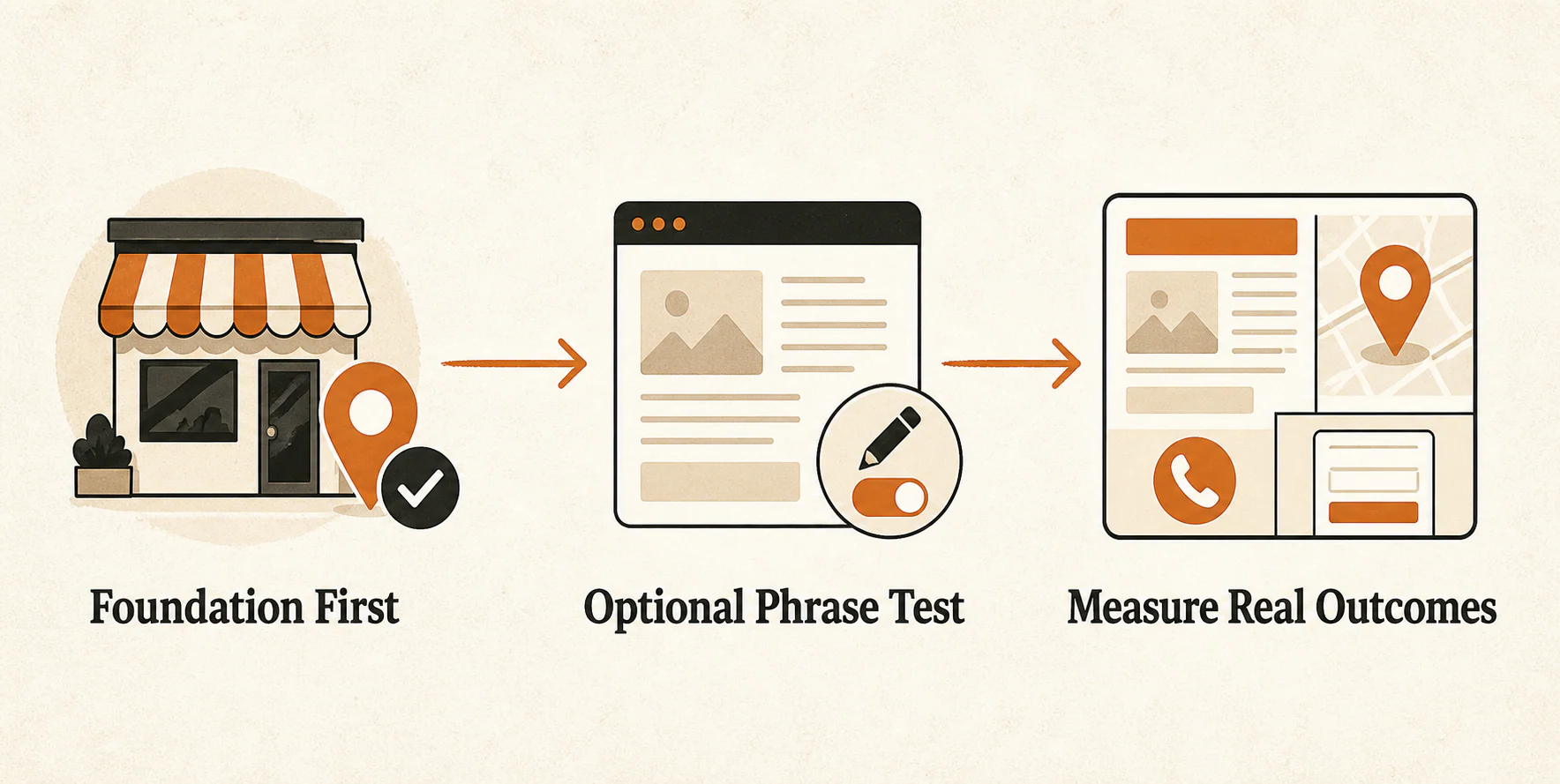
There are three stages to sensible “near me” SEO:
- Foundation first. Keep your business information accurate, complete your Google Business Profile, build useful service and location pages, and back them with reviews, local proof, and authority.
- Optional phrase test. Add one natural “near you” or “nearby” phrase to a limited set of valuable pages. Leave similar pages unchanged for comparison when practical.
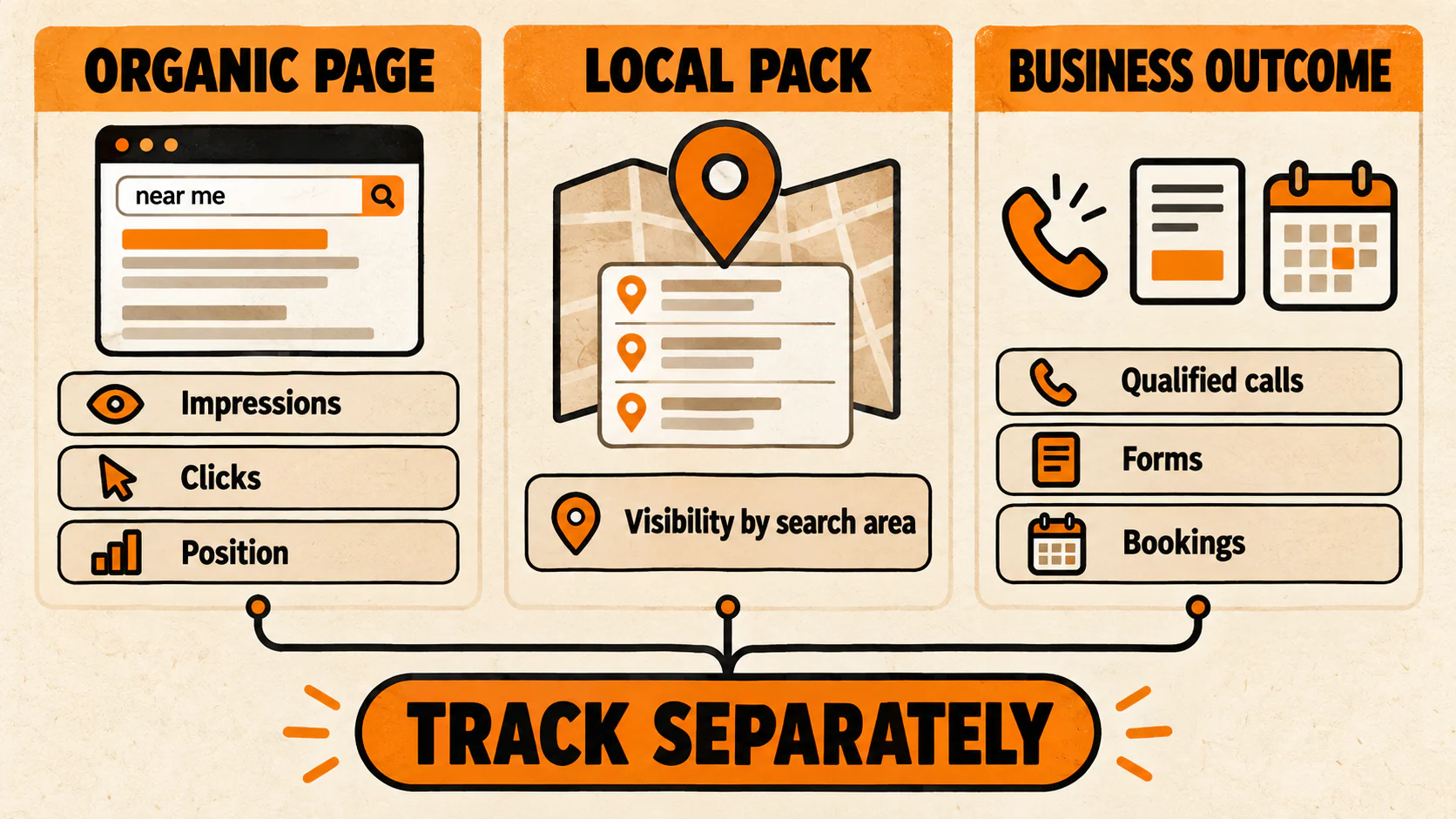
- Measure real outcomes. Check organic page performance, local-pack visibility, and qualified inquiries separately. A change in one does not prove a change in the others.
That last distinction matters. The local pack is the map-based group of business listings that may appear for a local search. Traditional organic results are the website pages below or around it. Both can bring customers, but they are different surfaces with different data.
If your location pages are thin, your profile is inaccurate, and your reviews have gone quiet, a clever phrase will not rescue the operation. Fix the evidence first. Test the wording later.
What Google Actually Uses for Local Rankings
Google says local results are mainly based on relevance, distance, and prominence.
- Relevance is how well the business matches what the person is searching for.
- Distance is how far the business is from the location used in the search.
- Prominence reflects how well known the business is, including signals such as links and reviews.
Distance is the irritating one because you cannot control where the searcher is standing. A plumber in Marietta does not become closer to a homeowner in Decatur because the word “nearby” appears six times in a title tag. Geography remains stubbornly committed to being geography.
You can improve the other evidence. Accurate profile information helps Google understand the business. The right primary and additional categories clarify what it does. Current hours, helpful photos, and complete service details help people decide whether it fits. Reviews and links can contribute to prominence.
None of that means every field is an independent ranking switch. It means completeness and accuracy give Google fewer reasons to misunderstand the business and give customers fewer reasons to leave. Start with the Google Business Profile optimization guide if the profile has been maintained on a “we’ll get to it eventually” schedule.
Why “Near Me” Keyword Advice Gets So Confusing
The internet has managed to turn a small wording choice into a philosophical dispute.
On one side, Sterling Sky reported organic gains after adding natural “near me” language in agency tests. Localogy later published case examples that also associated “near me” or “near you” changes with stronger organic performance and, in a narrower example, possible local-pack improvement.
On the other side, RicketyRoo examined 30 top-three results for one furnace-repair query across ten U.S. cities. Location terms were common in titles, headings, and body copy, while explicit “near” wording appeared much less often.
Those findings are not as contradictory as they look. RicketyRoo’s sample suggests businesses can rank for nearby intent without literally writing “near me.” The agency tests suggest natural phrase additions may help some organic pages. Neither proves that every local business should make the same edit.
The limits matter. These are narrow tests and observational examples, not a universal experiment across every industry, city, device, and website. Other changes may have happened at the same time. Correlation can produce a useful hypothesis, but it does not become a law of nature because it makes a good webinar title.
The practical conclusion is simple: local fundamentals are required. Phrase usage is a bounded test. That is less satisfying than a secret tag, but much more useful.
Build the Foundation That Makes Nearby Visibility Possible
Before testing copy, make sure the business has earned the right to run the test.
1. Represent the business accurately
Use the business name customers see in the real world. Do not add a city, service, or “near me” modifier because you hope it will improve rankings. Google’s representation rules are clear on this, and stuffing the name can create a compliance problem instead of a marketing win.
Use a real customer-facing address when the business qualifies to display one. If customers do not visit the location, follow the service-area rules and hide the address as required. A rented mailbox is not a local expansion strategy.
2. Match each page to a real service and geography
A useful local page answers practical questions:
- Do you offer the service I need?
- Do you serve my area?
- What makes you a reasonable choice?
- What should I expect when I call or book?
A page titled “Roof Repair in Roswell” should say something meaningful about roof repair in Roswell. Swapping the city name into a generic paragraph 40 times is not localization. It is mail merge wearing a blazer.
3. Add local proof a customer can use
Mention neighborhoods served when that information is accurate. Add recognizable landmarks, directions, parking details, travel limitations, or response-area constraints when they help. Show real staff, vehicles, work, and locations rather than generic stock photos of people shaking hands in suspiciously perfect lighting.
Testimonials, licenses, appointment availability, service exclusions, and category-specific credentials can help a customer judge fit. The goal is not to collect local nouns. It is to reduce uncertainty.
Use descriptive image alt text for accessibility. Describe what is in the image, such as “technician repairing an outdoor AC unit beside a brick home.” Do not turn alt text into a tiny keyword landfill.
4. Build prominence honestly
Genuine reviews, locally relevant mentions, and useful links can strengthen the business’s presence. Ask customers for honest feedback, make the process easy, and respond like a human. The online reviews guide covers the process without recommending scripts that put words in a customer’s mouth.
Do not ask customers to insert specific keywords into reviews. A review should sound like the customer, because it is supposed to be the customer.
5. Keep important business data accurate
Correct the major sources that customers and search platforms actually use. Pay attention to the business name, address, phone number, website, hours, and category information. The local SEO citations guide explains which listings deserve attention and when citation cleanup turns into busywork.
Perfect punctuation across every directory is not the goal. A person reaching the wrong phone number or driving to an old address is the problem.
Use the Right Local Page Strategy for Your Business Type
The right setup depends on how the business operates. A storefront, a mobile service company, and a 20-location practice should not copy the same template.
Storefront businesses
Use the real customer-facing address and make the visit easy to plan. Explain parking, entrances, nearby landmarks, accessibility, hours, and the services available at that location. A page for a dental office should answer different questions than a page for a restaurant, even if both are located on the same block.
Service-area businesses
Follow Google’s Business Profile representation rules for address display and service areas. Explain where the team genuinely travels and any constraints that affect availability or pricing.
Do not invent offices in cities you want to rank in. A service-area business may be eligible to appear beyond its immediate base, but proximity still matters and a city name does not create a physical location.
Multi-location businesses
Give each operationally real location a useful page with its own address, contact details, hours, staff or service distinctions, and local logistics. Unique does not mean spinning adjectives until a plagiarism checker stops complaining. It means the page reflects a real location.
Avoid city-swapped doorway pages that exist only to funnel visitors to the same generic destination. Google’s spam policies describe doorway abuse as substantially similar pages created to capture related searches without enough independent value. There is no magic location count that makes weak pages acceptable.
When a Natural “Near You” Test Is Worth Running
Run a phrase test only if all of these are true:
- The page is indexed and already connected to a real service and geography.
- The copy contains meaningful local proof.
- The page receives enough impressions to make a change observable.
- The phrase fits naturally and helps the reader understand the offer.
- Someone can record the exact edit and date.
If the page gets no impressions, it is a poor laboratory. You will learn little from changing one sentence on a page Google barely sees.
Keep the edit small. You might add one useful sentence in the body, test a helpful subheading, or revise the title and meta description if the result reads naturally. Do not change the title, H1, schema, image filenames, alt text, internal anchors, and every paragraph at once. If performance moves, you will have no idea which change mattered.
Human copy sounds like this:
If you need an emergency plumber nearby, our team serves Marietta, Smyrna, and the surrounding area seven days a week.
It does not sound like this:
Choose the best emergency plumber near me for the best plumbing near me.
The second version contains the phrase. It also sounds as though a robot was given a coupon for commas and declined to use it.
“Near you” often reads more naturally because the business is speaking to the customer. “Nearby” can work too. Choose the wording that lets the page keep its dignity.
How to Measure the Test Without Fooling Yourself
First, make a simple change log. Record the URLs, original copy, new copy, and publication date. If practical, select similar pages that remain unchanged. Call them comparison pages, because that is what they are. A few untouched pages are not automatically a sophisticated synthetic control group.
In Google Search Console, filter by the changed pages and relevant query variants. Google documents how query and page filters work, including regular expressions when a normal contains filter is not enough. Compare:
- impressions;
- clicks;
- click-through rate;
- average position;
- mobile and desktop performance; and
- changed pages versus the comparison pages.
Search Console does not expose every query, and its tables have limits. Treat the data as a useful view, not a complete ledger of every search.
Track local-pack visibility separately with an appropriate local rank-tracking setup. An organic service page gaining impressions does not prove that the Business Profile moved in the map results. The surfaces can influence the same customer journey without moving in lockstep.
Then check the business outcomes. Did calls, forms, or bookings increase? Were the inquiries inside the service area? Did they need a service the business actually offers? Did they become viable opportunities?
Call duration can be a clue, but it is not a universal definition of quality. A six-minute wrong-number call is still a wrong number. A 45-second call that books an appointment may be excellent. Judge service fit, geography, intent, and outcome.
Give the test a practical review window based on how often the page is crawled and how much search demand it receives. Do not promise a specific reranking date. Low-volume pages may need longer to produce usable evidence.
The wider goal is not prettier rank reports. It is a system that turns relevant visibility into qualified opportunities. That is the job of the Local Growth Engine, not a phrase by itself.
Diagnose the Result Before You Scale It
| What you see | What to examine next |
|---|---|
| No impressions | Check indexing, actual query demand, service-to-page fit, internal discovery, and authority. |
| Impressions but few clicks | Improve the title and snippet promise. Make sure the result matches what the searcher appears to want. |
| Clicks but wrong-fit leads | Clarify the service area, eligibility, offer, pricing context, and conversion copy. |
| Organic lift but no map movement | That is entirely possible. Organic pages and local-pack listings are different result surfaces. |
| The copy sounds awkward | Remove the phrase. A ranking test is not permission to make the website embarrassing. |
| A useful positive result | Reproduce the test carefully on the next small group. Do not deploy it across every page overnight. |
The most common mistake is scaling a result before understanding it. One page improving after one edit is encouraging. It is not a universal mandate for every service and city page.
What Not to Do for “Near Me” SEO
- Do not keyword-stuff the Business Profile name. Use the real-world business name.
- Do not use fake addresses or noncompliant virtual offices. A pin on a map does not make an office operationally real.
- Do not publish thin doorway pages. Each page should help someone make a location-specific decision.
- Do not repeat “near me” everywhere. Titles, headings, body copy, schema, filenames, and alt text do not need the same phrase sprayed across them.
- Do not script customers’ reviews. Ask for honest feedback, not a keyword recital.
- Do not treat schema as a ranking trick. LocalBusiness structured data should accurately describe the business in a machine-readable format. It is not a storage locker for colloquial search phrases.
Most gimmicks are attractive because they are easier than fixing the business information, pages, proof, and reputation underneath them. Unfortunately, Google and customers both have a habit of noticing the underneath part.
Fix First, Test Next, Skip the Rest
If your local foundation is weak, fix it. If the foundation is sound and the page already earns impressions, test one natural wording change. Measure organic visibility, map visibility, and qualified inquiries as separate outcomes. If the phrase makes the copy worse, take it out.
That is the playbook. Accurate business information. Useful local pages. Real proof. A small test. Honest measurement.
If you want help deciding what to repair before you experiment, YEAH! Local’s local SEO service is built around connecting local visibility to qualified leads, not collecting decorative rankings.
Frequently Asked Questions
Do I need to put “near me” on my website?
No. Google can understand nearby intent without an exact-match phrase on your page. Natural “near you” or “nearby” wording may be worth testing after the page has strong service, geographic, and local proof.
Does “near me” wording help Google Maps rankings?
Do not assume it will. Third-party examples suggest phrase changes may have a stronger effect on organic pages, and limited cases report possible local-pack movement. Measure the map results separately instead of treating organic gains as proof.
Should I use “near you” instead of “near me”?
Use whichever version reads naturally. Businesses usually speak to customers as “you,” so “near you” often fits better. The wording should help the sentence, not announce that someone discovered a keyword tool.
Can a service-area business rank in cities without an office?
It may appear where it genuinely provides service, but there is no guarantee and proximity remains part of local ranking. Follow Google’s service-area and address-display rules. Do not create fake offices or imply a physical location that does not exist.
How long should I run a local SEO test?
Long enough to collect meaningful impressions, clicks, and inquiry data for the page’s normal demand. Record the change date, compare the page with similar unchanged pages when practical, and avoid promising that Google will crawl or rerank the page on a fixed schedule.
Last updated