

Key Takeaway
Before ordering another article, answer one question your customers actually ask. Check the details with your team and put the answer where someone needs it before booking an appointment or service visit. That won't guarantee AI citations or leads. It gives people something useful to base their next step on.
Your website can explain a service for 20 pages and still leave someone wondering what happens when they book with you.
Another dental consultation guide. Another weight-loss article. Another med spa benefits list. Another home-services maintenance checklist.
Fine. But does any of it explain what your consultation or service visit includes? Who assesses the patient or the job? What affects the quote? How does someone confirm an appointment?
If the answer is buried in your team's heads, another generic article won't get it onto the page. Someone has to ask the team.
Start there. Give people the details they need to decide whether to contact your business. Then worry about what else belongs on the content calendar.
AI has to find an answer worth using
An AI system can break someone's question into smaller searches before choosing pages for its response. Researchers call that “query fan-out.” Finding those pages is “retrieval.”
The useful part for a business owner is simpler: your page needs an answer that fits the question. A beautifully formatted page can still leave it unanswered.
An unreviewed 2026 preprint by Mahe Chen and Nick Koudas compared retrieval with page features in a US home-internet analysis. Retrieval variables explained 32% of the differences in 90-day ChatGPT citation counts between pages on the same website. All measured page features explained 2.8%.
That is a comparison of how much variation the researchers could explain. It doesn't mean a page has a 32% chance of getting cited, or that formatting carries a 2.8% ranking weight. It also doesn't prove that editing a page earns more citations.
The broader study covered two commercial markets, not healthcare. Much of the evidence was observational, and the researchers replayed questions through APIs after collecting the original answers. Keep that scope in mind before turning the numbers into a marketing promise.
FAQ blocks and schema markup looked positive when the researchers compared different websites. Within the same website, those associations weren't statistically significant. FAQs can still answer useful questions, and accurate schema can still describe your content. They just don't deserve magic-switch status.
Before adding another FAQ block, check whether you have anything useful to put in it.
Your website should know what your business does
This sounds obvious until you try to find a straight answer about a consultation fee or service area.
In a separate Ahrefs test of 20,000 US ChatGPT prompts, official websites received 63.4% of citations for factual questions and 46.4% for comparison questions. Those percentages count citations, not prompts or patients.
Ahrefs also reported that PubMed rose from 64th to 4th among cited domains in a different March-to-September dataset. A check using the same prompts in both months found movement in the same direction. These are vendor-reported citation findings, not evidence of clinic bookings.
For your website, the practical distinction is useful. You can confirm which services you offer, where you work, what happens during a visit, and how someone books. You're the source for those details.
That doesn't make your website the authority on every related question. Clinical claims need medical or scientific support, and a qualified clinician must assess individual suitability. Comparisons and reputation need outside corroboration. Writing “we're the best” on your own website is still you saying it.
Keep publishing educational articles when they serve a real purpose. Just don't let a busy blog become an excuse for vague service pages.
Make a list of the questions your team already answers
Start with the people who know your services, scheduling, fees, and policies. A complicated content system can wait.
Ask what customers want to know before contacting you or booking. Leave out private and patient-identifiable details. Then use a list like this to decide what to verify and where to publish it.
| Customer question | What your team needs to check | Where the answer belongs |
|---|---|---|
| Do you offer this service at this location? | Current services, providers, and location availability; service area where relevant | Relevant service or location page |
| What happens during the consultation or service visit? | What it covers, who handles it, any fee, and the next step | Consultation or visit section on the service page |
| What does the price include? | Included items, exclusions, what changes the price, and whether an assessment is needed for a quote | Pricing or service page near the booking step |
| How do I confirm availability? | Booking channel, office hours, response process, and what you can actually promise about same-day service | Booking page and nearby service-page copy |
| What payment or patient policies apply? | Current policies, exceptions, and where the complete terms live | Policy page linked where the customer needs it |
Give each answer to someone who can confirm it. Scheduling checks availability. Finance checks fees. The person running the service checks the process. Record who approved the wording and when.
Someone should be able to look at the page and say, “Yes, we still do that,” or, “We changed that three weeks ago.” A spreadsheet can't make that call for you.
For healthcare businesses, get the appropriate qualified review of eligibility, safety, efficacy, expected results, and treatment decisions. Have the responsible person verify insurance coverage too. Marketing shouldn't fill those gaps by sounding more confident.
This is useful housekeeping for your website. The studies don't establish that completing this list will earn AI recommendations or bookings.
Fix the page that leaves people guessing
Take a hypothetical clinic question:
“What does the consultation include, and will I know the price before I decide?”
An article called Everything You Need to Know About Consultations could spend 1,500 words explaining consultations and never answer it.
Start with the actual process instead.
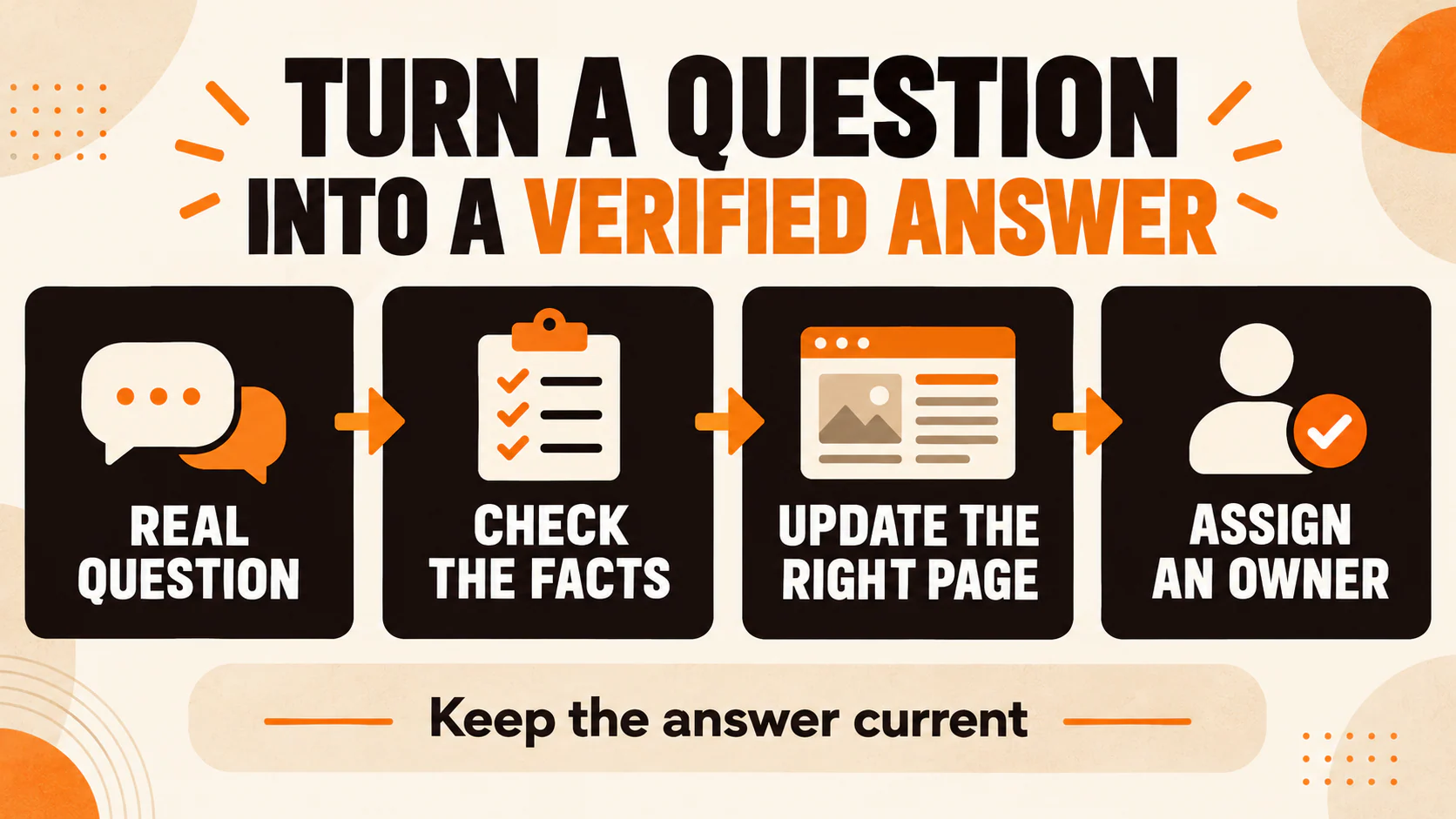
Ask whoever runs the consultation to walk through it, from booking to the end of the visit. Who handles each part? Who assesses suitability? When does the patient get pricing? Have the person responsible for fees confirm what's included, what's excluded, and why a final quote might vary. Get clinical review wherever the wording touches treatment decisions, safety, eligibility, or expected results.
Now you have something to write.
Explain the confirmed steps, when the price becomes available, what could change it, and what the person does next. If your team can't verify a detail, leave it out or explain what's still uncertain. “We'll explain everything when you arrive” doesn't answer a question about what happens before someone commits.
For a home-services company, the same exercise applies to the service visit or estimate. Confirm what the visit covers, who assesses the job, and when the customer can expect a quote. Use your real process, not a promise borrowed from someone else's website.
Put the answer on the existing service or consultation page, near the booking action. Then compare the page with your booking form and phone script. If the website promises one thing and the team describes another, sort that out before sending more people there.
You probably don't need a separate page for every question. A few related answers may fit in an FAQ. That's a good enough reason to use one.
Keep the answers true after you publish them
Fees change. Staff change. Booking systems change. The page needs someone to notice.
Keep a short internal record of who checks the answer, who approved the wording, when it was last checked, and when to review it again. Note anything that should trigger an earlier review, along with other places repeating the same promise.
That last part matters. Changing the service page won't fix old booking copy, intake scripts, ads, or articles that still describe the previous process.
A quarterly check may suit a stable policy. A staffing change may mean you need to check availability wording today. Set the schedule around what happens if the answer is wrong.
An AI mention still isn't a booked appointment
In a one-day Peekl experiment, Gemini 3.1 Flash-Lite produced 1,926 answers through an API with Google Search grounding. Among businesses named across three runs of the same question, 22% of dentists and 21% of aesthetic clinics appeared in all three.
That's the combined set of businesses named in those answers, not all local businesses or your chance of appearing next time. Separately, 13% of answers named no business at all.
The test used an API, not the consumer Gemini app or Maps grounding. Its automated name extraction wasn't manually validated. So treat it as a reason to check more than once, not a prediction of what your next customer will see.
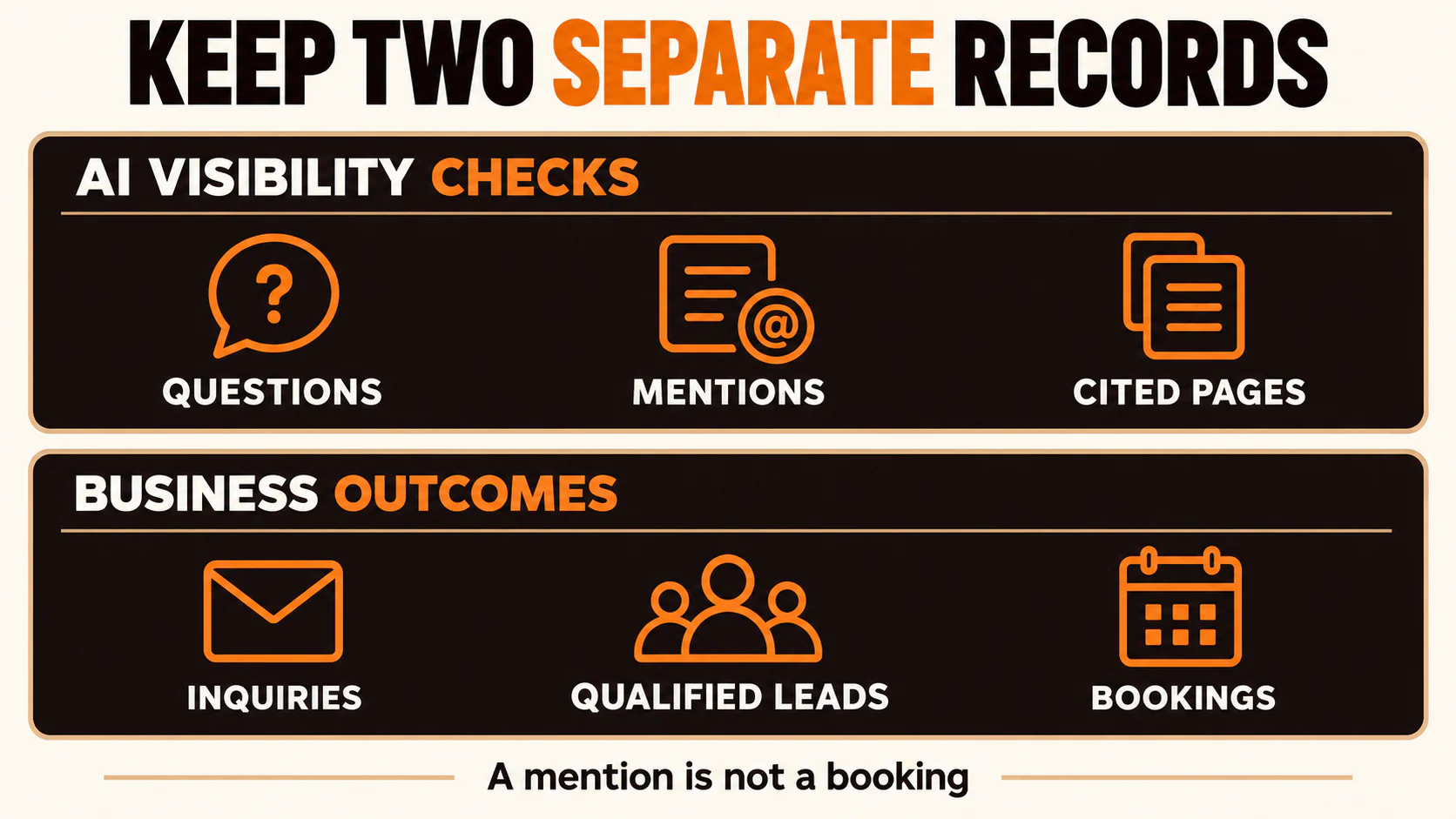
For your own checks, pick a few real buyer questions and a city. Repeat them using the same interface, model, location wording, and settings where possible. Log the dates. Count business mentions separately from links to your pages, and open the sources to see whether they support the answer.
That's a reasonable starting routine, not a proven testing standard. If the answers change after you edit a page, the timing alone doesn't prove your edit caused it.
Keep those observations separate from visits, inquiries, qualified leads, and booked appointments or service visits. If you can't connect a mention to an inquiry, leave that connection unknown. Your calendar doesn't fill itself because a chatbot remembered your name.
For more on measuring the difference, see why AI search impressions are not leads.
Fix one answer this week
Pick one service and one question prospects already ask your team. Choose something that affects whether the right customer contacts you.
Confirm the answer, get the appropriate review, and update the page where it belongs. Write down who's responsible and when they'll check it again. Test the contact path, and make sure the team gives the same answer.
One useful answer beats another article that could belong to any business in America.
If you'd like help turning those answers into useful service pages, explore YEAH! Local's SEO for local businesses.
Last updated