

Key Takeaways
- Most local businesses are not short on marketing data. They are short on channel-level truth.
- Google Ads, Local Services Ads, Facebook Ads, AI SEO, and Local SEO can all generate leads, but without attribution, it is hard to know which ones are producing qualified calls, booked appointments, and real revenue.
- The fix is not more reporting dashboards. The fix is a lead attribution system that captures calls, forms, and chats, then ties each lead back to its original marketing source.
- For healthcare, aesthetics, wellness, and home services, call attribution matters even more because many of the highest-value conversions happen over the phone, not on a website.
- The businesses that scale profitably are not the ones generating the most leads. They are the ones that know which channels are generating the right leads.
Most local businesses are running the same playbook.
They invest in:
- AI SEO
- Local SEO
- Google Ads
- Facebook Ads
- Local Services Ads
- sometimes other channels too
Leads come in. Calls happen. Forms get submitted. Someone books. Someone does not.
Then the monthly marketing review starts, and the same question shows up again:
Which channel is actually producing ROI?
That sounds like a simple question.
For most local businesses, it is not.
Because the phone rings, and suddenly the clean story your ad platform was telling falls apart.
The click happened on a screen.
The sale happened in a conversation.
And the gap between those two is where most attribution breaks.
That is why so many local businesses keep guessing.
The Real Problem: Most Marketing Reports Measure Activity, Not Revenue
This is where things go wrong.
Most local businesses can tell you:
- how many clicks they got
- how many impressions they got
- how many form submissions came in
- what their cost per lead was
That is not the same as knowing ROI.
A campaign can look strong in reporting and still produce:
- wrong-service calls
- out-of-area leads
- existing patients instead of new patients
- price shoppers
- low-intent inquiries
- spam
- people who never book
A lead is not automatically an opportunity.
And an opportunity is not automatically revenue.
That distinction is the whole game.
This is exactly why lead tracking platforms emphasize capturing every lead type, not just web conversions, and tying each one back to its marketing source so marketers can see which campaigns are actually driving qualified leads and revenue.
Why This Is Worse for Healthcare, Aesthetics, Wellness, and Home Services
For a lot of local businesses, the most valuable lead does not happen in a neat, trackable ecommerce checkout.
It happens when someone calls and asks:
- “Do you take my insurance?”
- “Do you offer this treatment?”
- “Can you come out today?”
- “How much does this usually cost?”
- “Are you accepting new patients?”
- “Do you service my area?”
- “Can I book this week?”
In healthcare and wellness, you often need to separate:
- new patients vs existing patients
- qualified consultations vs general inquiries
- high-value treatment interest vs low-fit calls
That kind of distinction is especially relevant in medical and health/wellness use cases, where attribution systems are explicitly used to separate new-patient inquiries from existing-patient calls and show how patients are finding a practice.
In home services, the same thing happens:
- emergency calls vs routine questions
- in-service-area vs out-of-area
- profitable job types vs low-value jobs
- ready-to-book vs “just checking price”
If those differences are not tracked, your reporting gets inflated with noise.
And then you scale the wrong channel.
The Fix: Attribution Tracking That Connects Spend to Sales
If you want to stop guessing, you need a system that does four things well:
1. Capture every lead type
Not just forms.
You need to capture:
- calls
- forms
- chats
- appointments
- ideally other lead actions too
Modern lead tracking systems are built around exactly this idea: capturing calls, forms, chats, appointments, and even transactions in one place so you can evaluate marketing performance more completely.
2. Tie every lead back to its source
You need to know whether the lead came from:
- Google Ads
- AI SEO / organic search
- LLM (ChatGPT, Perplexity, etc.)
- Local SEO
- Local Services Ads
- Facebook Ads
- direct
- referral traffic
Attribution tracking tools do this by assigning code and preserving attribution data so you can see which ads, keywords, and campaigns generated the lead.
3. Evaluate lead quality, not just lead volume
This is the part most businesses skip.
You need to know:
- was it a real lead?
- was it qualified?
- was it in the right geography?
- did it book?
- did it turn into revenue?
Lead tracking platforms increasingly emphasize evaluating lead quality, assigning value to leads, and distinguishing qualified leads from generic conversions.
4. Report on outcomes that matter
Not just “how many conversions.”
You want visibility into:
- qualified leads by channel
- booked appointments by channel
- cost per qualified lead
- cost per booked lead
- revenue by source, when possible
That is the difference between attribution and actual ROI visibility.
Why Calls Are the Hardest and Most Important Part
Calls are where the highest-value insight lives.
They are also where a lot of attribution breaks.
Why?
Because a form submission leaves a clean digital trail.
A phone call does not.
It happens off-screen, which means the most important part of the buying journey often disappears from the marketing report unless call attribution is set up correctly. That is why call tracking platforms position call source tracking, recordings, transcripts, and customer journey visibility as core features, not side features.
This matters a lot for local businesses because calls often represent:
- the highest urgency
- the highest buying intent
- the clearest expression of real demand
- the best source of feedback on lead quality
When the phone rings, that is often where marketing either proves itself or gets exposed.
What Most Local Businesses Are Doing Wrong
They trust platform-reported conversions too much
Google Ads says conversions are up.
Facebook says performance improved.
LSAs say leads increased.
That is useful.
It is not enough.
Those platforms do not automatically tell you:
- whether the call was qualified
- whether the caller booked
- whether the lead turned into revenue
- whether the channel is attracting the right customer profile
They count leads instead of classifying them
A local business might say:
“We got 80 leads last month.”
That sounds great until you break it down:
- 20 were spam or junk
- 18 were existing customers
- 14 were wrong service
- 10 were outside the service area
- 8 were price-only callers
- 10 were real opportunities
Now it is a very different conversation.
They optimize for cost per lead instead of cost per qualified lead
Cheap leads are not the goal.
For local businesses, especially in high-trust or high-ticket categories, cost per qualified lead is usually the more useful metric.
This aligns with how lead analytics tools position the problem: most marketing reports count calls, chats, and form fills as leads, while businesses actually need to know which ones were good leads and which campaigns produced them.
What Better Attribution Looks Like in Practice
Here is what a smarter system looks like.
For a med spa
Instead of just seeing:
- 40 Google Ads leads
- 25 Facebook leads
- 18 organic leads
You can see:
- Google Ads generated the highest number of consultation-ready callers
- Facebook generated more top-funnel interest but weaker booking rates
- organic search produced fewer leads but a higher close rate
- branded search drove many existing-client calls that should not be counted as new acquisition
For a wellness clinic
Instead of:
- “SEO is doing great”
You can see:
- Local SEO drives more new-patient calls
- AI SEO content generates research-stage traffic but fewer immediate bookings
- Facebook retargeting improves return visits but not always direct lead volume
- the best new-patient channel is actually Google Ads on a narrow service-specific campaign
For a painting company
Instead of:
- “Google Ads is expensive”
You can see:
- Search campaigns drive calls with high close rates
- LSAs drive volume, but many leads are lower-value
- SEO brings profitable service jobs with better margins
- after-hours calls are being missed, which is distorting apparent ROI
That is what real channel clarity looks like.
Spreadsheet Table Overview to Add to the Post
| Marketing Channel | What It Often Looks Like in Reporting | What Better Attribution Reveals | KPI That Actually Matters |
|---|---|---|---|
| AI SEO / Organic Content | Traffic and form fills are up | May drive research-stage traffic, branded searches, or some qualified leads depending on content intent | Qualified leads and booked appointments |
| Local SEO / GBP | More calls and visibility | Can drive high-intent local calls, but may also include existing customers or general inquiries | New-customer call rate |
| Google Ads | High lead volume | Often strongest for urgent, bottom-funnel intent, but only if calls are qualified and bookable | Cost per qualified lead |
| Facebook Ads | Cheap leads and engagement | Can create demand and retarget effectively, but quality varies widely by offer and audience | Cost per booked opportunity |
| Local Services Ads | Lots of calls | Volume can look strong, but lead quality may vary by service type and geography | Qualified call percentage |
| Branded Search | Low-cost conversions | Often captures demand created elsewhere and can inflate channel performance if not separated | Assisted revenue, not just last-click leads |
| Calls Overall | “Phone leads increased” | Some calls are junk, wrong-service, out-of-area, or existing customers | Revenue-producing calls |
| Forms / Chats | More conversions recorded | Not all inquiries are equal, and some may never turn into a real sales conversation | Sales-qualified inquiry rate |
| Reporting as a Whole | Channel totals look clean | Real ROI depends on source + lead quality + outcome | Revenue by channel |
How to Build a Real ROI View of Your Marketing
If you want to actually know which marketing channels are producing ROI, here is the framework.
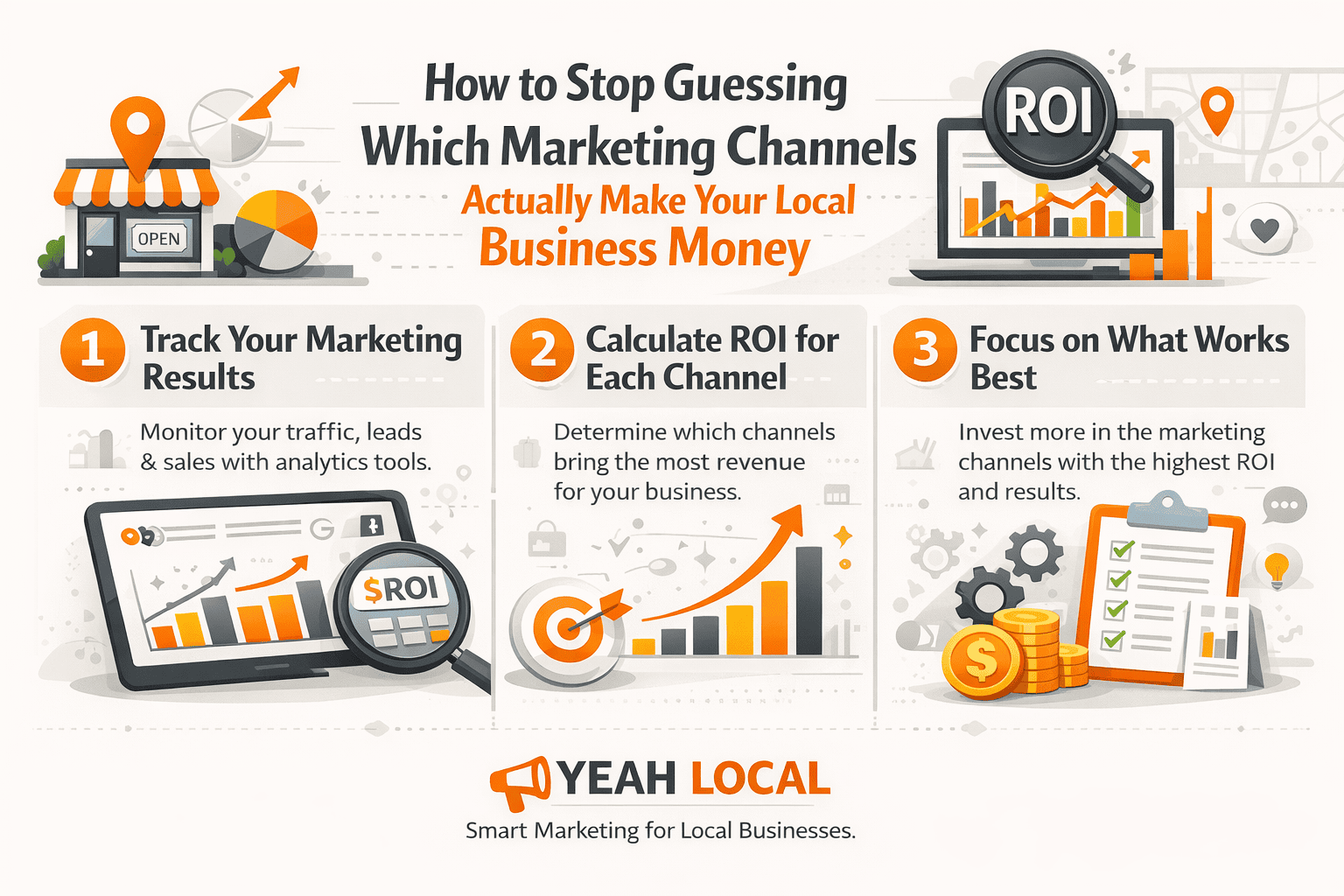
Step 1: Track every lead source
You need complete lead capture across:
- calls
- forms
- chats
- appointments
Otherwise, you are seeing only part of the picture.
Step 2: Preserve source-level attribution
You need the original source for each lead:
- channel
- campaign
- keyword, when relevant
- landing page
- ad source and medium
That is how you connect marketing spend to sales outcomes.
Step 3: Separate lead types
Not every lead should be counted the same way.
Classify:
- new patient / existing patient
- qualified / unqualified
- in-area / out-of-area
- right service / wrong service
- booked / not booked
This is one of the clearest takeaways from lead tracking use cases in health and wellness: separating lead categories creates much better channel-level reporting.
Step 4: Listen to calls or summarize them with AI
The call itself tells you what the report cannot.
Call recordings, transcripts, and AI summaries can reveal:
- common objections
- service confusion
- weak intake
- low-quality queries
- recurring qualification issues
Call recordings, transcriptions, and AI transcripts are explicitly used in lead attribution tools to review conversations and extract insights from them.
Step 5: Push insights back into the campaigns
Once you know which channels are really driving ROI, you can:
- cut wasted spend
- tighten targeting
- improve landing pages
- refine service pages
- add negative keywords
- improve intake scripting
- scale the channels producing qualified leads
That is how attribution turns into growth.
Why This Matters Even More in an AI-Heavy Marketing Stack
A lot of local businesses now invest in both classic and newer channels:
- Local SEO
- Google Ads
- Facebook Ads
- Local Services Ads
- AI SEO
- LLM AI visibility
That mix makes attribution more important, not less.
Why?
Because the buyer journey is getting messier.
Someone might:
- discover you through organic content
- see you again in Maps
- click a retargeting ad
- search your brand later
- then call from their phone
If you only look at last-click conversions, you will give too much credit to the final touch and not enough to the channels creating demand earlier in the journey.
That is why customer journey visibility and multi-touch attribution are such important pieces of modern lead tracking.
The Most Contrarian Truth About Local Marketing ROI
Most local businesses think they have a channel problem.
A lot of the time, they actually have a visibility problem around lead quality.
The problem is not always:
- “SEO is weak”
- “Google Ads is too expensive”
- “Facebook doesn’t work”
- “LSAs are bad”
Sometimes the real issue is:
You do not know which leads are good, so every channel gets judged too shallowly.
Once you fix attribution and lead classification, the conversation changes.
Now you can see:
- which channels drive revenue
- which channels assist revenue
- which channels are wasting budget
- which campaigns deserve more investment
- which sources look good only because the reporting is incomplete
That is how local businesses stop guessing.
Final Thought
If your business invests in AI SEO, Local SEO, Google Ads, Facebook Ads, Local Services Ads, + other channels, then guessing is expensive.
Because every month you do not know what is actually producing ROI, you risk:
- scaling the wrong channel
- underfunding the right one
- celebrating low-value leads
- missing the real growth opportunities hiding in your calls
The fix is not more marketing.
The fix is better attribution.
When you connect spend to calls, calls to qualified leads, and qualified leads to sales, your marketing finally becomes measurable in the way that matters.
That is when local businesses stop guessing.
And start making sharper decisions.
FAQ's
What does it mean to know which marketing channels are producing ROI?
It means knowing which channels generate not just clicks or leads, but qualified leads, booked appointments, and revenue.
Why is this so hard for local businesses?
Because many of the most valuable conversions happen over the phone, and phone calls often break the attribution trail unless call tracking is set up correctly.
Why is cost per lead not enough?
Because not all leads have the same value. A cheap unqualified lead is usually more expensive than a higher-cost lead that actually books and closes.
Which channels should local businesses compare?
At minimum: AI SEO / organic content, Local SEO, Google Ads, Facebook Ads, Local Services Ads, branded search, and any major referral or remarketing channels.
How do I know if calls are from new customers or existing customers?
You need lead tracking and classification rules that separate lead types, especially in healthcare and wellness, where that distinction matters a lot.
What should I measure instead of just conversions?
Look at qualified lead volume, booked appointments, cost per qualified lead, qualified call rate, and revenue by channel.
Can AI help with attribution?
AI can help summarize calls, categorize leads, and surface patterns faster, but it still needs accurate attribution and source-level tracking underneath it.
What is the first step to fixing this?
Start by capturing every lead type, preserving source attribution, and separating qualified leads from generic conversions. That creates the foundation for real ROI reporting.