
Marketing Attribution for Local Businesses: Stop Guessing What Makes Money

Key Takeaway
Build a practical marketing attribution workflow that connects channel source, qualified leads, and business outcomes without pretending the data is perfect.
Your ad platform reports a conversion. The phone rings. One caller books. Another does not.
Those are different events. Treat them as interchangeable and a clean marketing report can send your budget in the wrong direction.
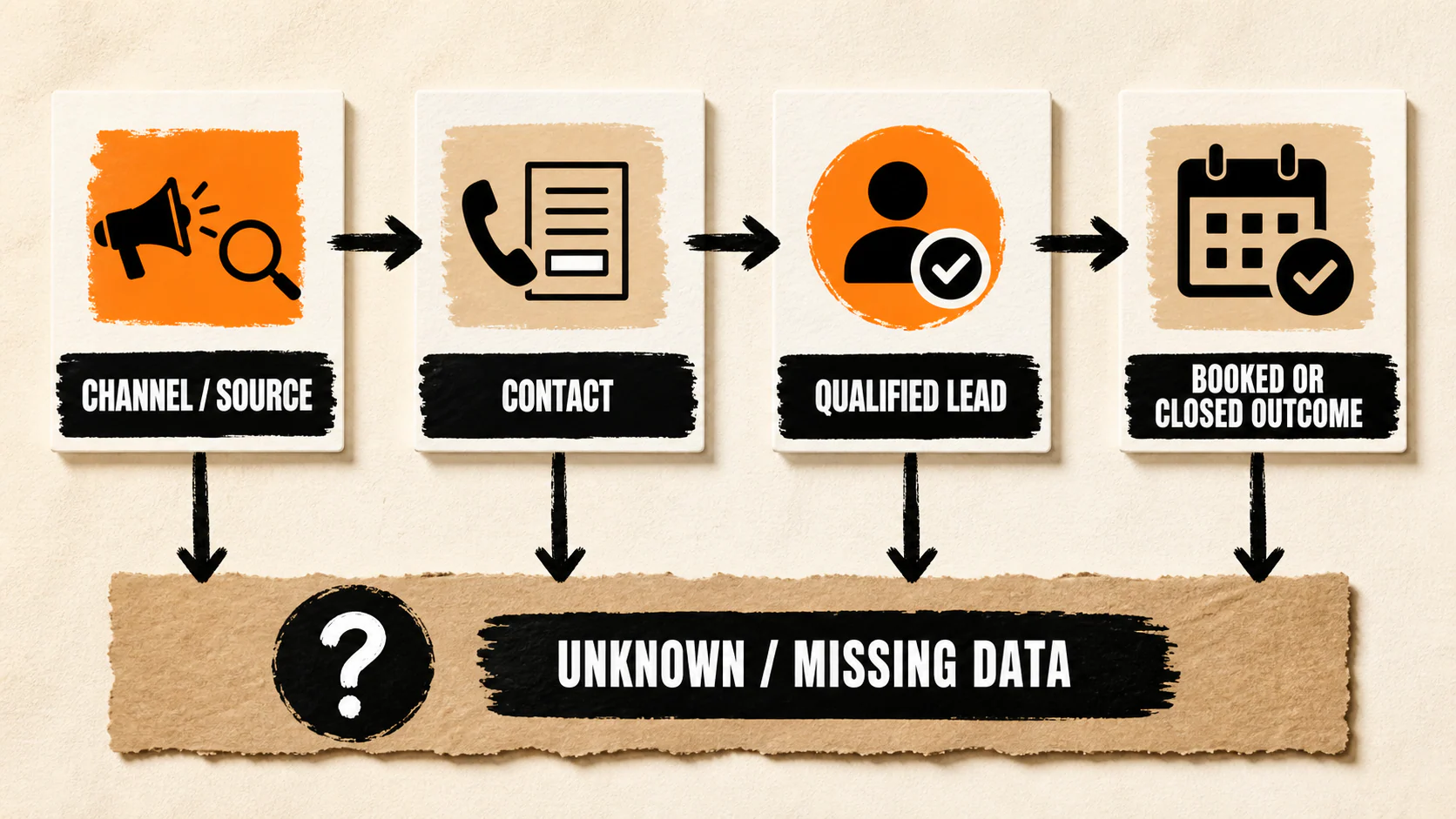
For a local business, the useful measurement ladder is simple:
- A click, call, form, chat, or booking request happened.
- Someone reviewed and classified the inquiry.
- The lead booked, bought, was lost, or is still unresolved.
Marketing attribution is the rule you use to assign credit to the channels and campaigns connected to that path. It organizes evidence. It cannot prove that one ad, search result, or social post single-handedly caused the sale.
That limitation should change how you use the report: stop pretending the dashboard knows more than it does.
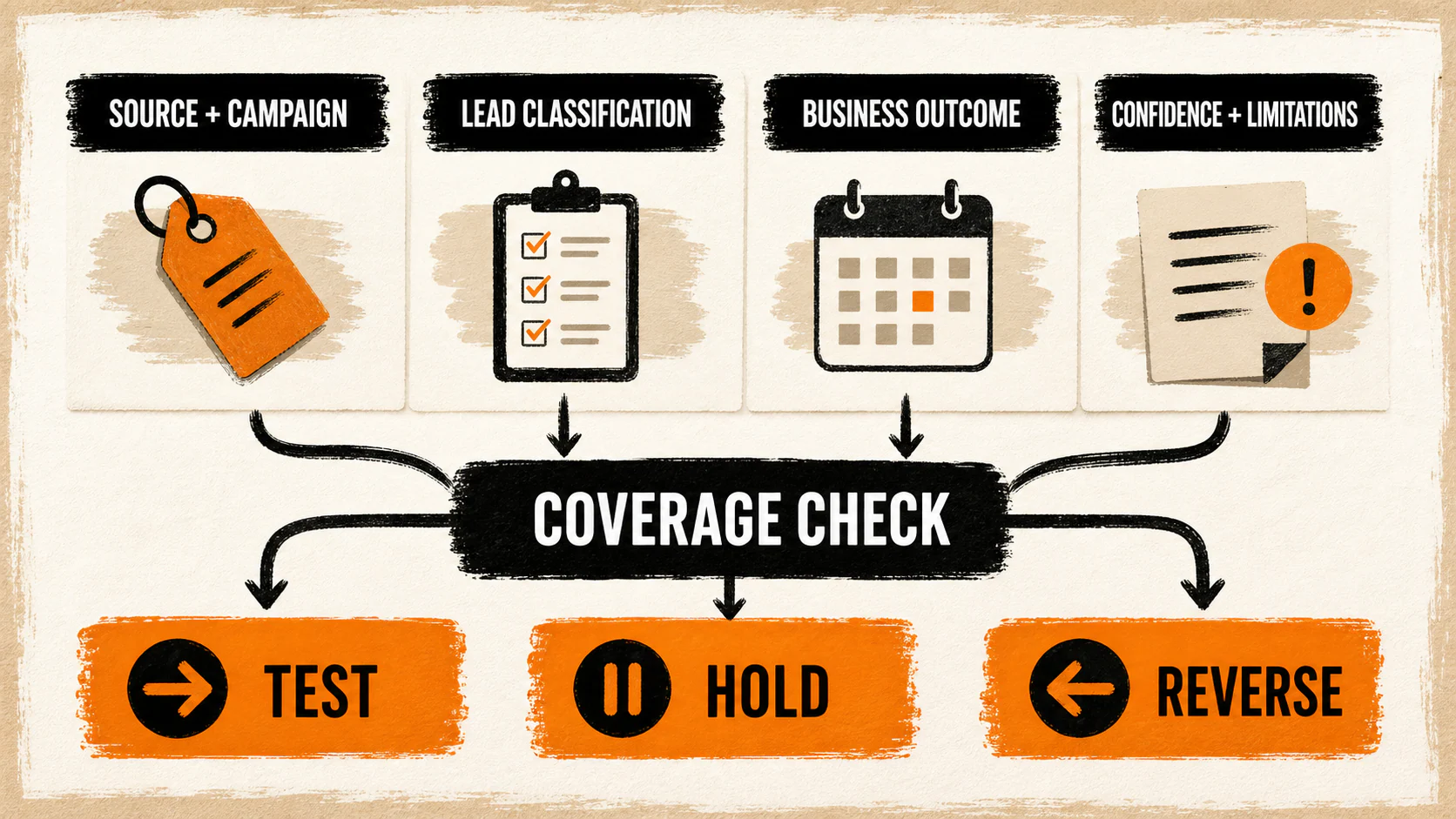
Start with a channel decision record that keeps four fields separate:
| Field | What to record |
|---|---|
| Source and campaign | Where the inquiry was recorded as coming from, plus the campaign when available |
| Lead classification | Qualified, unqualified, wrong service, out of area, existing customer, spam, or another definition your team uses consistently |
| Business outcome | Booked, completed, closed, lost, canceled, or unknown, plus value only when your system legitimately records it |
| Confidence and limitations | Missing source, unreviewed call, delayed outcome, conflicting totals, or another reason not to overstate the conclusion |
Build that record well and you can make a cautious channel decision. Build it badly and a fancier attribution model just rearranges the uncertainty.
What marketing attribution can tell you
Attribution answers a credit question: which recorded marketing touchpoint gets credit for an inquiry or outcome?
That is different from a causal question: would the same person have become a customer if that marketing touchpoint had never happened?
A routine attribution report cannot answer the causal question with certainty. Someone might discover you through search, read reviews, see an ad later, and finally call after typing your business name into Google. Different models can credit different steps without capturing every influence.
Arguing about the one "correct" model is usually a distraction when lead and outcome data is incomplete. Two views can still be useful:
- First-touch attribution credits the first recorded interaction. Use it to investigate which channels introduce people to the business.
- Last-touch attribution credits the final recorded interaction before the conversion. Use it to investigate which channels appear near the inquiry or booking.
Neither view becomes true because the dashboard defaults to it. The practical goal is narrower: connect legitimate inquiries to a recorded source where possible, classify those inquiries consistently, reconcile later outcomes, and keep the gaps visible.
Keep contact, qualification, and outcome separate
A platform conversion is not automatically a qualified lead. A qualified lead is not automatically a booked job. A booked job is not automatically collected revenue.
Contact
A contact is the recorded action: phone call, form submission, chat, appointment request, quote request, or another approved conversion event.
It tells you that something happened. It does not tell you whether the person wanted the right service, lived in your service area, or was an existing customer calling about an open job.
Qualification
Qualification applies the business's definition of a useful inquiry. Write that definition down before anyone reviews a report.
A local service business might require an offered service, an in-area prospect, and a new-customer inquiry. Your fields may differ. Consistency matters more than a generic agency definition.
Raw call totals deserve extra skepticism when calls are a major lead source. A missed call, vendor call, wrong-service request, and ready-to-book prospect should not all carry the same meaning. This guide to why bad calls can look good in local marketing reports goes deeper into that distinction.
Outcome
The outcome records what happened after qualification: booked, completed, closed, lost, canceled, still open, or unknown.
"Unknown" is a valid status. It is safer than silently treating an unresolved lead as a loss or a sale. If your sales cycle is longer than your reporting window, keep the cohort open and come back to it later.
Agree on the rules before buying another dashboard
You do not need a giant analytics stack to start. You need access to lead and outcome records, plus one person who owns the review.
Gather:
- A list of active marketing channels and current campaign names
- Access to website analytics, ad reporting, call tracking, and lead records that your business is authorized to use
- A CRM or shared log where lead status and outcome can be updated
- A written definition of qualified and unqualified
- A review period that fits your sales cycle
- Your consent, recording, privacy, and data-retention requirements
If the team disagrees about what "qualified" means, a new dashboard will display that disagreement more attractively. It will not solve it.
A seven-step attribution workflow for local businesses
1. Define the business outcome first
Pick the outcome that should guide the decision before opening a channel report.
Depending on the business, that could be a booked appointment, accepted estimate, completed job, signed agreement, or collected payment. Use the earliest outcome your team can record reliably. Keep later stages separate instead of pretending they are interchangeable.
Write down the outcome name, who updates it, where it is stored, when it becomes final, and which states remain open or unknown. Then test the definition: two people should classify the same sample lead the same way.
2. Standardize source and campaign names
One channel should not appear as google, Google Ads, paid search, and cpc in four files unless those labels intentionally represent different fields.
Create a short taxonomy:
- Channel: paid search, organic search, local listing, paid social, referral, direct, offline, unknown
- Source: Google, Microsoft, Facebook, referral partner, mailer, event
- Campaign: the stable campaign name your team uses across the URL, platform, and lead record
For links you control, UTM parameters can preserve source, medium, and campaign information in Google Analytics. Google's official GA4 URL builder documentation explains the supported campaign parameters and recommends consistent naming. A UTM value identifies campaign information. It does not tell you whether the visitor became a qualified lead or customer.
Each active campaign should map to one approved source, medium, and campaign label before you compare totals.
3. Preserve a source identifier with the lead
Your analytics report and lead log need a shared thread. The exact identifier depends on the channel and system, but the operational requirement stays the same: preserve the source information that was legitimately available when the inquiry arrived.
For forms, that may mean passing approved campaign fields into the lead record. For calls, it may mean attaching a call-tracking source to the call record. For offline referrals, it may mean a staff member completing an intake field.
Do not force precision where none exists. If the source is unavailable, use unknown. Never let a staff member choose the channel they assume was responsible.
Check a recent form, call, and other important lead type. Each record should contain either a source identifier or an explicit unknown status.
4. Classify the lead separately from the contact
Now review whether the inquiry met the qualification definition from Step 1.
Use a small, controlled list of statuses. A useful starting point might include:
- Qualified
- Wrong service
- Out of area
- Existing customer
- Spam or solicitation
- Could not determine
The classification should describe the inquiry, not reward or punish the marketing channel. If reviewers classify an identical request differently because one came from an expensive campaign, the process has already become biased.
Call recordings or transcripts may help when your business is permitted to use them. Human review still owns definitions and corrections. AI summaries can assist with sorting, but they are not a truth engine. If relevant, read how to use AI call summaries with human-reviewed lead categories.
Before recording, transcribing, or uploading call data, confirm the laws, vendor settings, notices, consent, access, and retention rules that apply to your business. This article is not legal advice.
5. Reconcile booked, closed, lost, and unknown outcomes
Attribution becomes more useful when the lead record comes back from the sales or intake process with an outcome.
Marketing can count contacts immediately. Bookings, completed jobs, and revenue may live elsewhere and appear later. Assign one person to update what happened and preserve unresolved cases, not decide which channel "won."
For eligible Google Ads leads, Google documents ways to send later outcomes back through offline conversion imports or enhanced conversions for leads. The official Google Ads offline conversion documentation explains the Google Ads-specific options, including requirements around identifiers and user-provided data. It also tells advertisers to provide clear information about collected data and obtain consent where required.
That feature is not a universal attribution system. It does not reconcile organic search, referrals, social, direct traffic, or offline marketing for you.
Every qualified lead in the review cohort needs an outcome: booked, completed, closed, lost, canceled, open, or unknown.
6. Review one consistent cohort and record the gaps
Pick a cohort based on when the inquiry arrived, then give it enough time to reach the outcome you defined. Comparing one channel's fresh leads with another channel's mature outcomes creates a fake difference.
Your working record should include:
| Source or campaign | Lead classification | Outcome | Confidence and limitations |
|---|---|---|---|
| Recorded source from the lead system | Approved status from the qualification list | Current business outcome | Missing source, incomplete review, delayed outcome, conflicting totals, or other caveat |
Add cost, booked value, or collected revenue only when available, consistently defined, and appropriate to record. Never turn an empty cell into zero unless zero is confirmed.
The confidence field keeps the report honest. High confidence might mean source, qualification, and outcome are reconciled under stable definitions. Limited confidence might mean source coverage is incomplete or outcomes remain unresolved. Keep those definitions stable each month.
7. Make one reversible decision
The first cleaned-up report does not justify a dramatic budget swing.
Choose one action you can reverse and one review date. You might tighten targeting, revise a landing page promise, add a negative keyword, change an intake question, or hold spend steady while outcomes mature.
If the channel brings qualified inquiries but few bookings, investigate the offer, landing page, follow-up, availability, or intake process. That is a conversion-path problem, not automatic proof that the channel failed. The guide to building higher-converting local funnels helps with that separate diagnosis.
If inquiries repeatedly misunderstand the service, clarifying the offer to attract more qualified leads may be more useful than changing the attribution model.
Put the action, owner, guardrail, review date, and evidence for keeping or reversing the change in the decision record. If you cannot fill in those fields, you are not ready to act.
What to do when the data breaks
The source is missing
Mark it unknown. Then identify whether the loss happened during capture, transfer, or reporting.
Check the link parameters, form fields, call source, CRM handoff, and staff intake process in that order. Do not retroactively assign the lead to the channel with the most plausible story.
Lead quality is unknown
Pause channel verdicts that depend on qualification. Review the underlying lead records using the written definition.
If a reviewer still cannot determine quality, keep that uncertainty visible. A pile of unreviewed calls is neither positive nor negative channel evidence.
The outcome is delayed or unknown
Keep the cohort open until the agreed review point. Compare mature cohorts with mature cohorts.
If the team routinely loses outcome updates, fix ownership before changing budgets. Better campaign tags will not repair a sales process that never closes the reporting loop.
Platform totals conflict
Different systems may answer different questions. Check date range, time zone, attribution window, conversion definition, duplicate handling, and whether each report counts contacts, people, or outcomes.
Do not average conflicting totals into a comforting number. Record the mismatch and decide which system owns each field.
Compare channels without fooling yourself
Use a stoplight rule before you scale, pause, or call a channel unprofitable.
Red: do not decide yet
Stop when source coverage is poor, qualification is inconsistent, outcomes are immature, or platform definitions conflict. The next action is measurement repair.
Yellow: run a bounded test
Proceed cautiously when the pattern is interesting but confidence is limited. Change one variable, keep a guardrail, and schedule the next review.
Orange: make a reversible allocation change
When definitions are stable, coverage is acceptable under your written rule, and outcomes are mature enough for the business's cycle, make a bounded change. Document the old setting so you can reverse it.
If a channel looks strong only in the first-touch view, it may be introducing demand. If another looks strong only at the last touch, it may be close to the inquiry. Investigate the difference. Do not divide revenue by intuition.
After reconciling calls and outcomes, this local SEO and Google Ads feedback-loop guide offers a deeper process for feeding qualified-call evidence back into campaign and content decisions. The recording and consent cautions still apply.
Your monthly attribution review
Use a cadence that fits your lead volume and sales cycle. Ask the same questions each time:
- Are source and campaign names still consistent?
- What share of important lead types has a recorded source?
- Did reviewers apply the same qualification definition?
- Which outcomes are mature, open, or unknown?
- Which conclusion has strong enough coverage to support a reversible action?
- What single action will you take, and when will you check it?
The monthly deliverable is an updated channel decision record, an honest list of gaps, and one action the evidence can support. That is a better management tool than a dashboard full of unexplained conversions.
Frequently asked questions
What is marketing attribution for a local business?
It assigns reporting credit to recorded touchpoints connected to inquiries or outcomes. It organizes channel evidence, but it does not prove causation.
Which attribution model should a local business use?
Use the model that answers the current question. First-touch shows recorded introductions. Last-touch shows recorded interactions near conversion. Neither is universally correct.
What should I do if I cannot connect a lead to a source?
Mark the source unknown, find where the data was lost, and avoid assigning it based on assumption. Unknown data is a limitation to fix, not permission to invent certainty.
When should I change a channel's budget?
Change it only after checking source coverage, qualification consistency, outcome maturity, and conflicting definitions. Start with a bounded, reversible adjustment and set a review date.
Stop looking for a perfect answer
Useful attribution will not reveal which channel secretly deserves every dollar. It gives your team a disciplined way to connect recorded source, lead quality, and business outcome while keeping uncertainty visible.
Define the outcome. Standardize the names. Preserve the source. Classify the inquiry. Reconcile what happened. Review one consistent cohort. Then make one decision you can reverse.
You will still have blind spots. The difference is that your team can now see them, work on them, and stop mistaking false precision for a decision.
Last updated