
What Most Local Businesses Get Wrong About AI SEO: Backlinks and Digital PR Still Matter

Key Takeaway
Use this five-question screen to evaluate local SEO backlinks and digital PR, reject manipulative links, and measure the work honestly.
The backlink advice aimed at local businesses tends to land at one of two extremes.
One side says links are dead because AI changed search. The other says the answer is to buy more links, preferably in a tidy package with a dashboard full of impressive numbers.
Neither is a useful strategy.
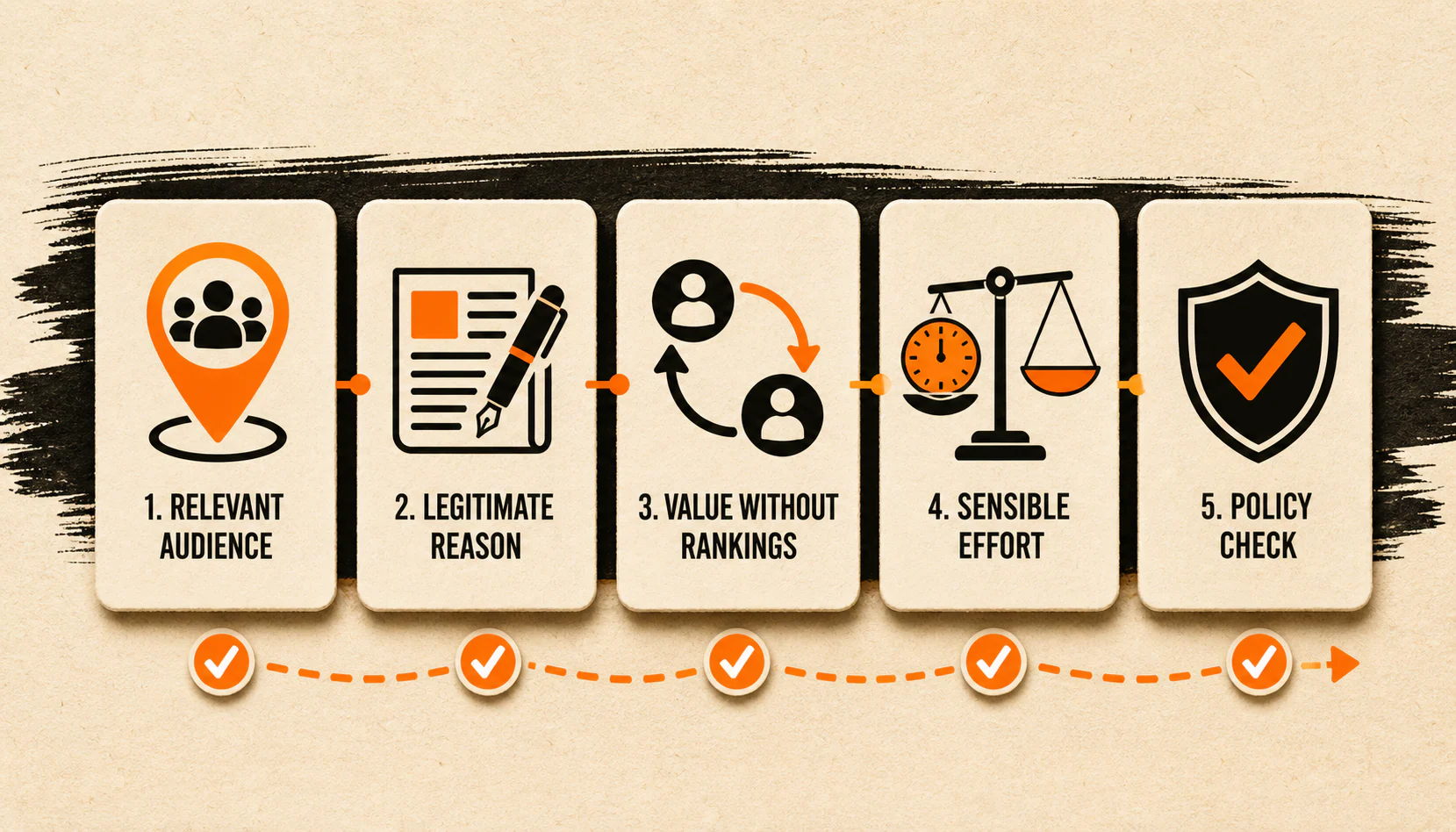
Backlinks and legitimate digital PR can still be worth pursuing. But they are not an AI shortcut, and a placement is not valuable simply because it includes a link. A better test is whether the opportunity reaches a relevant audience, has a legitimate reason to exist, offers value even if rankings never move, deserves the effort, and stays within Google's spam policies.
That is the standard for this article. There is no magic authority score here, and no promise that one link will move a ranking or earn an AI citation.
One useful point from the old article is still worth keeping: publishing more pages is not a complete marketing strategy. Your website needs useful service pages and clear information. A stream of weak articles cannot replace that work, and it cannot manufacture genuine attention elsewhere. If content volume has become the plan, read why local businesses need better service pages, not more content before commissioning another batch.
Four labels that get tangled together
The language gets messy fast once AI enters the conversation. Four related terms keep getting collapsed into one bucket.
A backlink is a clickable link from another website to yours. For a local business, it might come from a neighborhood organization, an event page, a local publication, a business association, or a partner.
A local citation is an online mention of basic business information, commonly the business name, address, and phone number. A directory listing may include a backlink, but the citation and the link are different things. This guide to local SEO citations goes deeper on that distinction.
Digital PR is the work of earning coverage, commentary, interviews, mentions, or other attention through a legitimate story, useful information, or real expertise. Coverage may include a backlink. It may not. If the campaign has no purpose beyond collecting a dofollow link, it is link buying dressed up as PR.
An AI supporting link appears with an AI-generated answer in a search product. It is an output chosen by a particular system for a particular response, not another name for a directory citation, backlink, or press mention. Nothing in this article suggests that a local backlink or press mention will make one appear.
Keeping the labels straight prevents bad reporting. A spreadsheet with 100 new citations does not show 100 earned editorial backlinks. A syndicated press release is not automatically earned media. A website mention does not prove visibility in an AI answer.
The five-question local link opportunity screen
Before paying, pitching, sponsoring, partnering, or creating a resource, ask the same five questions.
- Is the audience relevant? Would the people who see the placement reasonably care about the business, service, expertise, or location? For the business case, real local relevance is more useful than a flashy sitewide metric.
- Is the placement editorially legitimate? Is there a clear reason for the organization, publisher, or partner to mention the business? A genuine event sponsorship, expert contribution, useful resource, or business relationship has an explanation. A mystery link inserted into an old article usually does not.
- Is there value without rankings? Could the opportunity create useful exposure, referral visits, a relationship, a credible public mention, or community participation even if search visibility does not change?
- Is the effort sensible? Compare the likely audience and independent value with the time, fee, content, approvals, follow-up, and maintenance involved. A legitimate opportunity can still be a poor use of resources.
- Would it survive a spam-policy review? Reject offers that amount to payment for ranking credit, automated placement, or a hidden network link. Paid advertising and sponsorship are not automatically prohibited, but the links may need to be qualified.
The third question is the best filter in the set. If an opportunity becomes worthless the moment you remove the hoped-for ranking benefit, you are evaluating a ranking gamble rather than a marketing asset.
Local backlink and PR opportunities worth evaluating
These categories are starting points, not recommendations or promises. Apply all five questions to the actual opportunity in front of you.
Local organizations, events, and sponsorships
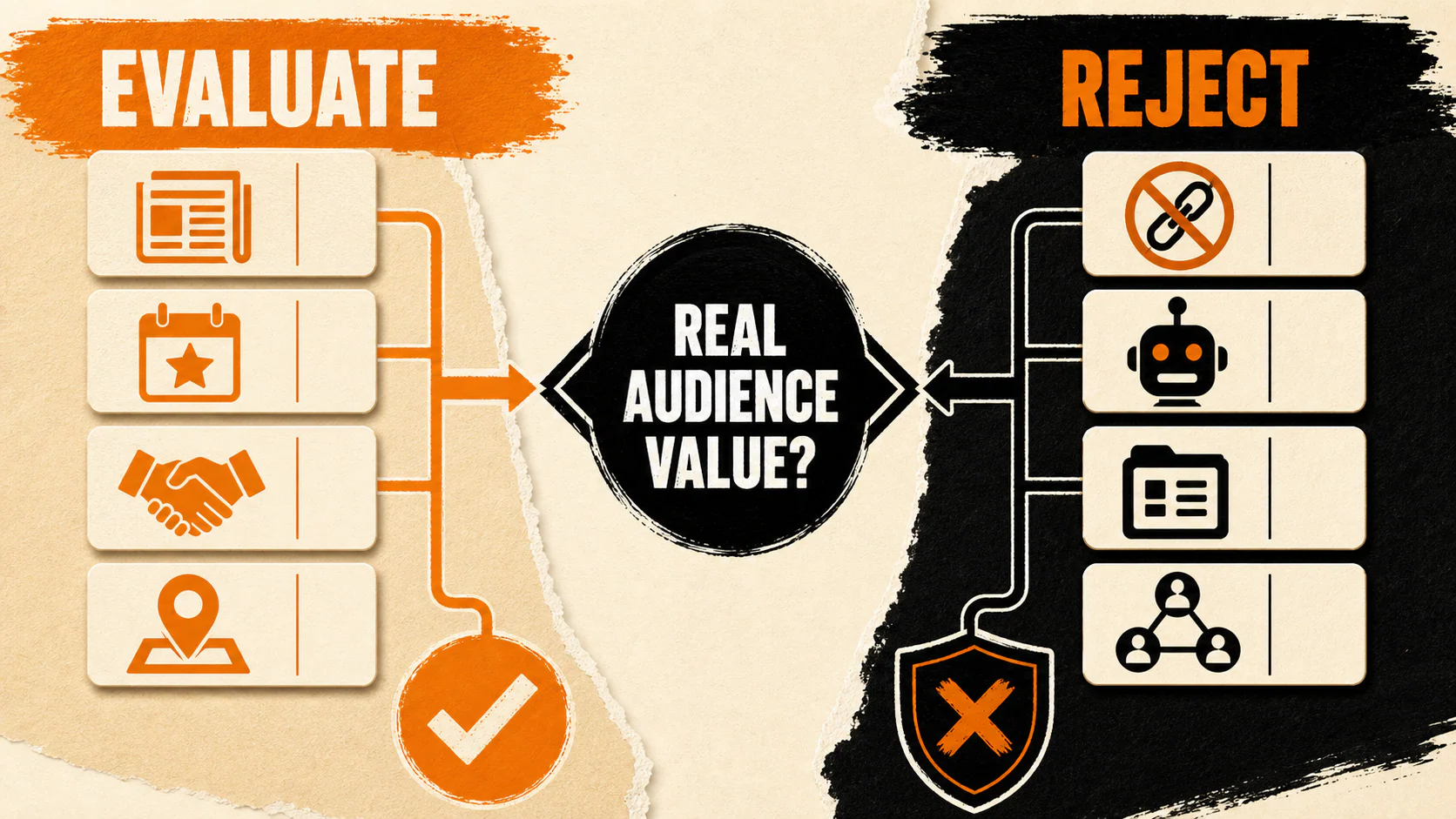
A chamber, neighborhood group, nonprofit, trade organization, event, or community program may have a natural reason to mention participating businesses. The opportunity is strongest when the group's audience overlaps with yours and your involvement is real.
Do not sponsor something solely because its website has a high metric or promises a link. Ask what the organization does, who it reaches, what participation involves, where the business will appear, and whether the relationship would still be worthwhile if the link were qualified or omitted.
That last question clears the fog quickly. Supporting a relevant local event may make sense as community participation and audience access. Buying a place on an unrelated sponsor page only for ranking credit is a different proposition.
Local media and expert contributions
Digital PR works better when there is something to say. A verifiable local event, a useful update, original information, or relevant expertise can give a reporter or publisher a reason to care.
The pitch should serve the publication's audience. "Please link to our website" is not a story. A concise explanation of what happened, why it matters locally, what can be verified, and who can provide informed comment is at least a real starting point.
Coverage without a link can still have value. A link without a legitimate editorial reason deserves more skepticism. That may be annoying to anyone selling guaranteed placements, but it is a healthier way to judge PR.
Real business partnerships and associations
Partners, suppliers, professional associations, and complementary local businesses can create sensible opportunities when a real relationship exists. A joint event page, member profile, useful partner resource, or accurate project mention can help a shared audience understand the connection.
The relationship comes first. A fake partnership or an exchange of keyword-rich links meant only to influence rankings fails the legitimacy test and may fail the policy test too.
Useful local resources and original information
A resource earns attention only when it gives people something worth using or referencing. That might be a clear local guide, an event calendar that is actually maintained, original data the business is allowed to publish, or an explanation grounded in genuine expertise.
Do not confuse this with publishing for volume. The resource needs a defined audience and job. It also needs a reasonable promotion plan, because uploading another generic article and waiting for strangers to discover it is not digital PR.
Directories and citations
Accurate listings give people another place to find and check basic business information. Start with directories relevant to the location or industry that a potential customer could reasonably use. Keep the details consistent with the website and maintain accurate Google Business Profile information.
Keep the label honest, though. A directory citation is not automatically an editorial endorsement. A directory backlink is not automatically a useful backlink. If the directory exists mainly to sell bulk listings and has no credible audience, another row in the count is not much of a win.
What to reject, even when the sales pitch sounds impressive
Reject offers built around the promise of ranking credit rather than reader or community value. Common examples include:
- packages of purchased "dofollow" links designed to pass ranking credit;
- automated link creation across sites you did not choose;
- low-quality directories created mainly to manufacture links;
- paid press-release distribution that passes ranking credit through optimized links;
- private blog network offers, including those marketed as footprint-free or update-proof;
- unexplained insertions into old articles, especially when relevance begins and ends with the anchor text.
Google's spam policies for Google Search identify buying or selling links for ranking purposes, automated link creation, low-quality directories, and paid press releases with links that pass ranking credit as examples of link spam. The policy distinguishes appropriately qualified advertising and sponsorship links from paid links intended to manipulate rankings.
The practical boundary is not "money touched the opportunity, so it is forbidden." Businesses pay for ads, event sponsorships, memberships, distribution, and creative work all the time. The problem is paying for unqualified ranking credit and pretending the placement reflects earned editorial judgment.
Where AI search fits, and where the evidence stops
Google says its usual SEO best practices remain relevant for AI Overviews and AI Mode, with no extra requirements or special optimizations for appearing in those features. Its guidance for AI features and websites also says a page must be indexed and eligible to appear with a Search snippet before it can be eligible as a supporting link. Meeting those requirements does not guarantee crawling, indexing, serving, or inclusion as a supporting link.
Google's operational advice includes allowing crawling, making important content available as text, using internal links, keeping structured data consistent with visible content, and maintaining current Business Profile information. That is a useful checklist. It is not a published formula saying backlinks or PR cause AI citations.
The research behind this article covers Google Search. It does not establish how ChatGPT, Perplexity, Bing, or every other answer system weighs links, mentions, reviews, or PR. Treating "AI systems" as one universal machine hides more than it explains.
The honest conclusion is narrower. Do solid website and local-search work, evaluate legitimate off-site opportunities on their own merits, and track AI supporting links as an external outcome if they matter to the business. Do not sell the possibility as a guaranteed result.
How to measure the work without fooling yourself
Measurement should help you make the next decision, not retrofit a victory story onto a placement. Keep four records separate.
- For placement quality, record the publisher or organization, the page, the audience fit, the reason for the mention, whether the link is present and qualified, and whether the information stays accurate.
- For referral and discovery, review referral visits and any trackable actions that follow. A small number is still a number. Zero is useful information too. Neither result proves what happened to rankings.
- For relationships, note whether the work created a real media contact, partner, association connection, speaking opportunity, event relationship, or repeat contribution. Do not force every relationship into a dollar value after one month.
- For search visibility, monitor relevant organic visibility, local visibility, indexed pages, and any observed Google AI supporting links separately. Add dates and annotations, but do not claim that one link caused a later movement. Site changes, competitors, demand, location, and changes to the search product can overlap.
Agree on expectations before the work starts. A seller cannot responsibly promise when one placement will affect visibility, which is why a clear explanation of how long SEO can take is more useful than a promise that a link will "kick in" on a particular day.
A practical first-month plan
Keep the first month small enough to learn from.
- Clean up the foundation. Confirm that the website states the services and locations clearly, important pages are internally linked, public business facts are accurate, and obvious directory errors are corrected.
- Build a short opportunity list. Choose a few local organizations, publications, partners, associations, or directories with genuine audience overlap. Write down why each one could matter without rankings.
- Run the five-question screen. Reject weak or risky opportunities before outreach. Rank the rest by relevance, legitimacy, independent value, effort, and policy risk.
- Choose one legitimate action. Join a relevant association, support a fitting event, correct a useful citation, offer a qualified expert contribution, or create one local resource people actually need. Pick an action the business can fulfill honestly.
- Record the baseline. Save the date, current placement state, referral baseline, relevant visibility measures, and known website changes. This will not create causal certainty, but it will prevent fuzzy before-and-after storytelling.
- Review what happened. Was the opportunity completed? Did the placement stay accurate? Did anyone visit, respond, refer, or continue the relationship? Decide what to repeat, change, or drop.
One defensible action beats a box of links you cannot explain.
The standard worth keeping
Backlinks and digital PR are not dead. The shortcut version deserves to be.
A worthwhile local link or PR opportunity should make sense to a relevant audience, have a legitimate reason to exist, offer value beyond hoped-for rankings, justify the effort, and withstand a spam-policy review. That standard will reject plenty of impressive-looking offers. Good.
If the website foundation and local visibility work need a broader plan, local SEO support is the relevant next step. But the decision in front of you does not require a grand campaign. Pick one legitimate opportunity, document why it deserves attention, and measure what actually happens.
Frequently asked questions
What is a local backlink?
A local backlink is a clickable link to your website from another site connected to the area or local audience you serve. The placement still needs a legitimate reason and useful audience fit. The word "local" does not make it valuable by itself.
Are local citations the same as backlinks?
No. A local citation is a mention of business information such as the name, address, and phone number. A citation may include a backlink, but it does not have to. Track citations and editorial backlinks separately.
Can a local business pay for links?
Buying links intended to pass ranking credit conflicts with Google's spam policies. Paid advertising, sponsorships, and similar arrangements are not automatically prohibited when links are appropriately qualified. Evaluate the audience value and any disclosure or qualification requirements, not just whether money changed hands.
Are press releases good for backlinks?
A press release can communicate a real, verifiable announcement. It should not be treated as a machine for buying ranking links. If paid distribution includes links, those links should follow the applicable qualification rules. Judge the release by whether the news is useful and the intended audience is relevant.
Do backlinks help a business appear in AI search?
This research does not support a promise that a backlink will cause an AI supporting link. Google says normal SEO practices remain relevant to AI Overviews and AI Mode, but it does not publish a special backlink or digital PR formula for inclusion. Treat any appearance as an outcome to observe, not something a link seller can guarantee.
Last updated