

Key Takeaway
Google Ads does not buy higher local rankings. Learn how to use paid search terms, message tests, and validated outcomes to make smarter local SEO decisions.
Paying Google for ads does not buy higher organic rankings. It does not buy a better position in the Local Pack or Maps, either.
So why look at Google Ads data when planning local SEO?
Because paid search can show your marketing team what happened inside a specific campaign: which reported searches triggered ads, which messages earned a paid response, how visitors used a landing page, and which advertiser-defined conversion actions were recorded. That evidence can help a person form a better SEO hypothesis.
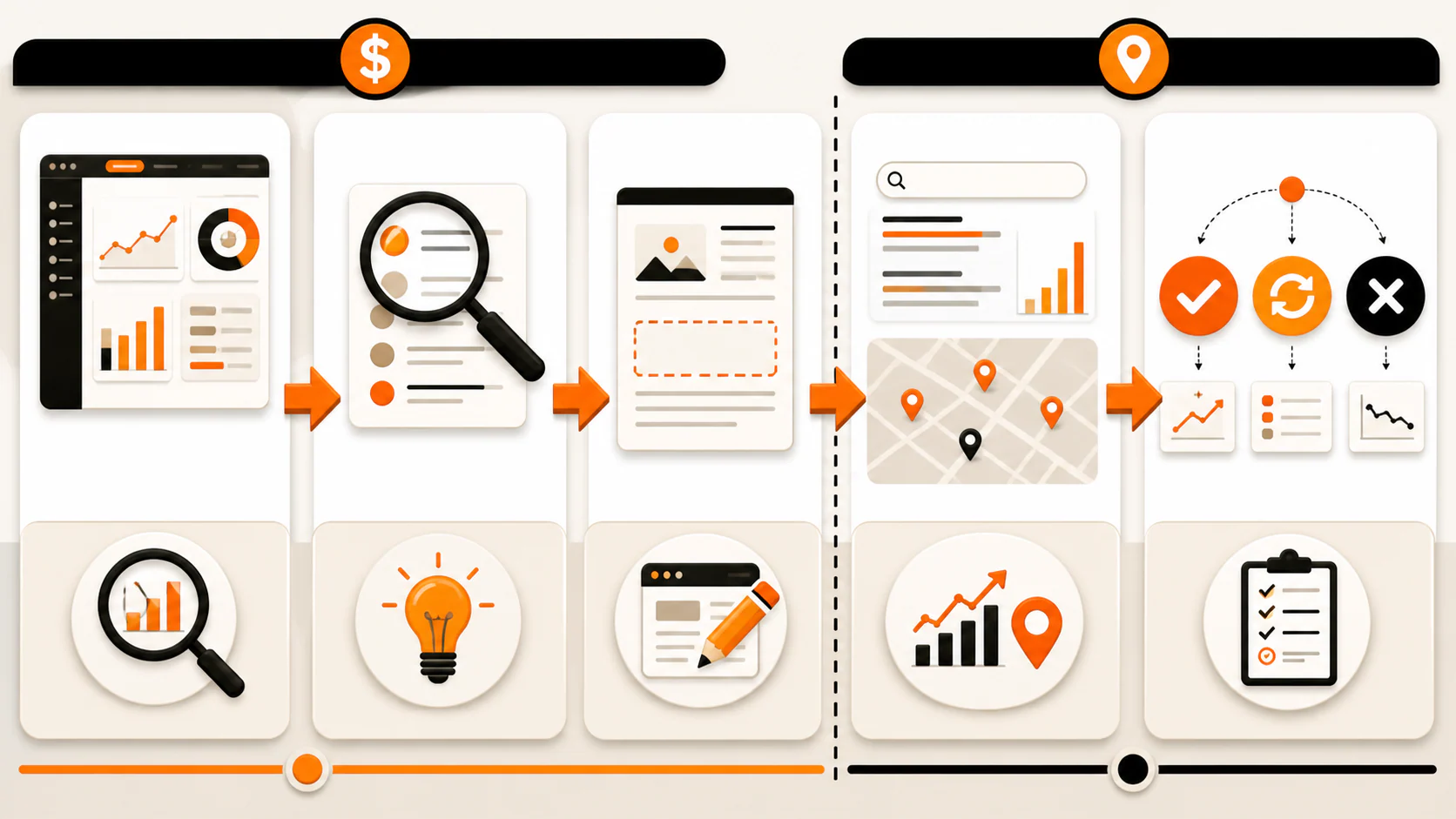
The useful path looks like this:
Ads evidence -> human validation -> one SEO hypothesis -> one page change -> organic and local measurement
Here's the distinction that matters: your marketing team acts on the data. Nothing in the sources cited here supports a direct path from your ad spend or conversion data into Google's organic ranking systems. Ads evidence can help your team learn. Your team still has to interpret it, make a controlled change, and measure the channel that is supposed to improve.
Does Google Ads data directly improve local SEO rankings?
No. Google's public guidance is blunt about payment.
Google Search Central says Google does not accept payment to rank pages higher. Google's Business Profile guidance also says there is no way to request or pay for a better local ranking. For local results, Google publicly describes relevance, distance, and prominence as the main categories it considers.
Those public pages do not reveal every internal Google system. They do give us a responsible boundary: nothing in the evidence for this article supports a claim that Ads spend, clicks, calls, forms, conversions, or campaign behavior directly boosts a business in organic Search, the Local Pack, Maps, or AI Overviews.
That may sound like splitting hairs. It isn't. Google Ads data can help a marketer choose a question worth investigating. It cannot answer the organic ranking question on the marketer's behalf.
If you want the broader foundation for improving local visibility, start with the website, Business Profile, reviews, local authority, and lead tracking covered in our local SEO services.
What Google Ads data can actually tell you
Google Ads reports activity inside Google Ads. Trouble starts when a team stretches that evidence beyond its original job.
Four inputs are worth your attention. Each comes with a limit that keeps it honest.
Search terms
The search terms report shows searches that triggered your ads and the performance associated with those reported terms. Google says the report can surface ideas for creative and landing-page content.
That makes the report useful for spotting repeated wording, service qualifiers, location combinations, objections, and questions. It does not make every term an SEO keyword. The evidence comes from one campaign's keywords, match behavior, targeting, budget, and traffic. Some query data may also be limited or aggregated for privacy.
Message response
Paid ads let you compare headlines, descriptions, offers, and calls to action within the conditions of the campaign. A stronger click-through rate may tell you that one message earned more response in that paid setting.
It does not prove the wording belongs on an organic service page. The ad position, audience, query mix, offer, and landing page may all differ. Treat a strong paid message as a candidate to investigate, not something to paste across the site.
Landing-page evidence
When campaigns send people to a specific page and the landing-page analytics and conversion tracking are sound, the team can inspect how that paid traffic used the page. Did visitors reach the relevant service information? Did they use the intended call or form path? Did the page attract inquiries from the wrong location or for the wrong service?
This evidence is still tied to paid traffic. Organic visitors may arrive through different queries, know more or less about the business, and enter at another point in the decision. A landing-page pattern can expose a question. It cannot prove the same pattern exists in organic traffic.
Conversion and lead-quality outcomes
Google Ads conversion measurement records actions the advertiser chose to define as valuable after an ad interaction. Those actions can help evaluate campaigns and can be used by Google Ads optimization and Smart Bidding.
The label "conversion" is only as useful as its setup. A button click, short call, form submission, booked appointment, accepted job, and completed sale are different events. If the account counts all of them as equal, the report may look precise while answering the wrong business question.
This is why our PPC approach connects search terms and campaign activity to calls, forms, appointments, and lead quality. The paid platform records the configured event. The business has to validate whether the event became a qualified opportunity.
The Google Ads-to-local-SEO feedback loop
Use a small, controlled process. If you change five pages, rewrite the offer, move budget, edit the Business Profile, and launch a new campaign at the same time, you may get movement. You will not get a clean lesson.
- Define the qualified business outcome. Write down what counts. It might be a call from someone seeking a service you offer in an area you serve, a booked appointment, an accepted estimate, or another outcome the business can verify. Keep raw contacts, qualified leads, bookings, and completed work separate.
- Clean the paid evidence. Separate brand from non-brand searches. Check service, location, device, match behavior, and irrelevant terms where those distinctions matter. Remove obvious noise before looking for a content idea.
- Find one repeated pattern. Look for a question, qualifier, objection, service phrase, or location mismatch that appears often enough to investigate. One odd query is not enough to justify a content plan.
- Check the organic evidence and existing page. Review Search Console, local tracking, the current page, and the live search results available to your team. The answer may already be on the page. The paid query may have no meaningful organic demand. Or the problem may be targeting rather than content.
- Write one testable hypothesis. Name the evidence, the inference, the page, the proposed change, and the measure. For example: "Qualified paid callers repeatedly ask whether Service A is available in Area B. Clarifying that availability on the existing Service A page may help organic visitors answer the same question before calling."
- Change one page or one tightly related element. Update the specific copy, title, FAQ, proof point, or call to action that addresses the hypothesis. Annotate the date. Avoid unrelated edits that would make the result harder to interpret.
- Review the appropriate outcome. Later, check the organic or local measure you chose, along with qualified business outcomes. Decide whether to keep, revise, or reverse the change. Ordinary ranking or lead movement does not prove that the edit caused it. It tells you whether the hypothesis deserves another round of investigation.
For call-heavy businesses, the missing validation often lives in the conversation itself. Our guide to a call-tracking feedback loop for local SEO and Google Ads explains how to separate calls, qualified inquiries, bookings, and later outcomes without pretending the source label proves causation.
Four practical ways to use the data without fooling yourself
Every row below is illustrative. These are hypotheses a local business could test, not reported outcomes or promises.
| Paid evidence | Possible SEO hypothesis | Controlled action | Measure |
|---|---|---|---|
| Qualified non-brand inquiries repeatedly use a specific service phrase | Organic visitors may understand that phrase better than the wording on the existing service page | Clarify the service wording on one relevant page | Search Console queries and clicks for that page, local visibility where tracked, and qualified inquiries |
| Paid searches and calls repeatedly come from outside the service area | The page may leave the service area unclear, or the campaign geography may be wrong | First fix targeting if needed; if the page is ambiguous, clarify the actual service area on that page | Out-of-area inquiry rate by source and relevant organic/local activity |
| Qualified callers repeatedly ask the same eligibility or fit question | The page may be missing a decision-critical qualifier | Add a concise, accurate answer near the service decision | Qualified call themes, page engagement where available, and organic outcomes for the page |
| One paid message earns response but the landing page does not support it clearly | The page may not continue the promise that brought the visitor there | Add or revise one supporting passage without overstating the offer | Paid landing-page behavior plus separate organic page and lead-quality measures |
The order matters. Paid evidence raises a question. Human review decides whether the pattern is credible. The page change answers that question. Organic and local systems measure what happened afterward.
Do not collapse those four layers into "Ads improved SEO." That shortcut sounds tidy and teaches you almost nothing.
When Ads data is a bad SEO input
Ads can become an expensive keyword-research tool when the conversion definitions are sloppy. More rows do not mean better evidence.
Be skeptical when:
- the main conversion is a button click, page view, or other action that has not been tied to a qualified inquiry;
- brand terms dominate the report and make campaign response look stronger than non-brand demand;
- broad match has drifted into services, problems, or locations the business does not serve;
- paid audience targeting creates a visitor mix that organic search cannot reproduce;
- the sample is too small or scattered to show a repeated pattern;
- seasonal demand, promotions, prices, availability, or offers changed during the observation period;
- several locations or services share a landing page, making the source of the pattern unclear;
- call outcomes, form quality, or later sales status are missing;
- the team changed paid campaigns, organic pages, the Business Profile, and sales follow-up at the same time.
Messy tracking does not become reliable because the report has more rows.

If you cannot connect a platform conversion to a consistent business definition, stop before making the SEO change. If volume is thin, keep collecting instead of inventing a threshold. If several changes were mixed together, record the limitation and design a cleaner next test. If paid and organic evidence disagree, investigate the query mix, page intent, geography, and visitor path instead of declaring one channel right.
The same discipline applies to attribution. Our local-business marketing attribution guide shows why a source label organizes evidence but does not prove that one touchpoint caused a sale.
What about the Local Pack, Maps, and AI Overviews?
Google Ads spend and conversion data do not come with a ranking promise for these surfaces.
Paid-search research may still reveal that customers use a different service phrase, misunderstand a location boundary, or need an answer that the website buries. Fixing that problem can make the page clearer and more useful. It may also help the business present its services and locations more consistently.
Those are useful editorial and operational improvements. Measure them in the relevant organic, local, and business systems. If something moves later, don't turn correlation into a story about paid data training Google's rankings or buying trust.
A simple monthly review agenda
For a business with enough activity to review, a focused meeting can take about 30 minutes. Lower-volume businesses may need a longer observation window before choosing a test.
- Confirm that tracked conversions still match the written business definitions.
- Review non-brand search terms, message response, location patterns, and validated lead outcomes.
- Choose one repeated pattern worth checking against organic evidence and the existing page.
- Write one hypothesis and assign one owner.
- Record the page, exact change, annotation date, review date, and measure.
- At the next review, choose keep, revise, reverse, or wait.
No valid outcomes? Fix measurement first. No repeated pattern? Don't force a test just to fill the meeting. Too many concurrent changes? Treat the period as directional and set up a cleaner comparison next time.
Frequently asked questions
Does running Google Ads improve organic rankings?
No. Google says payment does not buy higher organic rankings. Ads can give your team evidence for research and testing, but the team must make the change and measure organic outcomes separately.
Can Google Ads search terms help keyword research?
Yes, within limits. The report can reveal searches that triggered ads and may surface wording or questions worth investigating. Campaign targeting, match behavior, brand bias, low volume, and privacy limits mean paid search terms are not a substitute for organic keyword and page research.
Should I copy high-CTR ad headlines onto service pages?
Not automatically. A high CTR shows response in a paid setting. Check whether the message is accurate, supported by the page, relevant to organic visitors, and connected to qualified outcomes. If it passes those checks, test one controlled page change.
How much Google Ads data is enough for an SEO decision?
There is no universal budget, conversion count, or sample threshold in the evidence for this article. Enough depends on the query mix, the validity of the outcomes, the stability of the campaign, and the risk of the proposed page change. A reversible wording clarification needs less certainty than a new service-page strategy.
Can Ads data improve Local Pack or AI Overview visibility?
Ads data can inform a human decision to improve content, service clarity, or location relevance. The sources cited here do not establish a direct ranking boost or visibility promise. Measure Local Pack, Maps, organic Search, and AI Overview outcomes separately rather than treating Ads activity as the cause.
Use Ads as evidence, not a shortcut
A paid campaign can give your team campaign-specific evidence sooner than waiting for an organic page change to play out. That is valuable. It still does not buy higher organic or local rankings.
Choose one defensible signal. Validate it against the business outcome and the organic evidence. Make one controlled improvement, then measure the channel that is supposed to change.
If you want help connecting paid search, landing pages, lead quality, and local visibility without pretending one dashboard tells the whole story, YEAH! Local can help you build a practical PPC and local SEO plan.
Last updated