

Key Takeaway
Learn what AI can and cannot do for local SEO, how Google says local results work, and a safe workflow for profiles, reviews, content, and measurement.
Did a competitor outrank you because "Google's AI liked their profile better"? Maybe the result changed, but that explanation is too vague to help you fix anything.
AI is useful for finding inconsistent business details, organizing customer questions, comparing pages, drafting profile updates and review replies, and analyzing patterns. Every output still needs to be checked against your real services, locations, hours, policies, and customer experience. Google says local results are mainly based on relevance, distance, and prominence. It doesn't publish a special "AI Local Pack" formula. AI Overviews and AI Mode are separate search features, and Google says they need no special optimization beyond sound SEO and people-first content.
Useful AI work is less glamorous than a secret ranking hack. It's also much more dependable.
The short answer: use AI as an assistant, not an oracle
AI can make local SEO work faster and more consistent. It can scan a pile of information, sort it, compare versions, spot obvious gaps, and produce a decent first draft. What it can't do, without reliable source material, is know whether your Saturday hours changed or whether your roofing company really offers emergency tarping three counties away.
That distinction matters because inaccurate information doesn't become accurate when a confident chatbot puts it in a tidy table.
Google's public explanation of local results remains refreshingly unmagical: relevance, distance, and prominence. AI may help with the work surrounding those concepts, but using an AI tool isn't itself a documented local ranking factor. A prompt won't move your building closer to the searcher. It also won't turn an unverified service into a relevant one.
"AI local SEO" can mean two different things
People use the phrase "AI local SEO" for two related but separate jobs.
The first is using AI to do local SEO work. That includes comparing listings, grouping questions from call notes, reviewing service pages, drafting replies, summarizing reporting, and catching inconsistent details before someone publishes them.
The second is trying to appear in generative search experiences such as AI Overviews and AI Mode. Those features may summarize information and surface supporting web links. They are not the same thing as the Local Pack.
It helps to keep three surfaces straight:
- The Local Pack or Map Pack shows business listings with a map for certain local searches.
- Local organic results are the regular webpage listings that appear for a location-specific query.
- AI Overviews, AI Mode, and other generative experiences synthesize responses and may show supporting links.
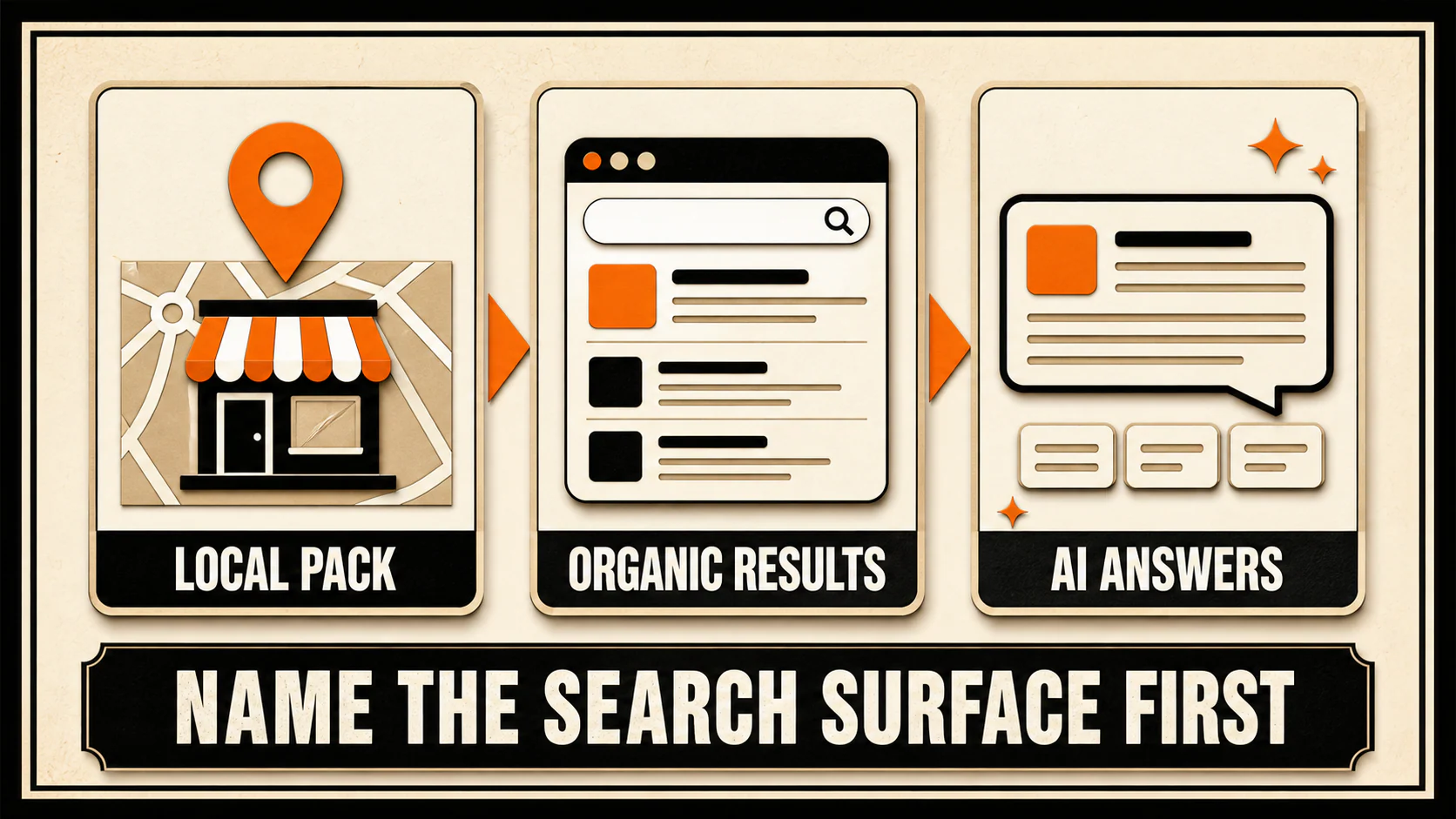
A business might appear on one surface and not another. That is why "we disappeared from AI search" isn't a useful diagnosis until you identify what the searcher actually saw. Was it a map with business profiles, ordinary web results, or a generated answer? For a closer look at that third category, read our AI local SEO explainer.
What Google actually says about local results
Google describes three main factors for local results:
- Relevance is how well a Business Profile matches what someone is searching for. Complete, detailed information helps Google understand a business and connect it with relevant searches.
- Distance is how far the potential result is from the location used in the search. If the searcher doesn't specify a location, Google calculates distance from what it knows about that searcher's location.
- Prominence describes how well known a business is. Google says signals include links from other websites, reviews, and positive ratings.
No published percentages attach to those three factors. Google keeps the exact algorithm details confidential, and the factors can interact. The claim "we fixed five citations, so rankings should rise five spots" is wishful bookkeeping.
Start with accurate, complete profile information because it helps Google understand what the business is and what it offers. Our Google Business Profile optimization guide walks through that maintenance in more detail.
Where AI is genuinely useful in local SEO
AI earns its keep when the task is narrow, the source material is trustworthy, and a person reviews the result. If the output can't be checked against a real record, it isn't ready for public use.
Compare business facts across sources
Give the tool your verified business record, website contact page, current Business Profile details, and a list of important directories. Ask it to flag mismatched names, phone numbers, hours, service areas, and URLs. Then check every flag against the record your team treats as authoritative before editing anything.
The model is finding differences. It isn't deciding which version is true. A useful output is a review queue with each discrepancy tied to its source, not an automatic batch of changes.
Organize real customer questions
Calls, emails, reviews, chat transcripts, and sales conversations often contain the plain-language questions customers ask before buying. AI can group those questions by topic and frequency so you can see where your website or profile leaves people guessing.
Remove private or sensitive information before sharing source material with any tool. Then have someone who understands the business confirm that each proposed answer reflects current operations. The finished list should show which questions deserve an answer and which need more information first.
Draft useful copy
AI can produce starting drafts for service descriptions, FAQs, page outlines, posts, and review replies. Supply the actual facts and set clear limits. A draft about weekend plumbing service should not casually become a promise of 24-hour availability because the model has seen that phrase elsewhere.
Before publishing, compare the draft with the approved facts line by line. Check every service, location, price, credential, time frame, policy, and claim. This is not glamorous work. Neither is explaining to a customer why your website promised a service you don't offer.
Find weak spots in a page or profile
Ask AI to identify duplicated language, missing prerequisites, unexplained jargon, vague calls to action, and claims that need proof. This is closer to a structured second read than an all-knowing audit. A human still decides whether the critique is valid and whether the proposed fix fits the customer.
Turn the response into a short action list. Each item should point to the exact passage, explain the problem, and name the evidence or owner needed to approve a change.
Sort performance data into questions
AI can summarize reporting, identify unusual movements, and suggest questions to investigate. For example: Did calls fall only at one location? Did a tracking number change? Did impressions move while qualified leads stayed flat?
Treat those as questions, not findings. Models are very good at producing a neat explanation for messy data. Neat isn't the same as true. The useful result is a set of checks for a person to run, not a polished story about what "must have" happened.
A safe AI local SEO workflow
Use this five-stage process whenever AI touches public business information:
- Build a verified source of truth for the business name, address, phone, hours, services, service areas, credentials, policies, and current offers.
- Give AI one narrow task and only the verified context it needs.
- Review every factual claim, location detail, recommendation, and link.
- Publish accurate, useful changes on the appropriate profile or webpage.
- Record the change and measure what happened without pretending correlation proves a ranking factor.
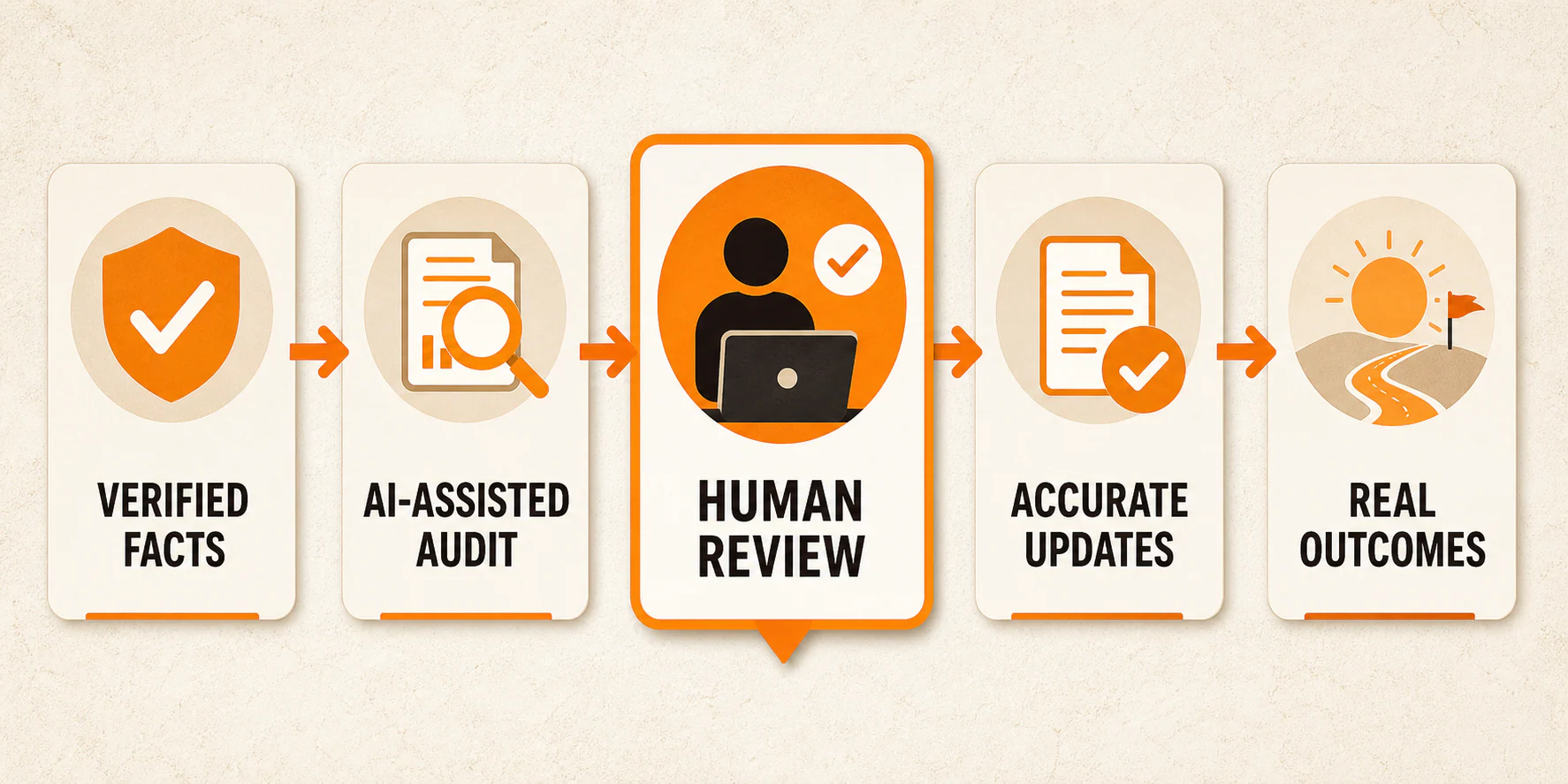
Suppose a roofing company notices repeated questions about emergency tarping in its call notes. AI can group the questions and draft an FAQ. Before that FAQ goes live, a person must confirm whether the service is available, which areas are covered, how pricing can be described, and whether any response-time statement is supportable. The model can arrange the lumber. It shouldn't sign the contract.
The workflow is complete when the published information matches the verified record and the change is logged. A ranking increase is not the completion check because nobody can promise it, and it may not happen.
That verification step is the difference between useful automation and very efficient misinformation.
Use AI to improve business information, not manufacture it
Google says it can compile Business Profile information from several sources, including the business owner, the business's official website, third-party data, user contributions, and Google's own interactions with a place. That makes consistency useful for a simple reason: customers and platforms shouldn't have to choose between conflicting versions of your hours or services.
Maintain accurate information on your site, your Business Profile, and the major profiles customers actually use. Our local citation guide can help you work through consistency issues. Don't turn the process into a formula about how many listings equal authority. Fix the profiles that matter because correct information helps people find, contact, and visit the business.
Never ask AI to invent a location, credential, service, photo, price, policy, offer, or opening hour. Don't create city pages that imply offices you don't have. And don't assume changing a field will improve rankings. Some edits correct customer-facing information without producing a visible ranking change. They're still worth doing.
Reviews need a human voice and a real customer
Google permits businesses to ask customers for genuine reviews. Its review guidance also prohibits offering incentives for people to post, change, or remove reviews. Fake reviews, review gating, and bargains disguised as reputation management are out.
Don't coach customers to insert keywords. Ask for an honest account of their experience and leave the wording to them.
AI can help draft a response, especially when a team is dealing with many locations or a busy week. The final reply should still address what the customer actually said. Remove details the model invented, vary repeated language, and avoid confirming sensitive information. Five replies that all say "We're thrilled you had a wonderful experience" amount to automated hold music.
For a policy-safe system, use our guide to getting online reviews.
What about AI Overviews and AI Mode?
Google's guidance for AI features and websites says there are no additional technical requirements or special optimizations needed to appear in AI Overviews or AI Mode. The familiar basics still apply: Google must be able to crawl and index the page, the content should be useful to people, and any structured data should match the visible content.
Google also says its generative search features use core ranking and quality systems to find relevant web content. Eligibility doesn't guarantee that a page will appear or be cited.
So, no, FAQ schema isn't a reservation slip for an AI citation. Repeating the same answer in six formats doesn't force inclusion either. Make the page accurate, clear, useful, accessible to search engines, and easy for a person to understand. Then monitor whether these features surface it over time without confusing that measurement with Local Pack rankings.
AI local SEO claims worth treating with suspicion
A little skepticism will save you a lot of spreadsheet archaeology. Ask for evidence when someone claims:
- "Clicks and dwell time are confirmed Local Pack ranking factors."
- "Posting every week trains Google's AI to favor your business."
- "Put exact keywords in every review."
- "One perfect citation beats 20 ordinary ones."
- "Schema tells the Local Pack where to rank you."
- "Our model can predict your next ranking with certainty."
- "AI can write 100 location pages and Google will reward the scale."
The right response isn't to replace each claim with an equally confident counter-myth. Ask what Google has documented, what was actually observed, what else changed, and whether the conclusion matches the evidence. Sometimes a tactic is still operationally useful even when the grand ranking story attached to it falls apart.
How to measure AI-assisted local SEO without fooling yourself
Track different outcomes separately:
- Available Business Profile interactions, such as calls, website visits, and direction requests
- Local rankings for defined queries and locations
- Organic impressions and clicks
- Qualified calls and form leads
- Bookings or appointments
- Closed business, where your tracking and sales process can support it
Record the date and substance of each meaningful change. Compare periods that make sense for the business, and note seasonality, promotions, tracking changes, outages, staffing issues, weather, and offline events that could affect results.
If rankings and calls rise after a profile update, you've found a useful clue. You haven't automatically proved that one edited sentence caused both. Keep the change if it helps customers and the broader evidence looks positive, but don't promote a model-generated explanation into a fact.
Also keep visibility and business outcomes separate. A ranking report can improve while qualified leads stay flat. Calls can rise because a promotion ran, not because an FAQ was added. Good reporting keeps those possibilities visible instead of smoothing them into a victory lap.
A practical AI local SEO checklist
- Confirm the business facts.
- Choose one specific task.
- Supply trustworthy source material.
- Ask AI to identify gaps or produce a draft.
- Verify every factual and policy-sensitive detail.
- Publish useful changes, not filler.
- Record what changed and when.
- Measure visibility and leads separately.
- Keep what helps customers, and undo what creates confusion.
If you want this system implemented and monitored without turning your marketing into a full-time prompt experiment, see how YEAH! Local approaches local SEO services.
Frequently asked questions
Does Google use AI to rank local businesses?
Google uses automated ranking systems across Search, but it doesn't publish a separate "AI Local Pack" formula. Its public local guidance says results are mainly based on relevance, distance, and prominence. Avoid claims about specific AI models or behavior signals unless Google documents them for local ranking.
Can AI improve my Google Business Profile ranking?
AI can help you find incomplete information, compare sources, and draft clearer updates. Those improvements may make the profile more accurate and useful. AI use itself isn't a documented ranking factor, and no edit guarantees a ranking increase.
What is the best way to use AI for local SEO?
Start with one bounded task and verified source material. Use AI to compare, organize, or draft. Then have someone familiar with the business check every fact, policy, link, and recommendation before publication.
Can AI write my review responses?
It can draft a starting point. A person should tailor the reply to the real review, remove invented details, protect customer privacy, and make sure the response doesn't sound copied across every customer interaction.
Do I need special SEO for AI Overviews or AI Mode?
Google says no special optimization or additional technical requirement is needed. Core SEO, crawlability, indexability, useful people-first content, and structured data that matches the page still matter. Meeting those basics doesn't guarantee inclusion.
Can AI create location pages for every city I serve?
AI can help draft pages when you have verified, location-specific information that genuinely helps customers. Don't publish mass-produced pages that swap city names, imply fake offices, or describe services and proof you don't have. Scale the workflow only as far as your real information can support it.
Last updated