

Key Takeaway
Learn how AI Overviews differ from Maps, what Google says affects local visibility, and the practical local SEO work worth doing now.
Most advice about "AI local SEO" starts with a basic mistake: it treats three different things as if they were one system.
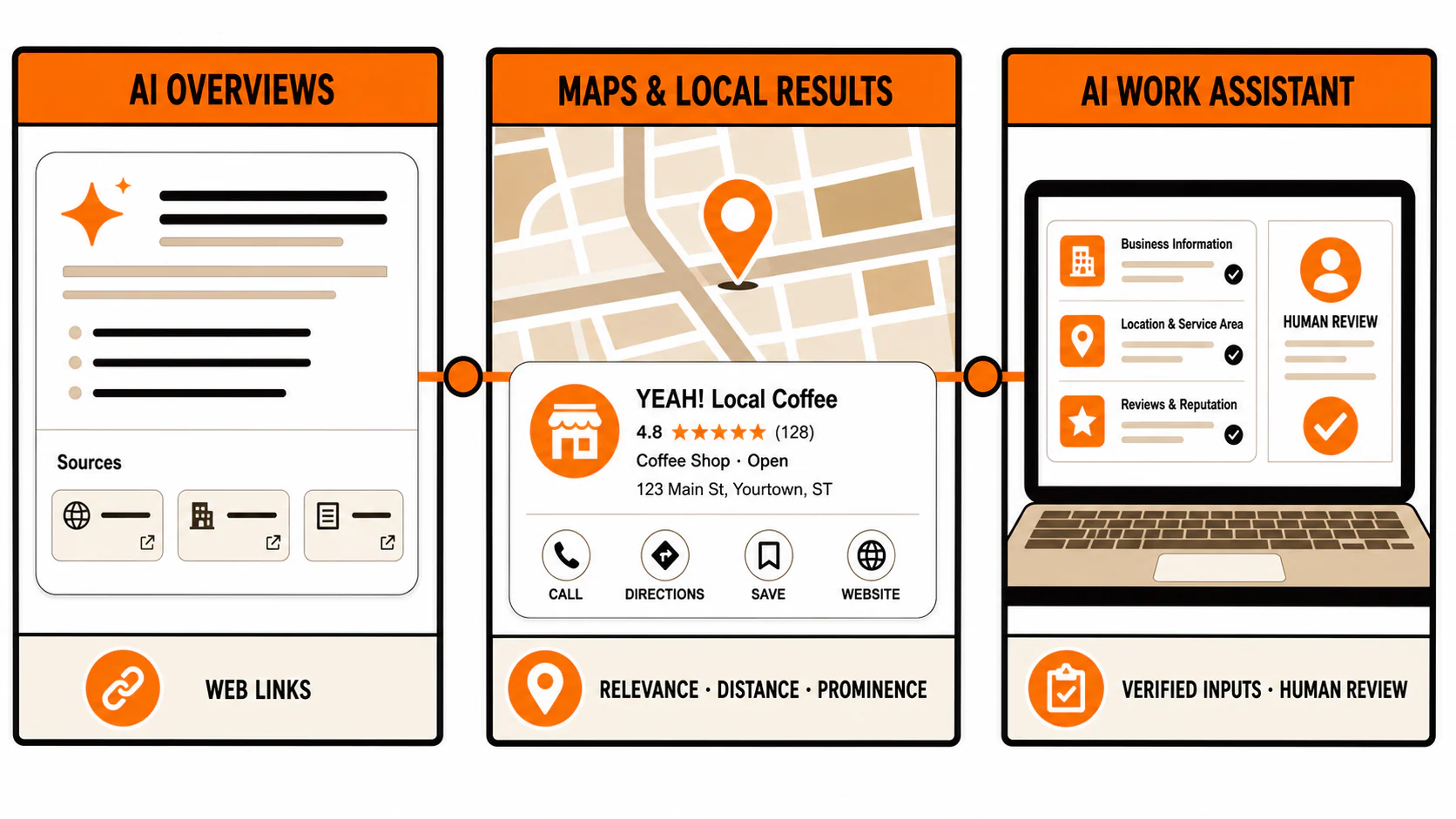
Google's AI Overviews and AI Mode can generate answers with supporting web links. Google Maps and local results show nearby businesses. And marketing teams can use AI tools to help with research and drafting. Those jobs overlap in conversation, but Google does not publish one formula that controls all three.
That distinction changes what you should do next. The practical work is less exotic: keep your business information accurate, publish useful pages that Google can crawl and index, earn legitimate reviews, and measure which surface produced the result. You do not need a new AI schema package or a pile of generic articles.
AI local SEO can mean three different things
The phrase is loose enough to cause trouble. Before you follow any tactic, name the job you are trying to improve.
1. AI Overviews and AI Mode
AI Overviews are generated summaries that can appear in Google Search when Google determines that a generative response adds value. AI Mode is a more conversational search experience. Both can include supporting links to pages on the web.
Google says these features may use a technique called query fan-out, which searches across related subtopics and data sources to assemble a response. The exact answer and links can vary. That is useful context, but it is not a published recipe for getting chosen.
2. Maps and local results
Maps and local results help people find businesses tied to a location or service area. Google documents their main ranking factors as relevance, distance, and prominence. Business Profile information, links, and reviews can matter here.
Those are local-result factors. They should not be quietly relabeled as proof of how Google selects a supporting link for an AI Overview.
3. AI as a marketing assistant
You can also use an AI tool to organize customer questions, outline a service page, or draft a review response. That is an internal workflow, not a Google ranking system.
AI can save time, but it can also produce confident nonsense. Give it verified inputs and require human review. Our guide to using AI in local SEO work covers that operating process in more detail.
What Google actually says about AI Overviews
Google's current guidance for AI features is refreshingly ordinary. The company says its established SEO best practices still apply to AI Overviews and AI Mode. It does not require special optimization, special schema, or a new AI text file.
For a page to be eligible as a supporting link, Google says it must be indexed and eligible to appear with a snippet in Search. That gives local businesses a practical floor:
- Google must be able to crawl the page.
- The page needs useful text that answers the reader's question.
- Internal links should make important pages discoverable.
- Structured data, when used, should match what visitors can see on the page.
- Business Profile and Merchant Center information should stay current where applicable.
Eligibility is not inclusion. Meeting the requirements does not guarantee that Google will crawl, index, serve, or cite a page. Anyone promising guaranteed AI Overview placement is selling certainty Google does not offer.
This also clears up a common schema pitch. Structured data can help Google understand eligible page content and can support specific search features. It is still worth implementing correctly. But there is no separate "AI Overview schema" that unlocks a citation.
AI Overviews are not the Local Pack
A local business may appear prominently in Maps without appearing as a supporting source in a particular AI response. A service page may earn organic visibility while its Business Profile does not appear for a nearby searcher. The reverse can happen too.
That is not a contradiction. The surfaces do different jobs and have different published guidance.
Google's local ranking guidance says local results are mainly based on relevance, distance, and prominence. Google also says complete and accurate Business Profile information makes a business more likely to appear in local search results. More reviews and positive ratings can help local ranking, and useful replies can help a business stand out to customers.
None of that proves that reviews are "AI training data" for an Overview, that Profile posts cause AI citations, or that direction requests feed a published AI selection formula. Those claims go beyond the official evidence available here.
What local businesses should work on now
The sensible work is unglamorous, which is good news. Most of it already belongs in a competent local SEO program.
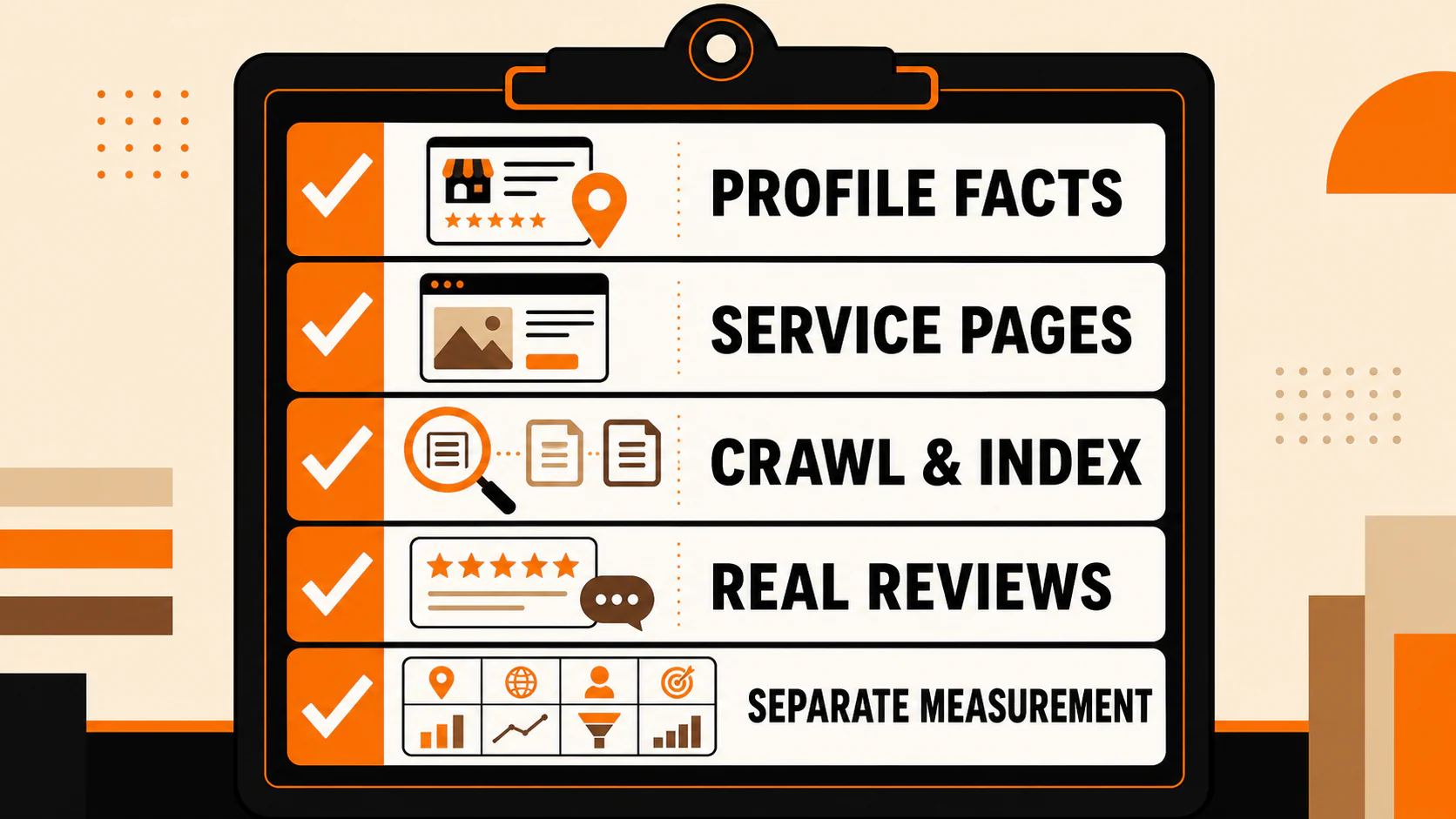
| Check | What it can reasonably improve | What it cannot promise |
|---|---|---|
| Accurate Business Profile facts | Customer accuracy and eligibility for relevant local results | An AI Overview mention |
| Clear, useful service pages | Index eligibility and customer decisions | A guaranteed ranking or citation |
| Crawlable pages and internal links | Discovery and indexing of priority content | Automatic inclusion in AI Mode |
| Authentic reviews and useful replies | Customer confidence and local prominence | Control over a generated answer |
| Separate reporting by surface | Better diagnosis and budget decisions | Proof that one edit caused an outcome |
Verify your Business Profile facts
Check the boring details first: business name, address or service area, phone number, hours, categories, and relevant attributes. If a customer could arrive when you are closed or call the wrong number, that is already a serious problem. You do not need an AI theory to justify fixing it.
Use our Google Business Profile optimization guide for the detailed maintenance work. Treat the Profile as a customer-facing record and a local-search asset, not as a guaranteed input to an AI Overview.
Inspect the pages that should win business
Your priority service pages should explain what you offer, where you offer it, who it is for, and what a customer needs to do next. Important facts should appear in readable page text. Google also recommends crawlable links to help it find other pages on your site.
Do not respond to AI hype by publishing fifty thin posts. Google's people-first content guidance asks whether content provides original information or analysis, covers the topic well, and offers real value. It also warns against using extensive automation mainly to manipulate search rankings.
If your main service pages are vague, another batch of generic articles is usually a distraction. The better move is to fix the pages closest to the sale.
Check crawl and index basics
Confirm that priority pages are accessible to Google, eligible for indexing, and capable of showing a search snippet. Make sure internal links point to them from relevant pages. If you use structured data, validate that it describes visible content accurately.
This is eligibility work. It removes preventable barriers. It does not force Google to include the page in an AI response.
Earn real reviews and write useful replies
Ask real customers for honest feedback without scripting the praise you want them to repeat. Respond in a way that addresses the actual review. Google connects review quantity and positive ratings with local ranking, and says helpful replies can make a business stand out.
Keep that advice in its lane. It supports local visibility and customer trust. The evidence here does not support promising that a particular review phrase will trigger an AI citation.
Measure the surface you are evaluating
Do not roll Maps visibility, organic rankings, AI answers, calls, and sales into one "AI visibility" score. That number may look tidy while hiding what happened.
Google says traffic from AI features is included in Search Console's Web search reporting. It does not provide a local-business selection formula there. Pair page-level Search Console data with analytics, Business Profile performance data, and qualified call or form tracking. Keep leads and business outcomes separate from visibility.
The deeper local SEO maintenance and measurement model explains how to keep those scoreboards from bleeding into each other.
What not to buy
New search features attract old sales tactics with fresher labels. Be skeptical of:
- A special AI schema package that supposedly unlocks AI Overviews.
- Guaranteed citations or a guaranteed place in AI Mode.
- Bulk generic content presented as topical authority.
- Reports that treat a Maps appearance, an organic rank, an AI answer, and a qualified lead as the same result.
- Advice that turns every known local factor into an undocumented AI factor.
If someone sells you special AI markup, ask them to show you the Google requirement. The current documentation does not contain one.
How to measure without fooling yourself
Start with the question you are trying to answer.
If you care about local results, track relevant Maps and Local Pack visibility alongside Business Profile actions. If you care about a service page, inspect indexing, search visibility, visits, and qualified conversions for that page. If you care about AI Overviews or AI Mode, record the query, location, device, date, answer, and cited sources. Then repeat the observation over time instead of treating one screenshot as a trend.
Call recordings and form details can reveal the questions customers ask and whether inquiries are qualified. Use those findings to improve content and evaluate business value. Do not call them Google ranking inputs unless Google documents that connection.
This separation is less exciting than a single dashboard score. It is also far more useful when you need to decide what to fix.
The practical takeaway
AI Overviews have not created a second internet for local businesses. Google's published guidance still centers on accessible pages, understandable information, and content that helps a searcher. Maps and local results still have their own documented local factors. AI tools can still help your team work faster, provided someone checks the output.
Name the surface first. Fix the information that customers and Google can verify. Improve the pages tied to real services. Then measure visibility, qualified inquiries, and business outcomes separately.
That will not guarantee an AI citation. It will give you a cleaner, more defensible local search program, which is the part you can control.
Frequently asked questions
Do I need special schema for Google AI Overviews?
No. Google says there are no additional technical requirements or special schema needed for AI Overviews or AI Mode. Structured data should still follow Google's existing guidance and match the visible page content.
Are AI Overviews replacing Google Maps?
Google documents AI Overviews, AI Mode, and local results as distinct search experiences. A results page may contain more than one type of feature, but the presence of an AI Overview does not erase the separate job of Maps or the Local Pack.
Do keywords still matter for AI local SEO?
The words customers use still help you understand their questions and write useful pages. But there is no supported reason to abandon ordinary search fundamentals for a special list of conversational phrases. Answer what customers actually ask, keep business facts accurate, and avoid forcing awkward variations into the copy.
Do reviews affect AI Overviews?
Google documents reviews as part of local prominence and customer presentation. The evidence used for this article does not establish a direct formula connecting review text or review volume to inclusion in an AI Overview.
Can anyone guarantee my business will appear in an AI answer?
No. Google says eligibility does not guarantee crawling, indexing, serving, or inclusion. Treat any guarantee as a sales claim, not a documented feature of the system.
Last updated