

Key Takeaway
Use these nine customer service examples to train your team, request honest Google feedback without pressure, and respond to reviews professionally.
Good customer service cannot guarantee a five-star rating, and your business should never dictate what a customer writes. What it can do is give customers something specific to describe when they choose to leave feedback: a clear answer, a thoughtful handoff, a solved problem, or a next step that arrived when promised.
For a local business, the practical goal is a repeatable system. Train service behaviors your team can use, invite honest feedback without steering it, and respond professionally to whatever customers choose to say.
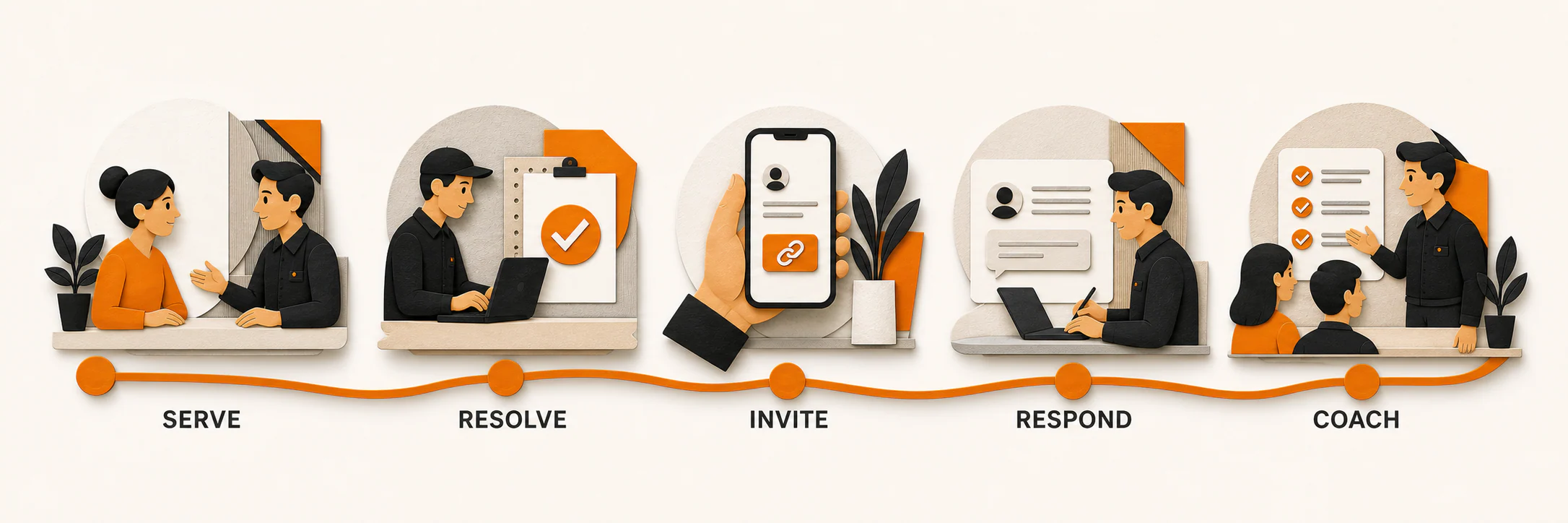
These nine customer service examples turn broad advice like "be helpful" into actions a manager can coach and verify:
- Be humble and never make the customer feel foolish.
- Be helpful before pushing a sale.
- Be friendly and pleasantly personal.
- Know the product, service, and next step.
- Solve the problem, not only the immediate question.
- Refer the customer to a vetted resource when you are not the right fit.
- Respond promptly and set an honest expectation.
- Treat every customer-facing employee as part of customer service.
- Ask for honest feedback without steering the rating or wording.
Before you train any of them, decide who can resolve common problems, when an issue must be escalated, and what an employee may offer without waiting for a manager. Otherwise, even a well-intentioned employee can get stuck behind "that's our policy."
1. Be humble and never make the customer feel foolish
A question that sounds basic to an experienced employee may be completely new to the customer. Answer it without an eye roll, a lecture, or a pile of jargon. If the customer needs more context, explain it in plain language and leave room for a follow-up question.
Illustrative scenario: A homeowner calls an HVAC company because the thermostat is running but the house is not cooling. Instead of saying, "Obviously, the system is frozen," the employee explains the likely issue, offers only the checks the company has approved for customers to perform, and makes clear when the homeowner should stop and schedule service.
Listen for phrases that put the customer on the defensive, such as "as I already explained" or "you should know." A more useful response is: "Here's what that means in this situation."
The interaction is complete when the customer can explain what happens next without having to decode the employee's terminology.
2. Be helpful before pushing a sale
Customer service breaks down when every question becomes a sales pitch. First, understand what the person is trying to accomplish. Then explain the options, limits, likely next step, and any information they should gather before deciding.
Illustrative scenario: A homeowner asks a landscaper for a quote on a full patio replacement. During the conversation, the landscaper learns that the existing base may be reusable. Rather than forcing the larger project, the landscaper explains both approaches and what an on-site inspection would need to confirm.
That honesty does not guarantee the prospect will return. It does give the person a useful answer and a fair basis for choosing.
When coaching this behavior, review whether the employee asked enough questions to understand the need before making a recommendation. The recommendation should fit what the customer said rather than what the business wants to sell. Even if no sale happens that day, the customer should leave with a clear option, tradeoff, or next step.
3. Be friendly and pleasantly personal
Friendly service is not forced small talk. It means paying attention and using relevant details without crossing into someone's private life. A returning customer may appreciate being greeted by name or having a service preference remembered. A first-time customer may simply need a warm welcome and a calm explanation of what happens next.
Illustrative scenario: A returning dental patient has previously asked the office to explain each step before treatment. At the next visit, the front-desk employee confirms the expected wait, and the clinical team honors that request without making the patient repeat it.
Personalize only with information the customer volunteered or that is legitimately part of the service record. Avoid assumptions, overly familiar comments, or questions unrelated to the service.
The check is simple: the interaction should feel attentive without asking the customer to disclose more than the service requires.
4. Know the product, service, and next step
Customers do not expect every employee to know everything. They do expect an accurate answer or a clear handoff to someone who has one. Guessing is worse than saying, "I need to confirm that before I answer."
Illustrative scenario: A potential legal client calls with a deadline-sensitive question. The intake coordinator does not offer legal advice or pretend to know the outcome. They explain the firm's intake process, collect only the permitted information, and give an honest time window for the attorney's response.
Build a short knowledge base for frequent questions. Include approved answers, scope limits, escalation contacts, and realistic response times. Update it when the same uncertainty appears more than once.
A customer should receive either an accurate answer or a named next step with an owner and a time expectation. "Someone will get back to you" is not enough.
5. Solve the problem, not only the immediate question
The first question is not always the whole problem. A thoughtful employee checks what the customer is trying to accomplish, fixes what can be fixed, and looks for the cause that might send the customer back into the same frustrating loop.
Illustrative scenario: A customer reports that an invoice has the wrong service address. The employee corrects the invoice, checks the account profile that generated it, and confirms that the next invoice will use the updated address. Fixing only the PDF would leave the underlying error in place.
Policies still matter. Give employees defined room to resolve common mistakes, and create a fast escalation path for exceptions instead of making them improvise.
After resolving a request, ask: "What caused this, and could the same cause create another problem?" The job is complete when the immediate issue is closed, the underlying record or process is corrected when possible, and any remaining responsibility has a clear owner.
6. Refer the customer to a vetted resource when you are not the right fit
Sometimes the most useful answer is, "We are not the right company for this." A dependable referral can save the customer another round of searching. A careless referral can create a second bad experience.
Illustrative scenario: A roofing contractor receives a request for a small chimney repair outside its service scope. Instead of ending the call, the employee offers contact information for a masonry company whose service area and specialty the business has checked recently. The employee also makes clear that the two companies are separate.
Maintain a short referral list with each provider's specialty, service area, contact information, and last verification date. Do not promise another company's availability, pricing, or results.
Teach employees to explain the fit: "They handle this type of repair in your area." Avoid vague endorsements such as "They're the best." The customer should understand why the referral may fit and that they still need to evaluate the provider independently.
7. Respond promptly and set an honest expectation
A prompt response does not always mean an immediate solution. It means acknowledging the customer, explaining what will happen next, and keeping the promised update time.
Illustrative scenario: A customer emails a complicated billing question after business hours. The automated confirmation states the actual support hours. The next morning, an employee acknowledges the issue, names the records they need to check, and commits to an update by 2 p.m. If the review takes longer, the employee contacts the customer before 2 p.m. with a revised expectation.
Measure whether the team keeps its promised update times, not just how quickly it sends a first reply. A fast "we received your message" followed by silence is not a resolved service experience.
The customer should know who owns the issue, when the next update will arrive, and how to reach the business if the situation becomes urgent.
8. Treat every customer-facing employee as part of customer service
The customer experiences one business, not an org chart. A helpful service representative cannot fully repair an experience if the receptionist is dismissive, the technician leaves no explanation, or the billing team sends the customer in circles.
Illustrative scenario: A patient visits a clinic and interacts with the parking attendant, front desk, clinical team, and checkout staff. Each person gives consistent directions and handles their part of the handoff. The patient does not have to repeat the same request at every stop.
Map the common customer journey and identify each handoff. Train those roles on the same tone, basic service standards, and escalation route, even if "customer service" is not in their job title.
To check the process, follow a typical request across departments. Look for ownerless gaps, conflicting instructions, and places where the customer has to start over.
9. Ask for honest feedback without steering the rating or wording
Once the service is complete, you may make it easy for a customer to share a genuine experience. The request should be neutral. Do not ask for five stars, suggest what to write, offer an incentive, or send the request only to customers you expect will be positive.
Google review request rules
Google's official guidance for requesting reviews allows businesses to share a review link or QR code, but it does not allow incentives. Google's prohibited-content policy also prohibits rating manipulation, including selectively soliciting positive reviews, pressuring people to review, setting staff review quotas, or requesting specific content such as an employee's name.
Use these guardrails:
- Invite feedback about a genuine customer experience.
- Base eligibility on a neutral event, such as a completed appointment or closed job, not on whether the customer said they were happy.
- Do not offer discounts, gifts, contest entries, or other incentives for a review.
- Do not ask for a five-star rating or tell the customer what to mention.
- Do not pressure someone to post while they are still on the premises.
- Do not set employee quotas for Google reviews or reward requested wording.
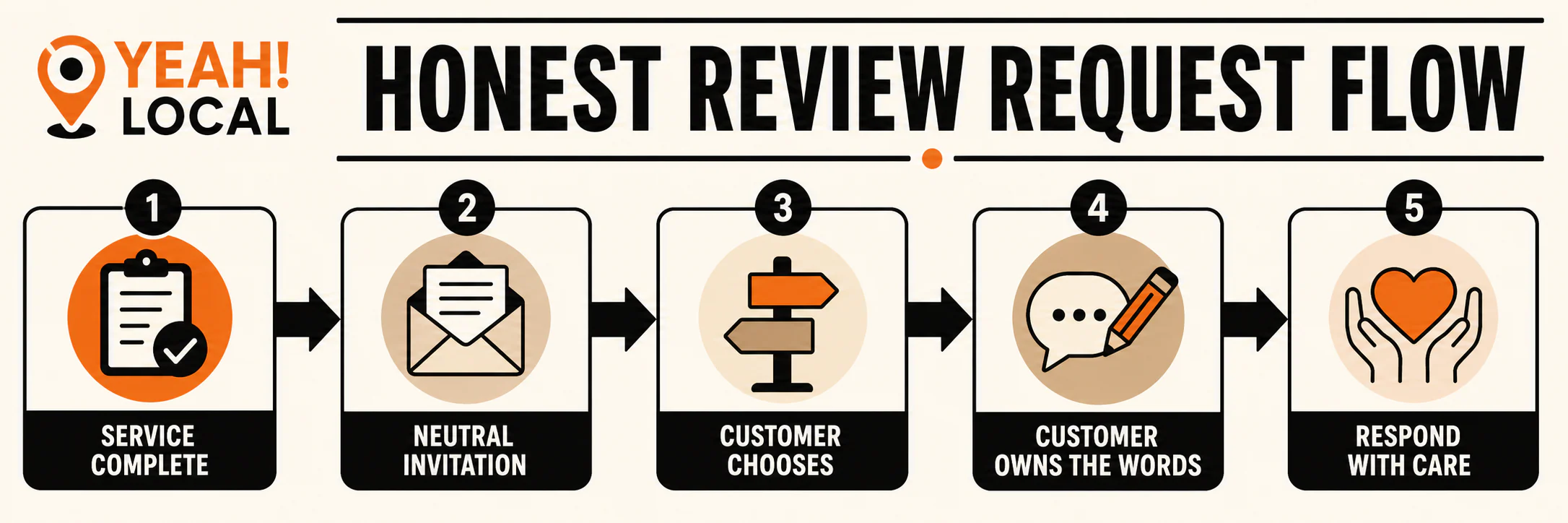
Neutral request example:
Thank you for choosing us. If you would like to share your experience, you can leave an honest Google review here: [review link]. Your feedback helps us understand what we are doing well and where we can improve.
An employee may share the link, but the rating and wording belong entirely to the customer.
Audit the actual email, text, card, QR-code sign, and spoken request, not just the approved script. Remove any "happy customers only" branch or language that nudges the rating. The process passes when the request welcomes honest feedback, offers no benefit for posting, and leaves the content to the customer.
How to respond to the review you receive
A neutral request can lead to positive, mixed, or negative feedback. Your reply should show that someone read the review without exposing personal or account-specific information.
Positive review
Thank the reviewer and refer briefly to the part of the experience they mentioned. Keep the reply conversational instead of turning it into an advertisement.
Example: "Thank you for taking the time to share this. We're glad the scheduling process was clear and the team kept you updated."
Neutral review
Acknowledge both the part that worked and the part that did not. If the review points to an operational issue, explain the next step only if you can actually take it.
Example: "Thank you for the thoughtful feedback. We're glad the repair went well, and we're reviewing the delay you experienced at check-in."
Negative review
Stay calm. Acknowledge the concern, avoid arguing about details in public, and invite the reviewer to continue the conversation through a private channel. Do not confirm that the person is a customer or reveal health, financial, account, or service details in the reply.
Example: "We're sorry to hear about your experience. We would like to understand what happened and review it with the right team. Please contact us at [business contact method] so we can discuss the details privately."
Keep every reply brief, professional, specific, and timely. If a complaint raises a safety, legal, or privacy issue, route it to the appropriate manager before posting.
A manager checklist for consistent customer service
Do not try to train all nine behaviors in one meeting and call the job done. Build them into daily operations:
- Choose one behavior to coach at a time.
- Define what it sounds or looks like during a real interaction.
- Review observed calls, messages, handoffs, or service records for that behavior.
- Give employees clear authority and escalation routes for common problems.
- Make the neutral Google review link or QR code easy to access.
- Define who receives the request by a neutral service event, not by expressed satisfaction.
- Do not tie compensation, quotas, or recognition to rating, review volume, or requested wording.
- Review public replies for tone, accuracy, and privacy.
- Recheck referral lists, scripts, and knowledge-base answers on a regular schedule.
Verify the service and feedback process
The process is in place when your team has a documented service standard, employees know what they can resolve, customers receive clear next steps, the review request stays neutral, and public replies follow one privacy-safe process.
That is the completion check. A target number of reviews or a promised star rating is not.
When the service foundation is in place, use our guide to getting online reviews for your business to improve the rest of the request process without making customers jump through unnecessary steps.
Last updated