

Key Takeaway
Turn competitors’ one-star reviews into a useful marketing brief. Check your own service, prove your promise, and test it with a free research worksheet.
Open a few local service websites and you can find the same promises: quality work, great service, a team that cares. Fine. What does any of that tell a customer worried about an unexpected bill?
A dissatisfied reviewer's account can be more specific. It may describe a price that changed, an arrival window that passed without an update, or a consultation that left the customer unclear about what came next. Those are clues about expectations your marketing could address—if your business can actually meet them.
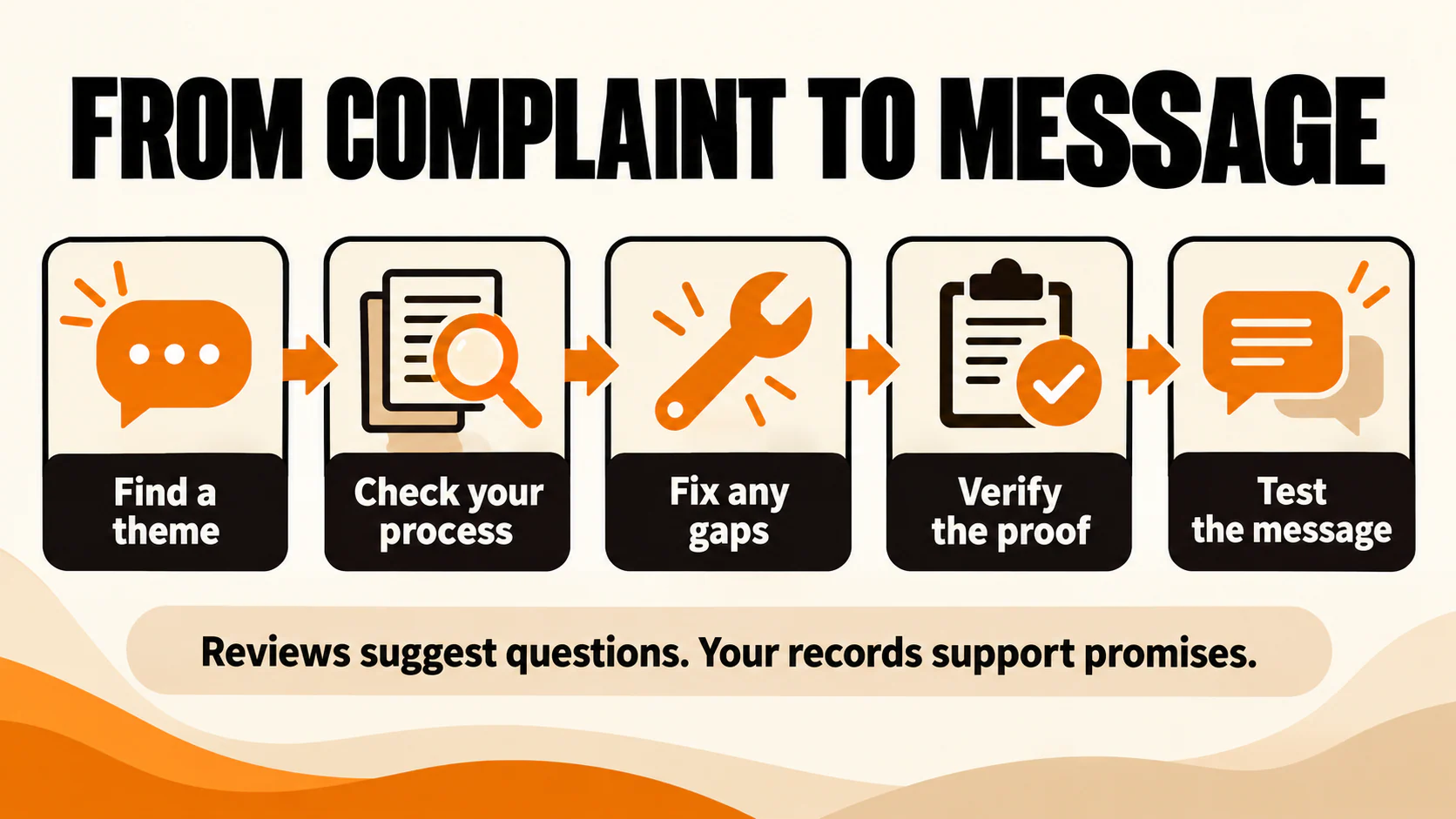
Turn a complaint into a question about your own service, check the answer, fix a weak process, and then write a promise you can prove. This guide takes you through that process with a blank worksheet and a hypothetical pricing example.
You need access to public reviews, a spreadsheet, and someone who understands how your business handles estimates, appointments, and customer inquiries. No paid review-analysis tool required. “Free” still involves staff time. The spreadsheet will not read itself, despite its impressive number of columns.
Read the complaint as a clue, not a verdict
One-star reviews tell you what some dissatisfied reviewers chose to report. They do not tell you how frequently the problem happens, what every customer values, or whether an allegation is accurate.
That distinction is selection bias: the people whose opinions you see are a selected group, rather than a representative cross-section of customers. An original study of online product reviews by Nan Hu, Paul Pavlou, and Jie Zhang examines biases in who purchases and who posts, including disproportionate representation of extreme opinions. It is product-review research, not a measure of complaints in your local service market. Filtering for one star narrows your view further.
Use a complaint to ask, “Could a customer have this concern when buying from us?” You can investigate that without deciding who was right in someone else's dispute.
Keep the research private. Paraphrase the service issue, leave out reviewer names and sensitive details, and do not republish allegations about named rivals or contact their reviewers. Google's contribution policy requires genuine experiences and prohibits posting on a competitor's place to undermine its reputation. Reading reviews for ideas is not an invitation to join the argument.
Choose businesses and a window you can compare
Pick competitors that serve the same customer, service, and area you want to reach. A plumbing repair business should not build its emergency-service message from complaints about a contractor's six-month remodeling project.
For a manageable pilot, you could choose three comparable businesses, one review platform, and the previous six months. That is a starting exercise, not a scientifically valid minimum. Write down your scope before reading so you do not keep changing it until you find the complaint you wanted.
Check the exact location and whether the reviewed service matches yours. Assign each business a private code—A, B, C—and use those codes in your working notes.
Read relevant one-star reviews, but also examine other ratings and business replies within the same window. Positive feedback about clear estimates is useful context for a complaint about an unclear bill. A reply may explain a disputed detail or describe a changed process; it is context, not independent verification.
If the window contains too little relevant material, broaden the dates consistently and record that change. Keep older observations separate from recent ones. If you still cannot identify a specific concern, stop with “insufficient evidence.” Do not promote an unrelated grievance just to finish the exercise.
Collect enough detail to check your thinking
Download the competitor review research worksheet and open it in your spreadsheet app. It is an original blank CSV with column headers, not a prefilled dataset or a validated scoring system.
Fill the collection fields first. Save the competitor code, service and area, platform, review URL, review date, star rating, and collection date. Then add a short complaint paraphrase, a theme, and any duplicate or context concern. Keep source links in your private worksheet so you can return to the original.
A theme is a shared issue you can investigate, such as “approval before extra work” or “updates when running late.” “Bad service” is too broad to tell anyone what to fix.
Separate the observation from what you think it means. In a hypothetical entry:
| Field | What you would record |
|---|---|
| Complaint paraphrase | Reviewer reports that the final repair bill included work they did not expect. |
| Theme | Approval before extra work. |
| Duplicate or context concern | Business reply disputes whether approval was given; account cannot be verified from the review. |
| Our own process check | Can we trace a changed scope from customer approval to the final invoice? |
The first line reports the complaint. The last line turns it into a question about your business. Neither establishes that the competitor acted improperly.
Leave the fix, owner, proof, message, and test fields blank until you have done the corresponding work. Otherwise, you are writing the answer before asking the question.
Find a theme that deserves action
Group related complaints, then clean up the groups before counting them.
If the same incident appears on two platforms, count it once. Similar dates, service details, and wording can flag a possible duplicate; when you cannot tell, mark it uncertain. Also flag vague complaints, old experiences, the wrong location or service, and suspicious-looking entries. Suspicion does not establish a fake review.
Look at where the observations come from. Several distinct complaints across comparable businesses deserve a different investigation from several posts about one incident at one business. Record the observed count in your collected set and which other competitor codes share the theme. Those counts describe your notes, not the market's complaint rate.
Before choosing a theme, ask:
- Would this concern affect a customer's decision about the service we sell?
- Can we control the part of the experience being discussed?
- Does it recur in distinct, relevant observations, or have we found one unresolved story?
- Can we check our process and produce evidence for a useful promise?
Read counterexamples deliberately. If other reviews praise a competitor's explanation of costs, preserve that information. If your own recent feedback contradicts your preferred theory, investigate it too. A spreadsheet full of evidence that you are wonderful is a morale exercise.
There is no universal number of complaints that makes a theme valid. Recurrence is a reason to investigate; your own process check determines what you can act on. A single specific complaint can prompt a worthwhile audit, but it cannot support a claim that a problem is widespread.
Work the pricing concern through your own business
Here is a hypothetical example from start to finish. The plumbing business, complaint, process gap, and proposed changes below are fictional. They demonstrate the method, not a result from client work.
Suppose your selected theme is unexpected charges after a repair begins. The buying concern is not necessarily “I need the cheapest plumber.” It may be “I need to know what I am agreeing to.” Lowering your price would not resolve that uncertainty.
Check what happens when the scope changes
Pull recent records for your own jobs that needed additional work. Trace the original estimate, the changed scope, customer approval, and final invoice. Include exceptions, such as an approval given over the phone, rather than inspecting only the cleanest file.
Ask the person handling estimates and the person doing the work to walk through the same case. Can both point to what the customer approved, when they approved it, and where that record lives? Does the invoice match?
In this fictional business, approvals happen verbally but are not consistently saved with the job. That is the gap to fix. The competitor's review did not prove it; checking the business's own records did.
What if your records show that you already handle the concern well? Keep the evidence and describe the process you actually follow. You do not need to invent a service gap to justify a clearer message.
Give the change an owner and an exception path
The proposed fix is to document the revised scope and price and obtain approval before proceeding with additional work. Assign the service manager to implement it, make sure technicians can use it, and decide what happens when a customer cannot be reached: pause the additional work and explain the next step.
Handle diagnostic fees and exclusions separately. A promise about approving extra work does not explain whether there is a charge to identify the problem. Put those terms where the customer books and in the estimate.
Require proof before writing the headline
A blank approval form shows that a form exists. It does not show that your team uses it.
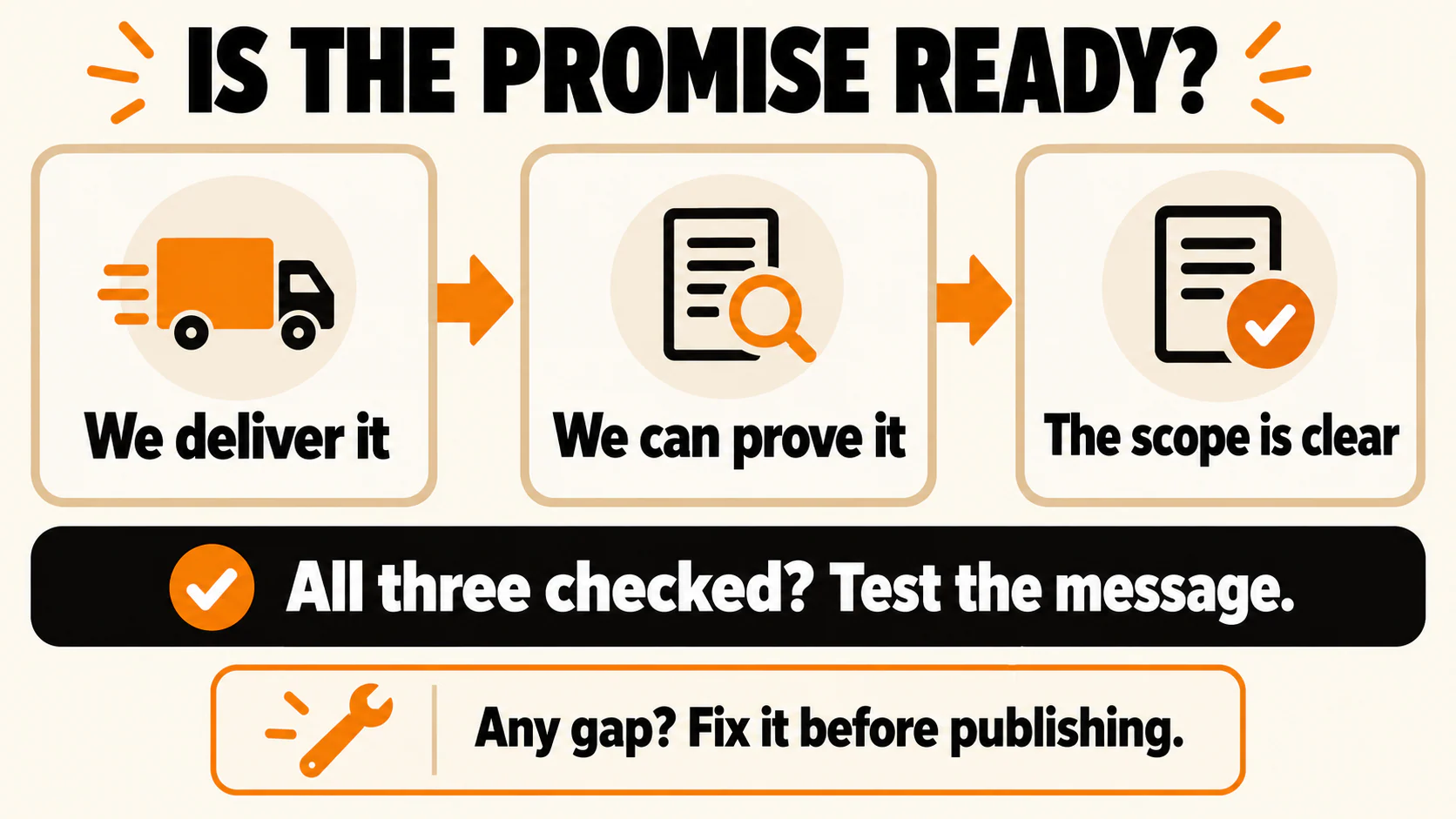
Check completed jobs after the change. Look for the estimate, approval record, timestamps showing approval before additional work, and a matching invoice. Test the exception path with the team as well. If records are missing or the process depends on one person remembering, keep fixing it before advertising it.
The FTC's advertising guidance for small businesses says claims must be truthful and backed by evidence. A rival's complaint cannot substantiate your promise.
Once the process is implemented and checked, the fictional business could test:
You approve the written scope and price before repair work begins. If additional work is needed, we document the change and get your approval before proceeding. Diagnostic fees and exclusions are explained when you book.
Use that wording only if each part matches your actual service. It does not promise a fixed total before diagnosis, the lowest price, or a bill that can never change.
The same approach applies to other concerns. Every row below is hypothetical, and every message depends on implementing and verifying the stated process.
| Complaint theme | Check your process | Improvement to verify | Message you could support |
|---|---|---|---|
| Unexpected extra work | Trace scope, approval, and invoice. | Save approval before additional work. | “We document changes and get your approval before proceeding.” |
| No update after an arrival window passes | Check who notices delays and contacts customers. | Assign delay updates and verify they are sent. | “If we expect to miss your arrival window, we contact you with an update.” |
| Unclear consultation expectations | Compare booking information with the consultation. | Explain the purpose, fee, and next steps before booking. | “Before you book, we explain what the consultation covers, its fee, and what happens next.” |
Notice what the messages leave out: a verdict on a competitor, a promise of perfect punctuality, and a guaranteed treatment or repair outcome. Specific process language gives you something you can check.
Put the promise where the customer needs it
For the hypothetical pricing concern, place the full explanation beside the estimate or booking step on the service page. If you use a shorter version in an ad, the landing page should explain the same promise and its conditions. Make sure the person answering the phone can describe it accurately.
A page that promises approval before extra work and an intake script that says “we'll figure out the bill later” are not ready for a message test. Check the ad, page, estimate, and intake together. This guide to clarifying your offer to attract more qualified leads goes deeper into keeping those expectations aligned.
Turn your chosen theme into a short marketing brief:
- Concern and scope: What expectation appeared, on which platform, across which services, locations, dates, and distinct observations? What remains uncertain?
- Own check: What records or steps did you inspect, and what did they establish?
- Fix and proof: What changed, who owns it, and what evidence shows it works in your process?
- Message and placement: What can you truthfully promise, with which conditions, and where will it appear?
- Measure and review: How will you identify qualified inquiries and bookings, and when will you assess the test?
You are ready to test when someone else on the team can read the brief, find the proof, and explain the promise without adding a guarantee.
Judge the message by fit and bookings
Define the measurement before changing the copy. A qualified inquiry is a genuine request from someone seeking a service you provide, in an area you serve, under conditions you can meet. Decide how your business handles timing, availability, and other fit requirements, then apply that definition consistently.
Keep raw inquiries, qualified inquiries, and bookings separate. More calls can include more wrong-service calls. A qualified inquiry can still fail to book because your next available appointment is too far away.
For a practical test, change one message in one placement where you can, record the previous wording, and choose a review date that fits your inquiry flow. There is no universal test duration. If you compare a period before the change with a period after it, use comparable records and keep the qualification rules the same.
Record:
- The message, placement, start date, and review date.
- Raw inquiries, qualified inquiries, and bookings, with the periods each count covers.
- Customer questions about the promise and any mismatch between it and the delivered service.
- Changes in spend, traffic source, season, staffing, appointment availability, or tracking that could affect the comparison.
You can do this with a simple inquiry log. For a deeper setup, the call-recording and analytics feedback guide explains how to connect inquiry quality with booking outcomes. Use records and tools appropriate to your business and privacy requirements.
At the review date, make one of three decisions:
| Decision | What supports it | Next action |
|---|---|---|
| Keep | The promise is delivered, customers understand it, and the qualified-inquiry and booking records support continuing. | Keep the wording and continue checking delivery. Do not claim the message alone caused an improvement. |
| Revise | Customers misread the scope, poor-fit inquiries increase, or delivery falls short. | Repair the wording or service process before testing again. |
| Inconclusive | Too few relevant inquiries, missing records, or substantial changes make the comparison unclear. | Record the uncertainty. Continue collection or run a cleaner comparison without declaring a winner. |
A failure to deliver the promise needs action even if the numbers look encouraging. And an inconclusive test is a usable decision. It tells you the evidence has not earned a bigger claim.
Start with one service, a defined review window, and one concern worth checking. Complete one worksheet entry through your own process audit before touching a headline. Repeat the check when the service process changes or new feedback challenges the promise.
If you want help connecting that work to your service pages, ads, and lead follow-up, explore YEAH! Local's Local Growth Engine. The next conversation can start with a concrete question: does the message match what your team delivers, and can you tell which inquiries become bookings?