

Key Takeaway
Use these 15 questions to compare SEO agencies, verify their plan and proof, protect account ownership, and spot answers that need a follow-up.
An SEO proposal can sound perfectly sensible when the seller controls the vocabulary. The audit is "comprehensive." The strategy is "custom." The reporting is "transparent." Then the contract arrives, and those reassuring words still do not tell you what will be done, who will do it, or what you will own.
You do not need a crash course in algorithms to hire an SEO agency. You need questions that make hand-waving difficult.
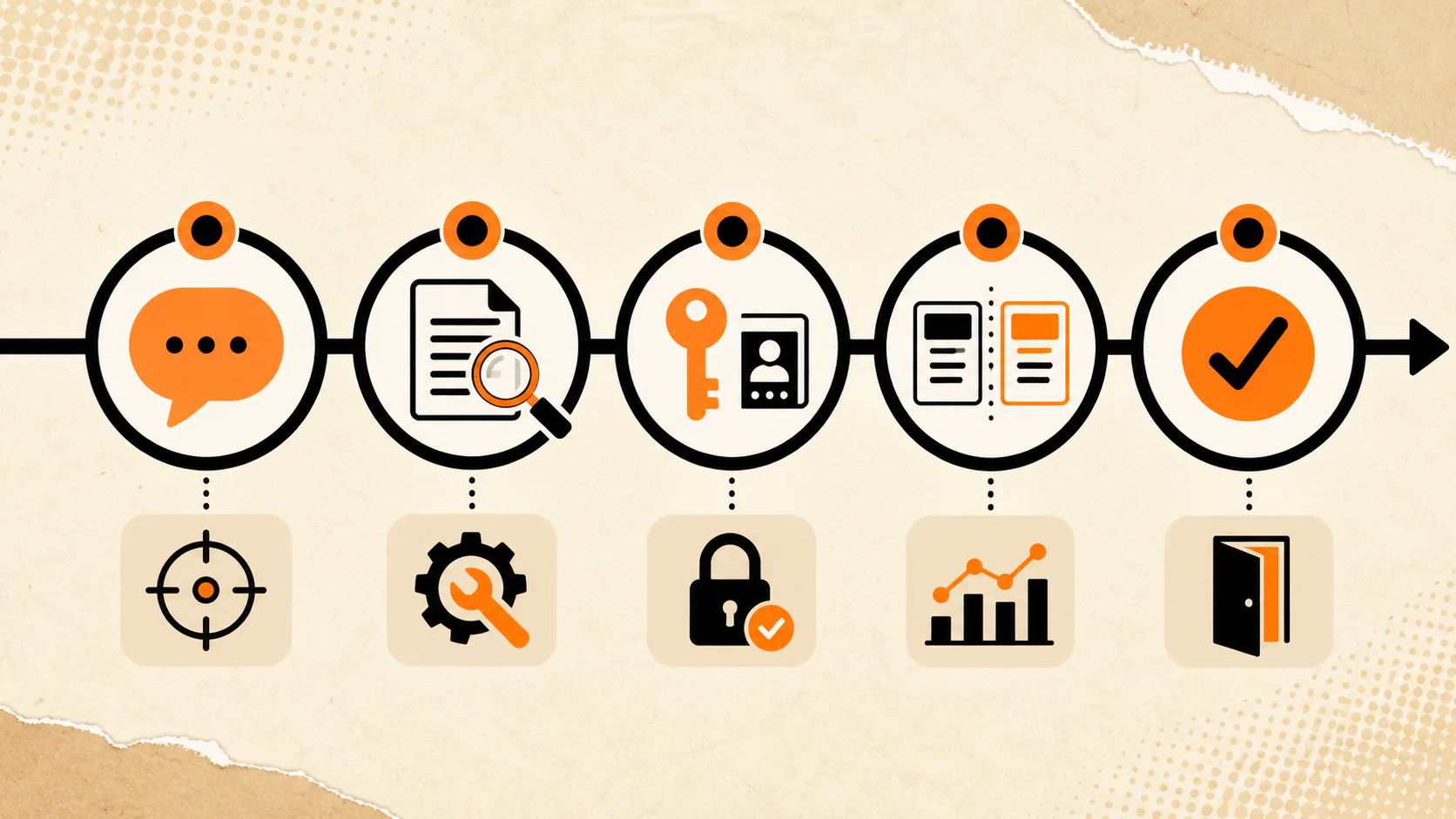
A useful agency interview covers five things before you sign: your business goals, the actual plan, the people doing the work, account ownership and exit terms, and proof tied to reporting. No single answer certifies an agency. Look for a pattern of specific answers, relevant evidence, clear limits, and a willingness to put commitments in writing.
Prepare your side of the conversation first
Start with a little self-assessment. An agency cannot build a sensible proposal around "we want more traffic." Before taking calls, write a one-page brief that includes:
- the business outcome SEO should support;
- your highest-value services and markets;
- what counts as a qualified inquiry;
- the current state of your website, Google Business Profile, analytics, and sales process;
- your budget boundaries; and
- who can approve content, website changes, and technical work.
That one-page brief gives every agency the same problem to solve. You can compare their thinking instead of comparing two completely different sales pitches. It also reveals whether an agency asks about your business before prescribing a package.
Use the same 15 questions with each agency. Take notes and request examples. If an answer sounds polished but leaves you unable to describe the next step, it is not complete yet.
Goals, scope, and the first plan
1. What business outcome are you trying to improve, and how will SEO contribute to it?
This moves the conversation away from rankings for their own sake. A useful answer connects SEO to the result you named, such as qualified calls, booked consultations, store visits, purchases, or another defined action. It should also explain where organic search fits in that path.
Ask to see: the proposed primary outcome, supporting indicators, and how each will be measured.
Follow up if: the answer stops at "more traffic," "more keywords," or "better visibility" without explaining what those changes should help the business accomplish.
2. What would you inspect before recommending a strategy?
An agency should be able to explain what it needs to learn before deciding what to do. That may include the site's technical condition, current search visibility, content, competitors, conversion paths, local presence, analytics setup, and internal constraints. The exact list should fit your business; a giant checklist is not automatically a better diagnosis.
Ask to see: a sample audit or discovery output that explains cause, consequence, and priority, not just a spreadsheet of warnings.
Follow up if: the "strategy" was settled before the agency had meaningful access to your site, data, goals, or team.
3. What would the first 90 days produce?
This is a question about outputs and decisions, not a demand for rankings by day 90. Ask what will be audited, fixed, created, measured, or approved, and which dependencies could change that sequence.
A strong answer separates work the agency controls from outcomes it does not. Google itself says following Search Essentials does not guarantee crawling, indexing, or serving. If you want more context before the interview, read our guide to how long SEO takes and what progress can look like.
Ask to see: a milestone plan with deliverables, owners, client dependencies, and review points.
Follow up if: the agency offers a confident ranking date but cannot show what it will actually produce along the way.
4. What is included, excluded, and dependent on us?
"SEO" can mean research, technical recommendations, implementation, content, local work, digital PR, reporting, or some combination. Never assume the proposal includes an activity because it appeared in the pitch deck.
Ask to see: a written scope with quantities or boundaries where they matter, plus a list of client responsibilities and out-of-scope work. Compare that scope, not a headline fee, when you evaluate SEO pricing and budget tradeoffs.
Follow up if: content approvals, developer work, website updates, tracking setup, or extra fees are left vague.
People and the working process
5. Who will do the day-to-day work, and who makes strategy decisions?
The person who sells the engagement may not deliver it, and that is normal. Opacity is the problem.
Ask to see: named roles, who owns strategy, who performs each major deliverable, and who is accountable when work stalls. If contractors or outside specialists are involved, ask how their work is reviewed.
Follow up if: you can meet the sales team but cannot learn who will manage or execute the account. Job title, seniority, employer location, or agency size alone does not decide quality; clear ownership and oversight matter more.
6. How do you choose priorities when everything cannot be fixed at once?
When a site has more possible work than available time and budget, the agency's prioritization method tells you more than a long list of recommendations.
Ask to see: how the team weighs likely business impact, effort, risk, dependencies, and confidence. Ask for one hypothetical example using your site: what would come first, what would wait, and why?
Follow up if: every issue is labeled urgent, or the agency cannot explain what it would intentionally leave alone.
7. How will SEO work with our website, paid media, content, and sales process?
SEO does not operate in a sealed room. A page change may require a developer. Search-query data may inform paid campaigns. Content needs subject knowledge and approvals. Leads still need to reach the right person and be handled properly.
For a service-area business, ask how the proposal distinguishes general organic work from local SEO involving location relevance, local trust, and the Google Business Profile.
Ask to see: handoffs, meeting points, and shared decisions across the teams or vendors already involved.
Follow up if: the agency cannot explain what it needs from the website, content, paid media, or sales owners.
8. How do communication, approvals, and reporting work?
"We send a monthly report" is not a communication plan. You need to know who talks to whom, how quickly questions are handled, which changes require approval, and what happens when the data is disappointing.
Ask to see: the meeting cadence, expected response times, approval workflow, escalation path, and a real sample report with confidential details removed.
Follow up if: reports show charts without definitions, source data, decisions, or next actions. A weak month is manageable. A report that cannot explain how the plan will respond is not.
Proof, methods, and responsible expectations
9. Can you show relevant work and explain what you actually contributed?
Client logos are not evidence of the work behind them. Ask for an example close enough to your business model or challenge to be useful, then ask what the agency actually did.
Ask to see: the starting problem, scope, agency contribution, measurement period, limitations, and outcome. A reference who can discuss the working relationship may be more revealing than a polished case-study headline.
Follow up if: the agency claims an entire result without separating its work from website changes, paid campaigns, brand demand, seasonality, or the client's own team.
10. How do you earn or acquire links, and what practices will you not use?
Do not ask only how many backlinks are included. Volume without method tells you almost nothing about relevance, editorial value, or risk.
Ask to see: the link-earning or acquisition process, example target types, quality criteria, approval rules, and reporting. Ask directly whether payment, owned sites, automated outreach, or other intermediaries are involved.
Google's spam policies describe manipulative practices and explain that violations can lead to lower rankings or pages being omitted from results. That does not prove a particular agency is using spam. It does make "our method is proprietary" a poor substitute for an understandable answer.
Follow up if: the agency sells a large link count but will not explain sources, standards, or practices it refuses to use.
11. What can you responsibly promise, and what is outside your control?
An agency can promise work: research, recommendations, content, implementation, communication, and reporting. It can set targets and explain assumptions. It cannot control Google's final ranking decisions or guarantee a specific position simply by following published guidance.
Ask to see: the commitments that will appear in the contract, the assumptions behind any forecast, and the risks that could change the plan.
Follow up if: the pitch depends on a guaranteed number-one ranking, guaranteed traffic, or certainty without conditions. One ambitious projection is not automatic proof of wrongdoing, but an agency should be able to defend the method and acknowledge what it cannot control.
12. How will you measure progress before revenue changes are visible?
Revenue matters, but early work may need earlier indicators. The right indicators depend on the plan: completed technical fixes, improved tracking, pages published, qualified visibility, relevant organic inquiries, conversion-path changes, or other agreed milestones.
Ask to see: which measures are leading indicators, which are business outcomes, where the data comes from, and how the agency will decide whether to continue, adjust, or stop an initiative.
Follow up if: success changes whenever the report looks weak, or the agency treats every upward number as proof that its work caused the increase.
Ownership, access, and a clean exit
13. Which accounts and assets will we own or control?
This question belongs in the interview, not in the unpleasant conversation after a contract ends. Make a checklist covering your domain and DNS, website and CMS, Google Search Console, analytics, Google Business Profile, call tracking, reporting dashboards, content, and creative files.
Permissions are platform-specific. In Search Console, Google distinguishes owners, full users, and restricted users; its Search Console permission guidance explains what those roles can do. For Business Profiles, Google provides a separate agency organization model. Those examples are exactly why "we'll handle access" is not enough.
Ask to see: the owner of record, your permission level, the agency's permission level, and the recovery method for each important system. Our Google Business Profile guide can help you understand one of the common local-search assets on that list.
Follow up if: the agency insists on sole control without a documented business reason, or your company cannot independently access its own source data.
14. What happens to access, work product, reporting, and active projects if we leave?
A clean exit is competent operations. Ask what happens to content in progress, dashboards, tracking numbers, reporting history, website changes, creative files, and third-party subscriptions.
Ask to see: termination notice, transition duties, final deliverables, file formats, access-removal steps, outstanding-payment terms, and any licenses that do not transfer.
Follow up if: the contract is clear about payment but silent about returning access and work product. Also ask who removes former users and verifies that old credentials or verification methods no longer work.
15. How are AI search features changing what you measure, if at all?
This question tests judgment, not buzzword fluency. An agency may have a thoughtful extension to its existing search measurement, or it may conclude that your current priority is stronger technical foundations, clearer content, and better conversion tracking.
Ask to see: which AI-search surfaces matter to your customers, what can be measured consistently, the limitations of that measurement, and what decision the data would change.
Follow up if: the agency guarantees AI citations, presents a special recipe without a testable mechanism, or adds an "AI optimization" fee without defining an output. A sensible answer can include uncertainty. In a changing search environment, false precision is not expertise.
Compare proposals without getting hypnotized by the pitch
After the calls, rate every agency against the same criteria. Use Clear, Needs follow-up, or Unresolved rather than inventing a numerical score that pretends to certify trustworthiness.
| Decision criterion | Clear | Needs follow-up | Unresolved |
|---|---|---|---|
| Understanding of the business problem | Restates the outcome, audience, and constraints accurately | Understands the goal but misses a material constraint | Prescribes tactics without diagnosing the problem |
| Scope and first-90-day outputs | Deliverables, owners, dependencies, and exclusions are written down | General sequence is clear; details remain open | Promises outcomes without a usable work plan |
| Team and communication | Named roles, cadence, approvals, and escalation are defined | Delivery team or response expectations need detail | Sales team is visible; delivery ownership is not |
| Proof and methods | Relevant example, actual contribution, limits, and method are explained | Evidence is useful but not comparable enough | Logos, claims, or "proprietary" language replace evidence |
| Data access and reporting | You can reach source data and understand how reports drive decisions | Access exists but roles or definitions need clarification | Reporting cannot be reconciled to source systems |
| Ownership and exit | Accounts, work product, transition, and access removal are documented | Most assets are covered; edge cases remain | Control or post-contract access is unclear |
| Risk and uncertainty | Tradeoffs, assumptions, and limits are stated plainly | Risks are acknowledged but not connected to decisions | Guarantees or certainty substitute for analysis |
| Overall fit | The plan suits your goals, resources, and working style | The strategy fits; operating details need work | The pitch is impressive, but the relationship is hard to picture |
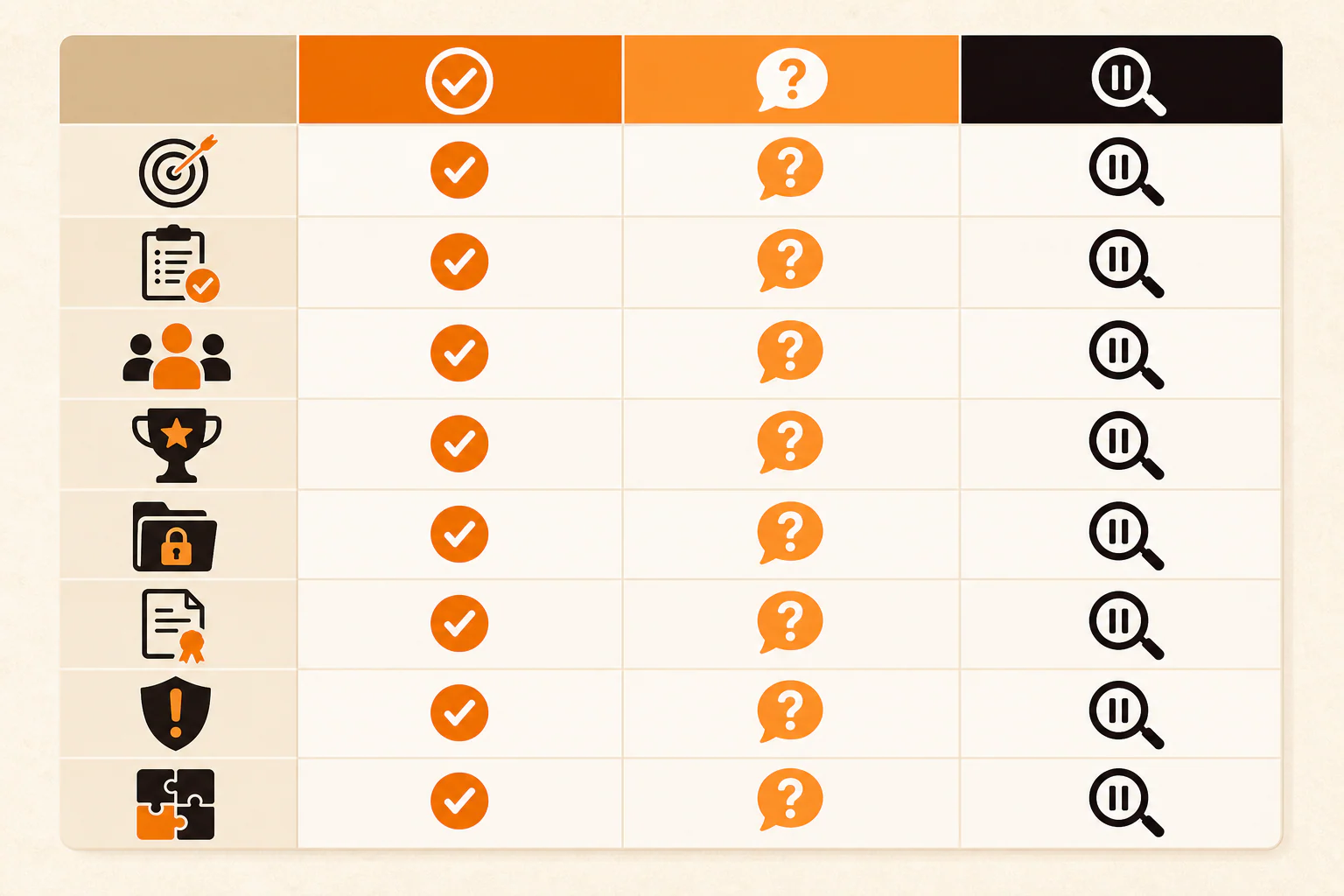
This scorecard is a comparison aid, not a fraud detector. Write every unanswered question beside the relevant criterion, send the same follow-ups to each finalist, and compare the revised answers instead of relying on your memory of who gave the smoothest presentation.
Red flags that deserve another question
Some answers should slow the process down:
- guaranteed rankings or other search outcomes without meaningful conditions;
- unexplained promises of high link volume;
- no clear explanation of how work is prioritized;
- reporting that cannot be reconciled to source data;
- unclear account ownership or exit terms;
- pressure to sign before useful discovery; and
- evasive answers about who performs or reviews the work.
These signals do not automatically prove misconduct. They do create an obligation to clarify. If the agency will not clarify a material risk, walking away is a reasonable business decision.
The best sales call leaves both sides clear about the problem, the work, the tradeoffs, the ownership, and the next decision. Feeling impressed is optional.
Once you have used the guide and know what a defensible proposal looks like, you can start an SEO conversation with YEAH! Local using the same questions and the same standard.
Last updated