
Key Takeaway
Learn when a press release is worth publishing, how to handle health claims, choose distribution, and measure AI-search visibility without making promises.
Publishing a press release and earning meaningful visibility are separate events.
A useful release creates a clear, dated, attributable public record around real news. Journalists, search engines, and AI search products can discover that record, but publication cannot guarantee a ChatGPT citation, a Google AI Overview, a ranking, or a new customer.
Bad PR advice usually starts at the wrong end. It asks how to distribute a release before asking whether the business has anything worth announcing. For a local clinic, medspa, counseling practice, dental office, or wellness company, the right order is simpler:
- Confirm that the announcement is real and verifiable.
- Approve the facts and any health-related claims.
- Publish an accessible source page you control.
- Choose outreach or distribution based on the actual goal.
- Record what happened without turning correlation into a success story.
Press releases can support a wider digital PR strategy. One release is not a digital PR strategy by itself.
Start with the newsworthiness gate
Before writing a headline or paying a wire service, ask whether a reasonable person outside the business would care that this happened.
A release may make sense when the announcement is both specific and provable. Examples include:
- opening a new location on a confirmed date;
- adding a clinician whose credentials can be verified;
- making a documented change to a program or service;
- beginning a community partnership that both organizations can confirm;
- publishing original research with a stated method; or
- receiving a real award from an identifiable organization.
Routine promotional copy fails the gate. So does an unchanged service list, unsupported trend commentary, a made-up anniversary milestone, or a vague claim that the business is "revolutionizing wellness."
Manufactured news is not clever. It gives reporters nothing useful, leaves readers with nothing to verify, and tempts the business to inflate ordinary marketing claims into facts.
If the announcement fails this test, stop. Improve the relevant service page, publish a genuinely useful guide, or wait until there is something real to announce. Distribution cannot rescue a non-story.
Build the fact record before writing
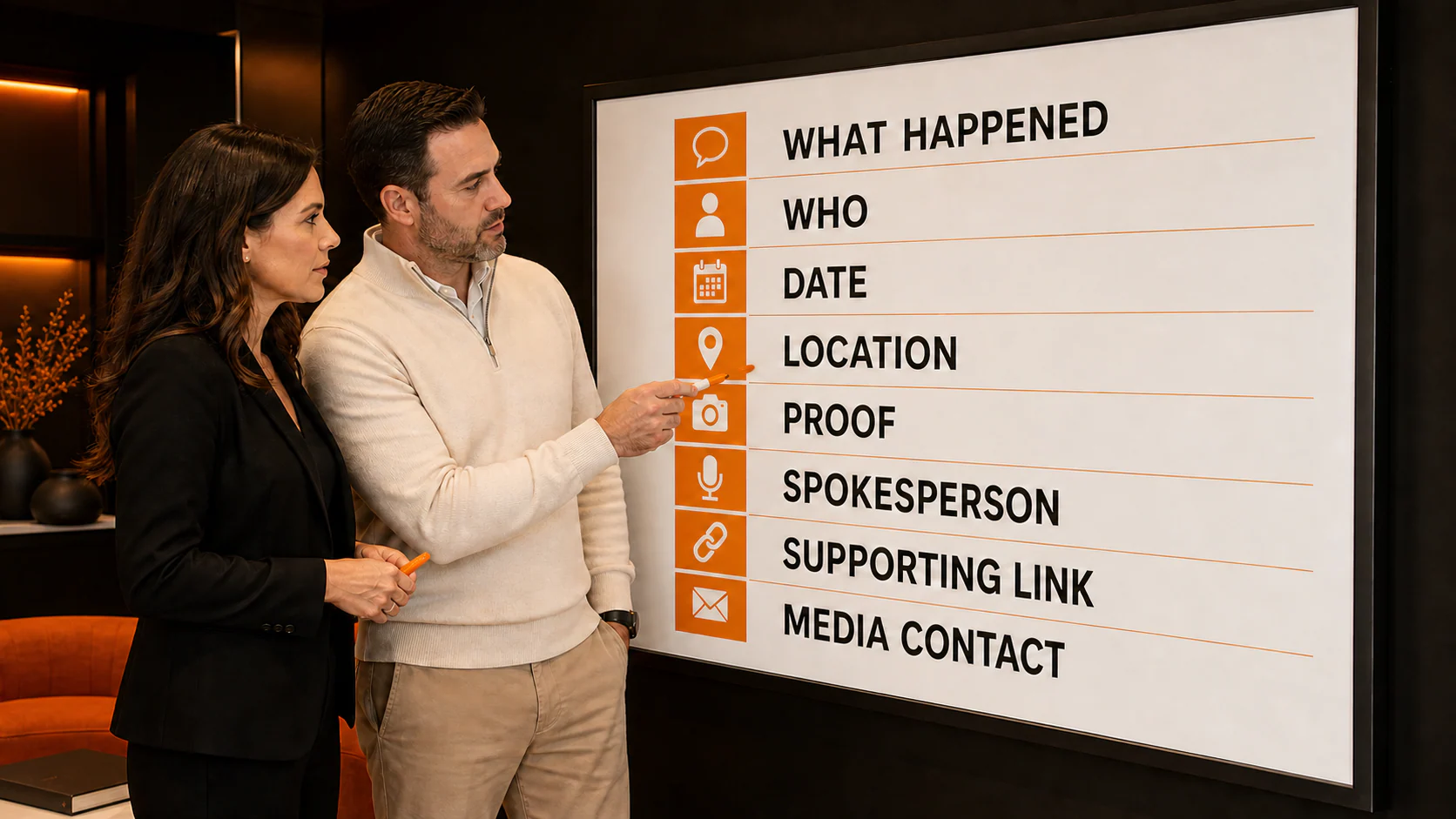
The easiest way to create a sloppy release is to start drafting while the facts are still moving. Build a short release brief first.
| Field | What to record |
|---|---|
| What happened | One factual sentence describing the announcement |
| Who is involved | Exact organization and person names, roles, and relevant credentials |
| Date | Announcement date plus any launch, opening, or event date |
| Location | The city, state, address, or service area that actually applies |
| Who is affected | The specific community, customer group, or professional audience |
| Proof | Credential record, partner confirmation, award source, research method, or other supporting document |
| Spokesperson | The person accountable for an approved statement |
| Quote | A substantive comment that adds context, not a slogan |
| Supporting link | The most relevant owned page or primary record |
| Media contact | A monitored name, email address, and phone number |
Do not write around a blank proof field. Resolve it, narrow the claim, or remove the claim.
Health-claim safety check
Health and wellbeing content deserves a higher trust bar. Google's people-first content guidance says its systems give more weight to strong E-E-A-T signals for topics that could significantly affect health, safety, or wellbeing.
For a health, wellness, or aesthetic business, a press release is the wrong place to improvise claims about efficacy, safety, superiority, before-and-after results, or patient outcomes. Use the exact evidence available. Attribute qualified statements to the right person. Get legal or compliance review when the business, claim, or jurisdiction requires it.
An approved quote is not proof merely because a clinician said it. The underlying claim still needs support.
Write the release so a person can verify it
An "AI-friendly" press release format does not exist. A useful format puts the facts where a person can understand and verify them.
Use a factual headline
Name the organization and the event. Add the location when it changes who the announcement affects. Skip unsupported superlatives such as "best," "leading," and "first" unless the fact record proves the full claim.
Put the announcement in the lead
The opening paragraph should answer what happened, who did it, where it applies, and when it happened. If a key date or condition is still unknown, the release is not ready.
Make the body earn its space
Use short sections to explain why the announcement matters, who is affected, and what evidence supports it. Keep names, credentials, locations, service terms, and dates consistent. Clear entity information helps a human understand the news and reduces ambiguity. It does not activate a special AI-search signal.
Quote someone with something to say
A quote should explain the decision, the constraint, or the expected practical change. "We are thrilled to announce" is filler wearing quotation marks. Attribute every quote to a named person with an accurate title, and obtain approval before publication.
Add useful supporting material
Include relevant photos, logos, transcripts, documents, or primary links when they help a reporter or reader verify the announcement. Give images descriptive alternative text. Attaching media does not establish that the release will be crawled or cited.
Finish with a current boilerplate and contact
The boilerplate should state what the organization is, where it operates, and what it does. The media contact must reach a real person or a monitored inbox. A dead contact address turns even a decent announcement into a cul-de-sac.
Publish an owned source page that can be found
Publish the complete release as visible HTML on a stable URL you control. A downloadable PDF can be a supporting asset, but it should not be the only public version.
Give the page a descriptive title. Link it from a relevant newsroom, blog, location, or service page so it is not orphaned. Make the media accessible. If structured data is appropriate, it must describe what visitors can actually see on the page.
Then check the technical boundaries:
- The URL returns the intended page without a login or accidental block.
- Search crawlers are allowed to access it.
- The page is eligible for indexing and for a search snippet.
- Canonical and robots settings point in the intended direction.
- Important names, dates, locations, and claims appear in visible text.
For Google, ordinary search requirements still apply. Google says there are no additional requirements for its AI features, and a page must be indexed and eligible to appear with a snippet before it can be considered as a supporting link. Eligibility is not a promise of inclusion.
For ChatGPT search, OpenAI documents OAI-SearchBot as the crawler used for search surfacing. GPTBot controls potential training use, which is a separate choice. Check the owned announcement page instead of assuming a press-release network settles crawler access for every copy.
For broader context, see our guide to Google AI Overviews and local search. The practical point here is narrow: publish an accurate page that is technically eligible to be found. Speculative schema or an "AI optimization" block does not finish the job.
If the page is blocked or not indexed, fix that eligibility problem before judging the announcement's visibility. If it is eligible but absent from a particular AI answer, that observation does not prove the page is broken.
Choose distribution based on the job
Distribution takes several forms. Decide what you want the release to accomplish before choosing a channel.
| Approach | Who controls the copy | What it can provide | What it does not prove |
|---|---|---|---|
| Owned newsroom page | The business | A canonical source of record with stable facts and links | That anyone else discovered, cited, or endorsed it |
| Paid wire syndication | The business supplies the release; participating sites may reproduce it | Wider distribution of the same announcement | Independent reporting, ranking lift, backlink value, or an AI citation |
| Targeted journalist or community outreach | The business controls the pitch; the recipient controls any response | A chance to put relevant news in front of a specific person or outlet | That coverage will happen |
| Independently authored coverage | The publisher controls its reporting and wording | A separate account that may add reporting, context, or criticism | That every statement is correct or that AI systems will surface it |
Paid syndication is useful when the goal is broad release distribution and the cost fits the plan. It is a poor purchase when the business cannot explain which audience or outcome the distribution is meant to serve.
Targeted outreach is more selective. Build a short list of local reporters, trade publications, community newsletters, professional associations, or partner organizations for whom the event is genuinely relevant. Send the facts, the primary link, a useful contact, and the reason their audience may care. Spraying an irrelevant pitch across a giant list creates activity, not interest.
Count a syndicated copy as a syndicated copy. Ten domains repeating the same release are not ten independent confirmations. Earned coverage is separately authored, even when the original release helped start the reporting.
Measure the chain, not a fantasy dashboard
Measurement should show what happened at each stage, without forcing every observation into a victory story.
Record the publication date and URL first. Then keep a simple log with:
- index or eligibility checks for the owned page;
- each pickup or mention, labeled as syndicated or independently authored;
- relevant referral visits using tagged links where practical;
- calls or forms that contain real source evidence;
- any qualified inquiry or documented business outcome; and
- a fixed set of prompts or search queries if AI visibility is part of the question.
For each AI-search observation, note the product, exact query, date, location or market when known, whether the business appeared, which source was cited, and a saved screenshot or export. Use the same query set on the planned review dates. Changing the questions after seeing the answers produces a prettier report and a worse comparison.
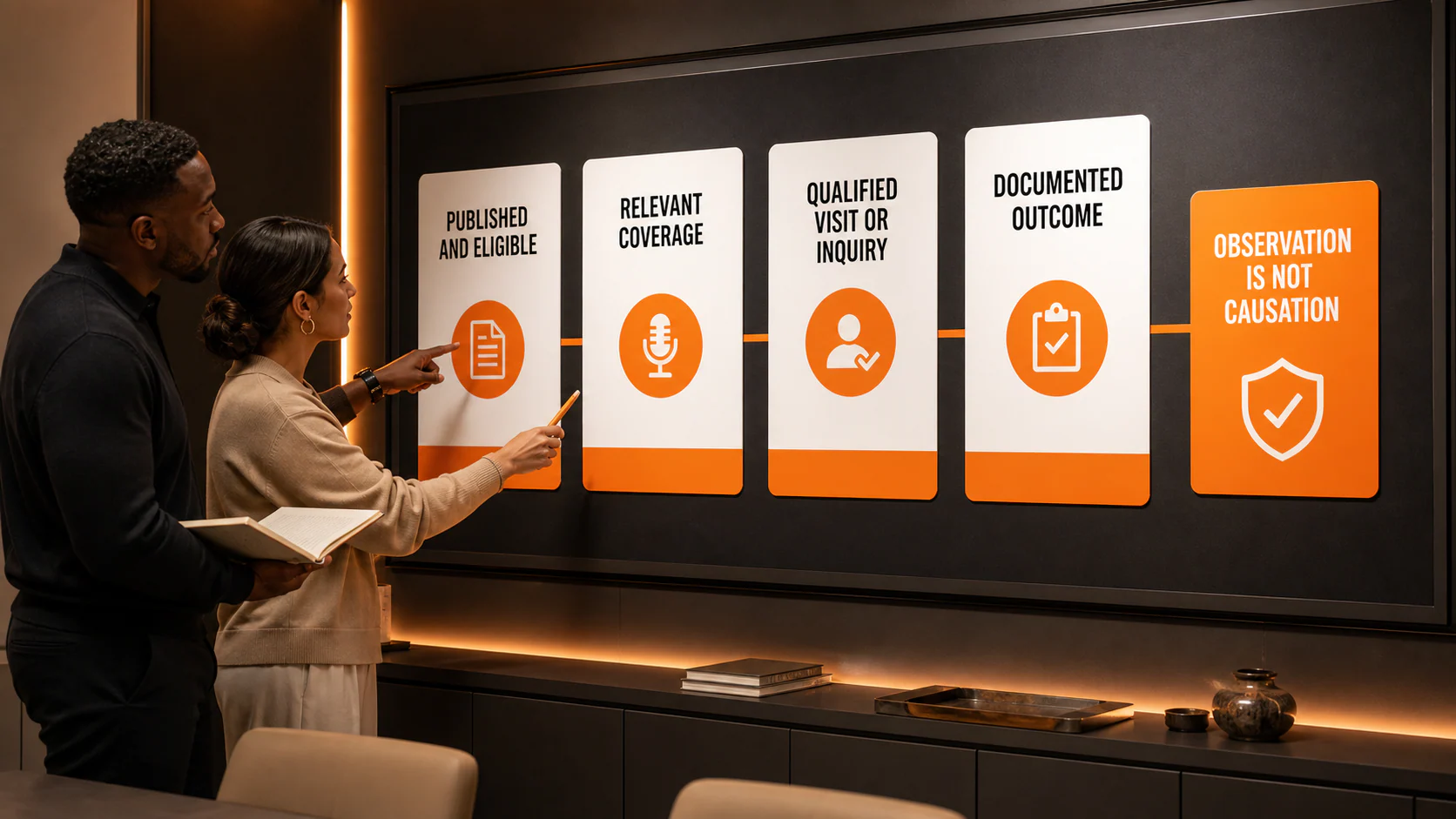
Treat the product, query, user context, location, and date as part of each observation. A mention is one observation. A referral visit is another. A tracked inquiry sits closer to the business outcome. None of them, alone, proves that the press release caused the next event in the chain.
If a dashboard cannot show the chain from published page to relevant coverage or visit to a documented outcome, it is a vanity dashboard. Colorful, busy, and not much help.
Common press-release mistakes
Manufacturing news
If the release exists only because someone decided the company "needs PR this quarter," go back to the newsworthiness gate. There is no supported universal publishing cadence.
Making unsupported health claims
Remove or qualify efficacy, safety, superiority, before-and-after, and patient-result language that the fact record cannot support. Our discussion of trust and evidence for medical, wellness, and aesthetic businesses offers additional context, but it does not replace compliance review.
Using a quote as decoration
Generic enthusiasm adds length without adding information. Ask the spokesperson to explain a decision, constraint, method, or consequence.
Publishing only a PDF
A PDF may be useful for download or printing. Keep the full release available as accessible text on an owned web page too.
Confusing syndication with earned coverage
Copied release text remains controlled messaging. Independently authored reporting is a different result and should be logged separately.
Buying distribution without a goal
Choose a wire because its reach matches a defined audience or communications need, not because a sales page promises vague visibility.
Counting copies as proof
More URLs carrying identical copy do not establish that the announcement was independently verified, influenced a ranking, or caused an inquiry.
Moving the measurement goalposts
Fix the query set, date range, conversion definition, and source labels before reviewing results. Otherwise the report becomes an exercise in finding whatever looks good.
A practical press-release workflow
You do not need expensive software to run this process. A document, a spreadsheet, access to the website, and a monitored media inbox are enough to start.
- Pass the gate. Write one sentence stating what happened and attach the proof. If either is weak, stop.
- Approve the facts and claims. Confirm names, dates, locations, credentials, quotes, links, and any required health-claim review.
- Write for verification. Use a factual headline, a complete lead, a short evidence-led body, a substantive attributed quote, a current boilerplate, and a working contact.
- Publish the owned source. Put the release on a stable, crawlable HTML page, link it from a relevant page, and check its technical eligibility.
- Distribute with intent. Choose owned publication, a paid wire, direct outreach, or a combination based on the audience and goal.
- Log the observations. Separate syndicated copies, independent coverage, referrals, inquiries, outcomes, and AI-search observations.
- Decide the next action. Correct inaccurate pickup, follow up with relevant contacts, improve the owned page, or close the campaign. Do not invent a win where the evidence stops.
If there is real news, publish one accurate source of record and pursue the people who might genuinely care. If there is no news, put the effort into the service page or another owned resource instead of manufacturing an announcement.
If the bigger issue is that your business cannot tell which pages, mentions, and inquiries contribute to local visibility, a wider local SEO audit and strategy is the more honest next step.
Last updated