How to Get Your Business Recommended by ChatGPT While You Build Google Rankings
Key Takeaway
Make it easy to verify what you do, where you work, and why a customer should call. Repeat the same ChatGPT questions over time, and use your own records to see which inquiries turn into bookings.
Your Google rankings aren’t where you want them. You’ve got room for more jobs, and waiting around for the ranking report to look better isn’t much of a marketing plan.
Meanwhile, someone can ask ChatGPT which local company to call. If it finds your business, what can it actually say about you? That you offer “exceptional service”? So does everyone else with a website and a keyboard.
Start with one service you want more of. Ask the questions a customer would ask before knowing your name, then look at the information available about your business. Can a stranger work out whether you serve their area, handle their problem, and give them a sensible next step?
That’s useful work you can do while you keep building Google visibility. It won’t buy you a guaranteed ChatGPT recommendation. It will give you something more useful than another vague instruction to “optimize for AI.”
Table of Contents
Keep working on Google. Check ChatGPT separately.
ChatGPT can search the live web automatically or when you select Search. OpenAI’s Search help says several factors affect its search rankings and placement isn’t guaranteed. Your Google ranking report can’t answer whether ChatGPT recommends you for a particular question. You have to check that question.
Google’s regular results, its AI Overviews and AI Mode, and ChatGPT answers are different places a customer can find you. For Google’s own AI features, the ordinary Google Search eligibility rules apply. Google says you don’t need special schema, the structured data in your page code, or extra technical setup for those features. That guidance is about Google, so don’t stretch it into a ChatGPT formula.
The practical job is still familiar: make the service clear, show proof, and help the right person contact you. When you review the work, talk about what changed and what you saw happen.
Start with work you actually want to sell
“More leads” leaves too much open. Pick a service you can deliver, an area you really serve, and work you have room to take on.
We’ll use a fictional plumber who wants more residential water-heater repair and replacement jobs in Atlanta, Georgia. Ask the person who answers the phone what homeowners want to know before scheduling. Those questions give you a better starting point than repeatedly typing “best plumber” and hoping your name turns up.
For this business, four discovery questions could be:
- “Which plumbers handle residential water-heater replacement in Atlanta, Georgia?”
- “My water heater isn’t keeping up, and I don’t know whether it needs repair or replacement. Which companies serving Atlanta, Georgia, could assess it?”
- “Who can help me compare replacing a tank water heater with switching to tankless at my home in Atlanta, Georgia?”
- “Which plumbers serving Atlanta, Georgia, can give me an on-site water-heater replacement estimate and explain what’s included?”
Use questions that match your services. If you don’t install tankless systems, leave that question out of your own set.
Keep your business name, website, and competitor shortlist out of these prompts. Don’t slip in an oddly specific requirement that happens to favor you, either. Save the answers before editing the page, using the same setup you’ll repeat later.
You can run a separate accuracy check by asking, “What services does [business name] offer, and where does it work?” Or give ChatGPT your page URL and ask what’s unclear. Both can help you improve the information. Save those replies separately. You handed it your name; it didn’t find you on its own.
Have your developer check the door isn't locked
Your service page might open perfectly on your phone while a crawler, the software requesting web pages, gets blocked.
OAI-SearchBot is OpenAI’s crawler for surfacing websites in ChatGPT Search. GPTBot handles content that may be used in model training. They have independent controls, according to OpenAI’s crawler documentation. A broad instruction to “allow AI” doesn’t tell your developer which one you mean.
Send the service page URL with this request:
Check whether robots.txt allows OAI-SearchBot to reach this page and whether our host or content delivery network (CDN) allows OpenAI’s published searchbot IP ranges. Keep our security protections in place. Check that the service details are public, readable as text, and linked from relevant pages. Send back the rules you checked, any block you found, and what supports your conclusion.
If the server or security logs show a request claiming to be OAI-SearchBot, have the developer verify its IP address against OpenAI’s published ranges. Ask for the date, page requested, and server response. The crawler’s name by itself doesn’t prove who sent the request.
No matching log entry? Record which rules allow access and leave the actual visit unconfirmed. Even a verified successful request only shows that the crawler reached the page. Your saved questions tell you whether the business appeared in answers.
Give people something better than “great service”
A homeowner comparing plumbers needs to know whether you handle the job, what backs up your qualifications, and what happens when they call. “Experienced team” leaves them doing the homework.
Here’s a fictional before-and-after for our Atlanta plumber. Borrow the approach only where the details match your business.
Before: We provide the best plumbing services with experienced technicians and unmatched customer care. Contact us today.
After: We assess, repair, and replace residential water heaters in Atlanta. Request an on-site assessment to discuss repair or replacement for your home. Our office will confirm your address, the problem, available appointments, and any assessment charge before scheduling.
See our team page for the responsible plumber’s license details and verification link, and our project examples for equipment installed and work involved. Your replacement estimate will explain the equipment, installation scope, exclusions, and applicable warranty terms. Price depends on the equipment and work required; call us to discuss the estimate process.
There’s something for the homeowner to evaluate there. But if your page promises license details and project examples, include the actual links. Mentioning proof you never show just creates another dead end.
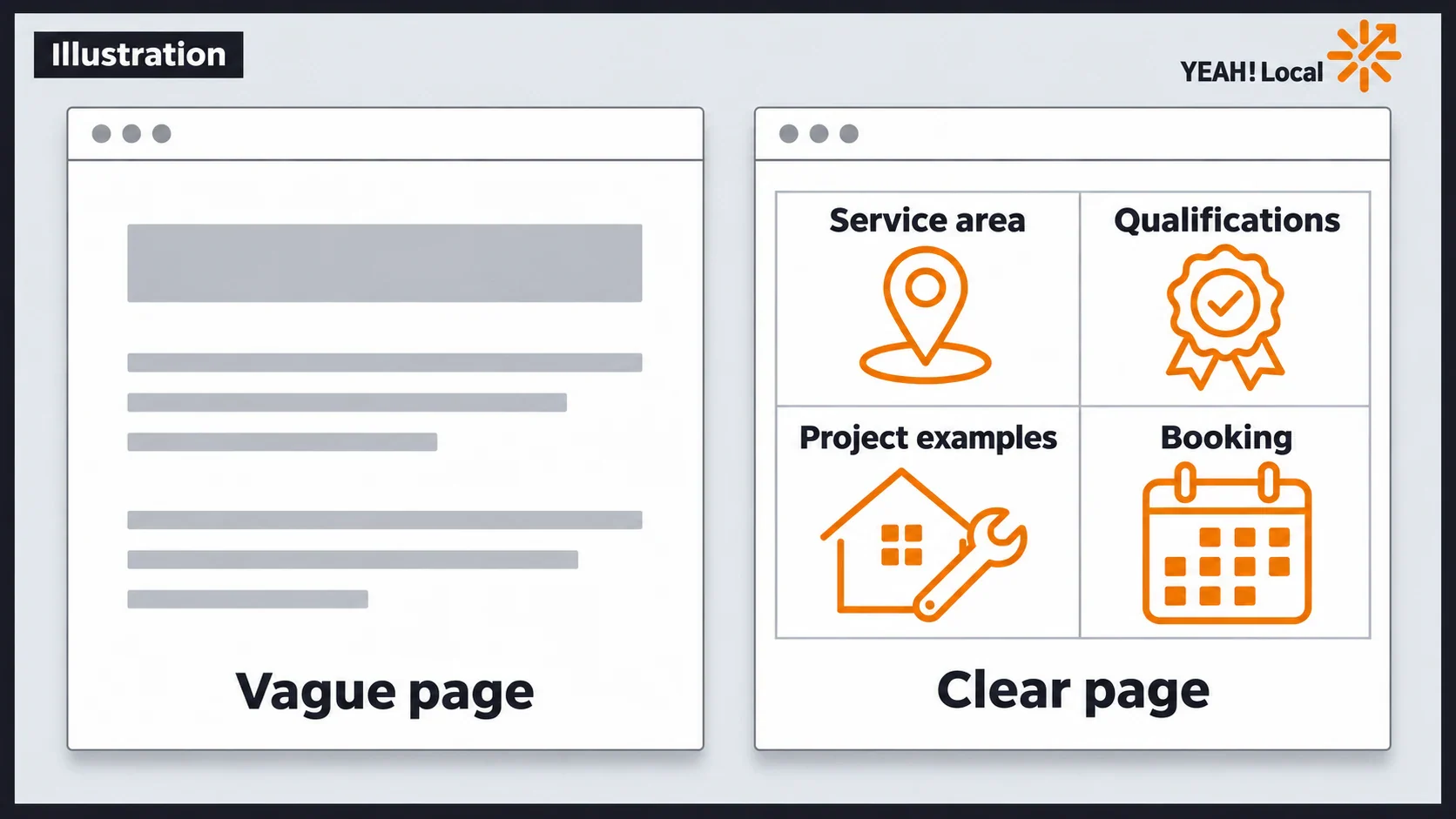
Use the customer questions to work out which information belongs on the page and who needs to supply it.
| Customer question | Evidence worth using | Where it belongs and who supplies it |
|---|---|---|
| Do you handle this job at my address? | Current services, actual service boundary, and exclusions | Service page; owner or operations manager confirms |
| Who is qualified to do the work? | Current applicable credentials, responsible person’s identity, and a verification link | Service/team pages; business supplies records, developer adds links |
| Have you done comparable work? | Genuine project photos and descriptions, with permission and clear scope | Relevant project example linked from service page; business supplies proof |
| What will the estimate cover? | Actual assessment charges, estimate process, inclusions, and exclusions | Near the estimate request; owner confirms terms |
| What happens when I contact you? | Intake process, hours, scheduling limits, and who responds | Contact section and confirmation; office manager confirms, developer checks the path |
If you can’t back up a claim, get the proof or narrow the claim. “We should have photos somewhere” isn’t a portfolio your writer can use.
Keep each service page focused on that service. A central “why choose us” page can hold the broader company information, with links where it helps. Pasting the entire company pitch onto every page makes the customer sort through it all again.
Read what the sources actually say
Open the links ChatGPT cites in your saved answers. A citation points to a page listed as a source; read it to see whether it supports the service, location, or qualification described. If there’s no source link for a detail, leave its source unknown.
Start with the website and relevant listings you already own or can legitimately claim. Fix the old phone number. Remove services you stopped offering. If you’re based in one city and serve another, explain that clearly. Keep your Google Business Profile accurate for the customers using it, without assuming it’s a direct ChatGPT feed.
When a directory appears in an answer, check that listing before paying for more directories. For our fictional plumber, a legitimate manufacturer’s contractor listing could support a specific relationship. A real project write-up could show what an installation involved. A customer review could describe the homeowner’s experience. Each has a useful job; none proves everything about the business.
Keep reviews in customers’ own words. Pursue third-party coverage when you have a real reason for the publisher to include you. Accurate business information is worth having even if ChatGPT never cites it.
Repeat the check without feeding it the answer
Start each prompt in a fresh chat. If your account offers Temporary Chat, choose Unpersonalized before the first message when that option is available. This excludes memories, custom instructions, and plugins. Personalized Temporary Chat can use them, as OpenAI’s Temporary Chat FAQ explains. “Temporary” alone doesn’t settle which settings you’re using.
On the ChatGPT website, select + in the message box, then Web search. The interface and options can vary, so record what you actually selected. Keep Atlanta in each example question and note any other location context being used, since location can affect results. Check OpenAI’s Search instructions if your controls look different.
A manageable first round is four questions on three dates. That gives you twelve answers to compare. It’s a practical workload, not a scientific sample size or a promise about how long results take. Note when page changes go live so you know which answers came before and after.
Your log can be simple:
| Field | Record |
|---|---|
| Date and test conditions | Date/time; interface and model if shown; Search selected; Temporary Chat/personalization setting; location context |
| Exact prompt | Paste it unchanged |
| Answer | Save the response; list businesses recommended and cited URLs |
| Accuracy | Wrong fact, supporting source, and correction needed, or no error found in the facts checked |
| Follow-up | Person responsible, intended change, and review date |
If you appeared in some of those twelve answers, say how many and which questions brought you up. That describes your checks. It doesn’t tell you your share of local buyers, and a better count after a page edit doesn’t prove the edit caused it.
Keep the old questions when adding a new one next round. You’ll have something to compare. Read the answers and their sources rather than asking ChatGPT to explain its hidden ranking formula.
Did anyone call? Were they a fit? Did they book?
Seeing your business recommended is encouraging. Now follow what happened beyond the answer.
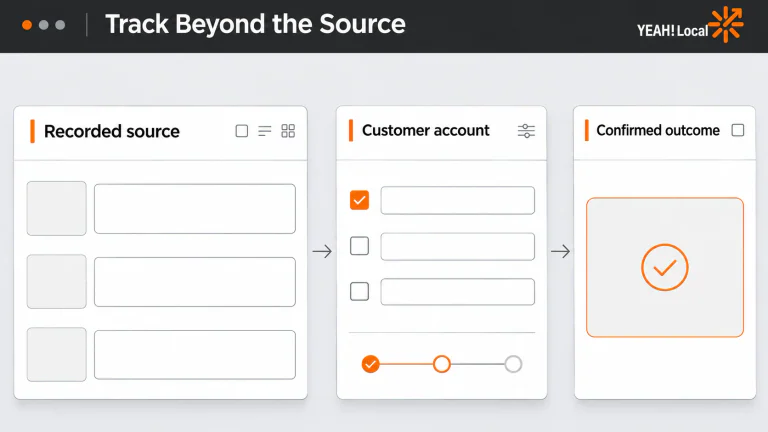
Keep the stages separate: a mention, a citation, a website visit, a connected call or delivered form, a qualified inquiry, a booking, and completed work. ChatGPT can name you without sending a website visitor. A phone-link click doesn’t tell you whether anyone spoke, and a ringing phone doesn’t make the caller a useful lead.
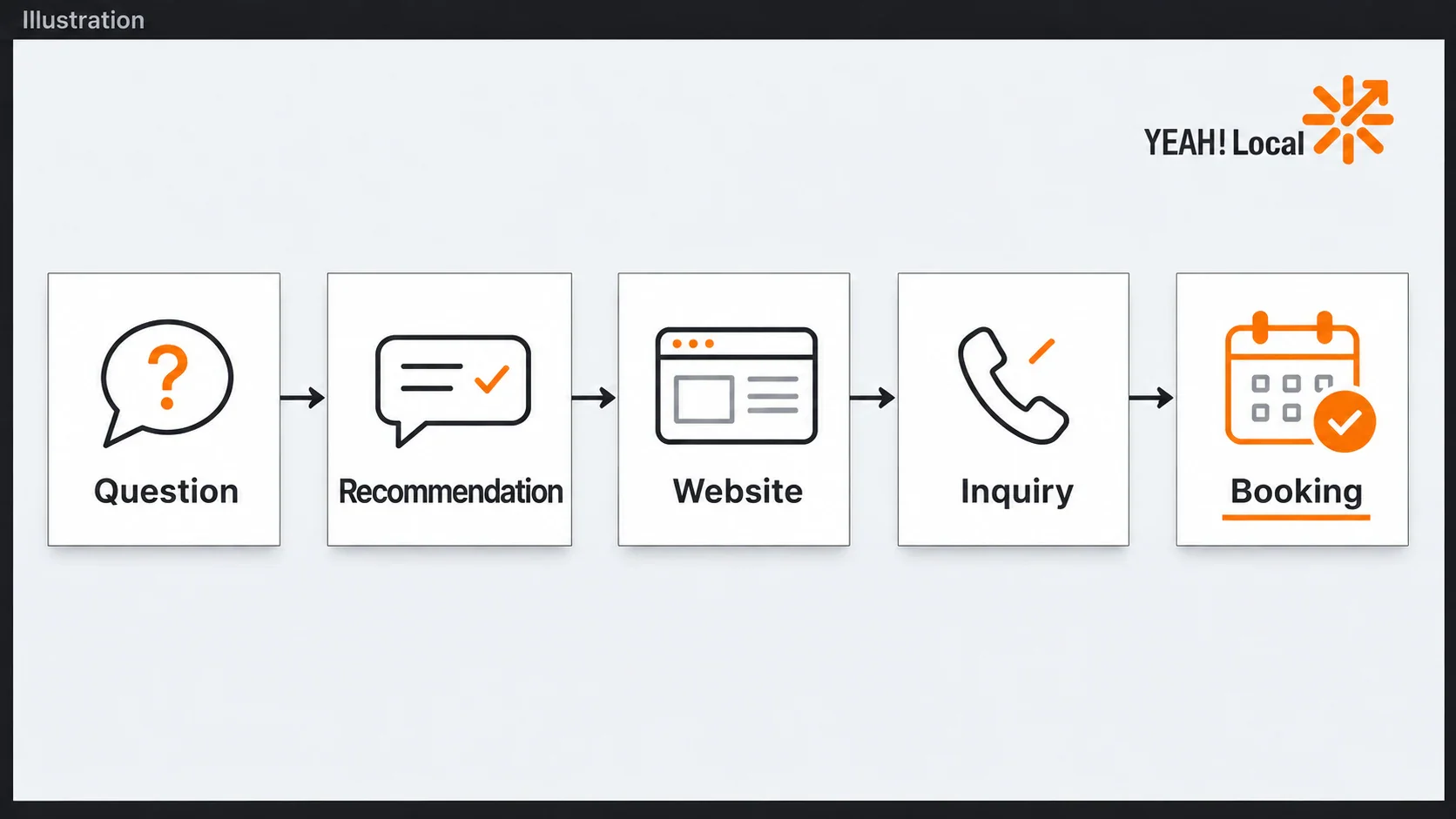
For our Atlanta plumber, a homeowner seeking a replacement assessment in the service area may be a fit. A supplier making a sales call can stay in the call log without becoming a customer opportunity.
Record the source your tracking captured and what the customer volunteers about finding you. Someone could hear about you through ChatGPT, search your name on Google, and call from a business listing. Keep both pieces of information. If that person calls again and sends a form about the same job, count one opportunity.
Some journeys cross channels or lose referral information. Mark the source unknown when you don’t have it. Our lead tracking and follow-up work helps connect the available records to the questions that matter: were these people a fit, and did they book?
Use what you find to choose the next fix:
- You’re missing from the answers. Check crawler access, service relevance, and supporting sources. Zero mentions in this small check doesn’t prove you’re blocked.
- ChatGPT gets your details wrong. Open the cited page and correct what you control, or ask its owner to update it. With no cited source, start by making sure the fact is clear on your own site.
- You appear accurately but get few inquiries. Read the page on your phone and test the contact path. Confirm calls and forms reach the right person. If the next step is vague, work on clarifying the offer.
- Good inquiries arrive but don’t book. Look at response time, capacity, price expectations, fit, and follow-up. Another paragraph on the website won’t fix a callback nobody made.
Pick one fix and put a name beside it
Choose one page, one missing piece of proof, someone responsible, and a review date. For the Atlanta plumber, the owner might supply photos and a description of a comparable installation for the developer to add beside the estimate instructions.
On the review date, open the live page and confirm the change is there. Repeat the saved questions. Then ask the office which replacement inquiries fit and which booked. Use what you find to choose the next thing to fix.
If you’d like help, we’ll look at the service you want to grow, what customers can find out about it, and what happens when they contact you.
Last updated