
How to Make Your Clinic Easier to Find in ChatGPT, Perplexity, and Google AI

Key Takeaway
Learn what Google, ChatGPT, and Perplexity document, then audit your clinic's access, public facts, service pages, reviews, and measurement.
No documented setting, schema field, review pattern, or content formula can make an AI system recommend your clinic.
That is the uncomfortable truth. It is also useful, because it keeps you from wasting time on supposed AI-search hacks while your hours are wrong, your best service is buried on a generic page, or a crawler cannot reach the site.
The practical job is simpler. Make the clinic's important pages accessible. Keep public facts accurate. Explain services and providers well enough for a person to evaluate them. Then measure what you can observe without pretending a sampled answer caused a booking.
Start there, before you buy another dashboard or publish another batch of generic content.
What Google, ChatGPT, and Perplexity actually document
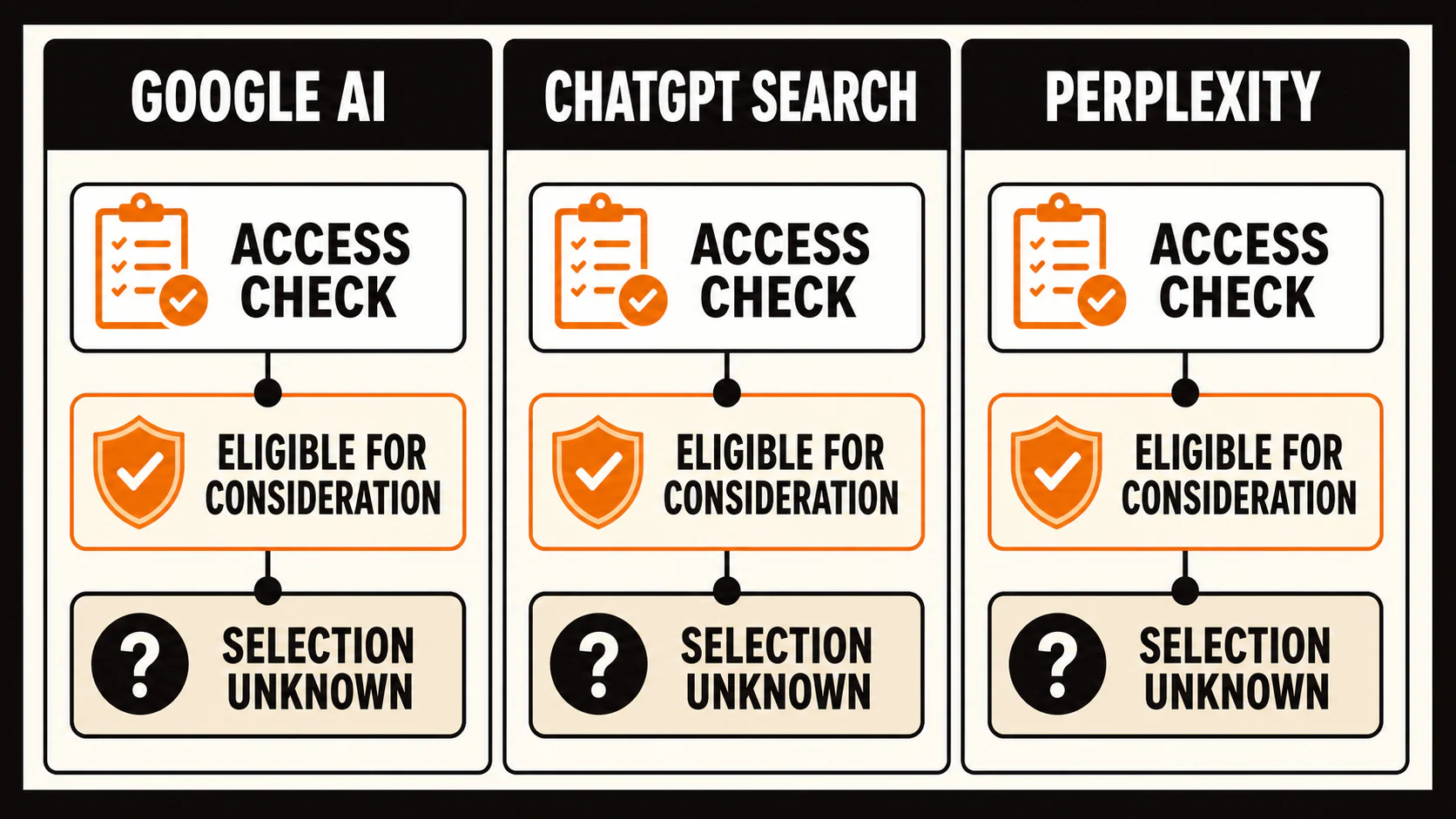
These platforms do not publish one shared formula for choosing local clinics. They do publish some access and eligibility information, and those boundaries matter.
| Platform | What the platform documents | What your clinic can check | What remains unknown |
|---|---|---|---|
| Google AI features | Google says its usual SEO practices apply to AI Overviews and AI Mode. A page must be indexed and eligible to appear with a Search snippet before it can be considered as a supporting link. | Indexability, crawl permissions, internal links, text content, structured data that matches visible content, and current Business Profile information. | Whether a page will be selected, linked, or shown for a particular query. |
| ChatGPT Search | OpenAI says ChatGPT Search can use web sources. It documents OAI-SearchBot access for search discovery and says placement is not guaranteed. | Robots rules, host or CDN access, and whether important pages can be reached. | Whether the clinic will be mentioned, which source will be used, or where a result will appear. |
| Perplexity | Perplexity documents PerplexityBot as its crawler for surfacing and linking websites in search. | Robots rules and access from Perplexity's published IP ranges. | How it chooses clinics for a particular answer or whether it will cite your site. |
You can verify the boundaries in Google's guidance for AI features, OpenAI's publisher FAQ, and Perplexity's crawler documentation.
Eligibility is the first boundary. It is not selection. Selection is not a click. A click is not a qualified inquiry. Keep those distinctions intact all the way through your reporting.
Step 1: Make the important pages accessible
Do not begin with content volume. Begin with the pages that explain your clinic, providers, locations, and priority services.
For Google, confirm that each important page is indexable and eligible to appear with a snippet. Check that robots rules permit crawling, internal links lead to the page, and the main information appears as text. Google specifically says there are no extra technical requirements or special optimizations for its AI features beyond its normal Search guidance.
For ChatGPT Search, review OAI-SearchBot access. OpenAI's ChatGPT Search guidance explains that answers can use web sources, while its publisher guidance keeps the no-guarantee boundary clear.
For Perplexity, check PerplexityBot separately. Do not assume that passing Google's crawl test proves access for another crawler.
A page loading in your browser is not enough. A firewall, hosting rule, or content delivery network can treat crawlers differently. If the robots file looks right but access is still uncertain, have a qualified technical owner inspect server or firewall logs. Record the page tested, crawler, date, response, and owner. "The site seems fine" is not a completed check.
Structured data belongs in this technical review, but keep it in its lane. It should accurately describe content a visitor can already see. It is not a special AI switch.
Step 2: Correct the clinic's public facts
Next, compare the website with the clinic's public profiles. Start with facts a prospective patient may rely on:
- Clinic and public-facing business name
- Address or accurately described service area
- Phone number and appointment path
- Regular and special hours
- Provider names and credentials
- Services currently offered
- Location-specific availability
Assign an owner to each fact. That matters more than adding another field to a spreadsheet. When hours, services, or a provider change, somebody needs to know which pages and profiles must be updated.
Google includes current Business Profile information among the ordinary practices worth maintaining for its AI features. Use our Google Business Profile optimization guide for the deeper profile work.
The completion check is straightforward: the clinic's priority website pages and Google Business Profile agree on the facts above, and a named owner has confirmed them. Do not turn that agreement into a claim about ChatGPT or Perplexity recommendations. It serves patients first.
If your hours are wrong, an AI visibility dashboard is theater.
Step 3: Build service and provider pages worth evaluating
A thin service page usually answers one question: "Do you offer this?" A useful page helps someone decide what to ask next.
For each priority service, explain what the clinic actually provides, who provides it, what an appointment or consultation involves, and how someone can take the next step. Address suitability, limitations, safety, pricing, insurance, availability, and expected results only when the clinic has accurate information and the right person has approved it.
Provider pages should identify the provider, their verified credentials, the services or areas they are qualified to discuss, their location, and the correct booking path. Avoid puffed-up expertise claims that nobody has checked.
This is where the clinic's review process matters. A marketing writer should not decide whether a treatment is safe, who is a candidate, what results are typical, which insurance plans apply, or how a credential should be described. Route those statements to the clinic's qualified clinical, operational, and compliance owners before publication. The FTC's health-products compliance guidance says health-related benefit and safety claims must be truthful, not misleading, and supported by science. That is an important U.S. marketing boundary, not a complete legal or clinical review for your clinic.
Fix your important service pages before feeding the blog. Our guide to service pages versus more blog content explains why that order is usually more useful for a local business.
You have completed this step when every priority page has a factual owner, a review date, an accurate provider and location connection, and a clear next action. You have not completed it because the page reached a preferred word count.
Step 4: Handle reviews without turning them into scripts
Reviews help people evaluate a clinic. That is enough reason to maintain an honest review-request process. You do not need an invented story about reviews "teaching" every AI platform what your clinic is known for.
Use a consistent eligibility rule based on a completed, genuine experience, and ask for voluntary, honest feedback under the rules that apply to your clinic and the platform. Do not ask for positive sentiment, treatment outcomes, keywords, or a particular story. Do not reward favorable language or use a private screening step to steer unhappy people away from public feedback. Our guide to requesting honest online reviews covers the workflow and current policy boundaries in more detail.
If a review mentions a treatment result, safety claim, or another sensitive health statement and the clinic wants to reuse it in marketing, route that use through the appropriate review. A public review and a clinic-approved advertising claim are not automatically the same thing.
Check the process, not just the review count:
- Who receives a request?
- When is it sent?
- Does the wording ask for honest feedback without scripting the answer?
- Are incentives, filtering, and staff instructions documented?
- Who approves the clinic's response when a review raises a sensitive issue?
The goal is a process the clinic can defend, not a pile of suspiciously similar reviews.
Step 5: Earn corroboration people can verify
Your clinic should not be described only on its own website. Accurate professional profiles, local organization pages, relevant directories, legitimate media coverage, and useful expert contributions can give people other places to verify who you are.
Do this for the reader, not to hit a mention quota. A local directory entry with the wrong provider or phone number creates more cleanup. A press mention that says nothing specific about the clinic adds little. A real professional profile with the correct role, location, and credential can be useful.
Review the sources that already mention the clinic. Correct what you control. Ask for corrections where the source has a legitimate process. Remove dead, duplicate, or misleading targets from your outreach list. Then look for a small number of relevant opportunities where the clinic has something accurate and useful to contribute.
No official source in this research establishes that a certain number of mentions, links, directories, or profiles will produce an AI recommendation. Do not report them as if they do.
Step 6: Sample visibility and measure outcomes separately
You can sample what the platforms show. You cannot turn a handful of prompts into a stable ranking report.
For each sample, record:
- Exact prompt and location wording
- Platform
- Date and time
- Account or login state, if known
- Answer shown
- Links or sources shown
- Material caveats or errors
Repeat the same small prompt set on a consistent schedule, and treat each result as a dated observation. Record the fields above so later samples can be compared against the same context instead of treated as a stable ranking.
Then keep the business measurements in separate columns:
| Stage | What the record must establish |
|---|---|
| Eligibility | Was the important page accessible and, where applicable, indexed and snippet-eligible? |
| Sampled visibility | Did a dated prompt sample mention or link to the clinic? |
| Website or profile action | Did an observable visit, call, or form event occur? |
| Qualified inquiry | Did the inquiry match the service, location, and other criteria the clinic defines? |
| Booking | Was an appointment actually scheduled? |
| Patient | Did the person establish the patient relationship as the clinic defines and records it? |
| Revenue | Was revenue recorded and properly connected in the clinic's business records? |
Do not collapse that sequence into one AI visibility score. A sampled mention does not prove a visit. A form submission does not prove a qualified inquiry. A qualified inquiry does not prove a booking. A booking does not prove someone became a patient. None of those, by itself, proves revenue.
If your tracking cannot connect two stages, leave the connection unknown. Guessing fills a dashboard. It does not improve a decision.
A practical 30-day maintenance cadence
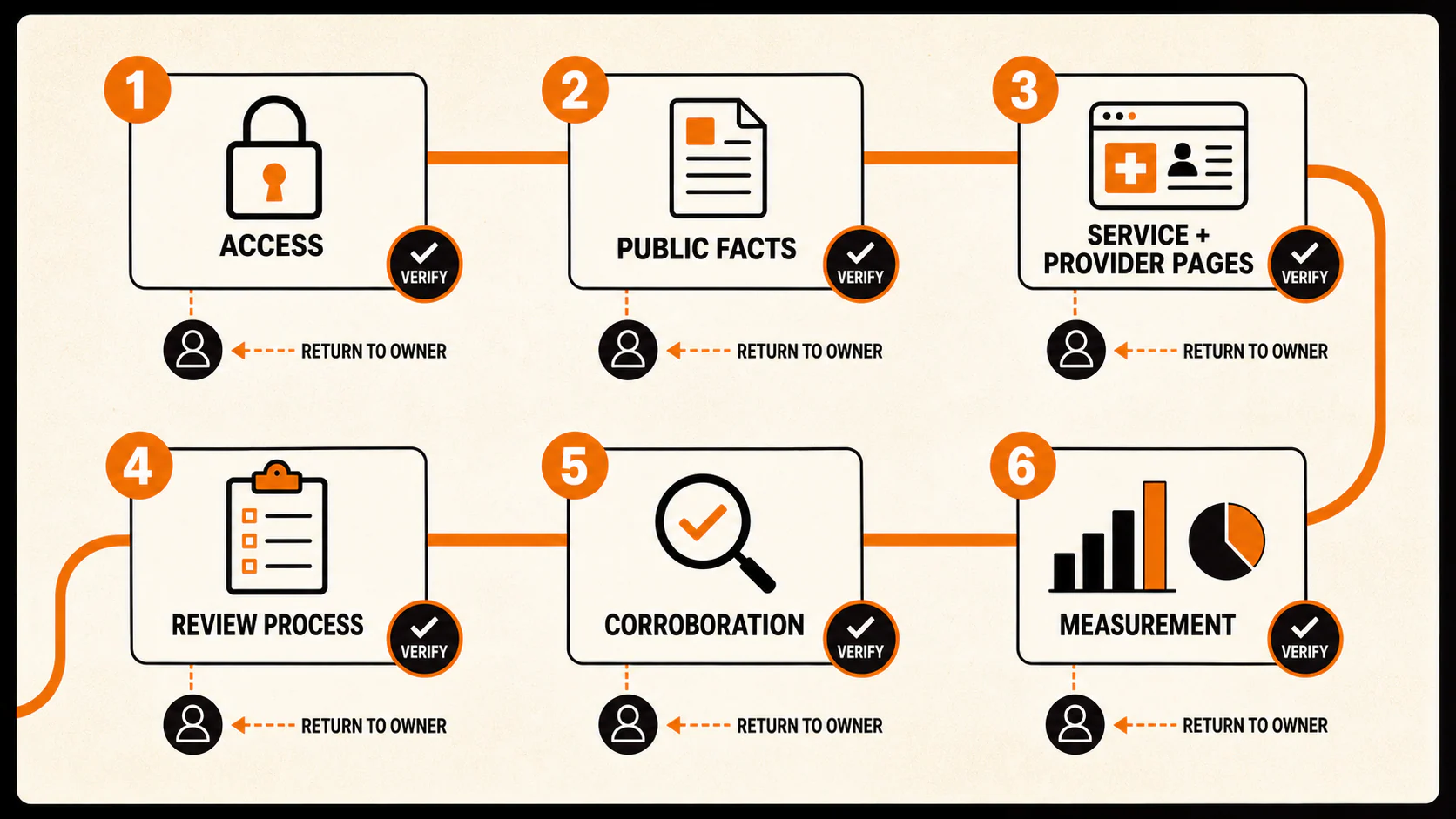
This is a management cadence, not a forecast. It gives a small clinic a way to finish the work instead of turning "AI search" into a permanent research project.
Week 1: Access and critical facts
Test the priority pages, assign technical failures, and compare website facts with the Google Business Profile. Correct verified errors first.
Week 2: Provider and service pages
Choose one priority provider or service page. Confirm its factual owner, fill supported gaps, and send sensitive claims through the proper review. Publish only through the clinic's authorized process.
Week 3: Reviews and corroboration
Audit the review-request process and the clinic's most visible third-party profiles. Fix inaccurate information. Do not chase volume for its own sake.
Week 4: Baseline and one material change
Run the documented prompt sample, save the observations, and review available search, profile, referral, inquiry, and booking records separately. Choose one material issue for the next cycle and write down why it was chosen.
At the end of the month, you should have completed checks, named owners, dated evidence, and one clear next priority. You should not have a promise that ChatGPT, Perplexity, or Google will recommend the clinic next month.
Accuracy before amplification
AI search is a bad place to amplify sloppy clinic facts.
Get the foundation right: accessible pages, current business information, useful service and provider details, a defensible review process, accurate third-party profiles, and measurement that respects the gaps between visibility and business outcomes.
That work does not guarantee a citation or recommendation. It gives prospective patients more accurate information and addresses the access checks Google, OpenAI, and Perplexity document.
If you need help turning this audit into a focused local search plan, see how YEAH! Local approaches SEO for local businesses or contact us. We will start with what can be verified, not a made-up AI score.
Last updated