
Key Takeaways
- Blog posts are useful, but they are usually not the highest-intent pages on a local business website.
- Most local buyers search for a specific service in a specific place, not a general educational article.
- If your service and city pages are weak, thin, vague, or missing, your blog is being asked to do a job it was never built to do.
- Local SEO and AI SEO both depend on clarity: what you do, where you do it, who you serve, why you are trusted, and what the next step is.
- Surrounding-city visibility does not happen by accident. If your website only tells Google you serve Atlanta, do not expect it to automatically understand you also want leads from Alpharetta, Johns Creek, Marietta, Sandy Springs, Dunwoody, Decatur, or nearby markets.
- Blogs can support your authority, but service-plus-city pages capture local buyer intent.
- AI search does not make service pages less important. It makes them more important because AI systems need clear, structured, trustworthy information to generate local answers.
- The fix is building useful local service pages that match how real buyers search.
- Before writing another blog post, audit your core money pages: title tags, service pages, city pages, FAQs, reviews, proof, internal links, and calls to action.
The Blog Trap Most Local Businesses Fall Into
Blogs are not bad.
A good blog can answer common questions, build topical authority, support internal linking, give your sales team helpful resources, and help prospective customers understand your process.
But your blog is not your local SEO strategy.
And it is definitely not your AI SEO strategy either.
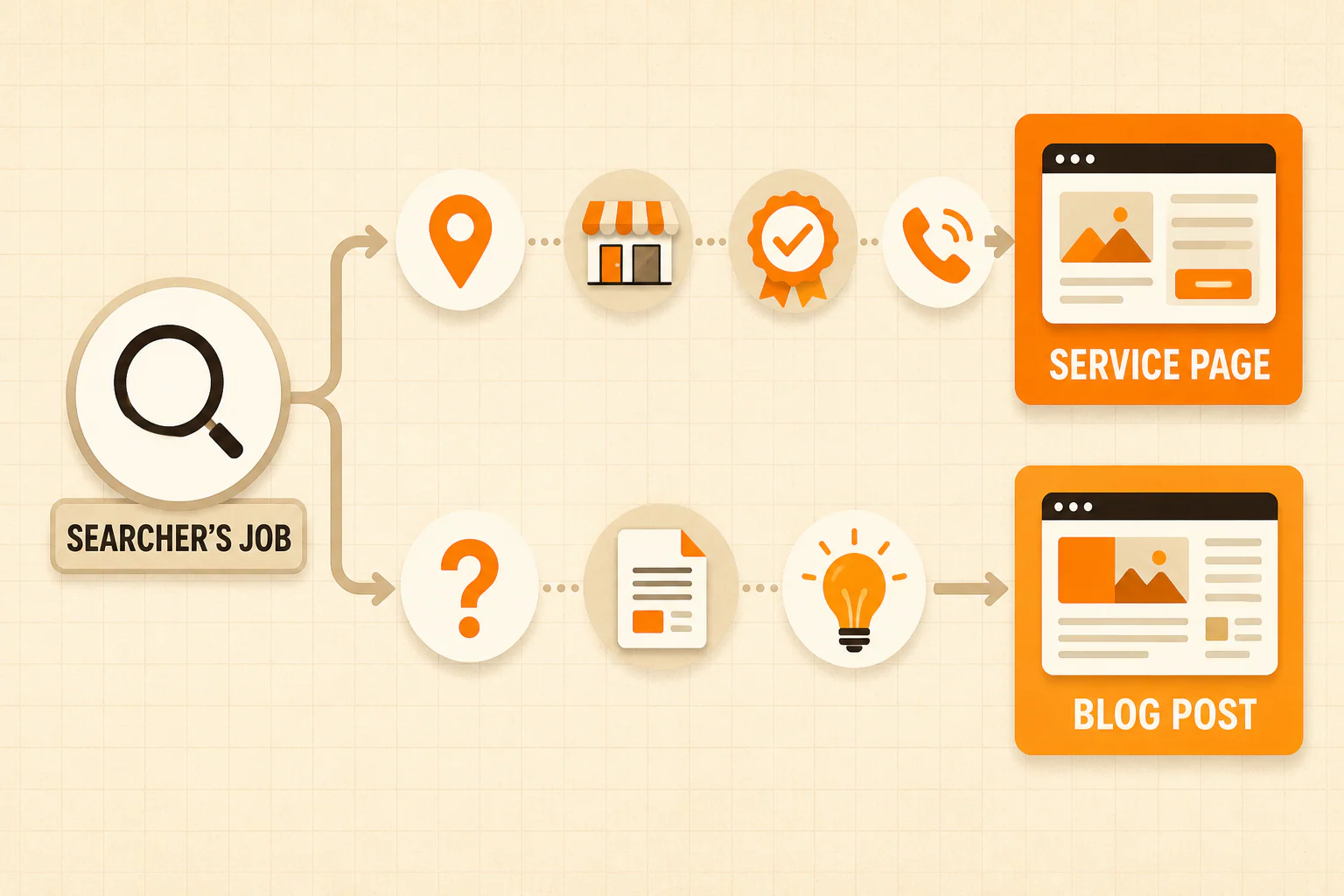
For most local service businesses, blog posts are not the pages that bring in the highest-intent leads.
A person searching:
- “spray foam insulation near me”
- “home care in College Park”
- “concierge doctor Alpharetta”
- “Botox near Buckhead”
- “functional medicine doctor Roswell”
- “attic insulation Marietta”
- “senior care Sandy Springs”
- “roof repair Johns Creek”
is not primarily looking for a general educational article.
They are looking for a provider.
They want someone who does the specific thing in the specific place they need it.
That is why your service and city pages still matter.
A blog can support those pages.
It cannot replace them.
The Difference Between Informational Traffic and Buyer Intent
A lot of local businesses confuse traffic with demand.
A blog post might rank for:
- “What is spray foam insulation?”
- “Benefits of in-home care”
- “What is concierge medicine?”
- “How does Botox work?”
- “What is functional medicine?”
- “How often should I replace attic insulation?”
Those searches can be valuable.
They can introduce your brand to new people. They can help customers understand your services. They can make your website feel deeper and more authoritative.
But they are often informational.
The person may be early in the research process. They may not be ready to call. They may not even be local.
A service-plus-city search is different.
When someone searches:
- “spray foam insulation Alpharetta”
- “concierge doctor near me”
- “home care College Park”
- “attic insulation Marietta”
- “Botox Sandy Springs”
- “hormone therapy Johns Creek”
they are showing commercial local intent.
They already know what they need, or they are close enough to compare providers.
That is where the money is.
And that is exactly where too many local business websites are weakest.
The blog gets attention.
The service page gets the call.
The Common Local SEO Problem: Your Website Tells Google One Narrow Story
A lot of local businesses have websites that look fine on the surface.
The homepage is decent.
The service pages exist.
There are a handful of blogs.
The business may even rank in the main city it has mentioned for years.
Then the owner says:
“We are getting killed on the near-me searches.”
Or:
“We should be getting leads from surrounding cities, but we are not.”
Or:
“We rank in Atlanta, but not in Alpharetta, Johns Creek, Marietta, Sandy Springs, Dunwoody, or Decatur.”
Usually, the site is telling Google and AI systems one narrow story:
We do this service in Atlanta.
That may be true.
But it is not enough if the business also wants leads from nearby markets.
Google is not a mind reader.
AI search platforms are not mind readers either.
If your website never clearly explains that you provide a specific service in those surrounding cities, you are asking search engines and AI systems to infer something your competitors may be stating directly.
That is not a strategy.
That is hope.
Why Blogs Do Not Fix Weak Money Pages
This is where the blog trap kicks in.
The business keeps publishing helpful articles, but the revenue-driving pages stay thin.
The title tags are weak.
The meta descriptions are vague.
The service pages do not answer the buyer’s questions.
The FAQ lives in a blog post instead of on the page where the decision is happening.
The surrounding cities are barely mentioned.
The proof is scattered.
The call to action is generic.
The homepage says the business serves “the greater Atlanta area,” but the site never builds real relevance for the actual cities where the business wants leads.
So the business publishes another blog.
Then another.
Then another.
The blog may bring in informational traffic.
But the service page brings in buyers.
And now, the service page is also one of the clearest sources AI systems can use when generating local answers.
That distinction matters more than ever.

The Core Local SEO and AI SEO Structure
Better local SEO and better AI SEO are often less glamorous than people expect.
It is not always a massive strategy reveal.
Sometimes it is cleaning up the pages that already exist and making them say the thing customers are actually searching for.
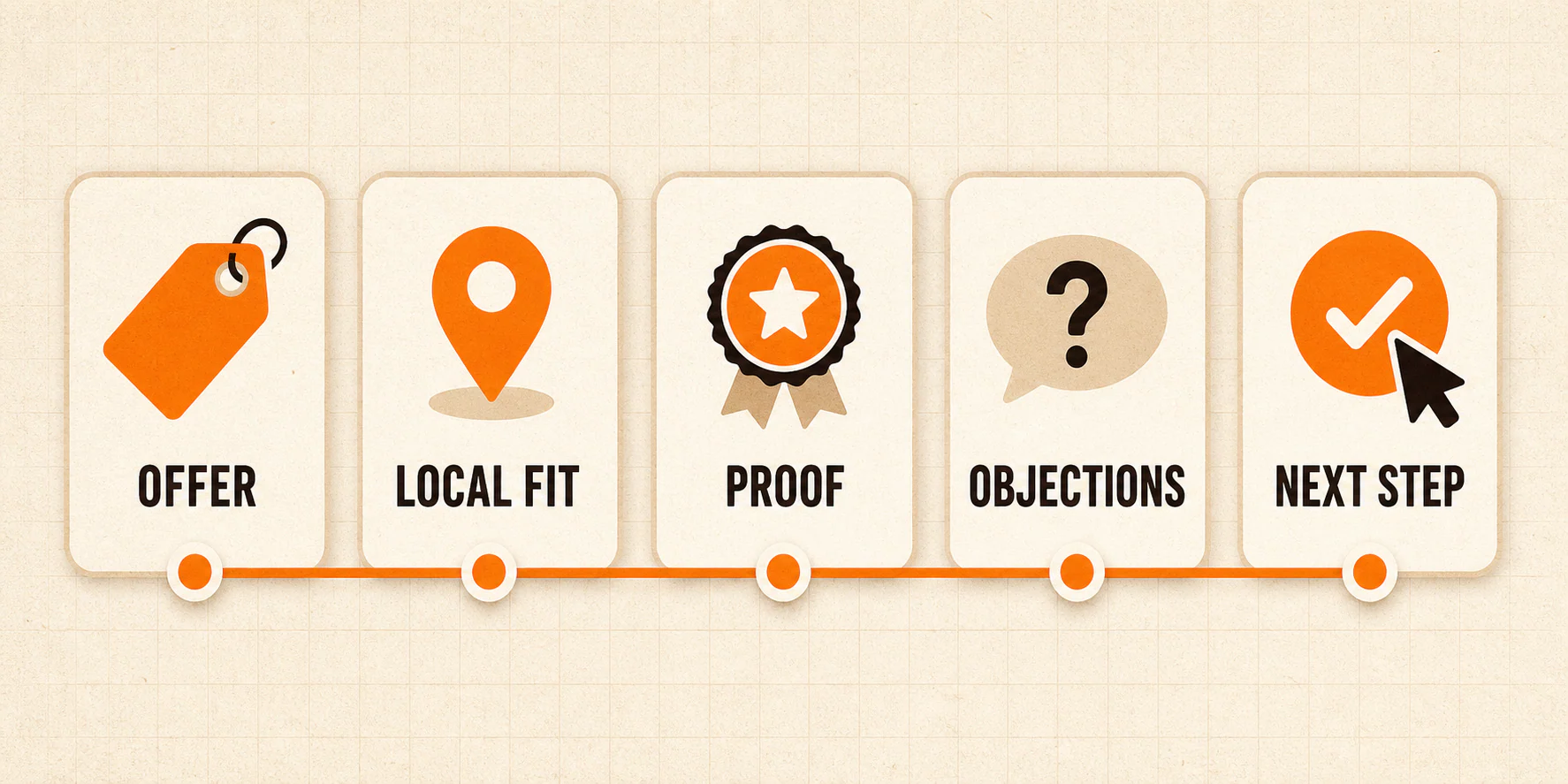
The structure is simple:
Service
What do you provide?
Not in vague terms.
Use the language buyers use.
Examples:
- Spray Foam Insulation
- Attic Insulation
- Home Care
- Concierge Medicine
- Hormone Therapy
- Botox
- Functional Medicine
- Senior Care
- Air Sealing
- Medical Weight Loss
- Dementia Care
- Roof Repair
City
Where do you provide it?
Not just “Atlanta area.”
Specific cities, neighborhoods, and service areas where you actually want leads.
Examples:
- Alpharetta
- Johns Creek
- Marietta
- Sandy Springs
- Dunwoody
- Decatur
- College Park
- Roswell
- Buckhead
- Brookhaven
- East Point
- Milton
Trust
Why should someone choose you?
This can include:
- Reviews
- Credentials
- Years in business
- Case studies
- Before-and-after examples
- Photos
- Provider expertise
- Team experience
- Local proof
- Awards
- Certifications
- Safety standards
- Clear process
Answers
What questions does the buyer need answered before taking action?
Examples:
- How does the process work?
- How much does it cost?
- Who is this service for?
- How soon can I schedule?
- Do you serve my city?
- What happens after I call?
- What makes you different?
- What should I expect during the first visit?
- Do you offer estimates or consultations?
Next Step
What should the visitor do now?
Examples:
- Call now
- Schedule a consultation
- Request an estimate
- Book a discovery call
- Check availability
- Get a quote
- Schedule an in-home assessment
- Speak with the team
That is the framework.
Service. City. Trust. Answers. Next step.
Blogs can support this structure.
They should not replace it.
The AI SEO Layer: Why This Matters Even More Now
AI search is changing how people find local businesses.
Instead of only typing short keywords, users are asking more natural questions:
- “Who is the best concierge doctor in Alpharetta?”
- “What company installs spray foam insulation near Johns Creek?”
- “What home care agencies serve College Park and offer dementia care?”
- “Where can I get natural-looking Botox near Buckhead?”
- “Which functional medicine clinic near Roswell works with hormone issues?”
AI tools need clear, structured, trustworthy information to answer those questions.
If your website does not clearly connect:
- service
- location
- expertise
- proof
- process
- next step
you are less likely to be included in those answers.
Blogs alone rarely provide that clarity.
Service-plus-city pages do.
AI SEO is not a separate strategy.
It is an extension of good local SEO done correctly.
Case Study 1: The Insulation Company With Blog Traffic but Weak Buyer Visibility
An insulation company had been publishing blog posts for years.
The articles were not bad.
They had posts like:
- “Benefits of Spray Foam Insulation”
- “How Insulation Can Lower Energy Bills”
- “What Is Blown-In Insulation?”
- “How to Tell If Your Attic Needs Insulation”
Some of those posts brought in traffic.
But the company was frustrated because the phone was not ringing enough from the markets it actually wanted.
They wanted more leads from Alpharetta, Johns Creek, and Marietta.
When the site was reviewed, the issue became obvious.
The blog content had depth.
The money pages did not.
The site had one general page for “Insulation Services in Atlanta.”
But there was no strong page for:
- Spray Foam Insulation in Alpharetta
- Attic Insulation in Marietta
- Air Sealing in Johns Creek
- Blown-In Insulation in Sandy Springs
- Crawl Space Insulation in Roswell
The company served those cities, but the website never made that clear.
So when someone searched “spray foam insulation Alpharetta,” Google had stronger options to show.
Not necessarily better companies.
Just clearer pages.
What changed
The company did not need five more blog posts.
It needed pages that matched buyer intent.
Each service-plus-city page included:
- The exact service
- The specific city
- The problems homeowners were trying to solve
- A simple explanation of the process
- Photos of real work
- FAQs about cost, timing, materials, and estimates
- Internal links to related services
- Reviews or project proof
- A clear estimate request CTA
The lesson
The blog built awareness.
The service-plus-city pages captured demand.
For local SEO, both can matter, but they do not do the same job.
Case Study 2: The Concierge Medical Practice That Only Looked Local to One City
A concierge medical practice had a strong reputation, a clear membership model, and a loyal patient base.
The practice wanted to attract patients from Alpharetta, Roswell, Milton, Johns Creek, and Sandy Springs.
But the website mostly spoke about one main location.
The homepage mentioned the practice’s city.
The About page talked about the doctor.
There were a few blog posts about concierge medicine.
But there were no strong pages explaining:
- Concierge Doctor in Alpharetta
- Concierge Medicine in Johns Creek
- Private Primary Care in Roswell
- Membership Medicine Near Milton
- Preventive Medicine in Sandy Springs
The practice assumed Google understood the surrounding market.
But competitors had built pages directly aligned with those searches.
What changed
The practice built a better local SEO structure.
The new pages were not thin copies with city names swapped.
Each page explained:
- The membership model
- Who the practice is a good fit for
- What types of patients choose concierge care
- How the first consultation works
- How location impacts access and convenience
- What services are included through the membership
- FAQs about pricing, availability, insurance, communication, and appointment access
- A clear call to schedule a discovery call
The lesson
For clinics, local SEO is not just about “near me.”
It is about helping the patient understand whether your practice is the right fit for their location, needs, expectations, and decision-making process.
A blog about concierge medicine can educate.
A concierge doctor page for Alpharetta can convert.
Case Study 3: The Home Care Agency Getting Found for the Wrong Terms
A home care business wanted more leads for in-home care.
But its website created confusion.
The homepage talked about care broadly.
The blog discussed senior living, assisted living, dementia, family caregiving, and aging in place.
Those topics were useful, but the site did not clearly separate:
- In-home care
- Personal care
- Companion care
- Dementia care
- Respite care
- Assisted living placement
- Skilled nursing
- Senior transportation
The result?
Search engines and users had to work too hard.
Some visitors were looking for assisted living.
Some wanted hourly in-home care.
Some wanted medical nursing.
Some wanted non-medical companionship.
The business was getting inquiries, but many were not the right fit.
What changed
The site was restructured around service clarity.
Instead of relying on blogs to explain everything, the agency built pages for:
- Home Care in College Park
- In-Home Care in East Point
- Companion Care in South Atlanta
- Dementia Care in College Park
- Respite Care in Hapeville
Each page clarified:
- What the service is
- Who it is for
- What caregivers can and cannot do
- What families usually ask before starting care
- What areas the agency serves
- How the care assessment works
- What the next step is
The lesson
A blog can educate families.
But families ready to hire need service clarity.
When the service pages became clearer, lead quality improved because the site did a better job pre-qualifying the visitor before the call.
Case Study 4: The Med Spa With Great Instagram Content but Weak Local Search Pages
A med spa had a strong Instagram presence.
The team posted before-and-afters, treatment videos, provider tips, and patient education.
Social engagement was good.
But when people searched:
- “Botox Sandy Springs”
- “lip filler Buckhead”
- “medical weight loss Roswell”
- “microneedling Dunwoody”
- “med spa near Brookhaven”
the business was not showing up as often as it should.
The issue was not brand quality.
It was page structure.
The website had one broad “Aesthetics” page and one general “Injectables” page.
There were plenty of social posts, but not enough search-ready pages.
Google and AI tools had to guess which services the clinic provided and where those services were relevant.
What changed
The med spa built dedicated pages for high-value services and local markets:
- Botox in Sandy Springs
- Lip Filler in Buckhead
- Microneedling in Dunwoody
- Medical Weight Loss in Roswell
- Med Spa Services in Brookhaven
Each page included:
- Treatment explanation
- Who it is for
- Who performs it
- What patients commonly ask
- Pricing factors
- Safety and expectations
- Local relevance
- Reviews mentioning that service
- Clear booking CTA
The lesson
Social media created interest.
Service-plus-city pages captured local search demand.
For med spas, the blog and social content can build trust, but local service pages are what make the business easier for Google and AI systems to understand.
What a Strong Service-Plus-City Page Should Include
A strong local service page should include these elements.
1. A Specific Title Tag
Weak:
“Blown-In Insulation Atlanta | Brand Name”
Better:
“Blown-In Attic Insulation in Atlanta, GA | Improve Comfort & Energy Efficiency”
Even better for surrounding markets:
“Spray Foam Insulation in Alpharetta, GA | Attics, Crawl Spaces & Air Sealing”
For clinics:
“Concierge Doctor in Alpharetta, GA | Membership-Based Primary Care”
For home care:
“Home Care in College Park, GA | In-Home Support for Seniors”
For aesthetics:
“Botox in Sandy Springs, GA | Natural-Looking Results From Experienced Injectors”
The title should tell the buyer what the page is about and why it matters.
2. A Clear H1
Weak:
“Our Services”
Better:
“Spray Foam Insulation in Alpharetta, GA”
Or:
“Concierge Medicine in Johns Creek, GA”
Or:
“Home Care in College Park, GA”
The H1 should match the intent.
3. A Buyer-Focused Intro
Do not start with generic company history.
Start with the problem the buyer is trying to solve.
Example for insulation:
“If your upstairs rooms stay hot in the summer or your energy bills keep climbing, your attic or crawl space may not be properly sealed. Our team provides spray foam insulation in Alpharetta for homeowners who want better comfort, improved efficiency, and a cleaner building envelope.”
Example for concierge medicine:
“If you live in Alpharetta and want longer appointments, easier access to your doctor, and a more personal primary care relationship, our concierge medicine model may be a better fit than traditional high-volume care.”
Example for home care:
“If your loved one needs support at home in College Park, our caregivers can help with daily routines, companionship, personal care, and family respite so they can remain safer and more comfortable at home.”
That is much stronger than:
“We are a leading company serving the Atlanta area.”
4. Local Relevance
Mention the specific city naturally.
This can include:
- Service area
- Local neighborhoods
- Common property types
- Nearby communities
- Access and scheduling
- Local proof or examples
- Distance or convenience
- Local patient or customer needs
Do not force it.
Make it useful.
5. Service Details
Explain what the service includes.
For a clinic:
- What the first visit includes
- Who provides the care
- What services are included
- What the membership or treatment model looks like
- Who is a good fit
- What the next step is
For a home service business:
- What the inspection includes
- What materials or methods are used
- What problems the service solves
- How long it takes
- What happens after the estimate
For home care:
- What caregivers can help with
- How scheduling works
- What types of care are available
- How families start the process
- What areas are served
For aesthetics:
- What the treatment does
- Who performs it
- Who is a good candidate
- What results are realistic
- What downtime or maintenance may involve
- What questions first-time patients usually ask
6. Trust Signals
Add proof where it belongs.
This can include:
- Reviews
- Certifications
- Provider credentials
- Photos
- Local project examples
- Years of experience
- Before-and-after photos
- Case studies
- FAQs
- Awards
- Associations
- Service guarantees
- Patient or customer testimonials
The page should not just say “trust us.”
It should show why.
7. FAQs on the Page
Do not hide important FAQs in a blog post only.
If the buyer is deciding on the service page, answer the questions there.
Examples:
- How much does this cost?
- Do you serve my city?
- How soon can I schedule?
- What happens during the consultation?
- Do you offer estimates?
- How long does the service take?
- Who performs the work?
- Is this covered by insurance?
- What makes your service different?
FAQs can rank.
But more importantly, they convert.
8. A Direct CTA
Do not end with vague language.
Weak:
“Contact us for more information.”
Better:
“Call today to schedule your consultation.”
Or:
“Request an insulation estimate in Alpharetta.”
Or:
“Schedule a home care assessment for your loved one.”
Or:
“Book a concierge medicine discovery call.”
Or:
“Schedule a Botox consultation in Sandy Springs.”
The next step should match the business model.
Local SEO & AI Page Priority Table
| Page Type | Purpose | Example | Role in Lead Generation |
|---|---|---|---|
| Homepage | Broad brand and market positioning | Atlanta Insulation Company | Builds trust and introduces the business |
| Core service page | Explains the main service | Spray Foam Insulation | Captures broad service intent |
| Service-plus-city page | Matches high-intent local searches | Spray Foam Insulation in Alpharetta | Captures buyers looking for a service in a specific city |
| Supporting blog post | Answers longer questions | Spray Foam vs Blown-In Insulation | Builds authority and supports service pages |
| FAQ section | Removes buyer objections | How much does spray foam insulation cost? | Improves conversion on the decision page |
| Case study / proof page | Shows real-world credibility | Attic Insulation Project in Marietta | Builds trust and supports local relevance |
| Contact / booking page | Converts the visitor | Request an Estimate | Turns intent into action |
Notice where the blog sits.
It is a support asset.
It is not the whole strategy.
Blogs Still Matter, But They Need the Right Job
None of this means blogs are useless.
Blogs are useful when they support the money pages.
A blog can:
- Answer long-tail questions
- Build topical authority
- Explain complex services
- Support internal links
- Educate prospects before they call
- Help your sales team answer objections
- Feed Google Business Profile posts
- Support AI search visibility by expanding context
- Build trust over time
But the blog should not be carrying the entire local or AI SEO strategy.
A blog about “Benefits of Spray Foam Insulation” should link to:
- Spray Foam Insulation in Alpharetta
- Spray Foam Insulation in Johns Creek
- Attic Insulation in Marietta
A blog about “What Is Concierge Medicine?” should link to:
- Concierge Doctor in Alpharetta
- Private Primary Care in Roswell
- Membership Medicine in Johns Creek
A blog about “How to Know When a Parent Needs Home Care” should link to:
- Home Care in College Park
- Dementia Care in East Point
- Companion Care in South Atlanta
That is how blogs support lead generation.
They feed the pages that convert.
The Internal Linking Mistake Most Local Businesses Make
Many local sites publish blogs but fail to connect them to the right service pages.
That leaves authority stranded.
A blog post gets traffic.
The visitor reads.
Then what?
If there is no strong internal link to the relevant service page, the blog does not help the buyer move forward.
Every blog should answer:
- Which service page does this support?
- Which city page does this support?
- What buyer question does this answer?
- What next step should the reader take?
If the blog does not support a money page, it may still be useful, but it should not be the center of the strategy.
The Title Tag Problem
Your title tag matters more than many local businesses realize.
A title tag does not just help rankings.
It helps the searcher decide whether your page is the answer.
Weak title tags are often:
- too vague
- too short
- too keyword-stuffed
- missing the city
- missing the service
- missing the value
- written for Google only
- not written for the buyer
Example:
“Blown-In Insulation Atlanta | Brand Name”
That is technically accurate, but it is not doing much work.
Better:
“Blown-In Attic Insulation in Atlanta | Improve Comfort & Energy Efficiency”
Or:
“Spray Foam Insulation in Alpharetta | Attics, Crawl Spaces & Air Sealing”
Or:
“Concierge Doctor in Alpharetta | Membership-Based Primary Care”
Or:
“Home Care in College Park | In-Home Support for Seniors”
Or:
“Botox in Sandy Springs | Natural-Looking Results From Experienced Injectors”
The best title tags combine:
- service
- city
- value
- clarity
That is often enough to make the page more aligned with the search.
The AI Search Reality: Clarity Wins
AI systems are not guessing.
They are extracting, summarizing, and connecting information.
If your site clearly says:
“Spray Foam Insulation in Alpharetta”
you are easier to understand.
If your site vaguely says:
“We serve the greater Atlanta area”
you are harder to place.
That difference determines whether you show up in:
- search results
- map packs
- AI-generated answers
- voice search responses
- local comparison queries
- near-me searches
- service-specific recommendations
Clarity is now a competitive advantage.
How to Know If Your Local SEO Strategy Is Too Blog-Heavy
Your strategy may be too blog-heavy if:
- You have more blogs than strong service pages
- Your blogs rank, but calls are weak
- You get traffic from outside your service area
- Your surrounding cities are barely mentioned
- Your service pages have fewer than 500 words of useful content
- Your FAQs live only in blogs
- Your title tags are generic
- Your pages do not explain pricing, process, or next steps
- Your Google Business Profile services are more detailed than your website
- You rank in your main city but not nearby markets
- Your blog traffic does not turn into booked calls, qualified leads, estimates, consultations, or new customers
That does not mean you should stop blogging forever.
It means your money pages need attention first.
What to Fix Before Writing Another Blog Post
Before publishing another blog, audit these pages.
Core Service Pages
Do they clearly explain each service?
Do they answer real buyer questions?
Do they have strong calls to action?
Do they include proof?
Service-Plus-City Pages
Do you have pages for the services and cities that matter most?
Are they useful, or are they thin duplicates?
Do they match real searches?
Title Tags and Meta Descriptions
Would a buyer know exactly why to click?
Do they include the service and city?
Do they communicate value?
FAQs
Are FAQs on the pages where decisions happen?
Or are they buried in random blog posts?
Internal Links
Do blogs link to relevant service pages?
Do service pages link to related services and locations?
Is the site helping users move toward action?
Trust Signals
Do pages show reviews, credentials, project examples, provider expertise, case studies, or local proof?
Or do they simply make claims?
Conversion Path
Is it obvious how to call, book, request an estimate, or schedule a consultation?
If not, fix that first.
A Simple 30-Minute Local SEO & AI Audit
Here is the action step every local business owner can do today.
Step 1: Search Your Top Service Plus Your Main City
Example:
- “spray foam insulation Atlanta”
- “concierge doctor Alpharetta”
- “home care College Park”
- “Botox Sandy Springs”
Look at your result.
Ask:
- Does your title tag match the intent?
- Does your meta description make someone want to click?
- Is the page the right page?
- Does it answer buyer questions?
- Is the call to action clear?
Step 2: Search the Same Service Plus Three Nearby Cities
Examples:
- “spray foam insulation Alpharetta”
- “spray foam insulation Johns Creek”
- “spray foam insulation Marietta”
Or:
- “home care College Park”
- “home care East Point”
- “home care Hapeville”
Or:
- “concierge doctor Alpharetta”
- “concierge doctor Roswell”
- “concierge doctor Johns Creek”
Or:
- “Botox Sandy Springs”
- “Botox Buckhead”
- “Botox Dunwoody”
Ask:
- Do you show up?
- If not, do you even have a page that deserves to show up?
- Does your site clearly say you serve that city for that service?
- Are competitors stating the service and city more directly?
Step 3: Open Your Service Page
Ask:
- Is the page thin?
- Does it mention the city naturally?
- Does it include FAQs?
- Does it show proof?
- Does it answer pricing or process questions?
- Is there a clear next step?
Step 4: Fix the Page Before Writing Another Blog
If your site does not clearly say you serve those searches, fix the service pages first.
Then use blogs to support them.
That order matters.
The Real Local Growth Engine Lesson
The best local SEO strategy is not “blog more.”
It is building a system where every page has a job.
Your homepage builds brand trust.
Your service pages explain what you do.
Your service-plus-city pages match high-intent local searches.
Your blogs support authority and answer longer questions.
Your FAQs remove objections.
Your reviews prove trust.
Your case studies show results.
Your calls to action move people forward.
Your internal links connect the whole system.
That is a Local Growth Engine.
Not random content.
Not blog volume.
Not thin city pages.
A structured system that captures demand, builds trust, and turns local searchers into real leads.
Final Thought
Your blog is not your local SEO strategy.
And it is not your AI SEO strategy either.
It is part of both.
Blogs can build trust, answer questions, and support authority.
But high-intent local leads and AI visibility usually come from pages that clearly match what buyers are searching for:
Service.
City.
Trust.
Answers.
Next step.
If those pages are weak, vague, thin, or missing, more blog posts will not fix the core problem.
Before you write another article, look at the pages that should be making the phone ring and the pages AI systems should be referencing.
Make them clearer.
Make them more useful.
Make them more local.
Make them more trustworthy.
Make them easier to act on.
That is where better local SEO and AI SEO usually start.
Not with another blog.
With a better answer to the search your buyer, and AI, are already making.
FAQ's
Are blogs still useful for local SEO?
Yes. Blogs can support local SEO by answering questions, building topical authority, and internally linking to service and city pages. But blogs should support your money pages, not replace them.
What is a service-plus-city page?
A service-plus-city page is a page focused on a specific service in a specific location, such as “Spray Foam Insulation in Alpharetta,” “Home Care in College Park,” or “Concierge Doctor in Roswell.” These pages match high-intent local searches more directly than general blog posts.
Does every city need its own page?
No. You should not create thin copy-paste city pages. Create pages only when they serve a real business purpose, match real demand, and provide useful local information for customers in that area.
What makes a good local service page?
A strong local service page explains the service, the city or area served, the problems customers are trying to solve, proof that supports the business, FAQs, and a clear next step.
Why do blogs bring traffic but not leads?
Many blogs attract informational searches. Those visitors may be researching, not ready to buy, or outside your service area. Service and city pages are more likely to attract people looking for a provider now.
Should FAQs go on blogs or service pages?
Both can work, but the most important buyer questions should appear on the service page where the decision is happening. Do not make visitors hunt through blog posts to get basic answers.
Do title tags matter for local SEO?
Yes. A strong title tag helps search engines and buyers understand the page. It should usually include the service, city, and a clear reason to click.
Can AI search understand my service area without city pages?
Sometimes, but you should not rely on inference. If you want leads from a specific city, your website should clearly explain that you provide the relevant service there.
Is AI SEO different from local SEO?
AI SEO builds on strong local SEO fundamentals. AI systems need clear, trustworthy, structured information about your services, locations, expertise, and proof. That is exactly what strong local SEO already creates.
What pages matter most for AI SEO?
Service pages, service-plus-city pages, FAQs, provider pages, case studies, review-rich pages, and clear location pages are often more valuable than generic blog posts because they provide direct information AI systems can use.
Should I stop blogging?
No. But blogging should support your core pages, not replace them. Focus on strengthening your service and location pages first, then use blogs to reinforce them.
What is the simplest way to improve both local SEO and AI SEO?
Make sure your website clearly states your services, your locations, your expertise, your proof, and your process. If a human can quickly understand what you do and where you do it, search engines and AI systems can too.
What should I fix first: blogs or service pages?
Fix service pages first. Once your core service and city pages are strong, use blogs to support them with educational content, internal links, FAQs, and authority-building topics.
What is the simplest local SEO action step?
Search your top service plus your main city, then search the same service plus three nearby cities you want leads from. If your site does not clearly match those searches, fix the relevant service pages before writing another blog.