

Key Takeaways
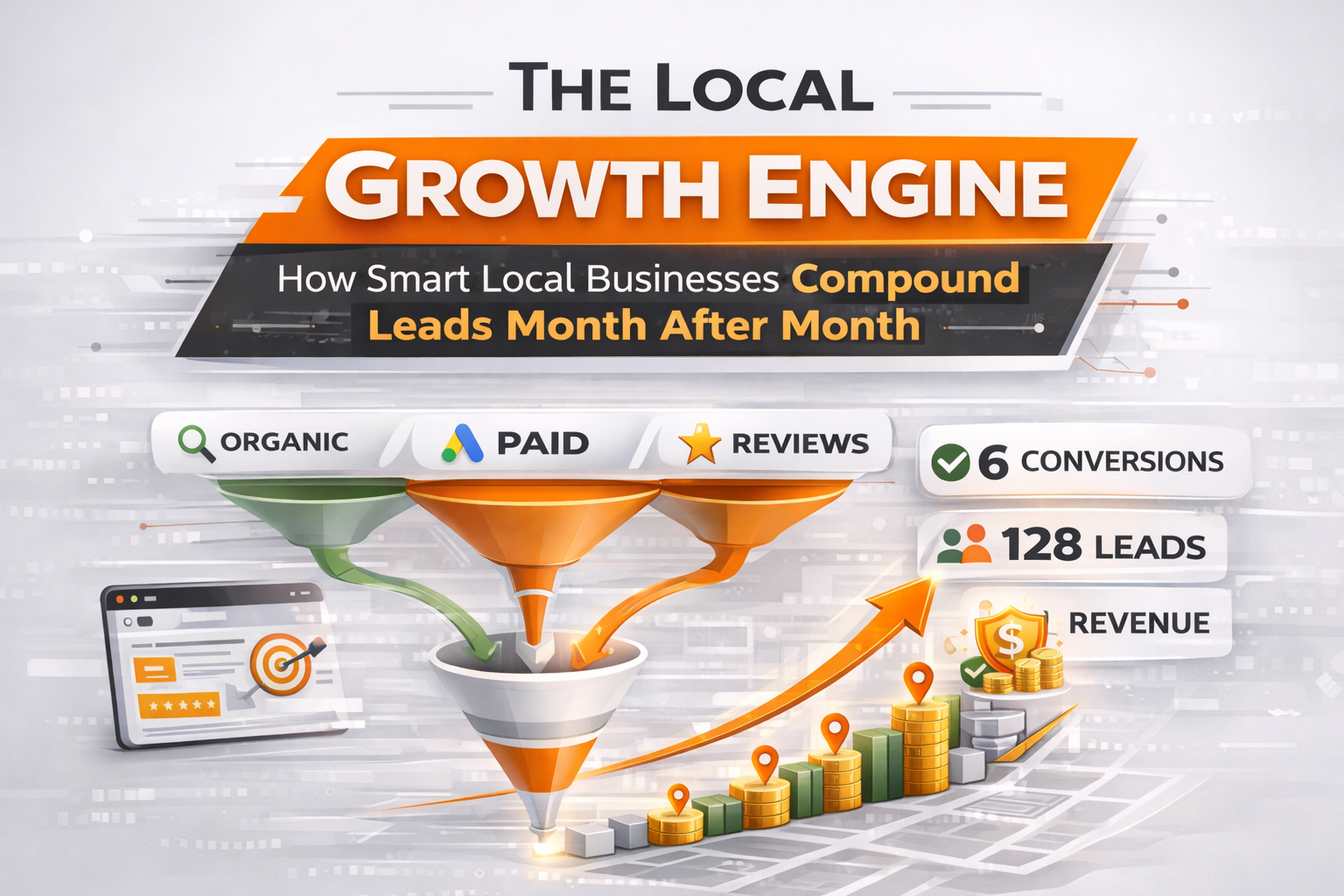
Most local marketing “works” but never compounds because channels operate in silos and feedback loops are missing. The Local Growth Engine is a system that connects SEO, Google Business Profile, reviews, paid ads, conversion assets, and call data into a single learning loop. Each month, insights from real leads sharpen messaging, targeting, and pages, which increases lead quality and lowers acquisition cost. Compounding happens when every new lead makes the system smarter.
Why Most Local Marketing Doesn’t Compound
Local businesses often feel like they are running on a treadmill:
- They post blogs and pages, rankings improve a bit, then plateau.
- They run ads, leads spike, then costs rise.
- They ask for reviews, ratings increase, but lead quality doesn’t.
- They change websites, conversions improve briefly, then flatten.
That is not because marketing “doesn’t work.”
It is because most marketing is campaign-based rather than system-based.
A campaign produces outputs.
A system produces learning.
Compounding is the result of learning loops.
What “Compounding Leads” Actually Means
Compounding leads means the same effort produces more results over time because the machine improves.
Signs you’re compounding:
- Cost per qualified lead drops over time
- Conversion rate rises without redesigning everything
- Better-fit customers show up more often
- Sales calls get easier because prospects are pre-sold
- Reviews start to “sound like your positioning”
- SEO content starts ranking faster because authority is established
- Ads become more profitable because targeting and messaging are sharpened
Compounding does not mean “do more.”
It means “the machine gets smarter.”
The Local Growth Engine Defined
The Local Growth Engine is an integrated local marketing system designed to compound leads by aligning five layers:
- Demand Capture: SEO, Maps, AI search visibility
- Demand Creation: Paid ads, retargeting, social distribution
- Trust & Authority: Reviews, citations, PR, proof assets
- Conversion Infrastructure: Landing pages, offers, follow-up
- Learning Loop: Call summaries, lead outcome tracking, CRO feedback
Most agencies stop at #1 or #2.
Smart local businesses build all five into a loop.
The Most Important Idea: Local Marketing Is a Feedback System
The Local Growth Engine works because it treats marketing like a feedback system.
Every week, you gather signals from:
- calls
- forms
- booked appointments
- objections
- no-shows
- “wrong fit” inquiries
- questions people repeatedly ask
- review language
- ad search terms
- GBP insights
Then you use those signals to update:
- ad copy
- negatives and targeting
- service pages
- FAQs
- offer framing
- scripts and intake
- GBP posts and Q&A
- review prompts
That is the compounding loop.
The 5 Layers of the Local Growth Engine
Layer 1: Demand Capture (SEO + Maps + AI Visibility)
This is the “existing intent” layer.
Goal: show up when people already want what you sell.
Components:
- Google Business Profile optimization
- Service and location pages
- Entity clarity (categories, schema)
- Content built around real questions
- Review language that reinforces specialty
Compounding signal: content ranks faster and Maps visibility increases as trust signals accumulate.
Layer 2: Demand Creation (Google Ads + Meta + Retargeting)
This is the “active lead flow” layer.
Goal: generate leads now while organic builds.
Components:
- Search campaigns for high-intent terms
- Call-focused campaigns
- Retargeting to convert researchers
- Offer testing (consult, assessment, quote, audit)
Compounding signal: cost per qualified lead decreases as targeting and messaging sharpen from lead outcomes.
Layer 3: Trust & Authority (Reviews + Proof + PR)
This is the “decision layer.”
People do not pick the best provider.
They pick the provider they trust.
Components:
- Review strategy (not just review collection)
- Before/after, case studies, outcomes, credentials
- Local press and authority mentions
- Clear differentiation and positioning
Compounding signal: conversion rate rises because trust friction drops.
Layer 4: Conversion Infrastructure (Landing Pages + Follow-Up)
This is the “make leads count” layer.
Components:
- Landing pages aligned with intent
- FAQs that remove objections
- Simple conversion flows (call, book, form)
- Speed-to-lead systems (text-back, follow-up sequences)
- Tracking for booked vs not booked
Compounding signal: higher booked rate even when traffic stays flat.
Layer 5: The Learning Loop (Call Data + Outcomes)
This is the layer most businesses do not have, which is why they do not compound.
Components:
- AI call summaries and categories
- Lead outcome tagging (qualified, booked, revenue)
- “Top objections” dashboards
- Search term mining from ads
- Content updates driven by real conversations
Compounding signal: messaging becomes sharper and lead quality improves month after month.
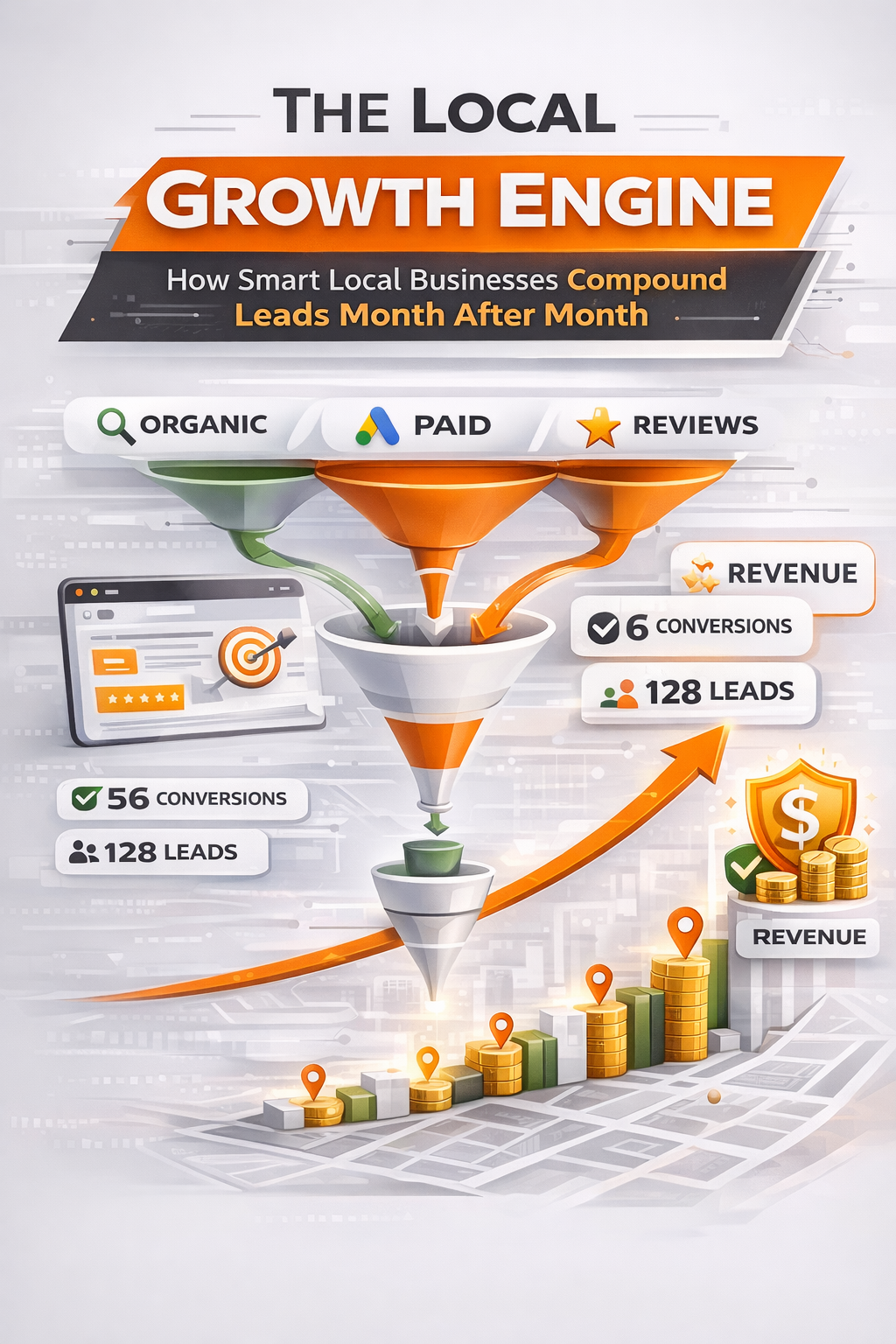
The Flywheel: How the Engine Compounds
Here is the compounding mechanism:
- Traffic and leads come in (SEO + Ads + GBP)
- Conversations happen (calls, forms, consults)
- AI summarizes and categorizes reality (intent, objections, quality)
- You update assets (ads, pages, FAQs, GBP, scripts)
- Higher-quality leads come in
- Better reviews and proof are created
- Authority increases
- SEO and ads perform better
- Repeat
It is not magic.
It is feedback.
Why “Silo Marketing” Fails
Silo marketing looks like:
- SEO team publishes blogs without using sales insights
- Ads team optimizes for clicks, not booked calls
- Reviews are collected passively
- Website copy never updates
- Nobody is accountable for lead quality
The Local Growth Engine fixes this by forcing alignment.
One truth.
One message.
One loop.
| Local Growth Engine Layer | Key Assets | Weekly Actions | Monthly Actions | KPI That Shows Compounding |
|---|---|---|---|---|
| Demand Capture (SEO + Maps) | GBP, service pages, location pages, schema | Update GBP posts/Q&A, fix listing issues | Publish 1 authority piece, improve internal linking | More calls from Maps, faster ranking |
| Demand Creation (Ads) | Search campaigns, call assets, retargeting | Add negatives, adjust bids, test 1 message | Create 1 new ad angle, refine landing page | Lower cost per qualified lead |
| Trust & Authority | Reviews, proof assets, PR mentions | Request reviews, respond to reviews | Publish 1 proof asset (case study or PR) | Higher conversion rate, less price pushback |
| Conversion Infrastructure | Landing pages, forms, booking flow, follow-up | Monitor speed-to-lead, fix friction | Improve top landing page, update FAQs | Higher booked rate |
| Learning Loop | AI call summaries, lead outcome tracking | Review themes and objections | Create “Top 10 insights” report and apply changes | Higher lead quality month over month |
How to Implement the Local Growth Engine (Without Overcomplicating It)
If you want execution that actually happens, use this cadence:
Weekly “Engine Meeting” (30 minutes)
- Top lead sources this week
- % qualified and % booked
- Top 5 objections
- Top 5 questions asked
- Any pattern in “wrong fit” leads
- One SEO update, one ad update, one conversion update
Monthly “Engine Upgrade”
- Publish one authority asset
- Improve one landing page
- Update one offer or script
- Improve review prompts and proof assets
- Expand one service cluster
Who This Works Best For
The Local Growth Engine works best for local businesses where:
- calls, form submission, and appointments are the main conversion
- lead quality varies widely
- trust matters (health, wellness, aesthetic, and home services)
- competition is heavy
- margins support optimization
It works in low-competition markets too, but the advantage is biggest where “generic marketing” loses.
The Most Contrarian Point
Most businesses think the path to growth is:
More traffic → more leads → more revenue
The Local Growth Engine assumes:
Better leads → better outcomes → better proof → more trust → more visibility → more leads
In local, quality creates volume.
Final Takeaway
If you want leads next week, run ads.
If you want leads next month, do SEO.
If you want leads that compound month after month, build a Local Growth Engine:
- Integrated channels
- Shared messaging
- Trust assets
- Conversion infrastructure
- A learning loop based on real conversations
That is how smart local businesses stop guessing and start compounding.
FAQs
What is the Local Growth Engine in simple terms?
A system that connects SEO, ads, reviews, conversion assets, and call data into a loop so every lead improves future performance.
How is this different from “doing SEO and ads together”?
Most businesses run both but do not connect insights. The Engine requires feedback loops: call themes and outcomes directly update ads, pages, GBP, and content.
How long does it take to see results?
You can see improvements in lead quality and conversion within weeks once the learning loop is active. Compounding becomes obvious over 60–120 days when assets and messaging have been iteratively improved.
Does this replace SEO?
No. It upgrades SEO by feeding it real-world demand and language from calls and conversions.
What’s the biggest reason local businesses fail to compound?
They do not measure lead quality and they do not operationalize learnings. Without a loop, they repeat the same work.