
Google Search vs. Performance Max for Local Businesses: What to Run First

Key Takeaway
Learn when a local business should start with Google Search, test Performance Max, follow the LSA migration path, or fix tracking first.
Two campaigns can give you twice the reporting and still optimize toward the same bad form fill.
That is the trap. Search and Performance Max are not inherently good or bad for local lead generation. What matters is whether you have decided what each campaign is allowed to do and what counts as a lead worth paying for.
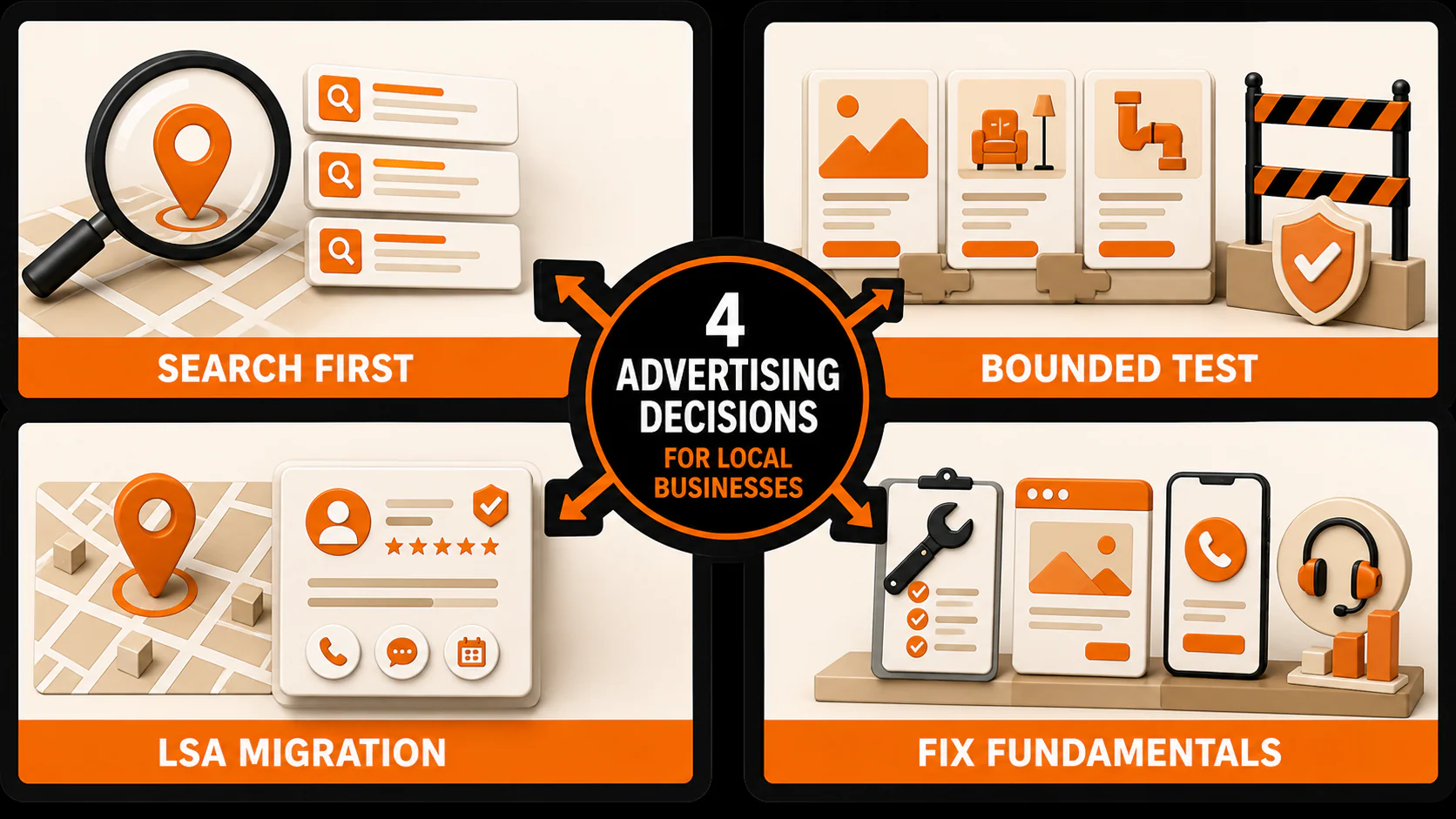
The practical answer is to start with Search when you still need deliberate control over queries, locations, messaging, and landing pages. Consider a bounded standard Performance Max test when broader Google Ads inventory is a conscious choice and your conversion and lead-quality signals are trustworthy. If you are being migrated from Local Services Ads, that is a separate product branch. And if your tracking, offer, or follow-up is broken, fix that before adding another campaign.
More dashboards are not more strategy.
What should your local business run now?
Use this as a decision table, not a universal prescription. Your live account settings, eligibility, service area, budget, policies, and ability to follow up on leads still matter.
| Path | When it makes sense | Why | Main risk |
|---|---|---|---|
| Search first | You need readable query feedback, tight geographic control, service-specific messaging, or a clear landing-page path | Search gives you a keyword-based environment for testing demand and message fit | A weak offer, bad location setup, or shallow conversion goal can still waste money |
| Bounded standard-PMax test | Your conversion goal, assets, pages, and lead-quality feedback are dependable, and you intentionally want access to broader Google Ads inventory | Standard PMax is goal-based and may use inventory across Google's channels | Automation can optimize toward an easy but worthless conversion if your inputs are weak |
| Specialized LSA migration path | Google has identified an eligible Local Services Ads account for migration | This is a pay-per-lead PMax campaign limited to Search and Maps, not ordinary cross-channel PMax | Treating it like standard PMax can lead to the wrong expectations and controls |
| Repair the fundamentals first | You cannot define a qualified lead, tracking is unreliable, calls go unanswered, or the offer and service area are unclear | A second campaign cannot repair a bad signal or broken handoff | Adding spend creates more activity without giving you a trustworthy business answer |
If you need the broader setup foundation before making this choice, start with the guide to running Google Ads for a local business.
Search and standard Performance Max do different jobs
Search is built around keywords. That gives you a deliberate way to connect a person's query with an ad message and a landing page. For a local service business, that control matters when the difference between "repair today" and "replacement estimate" changes the offer, the page, and the value of the inquiry.
Standard Performance Max is different. It is a goal-based campaign that may use all Google Ads inventory, including Search, YouTube, Display, Discover, Gmail, and Maps. Google describes it as a campaign type that complements keyword-based Search, but that does not prove the two will produce incremental qualified demand in your account.
Google's Performance Max documentation also explains an important overlap rule: when a query matches an exact-match keyword in a Search campaign, Search is prioritized. That is useful, but it is not a brick wall between the two campaigns. PMax may still serve on branded queries in documented situations, including when the Search campaign is limited by budget or uses stricter targeting.
The slogan "Search owns intent and PMax owns everything else" is not a reliable account plan. Your plan needs a role, a goal, and controls you can actually verify.
Pass this readiness gate before testing standard PMax
A local business does not need a magic monthly conversion number before it can even discuss PMax. The official evidence reviewed for this article does not establish a universal threshold, budget formula, learning period, or review cadence.
It does need answers to these questions:
What conversion should the campaign optimize toward?
A submitted form is an event. It is not automatically a qualified lead, a booked estimate, a completed job, or revenue.
Write down the conversion action you are using and the business meaning behind it. If every form submission is marked equally valuable, a spam inquiry and a perfect-fit request may look identical inside the platform.
What makes a lead qualified?
Keep the definition simple enough that the people answering calls and reviewing forms will use it consistently. Useful criteria may include:
- the requested service is one you provide
- the lead is inside your service area
- the timing is workable
- the person can take the required next step
- the inquiry is not spam, a vendor pitch, or a job application
This does not turn a lead into a customer. It gives you a cleaner stage between "Google counted something" and "the business received a real opportunity."
Are the offer, page, and assets ready?
Automation does not make a vague offer clearer. If the ad promises one service while the page drops people on a generic homepage, you have created a handoff problem before the campaign even starts.
The page should make the service, service area, qualification details, and next step obvious. The assets should accurately represent the business and the offer. If the offer itself is muddy, work through how to clarify your offer for better-qualified local leads first.
Who owns the feedback loop?
Somebody has to classify leads, note what booked, and catch obvious quality problems. If everyone assumes somebody else is doing it, nobody is.
The owner may be the person managing the account, the office manager, the sales team, or another clearly assigned operator. The title does not matter. The feedback does.
Can the business handle and protect the data?
If the plan involves call recordings, transcripts, customer lists, enhanced conversions, or CRM uploads, confirm the applicable consent, privacy, contractual, industry, and technical requirements before collecting or sending the data. Eligibility and setup also vary. This article is not legal advice, and a useful measurement idea is not permission to ignore those obligations.
When Search should remain the lead campaign
Search is the more responsible starting point when you need to learn what people are asking for and keep a closer grip on the path from query to page.
That is especially true when:
- the business is new to Google Ads
- the service or offer is still changing
- geography must stay tight
- different services need different messages and landing pages
- conversion tracking is thin or unreliable
- the asset library is weak
- the team needs clearer query feedback before broadening inventory
This is an editorial decision rule, not a claim that Search will outperform PMax. Search can still fail spectacularly with the wrong locations, loose keywords, generic copy, or bad conversion tracking. Control only helps when someone uses it.
For the bidding decision inside that foundation, use the separate guide to Google Ads automated bidding for local businesses instead of copying a one-size-fits-all bid strategy from somebody else's account.
When a bounded standard-PMax test is reasonable
A PMax test becomes more defensible when the business has a specific conversion goal, useful creative assets, relevant pages, and a dependable way to distinguish good inquiries from junk. You also need to want broader inventory on purpose.
That last point matters. Do not add PMax because the Search account feels too quiet or because a recommendation card says there is more opportunity. Decide what you are testing.
A clean hypothesis might be:
A standard PMax campaign focused on one established service can produce additional qualified inquiries inside our service area without weakening the quality and cost of the account's existing lead mix.
That is a hypothesis, not a promise. The account still needs starting controls, a baseline, a change log, and keep, change, or stop criteria based on its actual economics. It also needs enough budget to test without quietly starving the Search baseline, but no universal dollar amount can be prescribed from the evidence available here.
The controls that keep PMax from becoming a free-for-all
PMax has controls. The mistake is assuming those controls work exactly like Search keywords.
Search themes guide the system, but they do not fence it in
Search themes are optional and additive. They let you provide information about the queries you expect customers to use, but they are not a keyword list and they do not restrict PMax to those themes. Google says search themes have the same prioritization as phrase and broad match Search keywords, while exclusions and negatives still apply.
Use themes to guide. Do not describe them as targeting walls.
Negative keywords and brand exclusions solve different problems
Google supports campaign-level negative keywords and brand exclusions in PMax. Its documentation recommends brand exclusions rather than negative keywords when the intent is to prevent traffic tied to selected brands. Google also warns that negative keywords can restrict traffic that may be valuable.
That means "exclude the brand" is not a universal setup rule. Decide whether branded traffic belongs in the PMax test, review the tradeoff, and choose the control that matches the actual job. The same applies to negative keywords. Add them to prevent specific irrelevant traffic, not as a giant copied list that nobody has connected to the business.
See Google's guidance on PMax negative keywords and brand exclusions before making those changes.
Final URL expansion can change the page
Final URL expansion is on by default for standard PMax. Google may replace your submitted final URL with another page on the same domain that it considers more relevant. That can be useful when the site has strong, clearly separated service pages. It can be a problem when the business requires a tightly controlled landing-page path.
Google documents several Final URL expansion controls, including URL exclusions, URL rules, and turning the feature off. Review the live setting and the pages the campaign may reach. Do not assume the URL in your original ad plan is the only page in play.
Location and capacity still belong to the business
Check the campaign's location settings, the page's service-area language, and the team's actual capacity. An inquiry from the wrong county is not rescued by a pretty report. Neither is a lead for a service the business cannot schedule.
Measure business outcomes, not platform activity
A low cost per lead does not mean the campaign is working.
If the leads are out of area, asking for the wrong service, impossible to book, or plainly junk, the cheap campaign may be the expensive one.
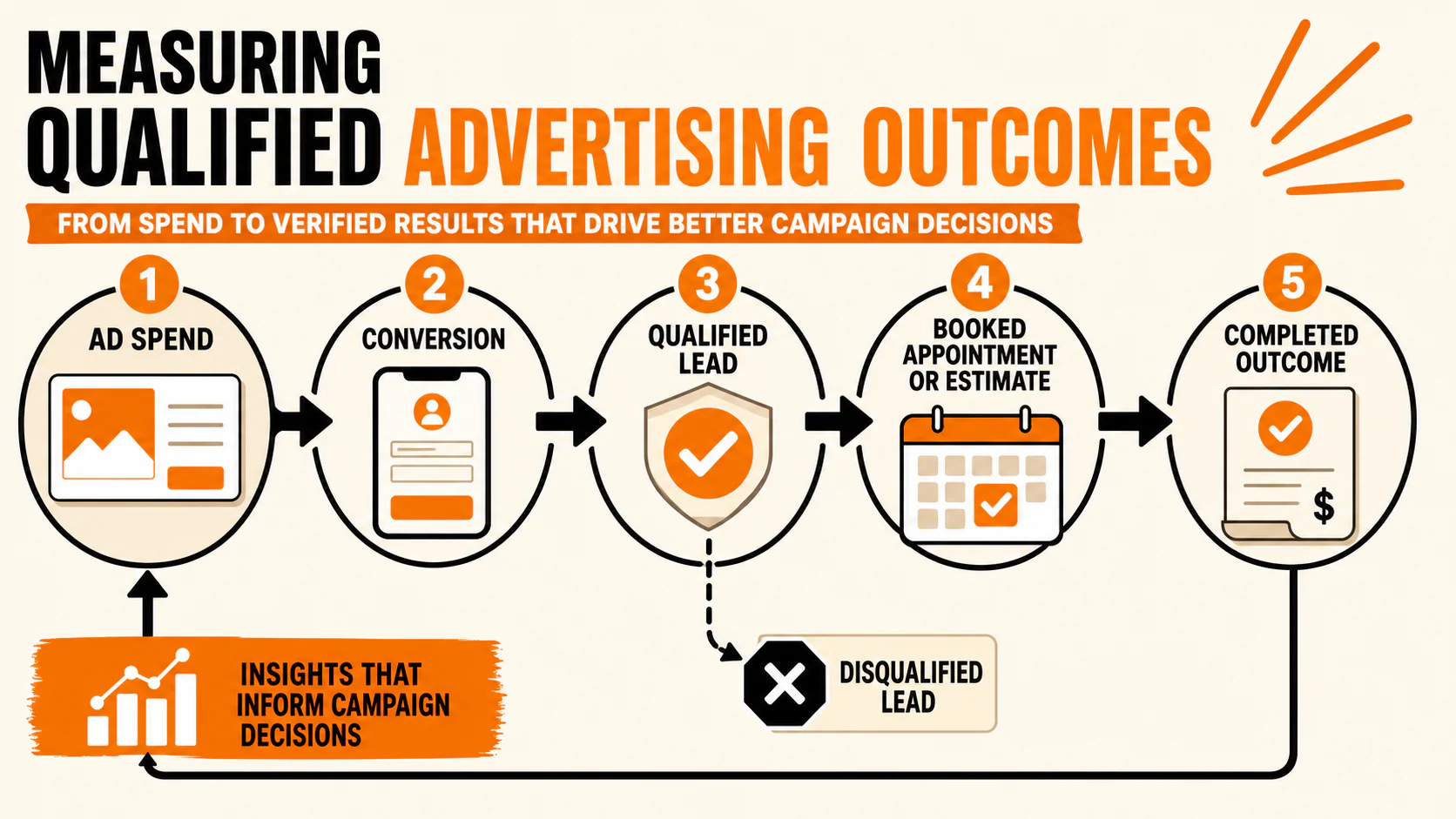
Build a scorecard that keeps funnel stages separate:
| Stage | What to record | What it does not prove |
|---|---|---|
| Conversion | Call, form, message, or other selected action | That the inquiry was relevant |
| Qualified lead | Service fit, geography, timing, and other documented criteria | That an appointment or estimate was booked |
| Booked appointment or estimate | The prospect accepted the next business step | That the appointment happened or a job was won |
| Completed outcome | A completed appointment, estimate, sale, or job when the business can verify it | That one campaign alone caused the outcome |
The gap between those rows is where a lot of bad advertising hides.
Google supports separate conversion actions for different funnel stages and provides qualified lead and converted lead goals for enhanced conversions for leads. Properly configured offline conversion imports can send later-stage outcomes back to Google Ads and may be used by Smart Bidding when the account settings and uploads support it.
Google's offline conversion import guidance is the place to confirm the current technical requirements. It does not establish that an import will improve your account. Upload timing, eligibility, conversion-column choices, data quality, privacy, and implementation all matter.
If calls are your primary lead source, the guide to why good reports can hide bad local leads goes deeper on the classification problem. Apply the consent and privacy rules relevant to your business before recording or analyzing calls.
Run a test you can interpret
Do not launch PMax, glance at the total conversions later, and declare victory. Search and PMax can interact, account demand can change, and the campaigns may not have identical roles.
Before launch, document:
- The baseline. Record total cost, selected conversions, qualified leads, booked appointments or estimates, completed outcomes when available, and the geography and service mix for the comparison period.
- One hypothesis. State what the PMax campaign is supposed to add or learn. Keep it narrow enough to judge.
- One campaign role. Name the service, audience need, or inventory choice the campaign is meant to explore. "Get more leads" is not specific enough.
- Starting controls. Record conversion goals, location settings, search themes, negatives, brand exclusions, Final URL expansion settings, URL rules, and relevant asset groups.
- A change log. Note changes to budget, bidding, creative, pages, goals, locations, and exclusions. Otherwise you will forget what moved halfway through the test.
- A review window that fits the account. Choose it from the business's conversion volume, sales cycle, budget, seasonality, and ability to collect later-stage outcomes. There is no universal number of days in this research packet.
- Keep, change, and stop criteria. Decide what business evidence earns more budget, what triggers a controlled adjustment, and what makes the test no longer defensible.
Compare the whole account as well as each campaign. A PMax campaign showing conversions does not prove those conversions were incremental. A Search campaign losing volume does not prove PMax stole it. Raw campaign totals tell you what was recorded, not what would have happened without the change.
Local Services Ads migration is a separate branch
Google is migrating eligible Local Services Ads accounts into a specialized Performance Max campaign with pay-per-lead goals. Despite the PMax name, Google says this campaign remains limited to Search and Maps and uses keywordless targeting.
That is not the standard cross-channel PMax campaign described in the rest of this article.
Eligibility and timing depend on Google's rollout and the live account. If you are in that migration path, review the current campaign notice and settings rather than following a generic standard-PMax launch checklist. The YEAH! Local guide to Google Local Services Ads explains the separate LSA model from eligibility through lead handling.
Make the campaign earn its role
Do not add Performance Max because the account feels too quiet. Add a standard PMax test only when you can say what it should do, what it may touch, and what qualified outcome would justify keeping it.
Search may be the right first move. Standard PMax may deserve a bounded test. An LSA migration may put you on a completely different branch. And sometimes the right advertising decision is to stop adding campaigns until the offer, tracking, page, or follow-up process is fixed.
That answer is less exciting than "run both and let the machine learn." It is also a lot more useful.
If you want help auditing those decisions and building the right campaign role for your business, see YEAH! Local's pay-per-click advertising services.
Last updated