

Key Takeaway
Learn how to turn AI call summaries into reviewed marketing decisions for SEO, Google Ads, lead quality, and follow-up without mistaking AI labels for proof.
AI call summaries can save you from listening to every minute of every call. They can turn a long conversation into sortable notes about the service requested, the caller's location, the objection, the next step, and what appeared to happen.
That is useful. The problem is that a neat summary can look more conclusive than it is.
An AI summary cannot prove that a lead was qualified or tell you whether the caller eventually booked, bought, or disappeared. It also has no direct effect on local rankings, Google Business Profile visibility, Google Ads bids, cost per lead, or revenue.
The summary is the start of the work. A person still has to check the label against the call and the real business outcome, choose one change to test, and measure what happened.
Do that, and call summaries can become a practical decision input for SEO, ads, lead qualification, and follow-up. Skip those steps, and you have a tidy pile of guesses.
What an AI call summary can capture
Call tracking tells you that a call happened and, depending on the setup, where it came from. A transcript gives you the conversation in text. An AI call summary tries to organize that conversation into fields you can review across multiple calls.
Useful fields may include:
- requested service
- caller location or service area
- urgency
- question or objection
- stated next step
- observed call outcome
Vendor capabilities vary, and the labels are not self-verifying. A system may call someone a qualified lead because the conversation lasted several minutes. Your business may define a qualified lead as someone in the service area who wants a service you provide and meets whatever other criteria matter to the sale. Those are different standards.
This is why a generic sentiment score is usually less useful than a small set of categories your team can define and correct. "Positive" does not tell you whether the person was eligible, booked an appointment, or needed a service you do not offer.
The distinction between a tracked call and a qualified opportunity matters well beyond AI. Our guide to why good call reports can hide bad leads explains that measurement gap in more detail.
Pass five checks before you use the data
The setup is not ready for marketing decisions until it passes five checks.
- Confirm permitted access to the call or transcript. Your recording, transcription, review, and data-sharing practices must be allowed for the calls in question. Requirements can depend on the jurisdiction, the people on the call, and the data involved. This article is not legal advice.
- Approve the data handling. Know which vendors create, receive, maintain, or transmit the recording, transcript, summary, and outcome data. Review access, storage, retention, security, and contract requirements before sending sensitive calls through another system.
- Make sure you have enough relevant calls to see a repeat. One odd call is an anecdote. A summary tool can sort it beautifully and it is still one odd call. Your review cadence should depend on usable call volume, staff capacity, and the time needed to observe a change. Weekly is not automatically right, and monthly is not automatically wrong.
- Check the summary against a real outcome source. Use a CRM, scheduling system, intake log, or another business record. Otherwise, "booked," "qualified," and "won" can become whatever the model guessed from the conversation.
- Name one accountable owner. Someone must review labels, correct the taxonomy, assign a test, and close the loop. If everybody can see the dashboard but nobody owns the next decision, the dashboard becomes expensive wallpaper.
Some clinics have an extra condition to address. When call content is electronic protected health information and HIPAA applies to the covered entity or business associate, an involved cloud service provider must have an appropriate HIPAA-compliant business associate agreement, and the parties still have to meet the applicable HIPAA requirements. HHS explains that cloud-computing boundary. That does not mean every clinic call is ePHI, and it does not certify any call-summary vendor. Get the appropriate legal, privacy, security, and compliance review for your situation.
Build a call-review loop you can trust
The goal is to shorten the distance between a real pattern and a careful decision without automating strategy.
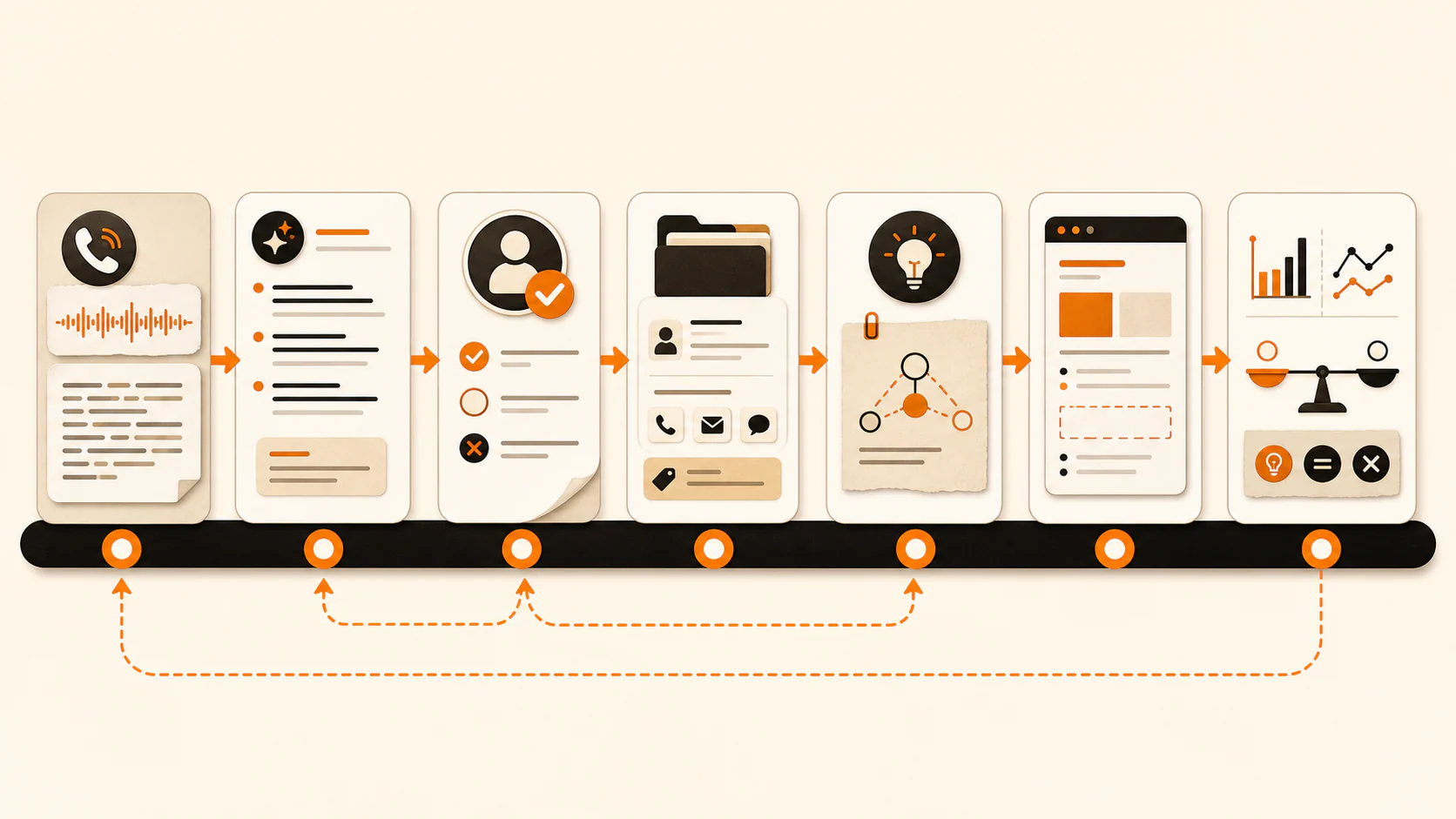
1. Define a qualified outcome
Write the definition before reviewing summaries. It might include the requested service, service area, eligibility, urgency, appointment status, or another business-specific condition. Do not let the AI tool quietly define "good lead" for you.
Keep the outcome separate from the call description. "Asked about financing" describes the conversation. "Qualified and booked" is a business outcome that needs confirmation.
2. Start with a small taxonomy
Use only fields tied to a decision somebody can make. Service requested, location, urgency, objection, next step, and outcome are a sensible starting point. Add a category when it changes an action. Remove one when nobody uses it.
3. Validate the labels
Review an initial set of calls or transcripts against the AI output. Correct false labels and unclear definitions. Then continue spot checks, especially after changing the prompt, model, vendor, taxonomy, or call-routing process.
If summaries keep confusing "asked about an appointment" with "booked an appointment," do not average the error into a report. Fix the category and review the affected calls again.
4. Match the call to the real outcome
Connect the reviewed summary to the record that shows what happened after the call. Only then can a conversation category become useful marketing evidence.
No outcome data? Stop at qualitative research. You may have a clue about what callers ask, but you cannot claim that the theme represents qualified leads, booked work, or revenue.
5. Choose one repeated pattern and one test
Group reviewed calls by a category that matters. Pick one pattern with a plausible action. Then choose one surface to change: a service page, an ad, a landing page, an intake script, or a follow-up process.
Changing five things at once creates a reporting problem. Even if the result moves, you will not know which change deserves credit.
6. Record the baseline, review window, and decision rule
Decide what you will compare before making the change. Use a measure tied to the hypothesis, such as the share of wrong-area calls, confirmed qualified-call rate, booked-call rate, or completion of a stated follow-up step. Choose a review window that fits call volume and the time needed for the change to affect behavior.
Then decide what happens next: keep the change, revise it, reverse it, or collect more evidence. "Looks better" is not a decision rule.
How reviewed summaries can inform SEO and service pages
Call summaries do not feed Google a ranking signal. They do not directly improve the Local Pack, Google Business Profile visibility, AI Overviews, or any other search surface.
What they can do is help a human editor notice repeated confusion. If reviewed calls show that people keep asking whether a service is available in a certain area, whether they are eligible, what the process involves, or which pricing factors matter, that may point to missing or unclear information on the site.
The next step is editorial judgment. Check the page. Confirm that the pattern is real and relevant. Then decide whether the answer belongs in a service section, eligibility note, pricing explanation, FAQ, or somewhere else.
Do not paste private caller language onto a public page. Do not turn every spoken phrase into a "keyword." And do not publish a page just because a topic appeared in the summaries. The question is whether clearer content helps the intended visitor make a better decision.
Repeated wrong-fit inquiries may also expose an offer problem rather than an SEO problem. Our guide to clarifying your offer for better-qualified local leads shows where service definitions, exclusions, and expectations fit.
How reviewed outcomes can inform Google Ads
Google Ads is where sloppy language causes the most trouble. Keep three layers separate:
- The AI summary or classification describes what the model thinks happened.
- The validated business outcome records what your team confirms happened.
- The configured Google Ads conversion route determines what data Google Ads can record or use.
Treat the AI summary as a draft classification. Google Ads uses a configured conversion action and, when you import an outcome, the validated business result that you supply. An unreviewed AI label does not become true when it enters an ad account.
Google documents a route for importing eligible phone-call conversion outcomes so they can be associated with ads and keywords. That phone-call import depends on the documented matching setup, including Google forwarding numbers for eligible click-to-call or call-only routes. Calls from other sources cannot be imported through that specific route.
Website-originated offline lead progression uses a different setup. Google's documentation distinguishes phone-call imports from enhanced conversions for leads and website-originated offline lead routes. The exact implementation and availability depend on the account and conversion path.
Configuration matters too. Google says primary conversion actions can be used for bidding, while secondary actions are observation-only. That is a reason to review conversion goals carefully. It is not evidence that sending more labels into the account will improve performance.
Before sharing conversion data, confirm permission under Google's conversion-data requirements and the rules that apply to your business. Google also warns that imported call conversions cannot be removed after import, which is a good reason to validate outcomes before sending them.
Once the measurement route is sound, reviewed call patterns can suggest a test. Wrong-area calls may justify checking location settings and service-area messaging. Repeated requests for a service you do not provide may justify reviewing search terms, negative keywords, ad copy, and the landing page together. These are hypotheses, not automatic fixes.
If you need to sort out campaign structure before adding call outcomes, start with our guide to Google Search versus Performance Max for local businesses.
Use the same process for lead quality and follow-up
Lead quality is not a label that marketing gets to declare alone. A caller may sound interested and still be outside the service area. Another may ask a basic question and later become a qualified opportunity. The business outcome is the check on the summary.
That makes the taxonomy useful across teams. Marketing can see which sources generate confirmed qualified calls. Sales or intake can see where callers get confused. Operations can see whether stated next steps were completed.
Keep attribution separate from causation. Connecting a call source to a confirmed outcome helps you understand the path. It does not prove that one channel, ad, or page caused the sale by itself. The local marketing attribution guide explains how to connect sources, qualified leads, and business outcomes without treating every tracked interaction as revenue.
Next-step fields can also create a useful review queue. If the summary says "send estimate" or "schedule consultation," a person should confirm that the task is accurate, assign it, and track completion. AI can surface the possible follow-up. It should not silently decide what the customer was promised.
For the operating side, use a defined follow-up process with owners and stop rules. This practical lead follow-up system covers that workflow.
Turn reviewed patterns into tests, not promises
The examples below are illustrations, not client results. Each row begins with a pattern that has already been checked by a person and matched, where relevant, to a real outcome.
| Reviewed pattern | Hypothesis | Possible action | Measure |
|---|---|---|---|
| Qualified callers repeatedly ask whether a specific service is available | The service page may not make the offering clear enough | Clarify the service description and where it applies | Confirmed qualified-call rate and repeated service-availability questions during the review window |
| Wrong-area calls recur from one paid campaign | Location settings, ad language, or landing-page service areas may be unclear | Audit campaign location settings and align the ad and landing page with the actual service area | Share of confirmed wrong-area calls from that campaign |
| Callers understand the service but hesitate at the next step | The page or intake process may leave the process unclear | Test a clearer process explanation or a revised intake step | Completion of the defined next step and confirmed booked-call rate |
| Reviewed summaries show promised follow-up with no matching completed task | The handoff between intake and follow-up may be breaking | Assign an owner and create a tracked follow-up step | Completion rate for the stated follow-up action |
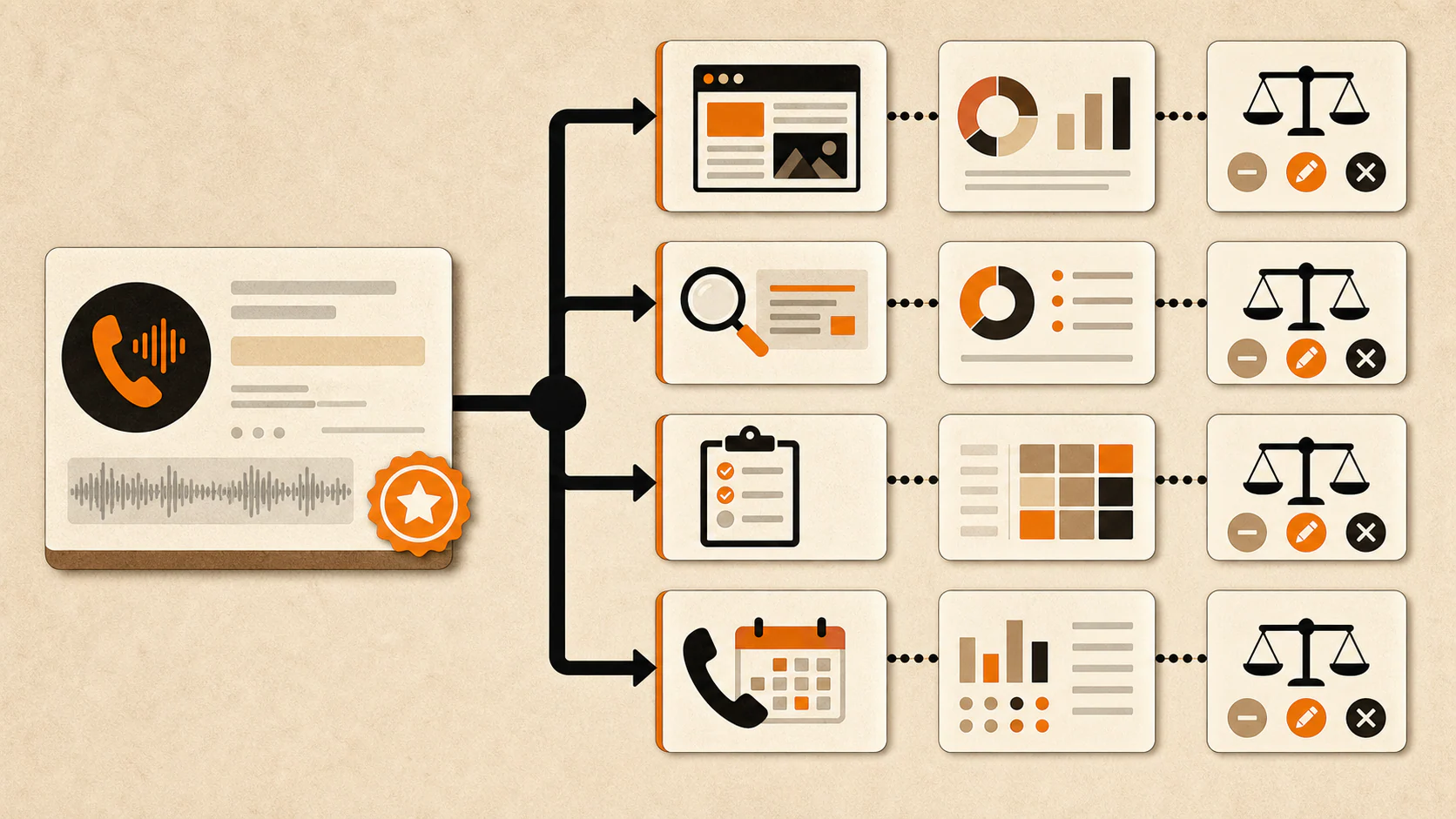
Notice what the table does not say. It does not promise lower cost per lead, better rankings, more bookings, or higher revenue. It gives you a reason to test a change and a way to judge it.
When this workflow is not ready
AI call summaries are a poor decision tool when the inputs and ownership are missing. Pause the workflow if:
- you do not have permission or an approved way to record, transcribe, review, or share the calls
- the vendor and data-handling requirements have not been reviewed
- call volume is too low or too mixed to support the pattern you want to claim
- there is no reliable record of the actual lead outcome
- nobody has time or authority to review and correct the labels
- the team wants the tool to choose strategy automatically
- the plan is to change several marketing and operational variables at once
There are useful fallback positions.
If the summaries are inaccurate, narrow the taxonomy and return to manual validation. If outcomes are missing, use the calls only as qualitative research. If call volume is thin, collect more relevant calls or avoid making a pattern claim. If the team wants to change five things, choose the one with the clearest owner and measure first.
Sometimes the right decision is to wait. A bad dataset processed faster is still a bad dataset.
Start with one reviewed pattern and one controlled change
The practical operating rule is simple: define the outcome, review the labels, pick one repeated pattern, make one controlled change, and check the agreed measure.
Keep the categories that help somebody make a decision. Fix or remove the ones that do not. Treat every AI summary as a draft until a person connects it to the call and the outcome.
If your call tracking, CRM outcomes, SEO work, and Google Ads reporting do not line up yet, YEAH! Local can help you build a measurement process that shows where the evidence stops and the next test begins.
Last updated