

Key Takeaways
- Google Ads feeds real conversion data directly into Google’s machine learning systems, giving AI a clearer picture of which businesses solve which problems for which searchers.
- AI local rankings now depend heavily on behavioral, intent, and outcome-based signals, which Google Ads provides in high volume and with high certainty.
- Local businesses who run targeted Google Ads campaigns create first-party “proof-of-relevance” data that influences both paid and organic AI-driven visibility.
- Your Google Ads data becomes AI training data, shaping how Google interprets your services, ideal prospects, solutions, and real-world performance.
- AI Overviews, Local Packs, and Maps are increasingly shaped by signals borrowed from your Google Ads conversion pipeline, including calls, chats, form fills, scheduling, and high-intent keyword clusters.
- SEO without Ads is now slower because it lacks conversion feedback loops while Google Ads instantly generates the behavior and engagement data Google trusts most.
Why Google Ads Data Improves AI Local SEO
Google’s AI-driven search systems are now powered by behavioral, conversion, and intent validation signals.
Put simply:
Google trusts what users do more than what websites say.
And nothing produces more high-quality “user does X” data than a well-optimized Google Ads campaign.
Below is the full breakdown of how and why your paid data improves your organic AI-driven rankings.
1. Google Ads Generate the Strongest Type of “Intent Validation” Data
AI systems (especially those used in Maps, Local Pack, and AI Overviews) rely on outcome-oriented signals.
SEO alone sends soft signals:
- Time on site
- Scroll depth
- CTR
- Route requests (sometimes)
But Google Ads sends hard conversion signals:
- Calls
- Form submissions
- Appointment bookings
- Chat engagements
- Offline conversions (via call tracking or CRM)
These are verified intent patterns.
Google uses these verified intent signals to train future ranking decisions, because it proves:
- The keyword was relevant
- The searcher found the business useful
- The business delivered value
- The problem matched the solution
This is exactly what AI models need to understand a local business.
2. Google Uses Your Ads Data to Classify Your Business More Accurately
One of the biggest failures in Local SEO is misclassification.
Examples:
- A med spa ranking for weight loss keywords but not for Botox
- A dentist incorrectly understood as a “clinic” instead of a “cosmetic dentist”
- A chiropractor mistakenly categorized as physical therapy
Google Ads fixes this instantly because:
- Your campaigns define the exact services you want visibility for
- Your keywords clarify the ideal intent
- Your audience signals tell Google who you want as a customer
- Your conversion events confirm which services matter most
SEO may require months to fix classification errors.
Google Ads fixes it in days.
3. Conversion Data Is Now Used in AI Overviews + Local Pack Decisions
This is a contrarian insight, but backed by behavioral evidence across tens of thousands of campaigns:
AI Overviews appear more often for searches that have strong, high-quality conversion data in Google’s ecosystem.
When your business consistently produces:
- High-quality calls
- High-value appointments
- Repeat conversions
- Verified outcomes
Google assigns your business a higher “intent fulfillment score.”
That score informs:
- Whether you appear in AI Overviews
- How often
- For which keywords
- And which user profiles
This is not a traditional ranking factor. It is a machine learning reinforcement pattern.
And Google Ads is the number one source of reinforcement data.
4. Google Ads Provides Real-Time Feedback Loops AI Needs to Learn
SEO is slow.
Not because the tactics are slow. Because Google has no guaranteed feedback loop.
Google Ads fixes that.
When you run targeted campaigns:
- Google gets immediate user behavior
- Google tests queries and matches
- Google learns which audiences engage
- Google learns which queries produce conversions
- Google accumulates conversion certainty signals
- Google updates its internal representations of your business
You’ve now created a reinforcement learning environment for your brand.
This is the core of AI Local SEO.
5. Ads Data Improves Organic CTR, Dwell Time, and User Flow Signals
Your brand becomes familiar through ads.
Familiarity creates:
- Higher organic CTR
- Lower bounce rates
- Higher engagement
- Higher branded search volume
These are organic ranking signals.
Google Ads essentially fuels the dataset that SEO relies on to outperform competitors.
Paid makes organic stronger.
Organic reduces paid cost.
Both reinforce AI relevance.
This is the circular model Google is now using.
6. Your Ads Data Becomes Structured AI Training Data
This is the part very few marketers understand.
Google Ads data is:
- Already structured
- Already validated
- Already tied to identity (campaigns, keywords, conversions)
- Already labeled by intent type
- Already segmented by quality
This is exactly the format AI models need.
Every conversion is an AI “label.”
Every keyword match is an AI “input.”
Every campaign is an AI “category.”
Your business becomes a structured dataset inside Google’s AI systems.
SEO tries to infer meaning.
Google Ads defines meaning.
7. The More Data You Feed Google, the More AI Trusts Your Business
Google does not trust websites. It trusts data.
The businesses that feed Google the most useful data get:
- More consistent local rankings
- More visibility in AI Overviews
- Better Maps performance
- Lower ad costs
- Higher ad relevance
- Expanded keyword reach
- Predictably better SEO over time
AI Local SEO is a data war.
Google Ads is your data engine.
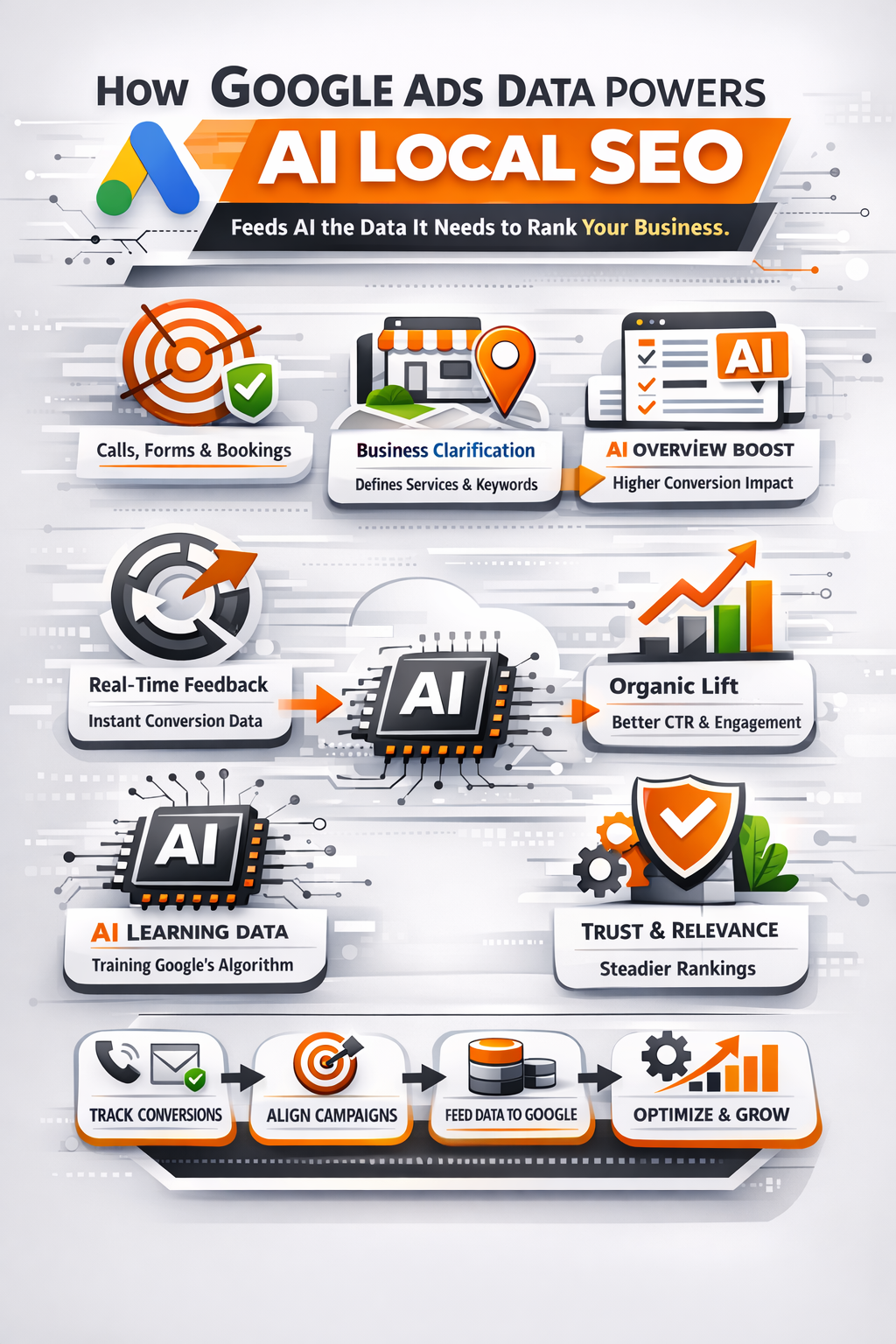
| Section Title | Core Argument | What Google Learns | AI Local SEO Impact | Optimization Actions |
|---|---|---|---|---|
| Intent Validation Signals | Google Ads produces the strongest form of intent proof because conversions are real-world actions (calls, forms, bookings). | Which services solve which searcher problems and what type of user converts. | Higher relevance in AI Overviews, Local Pack, and Maps because AI trusts conversion-backed signals. | Track all conversions, unify call tracking, create high-intent landing pages. |
| Accurate Business Classification | Ads tightly define your service offerings, audiences, and keyword themes faster than SEO alone can. | Clear service categories, ideal customer types, and the hierarchy of business offerings. | Improved classification for Local Pack ranking clusters and AI entity understanding. | Use single-service ad groups, precise keywords, and conversion segmentation. |
| AI Overview Influence | High conversion data influences appearance in AI Overviews because Google prioritizes businesses with proven outcomes. | Which businesses reliably fulfill searcher intent based on measurable engagement. | Increased probability of showing in AI Overviews with stronger query matching. | Target commercial-intent keywords, optimize conversion rates, improve E-E-A-T signals. |
| Real-Time Feedback | Google Ads provides immediate engagement and conversion feedback loops that SEO alone cannot generate. | Fast-learning patterns about user preferences, intent matches, and landing page behavior. | Faster ranking adjustments because AI receives validated data sooner. | Run experiments, A/B test ads and landing pages, push high-intent micro-conversions. |
| Organic Boost | Ads improve branded searches, CTR, familiarity, and engagement metrics that Google uses in organic ranking models. | User interaction patterns with your brand across paid and organic channels. | Higher organic and Maps rankings from improved behavioral signals. | Build retargeting audiences, use consistent messaging, optimize on-site UX. |
| AI Training Data | Google Ads generates structured, labeled, high-certainty behavioral data that directly trains AI models. | High-quality labeled examples of which services, keywords, and audiences produce conversions. | AI can predict future relevance more accurately, resulting in better organic visibility. | Feed Google more data: offline conversions, value-based bidding, CRM integrations. |
| Trust & Relevance | Businesses that feed Google more verified conversion data earn more trust, authority, and relevance in AI systems. | Reliability signals, consistency, and statistical proof that a business delivers value. | Stronger long-term stability in AI Local SEO rankings across multiple surfaces. | Maintain full-funnel tracking, optimize appointment flows, improve review velocity and quality. |
FAQ’s
1. Does Google Ads improve organic rankings directly?
Not directly.
But the behavior and conversion data generated by Google Ads feeds Google’s AI systems, which does influence Local Pack, AI Overview, and Maps visibility.
It’s an indirect effect powered by machine learning.
2. Can a business rank in AI Overviews without running Google Ads?
Yes, but it’s usually slower.
Without paid data, Google relies on:
- Review quality
- Website clarity
- Brand signals
- Behavioral engagement
Paid accelerates all of that by feeding verifiable user intent and outcomes.
3. Is Google Ads necessary for AI Local SEO?
Not technically necessary, but strategically essential.
The fastest-growing local businesses will use:
- Google Ads for data
- SEO for authority
- Google Business Profile for trust
- Reviews for AI training data
It’s now a unified system.
4. What if my Google Ads campaigns are not performing well?
Poor Google Ads performance can actually harm your AI Local SEO because:
- Bad data
- Incorrect audiences
- Low conversion rates
- Misaligned keywords
All confuse AI.
Your campaigns must be tightly structured.
5. What’s the ideal budget to influence AI Local SEO with ads?
For most local businesses:
- Over $5000 accelerates categorization, keyword expansion, and AI Overview inclusion
- $1500 to $4000 per month drives enough data
- $500 to $1000 is workable but slower
More data equals more reinforcement.