
Key Takeaway
Learn what reviews can and cannot do for AI search visibility, plus a privacy-aware workflow for healthcare, wellness, and aesthetic businesses.
Calling reviews "AI training data" sounds clever. It also claims more than the public evidence can carry.
Healthcare, wellness, medical, and aesthetic businesses should still take reviews seriously. Reviews help prospective customers judge a business. They can reveal recurring questions, praise, and frustration. They also exist on public platforms that search products and AI-generated answers may surface or summarize.
What reviews do not give you is a control panel for AI visibility. Google and other AI companies do not publish enough detail to tell you whether a particular review trained a model, was retrieved for an answer, affected a ranking, or carried more weight than another source.
That distinction is not nitpicking. It keeps a useful review program from turning into keyword coaching, privacy trouble, or a pile of made-up ranking promises.
The short answer
Online reviews can affect what people see and believe about a business. They may also appear as public source material on search surfaces. But there is no documented formula that lets a clinic turn specific review wording into an AI Overview mention, a ChatGPT recommendation, or a higher local ranking.
Google does say that machine-learning systems scan Maps contributions for suspicious activity. That is a fraud-detection statement in Google's Maps user-generated content policy. It does not prove that review text controls AI search answers or inclusion.
Different products also use different systems. Google Maps, local results, AI Overviews, AI Mode, ChatGPT, Gemini, and other assistants should not be treated as one giant algorithm. Our guide to AI local SEO and Google AI Overviews explains those search surfaces in more detail.
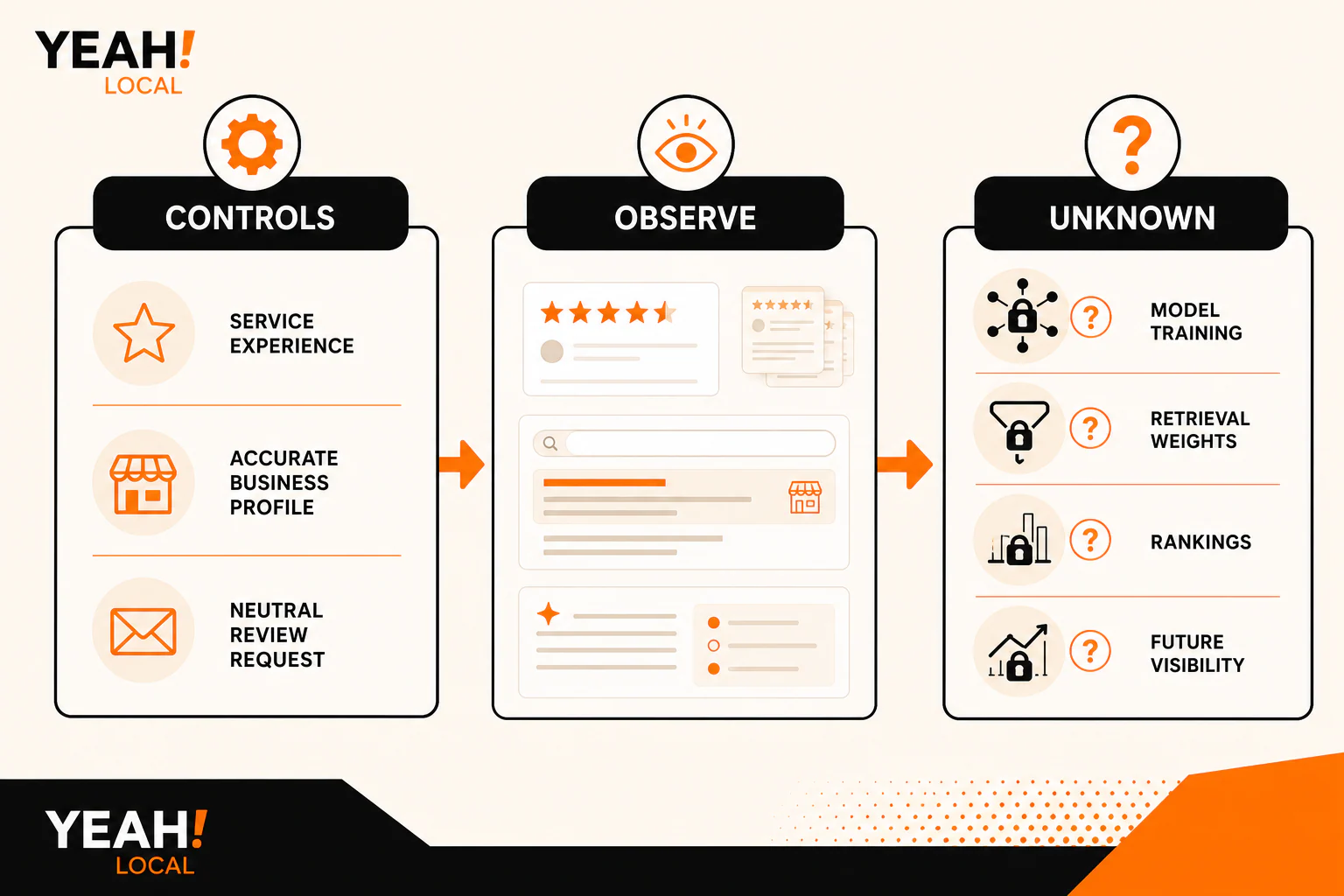
Here is the honest working model:
| What is known | What remains unknown | What to do next |
|---|---|---|
| Reviews are public third-party accounts that people can use when comparing businesses. | Whether a particular review was used to train a particular model. | Earn honest feedback by delivering a good experience and making the optional review process easy. |
| Reviews can contain recurring comments about communication, scheduling, service, and expectations. | How an AI system retrieves, weights, or summarizes those comments for a specific query. | Review recurring themes, verify them, and improve the business information people need. |
| Google has policies against fake engagement, incentives, selective positive requests, and attempts to influence review content. | Whether adding a service name or keyword to a review changes AI visibility. | Ask neutrally. Do not request a rating, keyword, staff name, treatment, diagnosis, or outcome. |
| Public review responses can expose sensitive information if handled badly. | Whether a response helps a business rank or appear in an AI answer. | Use a privacy-safe response process and move individual matters to a private channel. |
| You can observe AI answers, cited sources, profile accuracy, and website changes over time. | Whether one change caused a later mention or omission. | Monitor a fixed query set and record changes without claiming causation. |
Why reviews still matter without the hype
The case for reviews does not collapse when you remove the AI-training claim. It gets more practical.
Reviews help people make a decision
A star rating gives a quick signal. The comments can give a prospective customer more context about what dealing with the business felt like. That may include whether the office communicated clearly, whether scheduling was confusing, or whether the next step was explained.
A generic "Great service" review can still be sincere. It just does not tell the next reader much. There is no need to insult that reviewer or treat the comment as an SEO failure. Accept the feedback for what it is.
Reviews reveal recurring service themes
Patterns across genuine reviews can expose what customers notice. Repeated praise for clear explanations may point to a strength worth protecting. Repeated confusion about parking, forms, pricing, or follow-up deserves attention.
That is operational feedback, not an automatic marketing claim. Verify the theme against the actual business before changing website copy. A single dramatic comment is not a research study.
Reviews can improve public information
When recurring feedback shows that customers misunderstand a process, the business can improve its service page, FAQ, appointment instructions, or Business Profile. Accurate public information is a safer investment than trying to plant phrases in customer reviews.
Start with the basics. Our Google Business Profile optimization guide covers the fields and maintenance work that help customers find correct hours, services, contact details, and next steps.
Healthcare review requests need stricter guardrails
For a general local business, review manipulation is a policy and consumer-trust problem. In healthcare, wellness, and aesthetics, careless collection or response can also create a privacy problem.
Google's policy on prohibited and restricted review content bars incentives, selective solicitation of positive reviews, attempts to influence a rating or review content, and pressure to leave a review on the premises. Google also says fake-engagement violations can lead to removed reviews, warnings, or temporary review restrictions on a Business Profile.
The practical request is deliberately boring:
If you would like to share honest feedback about your experience, you can leave a review here: [review link]. It is completely optional.
Do not ask someone to mention a diagnosis, treatment, result, provider name, keyword, or target service. Do not send the public link only to people you expect to praise you. Do not trade a discount, product, drawing entry, or other benefit for a Google review.
The Federal Trade Commission's guide to soliciting online reviews adds US consumer-protection context. It tells marketers to seek reviews from people with real experience, follow platform rules, avoid positive-only solicitation, and handle incentives and material connections carefully. For Google reviews, the cleaner operating rule is to skip incentives.
This is practical marketing guidance, not legal advice. HIPAA coverage, state privacy law, professional-board rules, platform terms, and consent requirements can vary. Use your compliance process and legal counsel for the rules that apply to your organization.
Public responses can reveal more than you intend
A reviewer can choose to disclose personal information. That does not give the business permission to confirm it.
The safest public response does not confirm that the reviewer is a patient, received a service, spoke with an employee, attended an appointment, or discussed a condition. It also does not correct the public record by sharing private details. Move the conversation to an approved private channel without validating the relationship.
This is not a theoretical concern. The US Department of Health and Human Services Office for Civil Rights announced a settlement with Manasa Health Center involving protected health information disclosed in responses to negative online reviews. That enforcement record applies to its facts and HIPAA context. It is not a substitute for advice about your specific business.
A restrained public response might say:
We take feedback seriously. To protect privacy, we do not discuss individual matters here. Please contact [approved private channel] so the appropriate team member can review your concern.
Yes, that can feel impersonal. A public review thread is the wrong place to prove how much you know about the situation.
A safe review operating system
The best review strategy is an operating process, not a hunt for magic words.
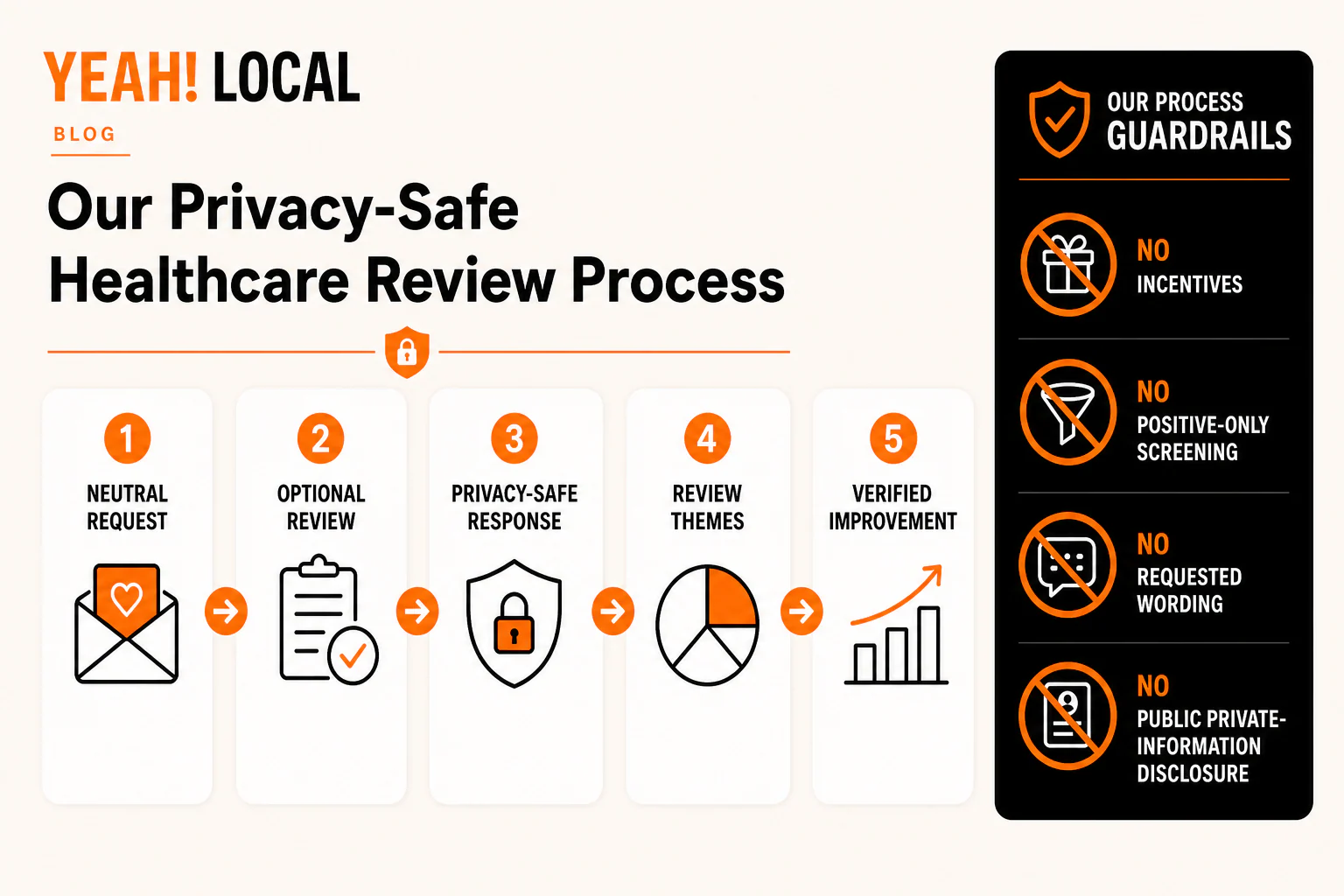
- Deliver the experience first. Fix the obvious service problems before asking public feedback to carry the reputation.
- Keep public facts accurate. Check the business name, categories, hours, location or service area, phone number, website, services, and appointment links.
- Choose a neutral trigger. Ask after a real interaction at a consistent milestone. Do not base the invitation on whether the person seems happy.
- Make feedback optional. Use a short neutral request and one direct link. Our guide to getting online reviews without being pushy explains the larger collection process, while these review request email templates provide neutral starting points.
- Respond with privacy in mind. Thank people when appropriate, avoid confirming any relationship or private fact, and route individual issues to an approved private channel.
- Review themes, not isolated drama. Look for recurring questions or friction across a reasonable body of feedback. Verify the issue with staff, policies, records, or other appropriate sources.
- Make supportable improvements. Update operations and public information when the evidence supports the change. Record what changed and when.
Turn recurring feedback into better marketing
Reviews can be useful market research, but only if you resist the urge to copy every customer phrase into an ad.
Start with recurring questions and points of confusion. If people repeatedly ask where to park, what to bring, how scheduling works, or what happens after an inquiry, answer those questions on the relevant page. If the website uses an internal term customers do not understand, replace it with plain language.
Keep the change within what the business can verify. A recurring compliment about clear communication can support a closer look at how the process is explained. It does not prove a universal patient outcome or make "best care in town" defensible.
Useful improvements may include:
- clearer service descriptions;
- more accurate appointment and eligibility information;
- FAQs based on recurring questions;
- better directions, parking, hours, and contact instructions;
- process descriptions that match what staff actually do;
- a clearer handoff from the website to the next approved step.
Do not copy private feedback into public marketing without appropriate permission and review. Do not turn one person's diagnosis, treatment, or result into a broad claim. The goal is to remove confusion, not build a testimonial factory.
Measure AI visibility without fooling yourself
AI answers can change. Prompts can produce different results across products, locations, accounts, and dates. A one-time screenshot is an observation, not a durable ranking.
Use a small, fixed monitoring set instead:
- Choose a stable list of realistic questions tied to the business, service, and market.
- Check the same products and prompts on a consistent monthly schedule.
- Record the date, exact prompt, answer, businesses mentioned, and sources cited or linked.
- Note whether the business profile and website facts were accurate at the time.
- Log meaningful website, profile, review-process, or operational changes.
- Compare patterns over time, keeping product changes, seasonality, location, personalization, and other marketing work in view.
Call this monitoring. Do not call it causal attribution.
If a business appears after a website update, you have a dated observation. You have not proved that the edit caused the mention. If it disappears the next month, that does not automatically mean the update failed. The system is opaque, and several variables can move at once.
No client analytics, review exports, AI citation log, Search Console data, or treatment-outcome evidence was supplied for this article. So there is no honest basis here for a review-count target, posting cadence, keyword formula, ranking promise, or lead forecast.
A 30-day action plan
Week 1: clean up the facts
Audit the Business Profile and relevant website pages. Correct hours, services, contact details, location information, and the next step. Write down the fixed prompts you will use for monthly AI-visibility monitoring.
Week 2: audit the request process
Find every review request sent by email, text, QR code, automation, or staff script. Remove incentives, positive-only screening, requested ratings, requested wording, and prompts for sensitive details. Confirm that the review link goes to the correct profile.
Week 3: set a response rule
Give the team a short public-response template and a clear private escalation path. Have the appropriate compliance or legal reviewer check the process for your organization.
Week 4: review themes and make one verified improvement
Look for recurring confusion or friction. Choose one change the evidence supports, such as clearer appointment instructions or corrected service information. Record the change, then monitor what happens without writing the victory speech in advance.
Reviews matter because real people read them, public platforms host them, and recurring feedback can make a business easier to understand. That is already enough reason to run the process well. You do not need to call reviews proven AI training data or promise an opaque system will reward the wording.
Frequently asked questions
Do online reviews train AI systems?
The broad claim is too imprecise to use as a strategy. The available evidence here does not establish that a particular business review trained a particular model or affects a specific AI search answer. Treat reviews as public customer evidence, not a direct instruction to an AI system.
Should we ask customers to include keywords in reviews?
No. Do not ask for keywords, service names, provider names, diagnoses, treatments, results, or other specific content. Ask for optional, honest feedback without steering the rating or wording.
Do more reviews improve local rankings or AI visibility?
This article does not provide a review count, cadence, star threshold, or causal ranking claim. Reviews can help customers evaluate a business. The evidence supplied for this article does not establish a formula linking review volume to local rankings, AI Overview inclusion, or another assistant's recommendations.
How can a healthcare business respond to reviews safely?
Do not confirm the reviewer is a patient or disclose treatment, appointments, conversations, or other private information. Use a restrained public response and move the matter to an approved private channel. Covered providers and other regulated businesses should follow their compliance process and get legal guidance for their situation.
What should we measure?
Track a fixed set of prompts, the date and product checked, cited sources, recurring review themes, profile accuracy, and meaningful website or operational changes. Keep visibility observations separate from leads, bookings, revenue, rankings, and clinical outcomes unless you have reliable data for each one.
Last updated