

Key Takeaways
- Reviews are no longer just reputation signals. They are AI-readable data.
- Google’s AI analyzes review language to understand services, outcomes, and patient types.
- Detailed reviews strengthen entity clarity and authority.
- Generic reviews weaken differentiation and AI visibility.
- Clinics that strategically guide reviews improve lead quality and search performance.
- Reviews now influence Maps, AI Overviews, and local ranking simultaneously.
The Shift: From Social Proof to Structured Data
For years, healthcare, wellness, and aesthetic businesses treated reviews as:
- Star ratings
- Reputation management
- Conversion boosters
That mindset is outdated.
In today’s AI-driven search environment, reviews function as:
- Linguistic training data
- Behavioral validation signals
- Service classification indicators
- Outcome reinforcement patterns
Google’s AI reads reviews like qualitative datasets.
They help the algorithm answer questions such as:
- What does this clinic actually specialize in?
- What patient types are common here?
- What outcomes are consistently mentioned?
- Is the reputation aligned with the website claims?
Reviews are no longer passive reputation assets.
They are structured intelligence.
How Google’s AI Uses Reviews
1. Service Understanding
When reviews mention:
- Specific treatments
- Conditions
- Technologies
- Outcomes
AI strengthens its understanding of your service profile.
For example:
“Dr. Smith helped my hormonal imbalance after years of frustration.”
That review reinforces:
- Hormone optimization
- Long-term care positioning
- Emotional transformation
- Patient satisfaction
Generic review:
“Great staff and friendly office.”
That adds almost nothing to AI comprehension.
2. Entity Reinforcement
Google operates on entities, not keywords.
When reviews repeatedly mention:
- Your clinic name
- Specific providers
- Treatment types
- Geographic markers
It solidifies your digital entity.
Consistency across:
- Website
- Google Business Profile
- Reviews
- Citations
…reduces algorithmic uncertainty.
AI prefers clarity.
3. Behavioral Validation
AI looks for signals from real humans:
- Call
- Book
- Leave detailed feedback
- Mention results
Volume matters.
But depth matters more.
A smaller number of detailed, treatment-specific reviews often outperforms large volumes of vague praise.
4. Intent Alignment
Reviews reveal:
- Why patients chose you
- What objections they had
- What convinced them
- What outcomes they value
This language informs:
- AI summaries
- Local pack rankings
- Search result snippets
- Patient decision-making
If your reviews do not reflect your ideal positioning, AI will not reinforce it.

Why This Matters More in Healthcare, Wellness, & Aesthetic Services
Healthcare, wellness, and aesthetic services fall into high-trust categories.
Google applies stricter evaluation standards.
AI asks:
- Is this provider credible?
- Are results realistic?
- Are experiences consistent?
- Does the language match the claims?
Reviews become real-world evidence.
They bridge marketing and lived experience.
The Hidden Cost of Generic Reviews
Most clinics passively collect reviews.
That leads to:
- “Highly recommend!”
- “Five stars!”
- “Great service!”
While positive, these reviews:
- Do not clarify specialties
- Do not reinforce outcomes
- Do not differentiate you
- Do not strengthen AI visibility
They create rating inflation, not authority.
How to Turn Reviews Into Strategic AI Signals
1. Guide, Don’t Script
You cannot control reviews.
But you can guide reflection.
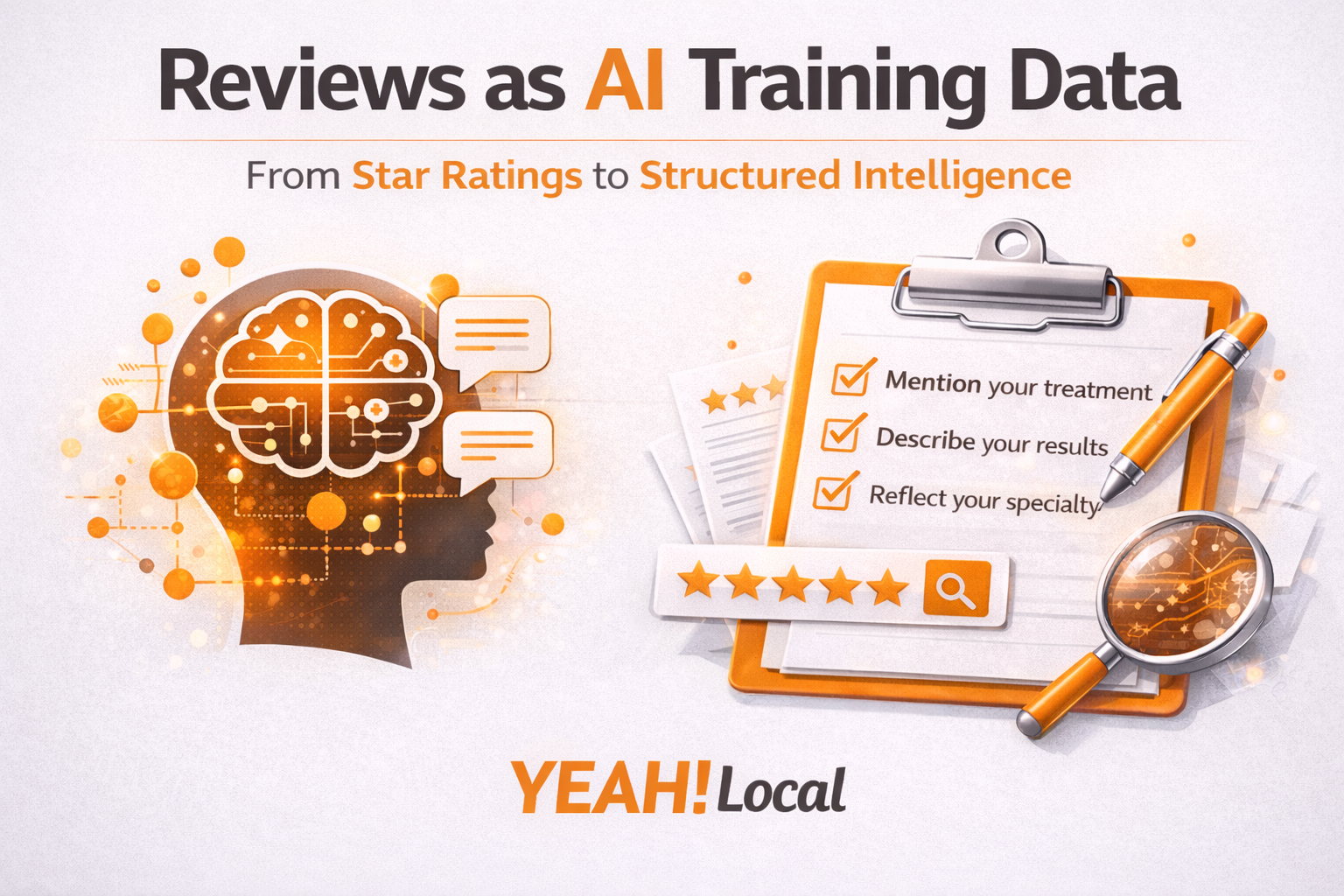
Encourage patients to mention:
- What treatment they received
- What problem they had
- Why they chose you
- What result they experienced
- What type of patient they are
This builds contextual data.
2. Align Reviews With Positioning
If your positioning is:
“Hormone optimization for high-performing women 35–55”
But your reviews mostly say:
“Friendly staff!”
There is a messaging misalignment.
AI will reinforce what it sees most often.
3. Use Reviews to Improve Messaging
Reviews reveal:
- Patient vocabulary
- Objections
- Transformation themes
- Emotional drivers
This should inform:
- Website copy
- FAQs
- Ad messaging
- Service page refinement
Reviews are market research.
4. Monitor Thematic Patterns
Look for repeated phrases such as:
- “Finally listened to”
- “Explained everything clearly”
- “Didn’t feel rushed”
- “Natural-looking results”
- “Comprehensive evaluation”
These themes indicate your real competitive edge.
AI sees repetition as validation.
Passive Reviews vs Strategic AI Review Strategy
| Category | Passive Review Strategy | AI-Driven Review Strategy | Business Impact |
|---|---|---|---|
| Collection Method | Ask for “a review” | Ask for experience details | Richer context |
| Content Depth | Short praise | Treatment + outcome + context | Stronger AI signals |
| Positioning Reinforcement | Inconsistent | Aligned with specialty | Clearer differentiation |
| SEO Impact | Minimal | Entity strengthening | Better visibility |
| Lead Quality | Broad inquiries | Ideal patient attraction | Higher conversions |
| Messaging Insights | Ignored | Analyzed for themes | Sharper copy |
| Reputation Management | Reactive | Strategic | Compounding trust |
| AI Overviews Influence | Weak | Higher citation probability | Competitive advantage |
Reviews, Maps, and AI Overviews Are Now Connected
Google’s ecosystem is integrated.
Reviews influence:
- Local Pack rankings
- Map visibility
- AI-generated summaries
- Suggested providers
- Snippet highlights
The clinics that dominate are not just well-reviewed.
They are well-understood.
The Compounding Effect
When reviews:
- Reinforce positioning
- Mention treatments
- Reflect outcomes
- Align with website messaging
You create a flywheel:
Clear Positioning
→ Detailed Reviews
→ Stronger AI Understanding
→ Higher Visibility
→ Better Patients
→ Better Reviews
This is not reputation management.
This is growth infrastructure.
Final Thought
If you treat reviews as marketing garnish, you will get surface-level benefits.
If you treat reviews as AI training data, you build structural authority.
In healthcare, wellness, and aesthetics, trust is everything.
AI is simply measuring it at scale.
FAQs
Do star ratings still matter?
Yes, but the language inside the review carries increasing weight in AI systems.
Can clinics influence what patients write?
You cannot script reviews, but you can guide patients toward reflecting on their experience more thoughtfully.
Are review keywords important?
Exact-match keywords matter less than contextual clarity and repetition of meaningful themes.
How many reviews are enough?
There is no fixed number. Consistency, recency, and depth matter more than raw volume.
Do reviews affect AI Overviews?
Yes. Reviews influence entity clarity, trust evaluation, and thematic reinforcement, all of which impact AI summaries.
Should clinics respond to reviews?
Yes. Responses add additional contextual data and demonstrate engagement, which reinforces credibility.