
Key Takeaway
Health and wellness marketing sounds generic when claims lack proof. Use this practical framework to make your message specific, credible, and useful.
Your website can be attractive, professional, and completely forgettable.
That sounds harsh. It is also a useful problem to admit, because a new color palette or another round of homepage edits will not fix it. Pretty is not the same as persuasive.
Look at the language common to health, wellness, medical, and aesthetic websites:
- Personalized care
- A holistic approach
- State-of-the-art technology
- An experienced team
- Patient-centered treatment
Any one of those statements might be true. The trouble is that a nearby practice can probably say the same thing. The words describe the category, not the practice.
The culprit is usually upstream: generic marketing is a positioning and proof problem before it is a design or copy problem. If the practice has not decided who it is best equipped to help, what is observably different about its process, and what evidence supports that difference, the writer has nothing solid to work with. So the copy falls back on safe adjectives. Polished words, empty center.
The fix is not to sound louder. It is to become more specific without wandering into claims you cannot support.
Templates do not create the problem. They expose it.
A template is not automatically bad. A familiar page structure can make a website easier to use. A service page still needs a clear title, an explanation of the service, practical details, and a next step.
But a template cannot decide your positioning for you. When you pour an undefined offer into a standard layout, you get a standard message. Swap the logo and treatment names, and much of the page could belong to somebody else.
The same thing happens in other channels:
- Ads can default to discounts when the underlying reason to choose the practice is unclear.
- Social posts can repeat broad health tips when nobody has chosen a useful point of view.
- Service pages can list procedures without explaining the process around them.
- AI-assisted drafts can repeat category language when the input contains no practice-specific facts.
AI tools can produce this sameness faster. They cannot supply the missing decisions or credible proof. That part still belongs to the practice.
Promotions can expose the same weakness. A limited offer may give someone a reason to act, but it does not explain why your practice is the right choice. When every message depends on a discount, the offer starts doing work that positioning should have done first.
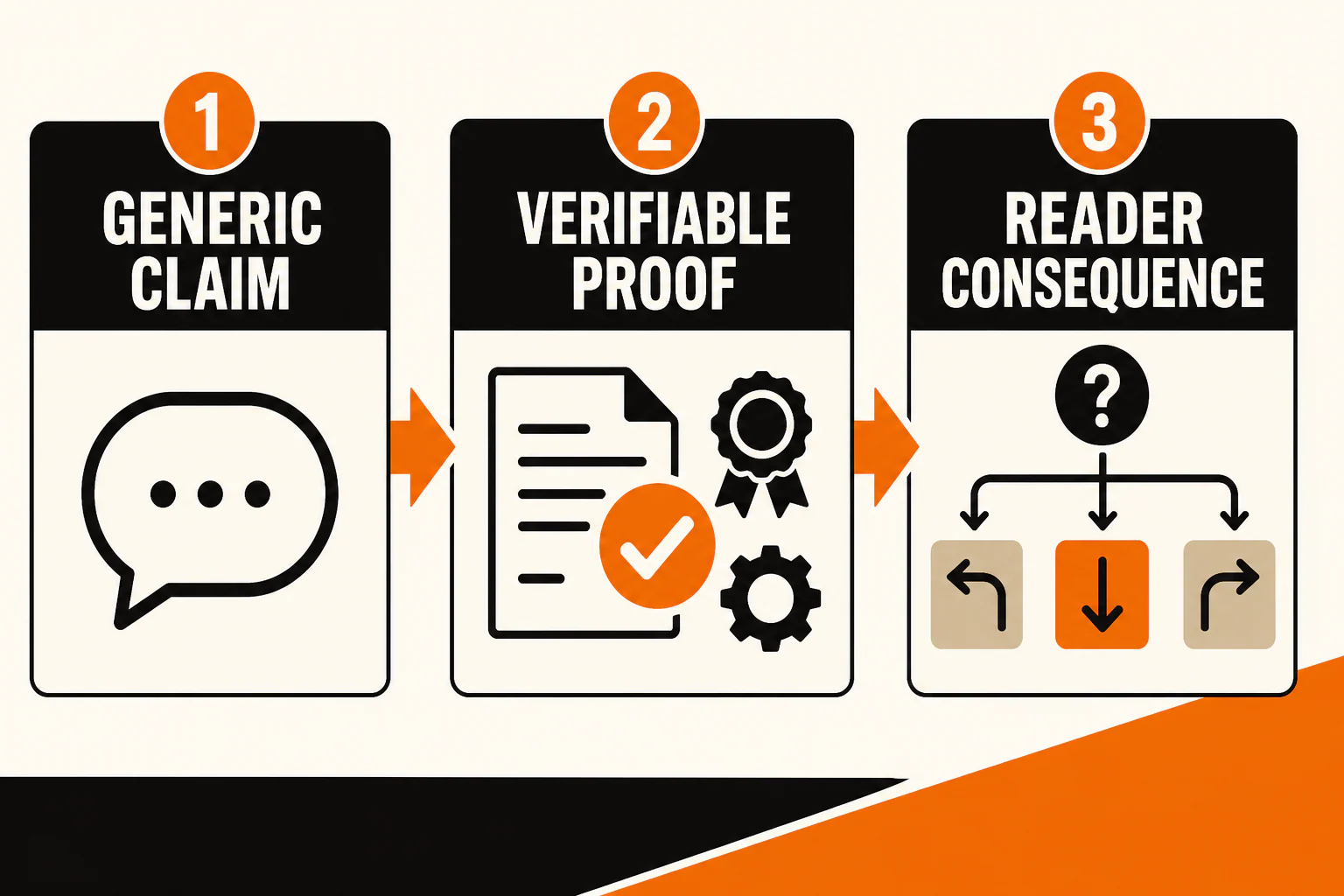
Use the claim, proof, consequence test
Run every important marketing message through a simple three-part test:
- Generic claim: What broad statement are you making?
- Verifiable proof: What fact, process, credential, or authorized evidence makes that statement true?
- Reader consequence: What can the reader understand or do because of that proof?
The third part is easy to get wrong. A reader consequence explains the practical meaning of the proof. It does not promise a clinical or business outcome.
Consider "personalized care." By itself, it says very little. A stronger version might explain that every new client begins with a defined consultation, that the provider reviews stated goals and relevant history, and that recommendations are discussed before a plan is selected. Those details must reflect the practice's real process. The reader consequence is that a prospective client knows what the first appointment includes and can decide whether that process fits what they want.
Here are three hypothetical examples. Use them as a structure, not as copy to paste.
Wellness practice example
- Generic claim: "We take a holistic approach."
- Possible proof: "If accurate, explain which parts of the client's situation the initial assessment covers, who conducts it, and how long the appointment is scheduled for."
- Reader consequence: "The reader can see what 'holistic' means at this practice and arrive with the right information."
Aesthetic practice example
- Generic claim: "We create customized treatment plans."
- Possible proof: "If documented, explain that a consultation happens before treatment selection, who performs it, and which factors are reviewed."
- Reader consequence: "The reader understands that the practice does not treat a menu choice as a substitute for an assessment."
Clinic example
- Generic claim: "We make care convenient."
- Possible proof: "List the actual operational details, such as online scheduling, stated appointment windows, onsite services, or a documented follow-up process."
- Reader consequence: "The reader can compare the process with their schedule and needs."
Notice what these examples do not say. They do not promise a treatment result. They do not claim superiority. They do not call the practice "best in class" and hope nobody asks what that means.
Specificity is not about adding more adjectives. It is about replacing adjectives with facts.
Build your positioning before rewriting the homepage
Do not open the website editor yet. First, answer five questions in plain language:
- Who are we best equipped to help? Describe the relevant situation, need, or service fit. Avoid turning this into an unsupported demographic or medical conclusion.
- What situation are they trying to resolve? Use the language people use in inquiries when you have permission to review it.
- What is observably different about our process? Name something a reader could verify, such as scheduling, consultation structure, provider credentials, service scope, or follow-up steps.
- What evidence supports that difference? Identify the source before writing the claim.
- What should the reader understand next? Choose a practical next step, not a guaranteed outcome.
Then write one sentence:
We help [appropriate audience or situation] understand or access [specific service] through [verifiable process], so they can [practical next step or decision].
It may not be homepage copy. That is fine. Its first job is to force a decision.
If that sentence still sounds broad, the issue may be the offer itself. This guide to clarifying an offer for more relevant inquiries goes deeper into the audience, problem, process, proof, and next-step decisions behind the message.
Narrowing a message does not require refusing everyone outside a tiny profile. It means making the strongest fit visible. A practice can offer several services while giving each important page a clear reader, situation, and purpose.
Carry the positioning through every channel
Positioning that lives in a worksheet is not positioning. It has to change what a prospective client sees, hears, and understands.
Service pages: explain the decision, not just the procedure
A useful service page should help the reader understand:
- Who the service may be relevant for, within the practice's approved scope
- What happens before, during, and after the appointment
- Who provides the service and what documented credentials matter
- Important limitations, prerequisites, and questions to discuss
- What the next step involves
This is where vague claims such as "advanced care" should either earn their place or disappear. Name the technology, credential, or process only when it is accurate, current, and meaningful to the reader. Do not imply that a named device or credential guarantees a result.
Educational content: answer real questions with real boundaries
Publishing more is not the goal. Publishing material that helps a reader make a decision is.
A useful guide might explain how a consultation works, what factors affect candidacy, what cost variables a practice can responsibly discuss, or which questions someone should ask before booking. It should also say what cannot be decided from a web page.
Google's official guidance asks creators to focus on helpful, reliable, people-first content. That supports a straightforward editorial rule: write for the person trying to understand the service, not for a content calendar that needs another box checked.
Reviews and testimonials: useful, but not free copy
Reviews can show what people noticed about the process, communication, or environment. They can also raise privacy, permission, and substantiation questions.
Do not assume that a public review is automatically cleared for reuse in an ad, email, or website testimonial. Confirm permission and the practice's applicable privacy and compliance requirements before republishing it. Do not coach someone to make a result claim. If you ask for feedback, use open-ended questions and let the person choose what to share.
Health-related advertising deserves extra care. The FTC's Health Products Compliance Guidance says health-related claims must be truthful, not misleading, and appropriately substantiated for the claim being made. That is a general US guardrail, not legal advice or a substitute for reviewing a specific campaign.
Ads and social posts: make one specific promise you can keep
An ad does not have room for the whole positioning worksheet. It should carry one clear idea into a matching page.
If the ad promotes a consultation, explain what that consultation actually includes. If it promotes a service, match the claim and next step on the landing page. If it uses a discount, keep the eligibility, terms, and value clear. A promotion can support positioning, but it should not replace it.
Use an evidence hierarchy before you make the claim
Not every type of proof deserves equal confidence. Start with the evidence closest to the statement you want to make.
| Evidence level | Examples | Safe marketing use |
|---|---|---|
| Direct practice facts | Hours, locations, provider names, credentials, service availability, appointment steps | State accurately and keep current |
| Documented process details | Consultation structure, scheduling flow, communication steps, follow-up policy | Explain what the reader can expect, without promising a result |
| Authorized third-party feedback | Reviews or testimonials with confirmed reuse permission | Preserve context and avoid turning one person's experience into a typical outcome |
| Treatment or outcome claims | Clinical benefits, comparisons, expected results, before-and-after implications | Use only with appropriate substantiation and the necessary compliance review |
The safest strong copy often comes from the first two rows. Those facts may feel less dramatic than a sweeping promise, but they are more useful. They tell a reader what actually happens. In this category, boring and provable beats exciting and vague.
Credentials need context too. Do not pile initials onto a page and make the reader decode them. State the credential accurately, identify who holds it, and explain why it matters to the service when that connection is supportable.
What specificity can and cannot do for search and AI
Clear pages can make a practice's services, people, locations, and processes easier for readers to understand. That same clarity may also make the information easier for search systems to interpret. It does not guarantee a ranking, an AI citation, or inclusion in a particular answer.
That distinction matters because "AI visibility" can become the newest vague promise in marketing. A page should not claim that generic language is penalized or that adding a few entity terms will make an AI system prefer the business.
The durable work is less exciting and more useful:
- Keep the practice name, provider information, locations, and service facts consistent.
- Explain important services with enough context to answer the reader's question.
- Show who created or reviewed the content when that information is available.
- Update facts when the practice, service, or process changes.
- Make limitations and next steps clear.
For a focused next step, read how to make a local clinic's information easier to understand in AI search. The related guide to how Google evaluates medical, wellness, and aesthetic websites covers trust and documentation questions in more detail. Neither topic changes the basic rule here: help the human reader first, then measure external visibility separately.
Measure the inquiries, not just the counter
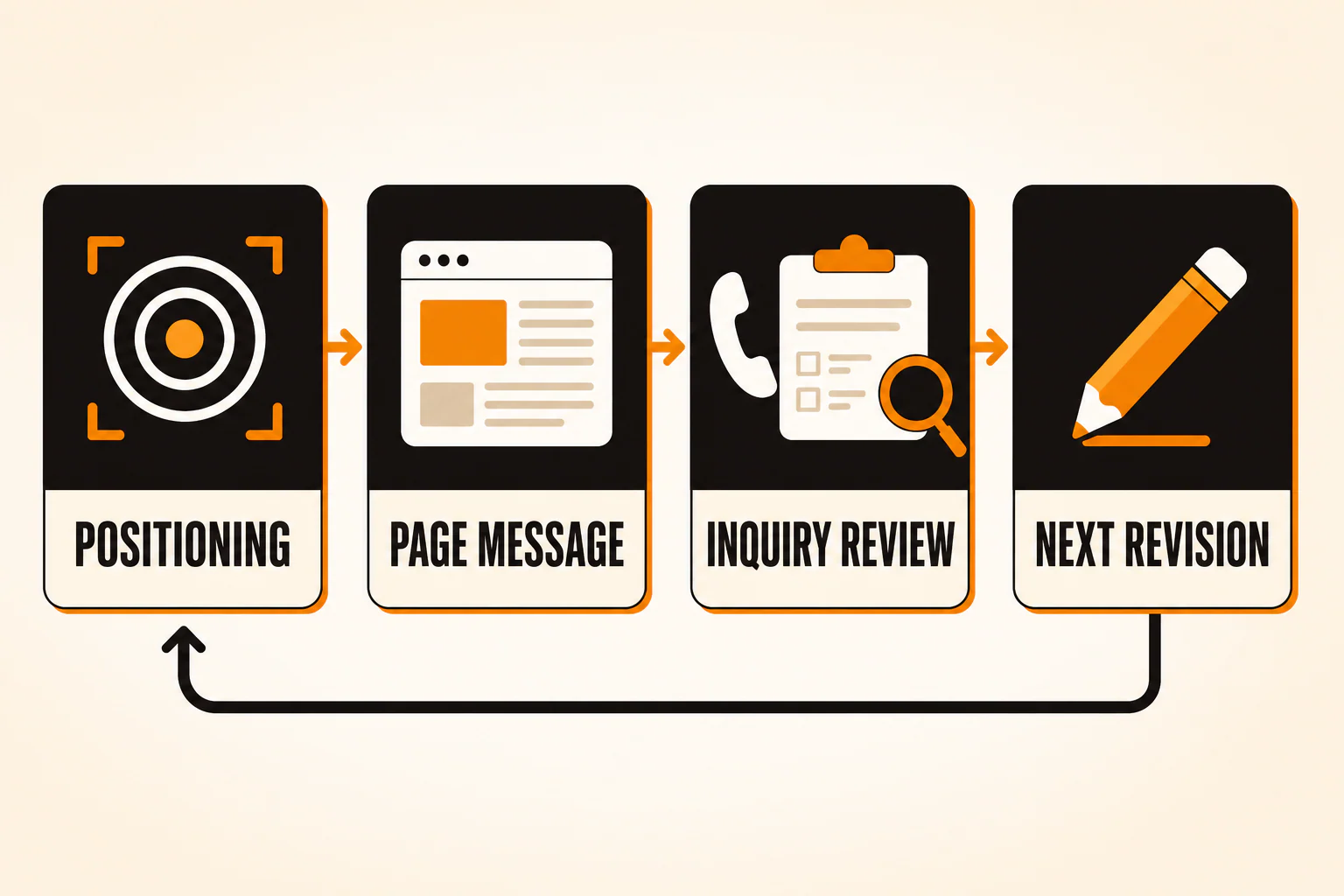
Sharper messaging is a hypothesis until the practice reviews what happens next. A higher form count is not automatically better. A tracked call is not automatically a qualified opportunity, a booked appointment, a patient, or revenue.
Define the stages before changing the copy:
- Inquiry: A call, form, chat, or other contact captured by the practice.
- Relevant inquiry: The person appears to be asking about a service the practice offers in the area it serves.
- Qualified opportunity: The inquiry meets the practice's documented fit criteria and reaches an appropriate next step. This is an internal marketing and sales label, not a patient or revenue claim.
- Disqualified inquiry: The contact is outside service, geography, timing, eligibility, or another defined fit condition.
Then review a consistent set of fields:
- Source or campaign, when it can be identified
- The service or situation the person described
- Whether the language matches the page or ad message
- Fit against the documented criteria
- The next step offered or taken
- The disqualification reason, if applicable
This is why reviewing call content, within the practice's permission and privacy rules, can matter. A dashboard can count a call without revealing whether the caller misunderstood the service. The guide to why weak calls can look good in marketing reports explains that measurement problem without treating every call as business value.
Use what you learn to revise the message. If several relevant inquiries ask a question the page should have answered, add the answer. If people repeatedly expect a service you do not provide, inspect the ad and landing-page language. If the practice cannot classify inquiries consistently, fix the definitions before announcing that lead quality changed.
For teams building a broader search measurement process, the Google and Bing AI SEO roadmap for local health and wellness businesses provides a separate framework. Keep those visibility measures apart from appointment, patient, and revenue claims unless the practice has evidence connecting them.
A 30-minute rewrite exercise
You do not need to rewrite the whole website today. Pick one page tied to an important service and set a timer.
Minutes 1 through 5: circle the empty phrases
Mark every phrase a competitor could use without changing a word. Common candidates include "personalized," "innovative," "leading," "holistic," "compassionate," and "results-driven."
Do not delete them yet. Make them prove themselves.
Minutes 6 through 12: list the available proof
For each marked phrase, write down the fact that supports it. Look for a documented process, credential, schedule, service boundary, or practical detail. If no proof exists, label the phrase "unsupported" or "undefined."
Minutes 13 through 20: write the reader consequence
Finish this sentence: "This matters to the reader because they can now understand..."
If the answer becomes a promised treatment result, stop. Bring the language back to the process, expectation, comparison, or next decision the evidence supports.
Minutes 21 through 26: replace one section
Rewrite one headline and the paragraph below it. Use the claim, proof, consequence structure. Keep the language plain enough that a front-desk team member could explain it accurately on a call.
Minutes 27 through 30: check the handoff
Confirm that the call to action matches what happens next. If the button says "Schedule a consultation," the page should explain what the consultation includes. If the next step depends on eligibility, location, or availability, say so.
That is enough for one session. A specific, supportable section is more useful than a polished page full of fog. Clear one section before you declare war on the whole website.
The strategic shift is from adjectives to evidence
Generic health and wellness marketing does not need a more dramatic voice. It needs better decisions upstream.
Define the audience and situation. Identify what the practice actually does differently. Match each claim with proof. Explain why the proof matters without stretching it into an outcome promise. Then review inquiries to see whether people understood the message.
Design still matters. Ads still matter. Search visibility still matters. But none of them can rescue positioning that says nothing a nearby practice could not also say.
Start with one sentence on one important page. Replace the adjective with a fact. That is where differentiated marketing begins.
Frequently asked questions
What makes health and wellness marketing feel generic?
It feels generic when the message relies on category phrases such as "personalized care" or "advanced solutions" without explaining the practice-specific facts behind them. Templates and AI-assisted writing can reveal or repeat the problem, but the underlying issue is usually unclear positioning and missing proof.
How can a practice differentiate without making risky claims?
Lead with verifiable facts about the people, services, credentials, process, locations, scheduling, and next steps. Explain the reader consequence of those facts without promising a treatment result. Health or outcome claims need appropriate substantiation and campaign-specific review.
Does specialization make the audience too small?
Not automatically, but there is no universal answer. The useful question is whether the message makes the practice's strongest fit clear while accurately representing the services it offers. Review inquiry patterns and business constraints before narrowing or expanding the message.
What should a practice measure after changing its message?
Track more than raw forms and calls. Review source, service interest, geography or other fit criteria, the language used in the inquiry, the next step, and any disqualification reason. Do not label an inquiry as a patient, booking, or revenue unless the underlying record supports that stage.
Will more specific marketing guarantee better SEO or AI visibility?
No. Clear, helpful, reliable information may make a page easier for people and systems to understand, but it does not guarantee rankings, AI citations, or traffic. Those are external outcomes to measure after the content and technical setup are in place.
Last updated