

Key Takeaways
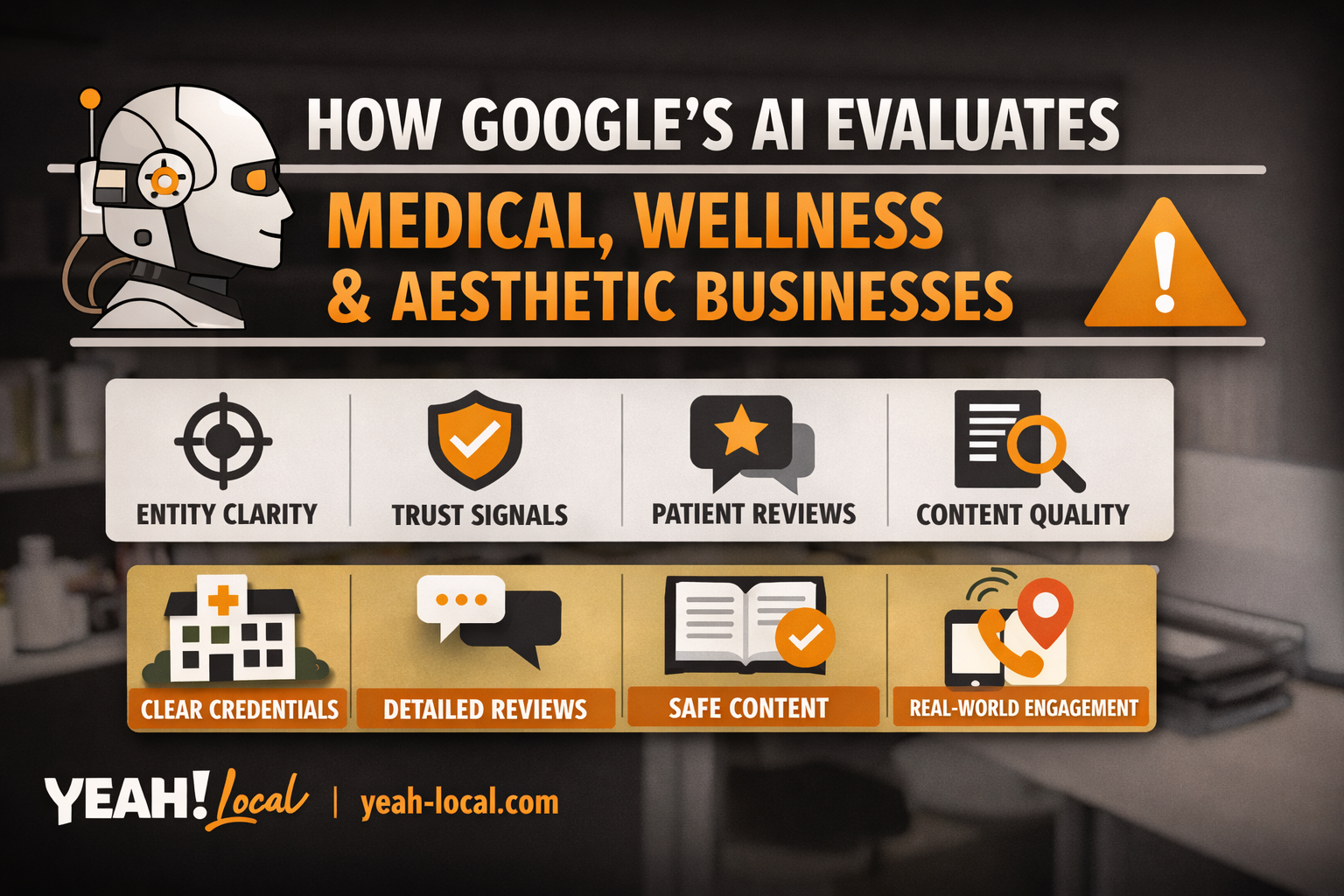
Google’s AI evaluates medical, wellness, and aesthetic businesses less like websites and more like real-world providers. It looks for trust, consistency, authority, and proof that real patients choose you. Rankings alone are no longer enough. If Google’s AI does not understand who you are, what you specialize in, and why patients trust you, you will be filtered out even if you “rank.”
How Google’s AI Thinks About Health, Wellness, and Aesthetic Businesses
Health and aesthetic searches fall into Google’s highest-trust category. These are decisions that affect someone’s body, health, safety, confidence, or finances.
Because of that, Google’s AI is cautious.
It does not just ask:
- “Is this page relevant?”
It asks:
- “Is this provider legitimate?”
- “Is this information safe?”
- “Would a real person trust this business?”
This evaluation happens across multiple systems at once, not just traditional SEO.
| Evaluation Area | What Google’s AI Looks For | Why It Matters |
|---|---|---|
| Entity Clarity | Consistent business identity and services | AI must understand who you are |
| Reviews | Specific, detailed patient experiences | Reviews act as validation data |
| Content Quality | Clear, educational, balanced answers | Builds safety and trust |
| Authority Signals | Mentions, links, citations | Confirms legitimacy |
| Behavioral Data | Calls, bookings, engagement | Proves real-world choice |
| Consistency | Alignment across platforms | Reduces AI uncertainty |
| Transparency | Honest expectations and scope | Prevents misinformation |
The Core Systems Google’s AI Uses to Evaluate Clinics
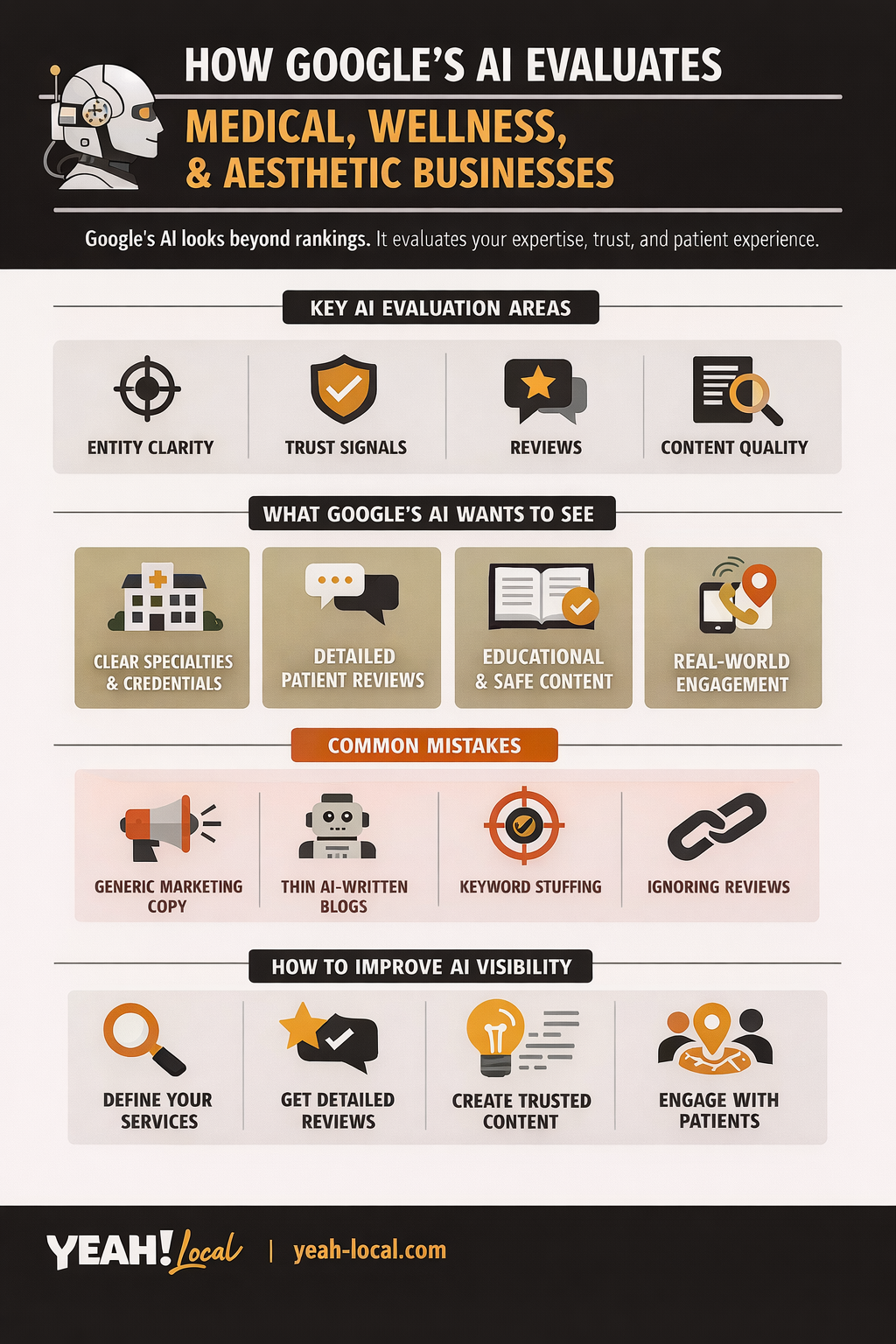
Google’s AI evaluates clinics using four overlapping lenses:
- Entity understanding
- Trust and credibility signals
- Real-world validation
- Content quality and intent alignment
If one layer is weak, visibility suffers everywhere.
1. Entity Understanding: Who You Are Must Be Obvious
Google’s AI first determines whether your business is a clearly defined entity.
It needs to understand:
- Your legal business name
- Your physical location
- Your specialties
- Your providers or practitioners
- Your service categories
This comes from consistency, not clever copy.
What strengthens entity clarity:
- Accurate Google Business Profile categories
- Schema markup on service and provider pages
- Clear service definitions on your website
- Reviews that mention specific treatments
If Google is unsure what you do, it will not recommend you.
2. Trust Signals Matter More Than Rankings
In medical, wellness, and aesthetics, Google treats trust as a prerequisite, not a bonus.
Trust signals include:
- Review volume and quality
- Review language and specificity
- Practice transparency
- Professional credentials
- Website clarity and tone
Generic marketing language hurts you here. AI looks for confidence without exaggeration.
Overpromising results, vague claims, and thin content reduce trust.
3. Reviews Are AI Training Data, Not Just Social Proof
This is one of the most misunderstood areas.
Reviews are not just star ratings. They are behavioral and linguistic data that AI uses to understand:
- What services you actually provide
- Who your ideal patient is
- What outcomes people experience
- How your business is perceived
Reviews that mention:
- Conditions
- Treatments
- Results
- Staff experience
- Location
…carry far more weight than generic praise.
AI reads reviews like case studies.
4. Content Quality Is Evaluated Through Intent, Not Length
Google’s AI does not reward long content.
It rewards complete answers.
For health, wellness, and aesthetic businesses, AI looks for:
- Clear explanations
- Balanced expectations
- Risks and suitability
- Who a treatment is for and not for
- Cost ranges or factors
- Recovery or timeline clarity
Content written only to sell performs worse than content written to explain.
Educational clarity builds trust.
Trust builds visibility.
5. E-E-A-T Is Not a Checkbox. It Is a Pattern.
Experience, expertise, authority, and trust are evaluated across the entire digital footprint, not one page.
Google’s AI cross-references:
- Your website
- Your Google Business Profile
- Reviews
- Local articles
- Press mentions
- Backlinks
- Provider bios
If these tell different stories, AI gets cautious.
Consistency wins.
How Google’s AI Evaluates Different Health Business Types
Medical Practices
AI prioritizes:
- Clinical clarity
- Safety language
- Provider credentials
- Conservative claims
Wellness Clinics
AI looks for:
- Holistic consistency
- Clear scope of services
- Educational tone
- Transparency about outcomes
Aesthetic Businesses
AI evaluates:
- Reputation and reviews
- Before-and-after credibility
- Expertise positioning
- Patient experience language
Each category has different trust thresholds, but none tolerate ambiguity.
Common Mistakes That Hurt AI Visibility
- Using generic marketing copy
- Publishing thin, AI-generated blogs
- Ignoring review content strategy
- Over-optimizing keywords instead of clarity
- Separating SEO, ads, and reputation management
These mistakes signal low confidence to AI systems.
How Can You Improve AI Evaluation
Focus on these fundamentals:
- Make your services unmistakably clear
- Encourage detailed, experience-based reviews
- Publish content that answers real patient questions
- Align website messaging with GBP and reviews
- Treat trust as an asset, not a conversion trick
AI visibility is earned through consistency, not hacks.
Final Takeaway
Google’s AI does not reward the loudest clinics.
It rewards the clearest ones.
Medical, wellness, and aesthetic businesses that:
- Educate instead of exaggerate
- Build trust instead of chasing traffic
- Align messaging across platforms
…become the providers AI recommends.
The goal is no longer to rank.
The goal is to be trusted enough to be chosen.
Frequently Asked Questions (FAQs)
Does Google’s AI treat health businesses differently from other industries?
Yes. Health, wellness, and aesthetics fall under higher trust standards, meaning weaker signals are filtered out more aggressively.
Can small clinics compete with large brands in AI results?
Absolutely. Local expertise and consistent trust signals often outperform national brands for local intent searches.
Does AI penalize promotional language?
It does not penalize promotion directly, but it distrusts exaggerated or unclear claims.
Is blogging still worth it for health and wellness businesses?
Yes, but only when content is educational, structured, and aligned with patient intent.
How long does it take to improve AI visibility?
Most clinics see early movement within 60–120 days when trust and clarity improve consistently.