

Key Takeaway
Learn what Google documents about medical and wellness websites, then audit provider facts, helpful content, local information, and search visibility.
Someone hands you a tidy checklist called "Google AI trust factors." It has a few sensible items, a few mysterious ones, and just enough jargon to look official.
Tempting, right? It also creates the wrong job.
Google does not publish a clinic trust scorecard. And "Google's AI" is not one result type with one set of rules. Classic organic results, the local pack and Maps, AI Overviews, and AI Mode are different search surfaces. They overlap, but they are not interchangeable.
Google publishes guidance about search eligibility, helpful content, local ranking, structured data, AI features, and measurement. A medical practice, wellness clinic, or aesthetic business can turn that guidance into a practical audit. The goal is to make the business, providers, services, location, and health-related claims easy to access, understand, and verify.
Clarity and proof still matter. We just do not need to invent an algorithm story to explain why.
Stop treating every Google surface as one algorithm
Before you diagnose visibility, name the surface. "We are not showing up on Google" is too vague to fix.
| Search surface | What it is | What Google publicly documents | What your clinic can check |
|---|---|---|---|
| Classic organic results | The familiar website links on a search results page | Pages need to be accessible, indexable, and relevant. Google says its systems aim to prioritize helpful, reliable, people-first content. | Indexing status, query and page impressions, titles, visible content, internal links, and factual quality |
| Local results and Maps | Business listings shown for location-sensitive searches | Google describes relevance, distance, and prominence as the main local-ranking factors. Complete and accurate Business Profile information helps Google understand relevance. | Business name, categories, address or service area, hours, services, photos, reviews, and local visibility observations |
| AI Overviews | An AI-generated overview that may appear in Google Search | Google says normal SEO best practices apply. A page must be indexed and eligible to appear with a snippet to qualify as a supporting link, but eligibility does not guarantee inclusion. | Whether the underlying page is accessible and useful, plus dated observations of the queries, overview, and cited links |
| AI Mode | A conversational Google Search experience | Google describes AI Mode and AI Overviews as distinct features that may use different models and techniques, so their responses and links can differ. No special markup or secret optimization is required. | Dated prompt and response observations, linked pages, and changes to the underlying site content |
Google's guidance for AI features in Search is refreshingly plain: established SEO practices still apply, there are no extra technical requirements, and meeting the requirements does not guarantee that a page will be crawled, indexed, served, or included.
That last boundary matters. Eligibility is something you can work on. Inclusion is an external result you can observe later.
ChatGPT, Perplexity, and other assistants are separate products. Do not use a Google Search explanation as proof of how every assistant selects or cites sources. If you want the broader platform distinctions, read our guide to making a local clinic easier to find across ChatGPT, Perplexity, and Google AI after you have the Google-specific basics straight.
What Google documents and what marketers infer
Plenty of bad advice begins with a true idea and adds an unsupported mechanism.
| Claim | Defensible boundary |
|---|---|
| "Helpful, reliable content matters." | Documented in Google's people-first content guidance. |
| "E-E-A-T gives us useful editorial questions." | Reasonable as a quality-review lens, especially for content that can affect health or safety. It is not a published clinic score. |
| "Structured data helps Google understand explicit page information." | Documented. It can also make a page eligible for certain rich results when the relevant requirements are met. |
| "Structured data boosts rankings." | Not established by the sources checked for this article. Markup is useful, but it is not magic. |
| "Accurate Business Profile information supports local relevance." | Documented for local results. It cannot change the searcher's distance from the business or guarantee placement. |
| "Detailed reviews train Google's AI and carry more weight." | Not established by the sources checked for this article. Reviews are valuable reputation and customer-decision evidence without that claim. |
| "Calls and bookings prove that Google should rank the clinic." | Not established here. They are business outcomes to measure, not alleged ranking inputs. |
This distinction is not timid SEO. It is disciplined SEO. When you label an inference as a fact, you can spend months repairing the wrong thing.
What E-E-A-T can and cannot tell you
E-E-A-T stands for experience, expertise, authoritativeness, and trust. You can use those ideas to review a clinic's website without pretending Google gives the clinic a score from one to 100.
Google uses the label YMYL, short for "Your Money or Your Life," for topics that could significantly affect someone's health, financial stability, or safety. It is a useful reminder that health-related content deserves careful sourcing and review, not proof of a hidden clinic score.
Use the four parts as editorial questions:
- Experience asks whether the page shows the kind of first-hand understanding that fits the topic, without manufacturing stories or implying outcomes.
- Expertise asks whether the person responsible for medical or safety-sensitive information is named, qualified, and working within an appropriate scope.
- Authoritativeness asks whether a reader can see why this provider or business is a credible source for this specific service or subject.
- Trust asks whether the claims are accurate, the business details are consistent, the sourcing is clear, and the next step is honest about limits and expectations.
For health-related material, trust deserves extra attention because a vague or exaggerated claim can affect a real decision about someone's body, safety, or money. That does not mean every wellness or aesthetic page faces one identical hidden threshold. The public guidance checked for this article does not establish category-specific trust scores.
Google's people-first content self-assessment asks practical questions about clear sourcing, evidence of expertise, author and site background, factual accuracy, and whether the content genuinely helps the intended audience. Those are better questions than "How many E-E-A-T points did we earn?"
Run the clinic trust-and-clarity audit
This is an audit of what a clinic can verify. It is not a prediction of what Google will rank, quote, or recommend.
1. Check access and eligibility
Start with the boring failure that can make every content debate irrelevant: can Google access and index the page?
Check that each important service, provider, and location page:
- returns a usable page instead of an error or redirect loop;
- is not blocked from indexing by a
noindexdirective; - has a canonical URL that points where you intend;
- exposes the important information as visible text;
- works on a phone without hiding the service details or next action;
- can be reached through sensible internal links.
Search Console can help you inspect indexing and query visibility. It cannot certify future rankings or AI-feature inclusion. Use it to identify an observable access or visibility problem, then fix that problem.
2. Verify business and provider facts
Your website should answer basic questions without making a visitor piece together clues:
- What is the business called?
- Where does it operate?
- Which services are offered at each location?
- Who provides or oversees those services?
- Which credentials, licenses, or qualifications are relevant?
- How can someone contact the correct location?
Provider attribution is especially important when a page makes health, treatment, safety, recovery, or suitability claims. Name the author or reviewer where appropriate, show the relevant credentials, and keep the review date meaningful. A fresh date on stale copy proves nothing.
3. Make service content useful before making it persuasive
A service page should help a prospective patient or client understand the decision. Depending on the service and the clinic's compliance requirements, that may include:
- who the service may be for;
- what the appointment or treatment involves;
- important limitations, suitability considerations, or risks;
- what preparation or follow-up may involve;
- which factors affect cost, timing, or recovery;
- what the reader should do next.
Do not add medical details from memory just to make a page longer. Use an appropriate source, qualified review, and a documented update process for clinically meaningful information.
4. Audit claims and proof
Read the page like a skeptical patient, not the person who approved the ad campaign.
Flag absolute outcomes, unsupported superlatives, vague phrases such as "the best," before-and-after claims with no usable context, and expertise language the business cannot substantiate. Then ask a simple question: what could a reasonable visitor verify?
If the answer is "nothing," rewrite the claim. Specific, bounded language is usually more credible and more useful than a louder promise.
5. Treat structured data as markup, not magic
Structured data gives search systems explicit information about the page. For example, LocalBusiness markup can describe details such as hours and departments when those details fit the page and Google's supported properties.
The workflow is simple: mark up information that is visible and true, validate the code, deploy it, inspect the page, and monitor for errors. Google's structured data introduction explains how markup can make pages eligible for richer results. It does not promise a ranking boost.
Contradictory markup is a cleanup problem. If the schema says one address, the page says another, and the Business Profile shows a third, adding more schema is not the answer.
6. Clean up local information and reputation work
For local results, Google tells businesses to focus on complete, accurate information. Its local-ranking guidance also makes an uncomfortable point marketers sometimes skip: distance is part of the system. No profile cleanup can move the clinic closer to the searcher.
Still, there is plenty to verify:
- select accurate primary and secondary categories;
- keep hours, address, phone, services, and location details current;
- use photos that accurately represent the business;
- request genuine reviews without coaching customers to stuff in keywords;
- respond professionally with a privacy-conscious process;
- investigate material conflicts between the profile, website, and other prominent listings.
If the review-request process needs work, use a policy-conscious approach to getting more online reviews. The reputation benefit is enough. There is no need to call reviews AI training data.

What to fix first
Do not total up the audit and call it an AI score. Find the first failed verification that can block everything after it.
| Observed problem | How to verify it | Smallest sensible repair | What the repair cannot prove |
|---|---|---|---|
| Important page is absent, blocked, or inaccessible | Inspect the live URL, indexing directives, canonical, internal links, and Search Console status | Restore a usable page, remove the unintended block, correct the canonical, or add the necessary internal link | That the page will rank or appear in an AI feature |
| Provider or location facts conflict | Compare the page, provider bio, contact page, Business Profile, and current business records | Correct the authoritative source and propagate the accurate fact to the affected pages and profile | That consistency alone will improve placement |
| Health-related sourcing is weak | Identify each material health or safety claim, its source, reviewer, and review date | Replace unsupported copy, add appropriate sourcing, and obtain qualified review where needed | That a citation creates authority or guarantees visibility |
| Outcome language is exaggerated | Compare each promise with the evidence and required disclosures | Narrow the claim, add the missing condition, or remove it | That cautious wording receives a ranking reward |
| Structured data conflicts with the page | Test the live markup and compare every marked-up fact with visible content | Correct the visible fact first, then update and validate the markup | That valid markup boosts rankings |
| Business Profile information is incomplete | Review categories, services, hours, contact details, location data, and recent changes | Correct the missing or inaccurate fields and document the update date | That the business will outrank a closer or more prominent competitor |
| Measurement is unclear | Name the surface, query or page set, baseline date, and business outcome being reviewed | Choose one fixed observation set and record changes consistently | That one movement explains Google's internal ranking inputs |
Access and factual conflicts usually deserve attention before a new content campaign. A brilliant article cannot rescue a blocked service page. A polished provider bio cannot fix the wrong location information. Sequence repairs by dependency, not by which tactic sounds more advanced.
For a deeper profile cleanup, use our Google Business Profile optimization guide.
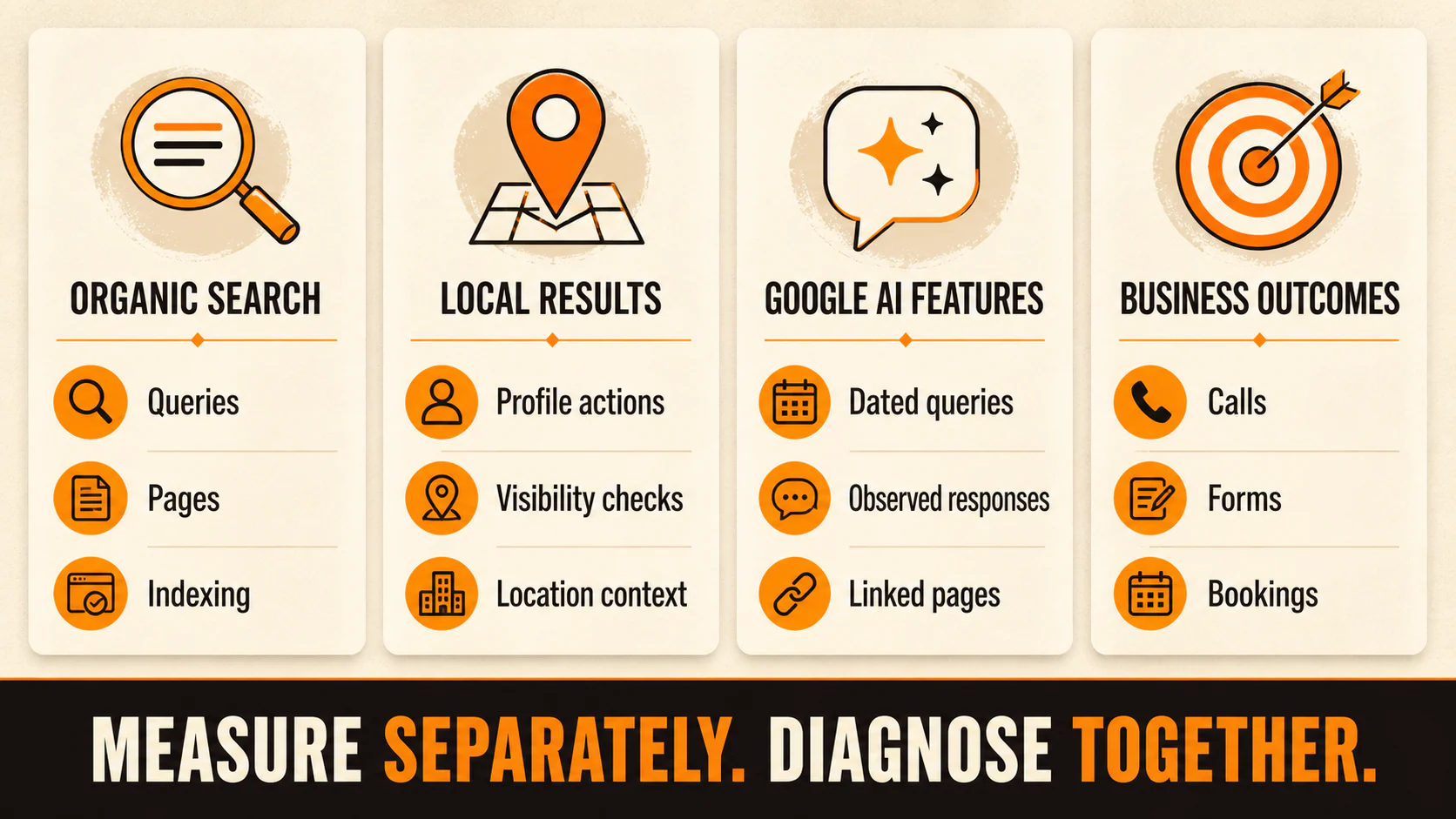
Measure each surface without inventing an AI score
The measurement plan should preserve the same distinctions you used in the diagnosis.
Organic search
Track a fixed set of relevant queries and pages in Search Console. Record impressions, clicks, average position as directional context, and indexing changes. Note the exact date of material page edits. Do not call one good week a durable gain.
Local results
Record Business Profile actions and a consistent set of local visibility observations. If you use a rank grid, keep the locations, keywords, settings, and review cadence comparable. A single search from the office is an anecdote, not a local visibility baseline.
Google AI features
Record the exact query or prompt, date, device or surface, response, and linked pages. AI Overviews and AI Mode can return different answers and links, so keep them in separate columns. One appearance is an observation. It is not an "AI ranking" or a guarantee that the same result will appear again.
For more context about the Google-specific feature, see what AI Overviews mean for local businesses.
Business outcomes
Track calls, forms, scheduled consultations, and booked services with definitions your team can apply consistently. These numbers tell you whether marketing is producing useful business activity. They do not automatically reveal why Google ordered a result.
The distinction is practical. Search visibility can improve while lead quality gets worse. Calls can rise because of ads, seasonality, referrals, or an offline campaign. Measure the surfaces separately, then diagnose them together.
Use a 30-day repair cadence without making a 30-day promise
Thirty days is a reasonable management rhythm for a focused cleanup. It is not a forecast for rankings, AI-feature inclusion, calls, or bookings.
- Choose the surface and baseline. Name the affected pages, queries, local observations, or AI-feature checks. Record the date and definitions.
- Fix critical access, fact, and claim failures. Start with anything that blocks a page, misstates a provider or location, or presents an unsupported health-related claim.
- Validate the implementation. Inspect the live page, markup, profile, links, and mobile experience that actually changed.
- Record the change date. Keep a short log of what changed, where, why, and who verified it.
- Review comparable evidence. Use the same observation set where possible. If the inputs changed, say so instead of pretending the comparison is clean.
At the end of the cycle, choose the next repair based on evidence. You may find that the page still needs work. You may also find that the original theory was wrong. Good measurement is allowed to ruin a tidy story.
Your clinic does not need a mythical AI score
A medical, wellness, or aesthetic business needs accurate facts, accountable expertise, useful service content, a clean local presence, and honest measurement. Those practices help real people make a higher-stakes decision and align with the public guidance Google actually provides.
They do not guarantee a rank, a citation, an AI mention, a lead, or a booking. Anyone selling that guarantee is selling certainty Google has not published.
Start with the first failed verification in the audit. Fix it. Record the change. Measure the right surface. Then repeat with the next real problem.
If you want help separating technical access, local visibility, content quality, and lead tracking, see how our local SEO work approaches the problem or contact YEAH! Local to discuss the specific gap.
Last updated