

Key Takeaways
- Most health, wellness, and aesthetic marketing blends together because it is built from templates, not positioning.
- Clinics copy competitors instead of clarifying differentiation.
- AI-generated content has amplified sameness, not authority.
- Trust, clarity, and specificity outperform promotions and buzzwords.
- The fix is not louder marketing. It is sharper positioning.
- Businesses that define who they are not, attract better patients than those trying to attract everyone.
The Real Problem: Everyone Sounds the Same
Visit ten healthcare websites.
Visit ten wellness clinics.
Visit ten aesthetic practices.
You will see:
- “Personalized care”
- “Holistic approach”
- “State-of-the-art technology”
- “Experienced team”
- “Patient-centered treatment”
None of it is wrong.
But none of it differentiates.
Generic marketing happens when businesses describe themselves using industry clichés instead of strategic clarity.
In competitive local markets, that leads to three predictable outcomes:
- Price competition
- Low-quality leads
- Short-term patients
And increasingly, it also leads to poor AI visibility.
Because AI does not reward vague positioning.
Why Marketing Became So Generic
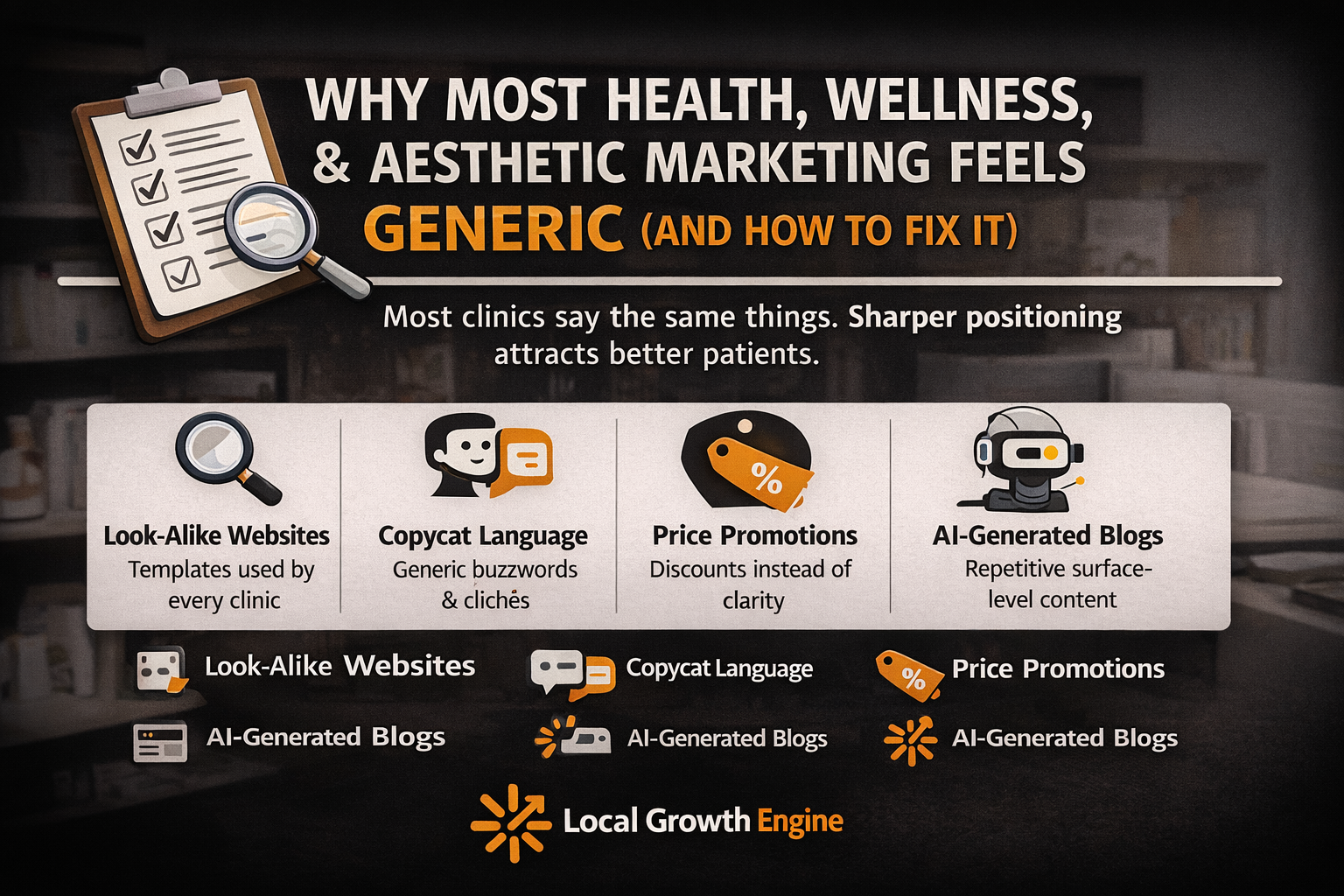
1. Template-Based Website Builds
Most agencies use industry templates. The structure is identical. The language is nearly identical. The only changes are logos and treatment names.
If your site looks like everyone else’s, Google’s AI has no reason to prefer you.
2. Fear of Narrowing Your Audience
Many clinic owners believe:
“If I specialize, I will lose patients.”
The opposite is true.
Broad positioning creates ambiguity.
Ambiguity lowers trust.
Lower trust reduces bookings.
High-performing clinics clearly define:
- Who they serve
- What they specialize in
- What they do differently
- What they do not focus on
Specificity builds authority.
3. Over-Reliance on Promotions
Discount marketing trains patients to compare price instead of value.
When your homepage highlights:
- “$9.99 consult”
- “20% off filler”
- “Limited time special”
You position yourself as interchangeable.
Premium positioning requires:
- Education
- Confidence
- Outcome clarity
- Authority signals
4. Thin AI-Written Content
AI tools have made content easier to produce.
They have not made it more differentiated.
Generic AI content often:
- Repeats surface-level explanations
- Avoids strong positioning
- Lacks real-world experience
- Uses industry-safe language
AI visibility improves when content is specific, structured, and experience-driven.
How Patients Actually Choose Clinics
Patients rarely say: “I chose them because their marketing was impressive.”
They choose because:
- The messaging felt clear
- The provider felt credible
- The reviews felt relatable
- The expectations felt realistic
- The clinic felt aligned with their goals
Generic marketing removes emotional clarity.
Clarity builds trust.
Trust drives bookings.
The Cost of Generic Marketing
Generic marketing leads to:
- More inquiries from unqualified patients
- Higher no-show rates
- Lower conversion rates
- More price objections
- Lower lifetime value
And in today’s AI-driven search environment, it also leads to:
- Reduced authority signals
- Lower review differentiation
- Weaker entity clarity
- Lower probability of being cited in AI Overviews
You do not just lose differentiation.
You lose visibility.
How to Fix It
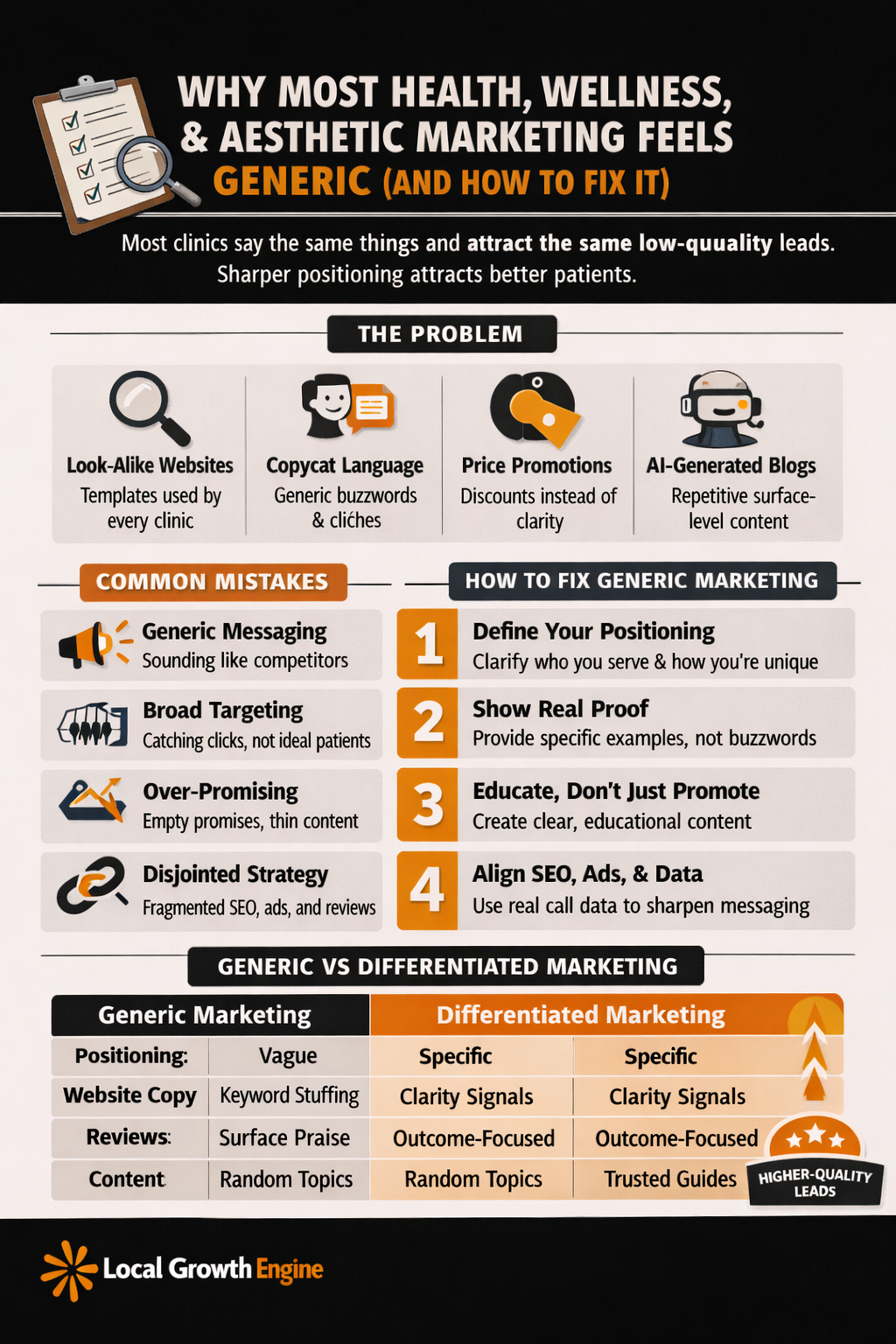
1. Define Your Positioning Before You Write Copy
Answer these clearly:
- What do we specialize in?
- Who are we best for?
- What outcomes do we consistently deliver?
- What do we not focus on?
- What makes our approach structurally different?
If you cannot answer those in one sentence each, your marketing will default to generic.
2. Replace Buzzwords With Proof
Instead of:
“State-of-the-art technology”
Say:
“We use fractional RF microneedling for acne scarring because it stimulates collagen at multiple dermal depths.”
Specificity signals expertise.
3. Align Reviews With Positioning
Most clinics collect passive reviews.
High-growth clinics guide patients toward describing:
- The treatment they received
- The result they experienced
- The reason they chose the clinic
- The type of patient they are
Reviews should reinforce positioning.
4. Build Authority Through Education, Not Volume
Three deep guides outperform twenty shallow blogs.
High-performing content:
- Explains who a treatment is for
- Explains who it is not for
- Discusses risks and expectations
- Addresses cost variables
- Answers common objections
Educational clarity beats promotional language.
5. Integrate SEO, Ads, and Real Call Data
Most clinics treat:
- SEO
- Google Ads
- Reviews
- Website content
…as separate silos.
The most differentiated businesses use call data to identify:
- Common objections
- Common misunderstandings
- Language patients use
That language shapes:
- Website copy
- FAQ sections
- Ad messaging
- Review prompts
This is how messaging becomes sharp instead of generic.
Generic vs Differentiated Marketing
| Category | Generic Marketing | Differentiated Marketing | Result |
|---|---|---|---|
| Positioning | “We offer comprehensive care.” | “We specialize in hormone optimization for high-performing women 35–55.” | Higher trust from ideal patients |
| Website Copy | Industry buzzwords | Specific treatments, outcomes, and exclusions | Increased authority |
| Reviews | “Great staff!” | “Dr. X helped my postpartum hormone imbalance with…” | Stronger AI signals |
| Content Strategy | 2 blogs per week on random topics | 4 deep guides aligned with core services | Higher AI visibility |
| Pricing Strategy | Constant promotions | Value-based positioning | Better margins |
| Ads | Broad targeting | Intent-driven targeting aligned with specialty | Better lead quality |
| Brand Voice | Safe and neutral | Clear, confident, specific | Memorable identity |
| SEO Strategy | Keyword-focused | Entity + authority-focused | Sustainable rankings |
The Strategic Shift
The businesses that win in health, wellness, and aesthetics do not try to be everything.
They:
- Narrow their message
- Deepen their authority
- Align their digital footprint
- Build systems instead of campaigns
In an AI-driven search landscape, generic brands fade.
Clear brands compound.
Final Thought
If your marketing feels interchangeable, it probably is.
The fix is not better design.
Not more posts.
Not louder ads.
It is clarity.
When you define who you are with confidence, the right patients respond.
And increasingly, so does AI.
FAQs
Why does health and aesthetic marketing feel more generic than other industries?
Because many practices use similar services, similar terminology, and similar agency templates. Without strategic positioning, everything blends together.
Is specializing risky for local clinics
Specializing reduces ambiguity and increases authority. It typically improves lead quality rather than shrinking volume.
Does AI penalize generic content?
AI does not “penalize” it directly, but it prefers clearer, more authoritative sources when generating answers.
Should clinics stop running promotions?
Not necessarily. But promotions should support positioning, not replace it.
How long does it take to reposition a clinic’s marketing?
Most businesses see meaningful clarity and improved lead quality within 60–120 days when messaging, reviews, and content are aligned.