

Key Takeaways
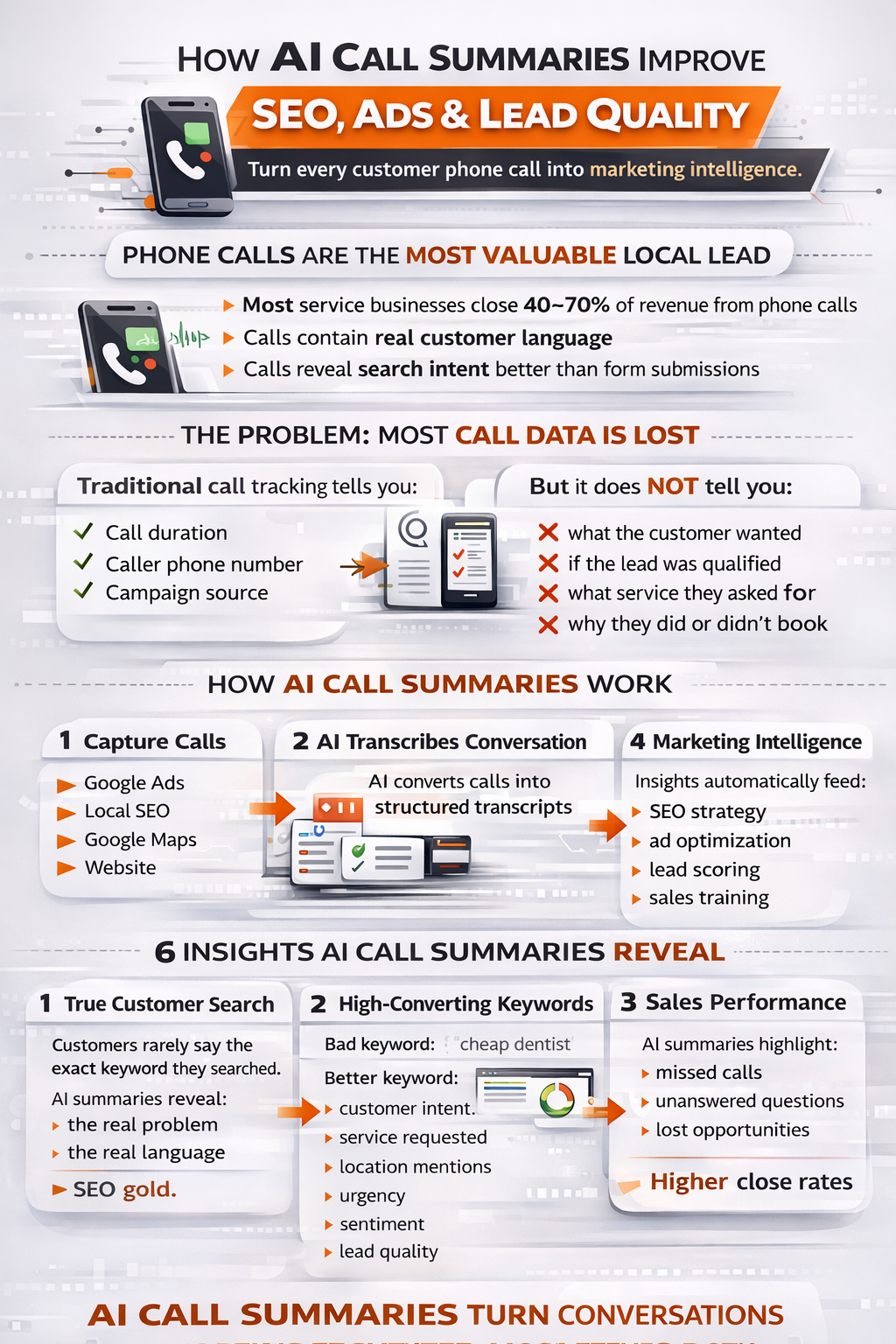
- Phone calls are the highest-intent conversion for most local businesses, but most treat call data like a black box.
- AI call summaries convert messy conversations into structured insight you can use for SEO, ads, sales, and operations.
- The biggest win is not “tracking calls.” It’s turning call patterns into better targeting, messaging, and pages.
- AI call intelligence reduces wasted ad spend by identifying bad leads, wrong-fit services, pricing shoppers, and after-hours leaks.
- Call summaries can directly improve your Google Business Profile content, review prompts, and AI visibility by reflecting real customer language.
- The fastest compounding system is: Calls → AI Summaries → Insights → Content/Ads Updates → Better Calls.
Why Calls Are the Most Undervalued Growth Asset in Local Marketing
Local marketing has a measurement problem.
Most businesses optimize around what is easy to measure:
- clicks
- impressions
- form submissions
- pageviews
But for service businesses (and many clinics), the real money is in:
- phone calls
- appointment requests
- schedule conversations
- qualification and closing
Calls contain the truth:
- what customers actually want
- what they think you do
- what they are afraid of
- what they compare you to
- why they choose (or don’t)
If you can turn call conversations into usable data, you unlock the most accurate growth lever available.
That’s what AI call summaries do.
What Are AI Call Summaries?
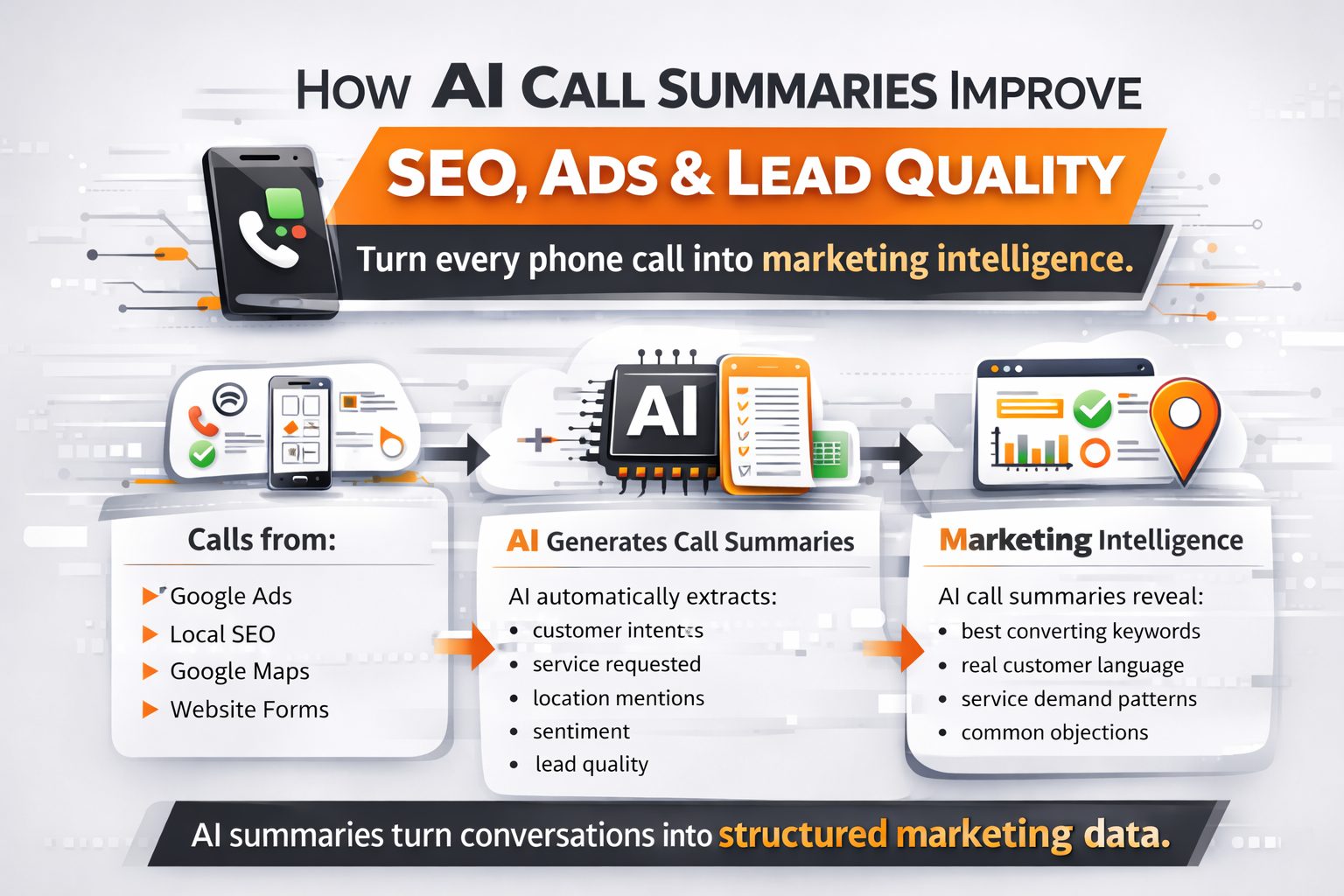
AI call summaries are automated, structured notes generated from recorded calls (or call transcripts). Modern systems can produce:
- a short call summary
- lead intent (what they wanted)
- service requested
- location mentioned
- urgency level
- price sensitivity
- objections raised
- outcomes (booked, not booked, wrong number, spam)
- next steps and follow-up tasks
- sentiment and quality score (optional)
Think of it as taking thousands of unstructured conversations and turning them into a searchable, analyzable dataset.
The value is not in the transcript.
The value is in the pattern recognition.
The Core Advantage: AI Turns Conversations Into Strategy
Traditional call tracking answers:
- “Did we get a call?”
AI call summaries answer:
- “What did they want, why did they call, what did they say, and how do we get more of the good ones?”
That difference is the gap between:
- marketing that reports
- marketing that improves
How AI Call Summaries Improve SEO
SEO is ultimately a language-matching problem:
- customers search using a mental model
- your content must match that mental model
- Google must understand your relevance and trust
Calls reveal the exact language customers use.
1. You discover the real keywords
Not the keywords you think matter.
The phrases people actually say.
Examples:
- “Do you do emergency water heater replacement today?”
- “I need Invisalign, but I’m nervous about cost.”
- “Do you take my insurance?”
- “Do you treat sciatica or just back pain?”
These become:
- headings
- FAQs
- service page sections
- blog topics
- Google Business Profile Q&A
2. You fix “intent mismatch” pages
Many local pages rank but don’t convert because they answer the wrong question.
AI summaries show:
- what people expected
- what they were confused about
- what they needed clarified
That tells you exactly what to rewrite.
3. You build content clusters based on demand
Instead of guessing content strategy, you build it from call themes:
- pricing questions
- “near me” location intent
- emergencies vs scheduled work
- eligibility and insurance
- treatment suitability
- comparison to competitors
This content ranks because it is rooted in real demand.
4. You strengthen entity clarity for AI search
When you incorporate call language into structured content, it helps Google’s AI understand:
- what you do
- who you serve
- what problems you solve
- what outcomes you deliver
That improves your visibility in:
- Local Pack
- AI Overviews
- “best” and “near me” searches
How AI Call Summaries Improve Google Ads
Ad accounts fail for predictable reasons:
- wrong targeting
- wrong messaging
- wrong landing page
- wrong qualification process
AI call summaries identify which one is breaking.
1. You stop paying for wrong-fit calls
AI can tag:
- wrong number
- spam
- out-of-area
- not your service
- price shoppers
- after-hours leakage
Once tagged, you can:
- tighten keywords and match types
- add negative keywords
- adjust location targeting
- change ad schedules
- improve call routing
2. You write ads that match real intent
Most ads are generic:
“Top-rated service. Call now.”
Call summaries reveal what actually converts:
- urgency phrases
- pain points
- desired outcomes
- objections
That becomes:
- headlines
- callout extensions
- landing page hooks
3. You optimize bidding with quality signals
Even if you cannot import perfect offline conversion data, you can still train your system.
You can track:
- booked calls vs non-booked
- qualified vs unqualified
- duration thresholds
- intent categories
Then optimize toward the calls that turn into revenue.
4. You improve landing page conversion
If calls repeatedly ask something your page doesn’t answer, your page is failing.
AI summaries tell you:
- what’s missing
- what’s confusing
- what’s not credible
- what’s causing price objections
Fix that, and you reduce cost per lead without changing spend.
How AI Call Summaries Improve Lead Quality
Lead quality is mostly about:
- expectation alignment
- qualification
- matching the right offer to the right person
AI summaries improve lead quality in four ways.
1. Better pre-qualification messaging
If most bad leads are:
- price shoppers
- not eligible
- wrong service
- wrong geography
You can pre-filter them with:
- clearer service definitions
- transparent ranges
- eligibility language
- location clarity
Less time wasted. Higher close rates.
2. Better intake and scripting
AI summaries show where your team loses calls.
Common issues:
- slow response time
- weak discovery questions
- unclear next steps
- failure to anchor value
- inconsistent quoting
That becomes:
- training
- scripts
- SOPs
3. Faster follow-up, fewer lost leads
Summaries can generate follow-up tasks:
- “send pricing info”
- “schedule consult”
- “request photos”
- “verify insurance”
- “send directions”
Speed wins in local.
4. Continuous offer improvement
Calls surface repeated demand:
- “Do you offer financing?”
- “Do you do same-day appointments?”
- “Do you have weekend hours?”
- “Can you come out tonight?”
That data informs:
- service packaging
- hours
- staffing
- upsells
- new offers
This is where marketing turns into business strategy.
The Local Growth Engine Loop (The Compounding Flywheel)
This is how you deploy AI call summaries as a system:
- Capture calls (tracking numbers + recording where legal)
- Generate AI summaries + categories
- Review weekly themes (top questions, objections, services)
- Update:
- SEO pages and FAQs
- ad copy and negatives
- landing pages
- GBP posts and Q&A
- scripts and follow-up workflows
- Measure:
- booked rate
- qualified rate
- cost per booked call
- revenue per lead source
- Repeat
This loop compounds because each round improves both traffic quality and conversion.
| Call Insight (From AI Summaries) | SEO Action | Google Ads Action | Lead Quality / Ops Action | Metric to Watch |
|---|---|---|---|---|
| Callers ask “Do you offer X?” | Add FAQ + service section | Add “X” to ad copy | Train intake to qualify for X | Booked call rate |
| High volume of “price” calls | Add pricing factors page | Add negatives + tighten match | Add price framing + financing | Qualified call % |
| Many out-of-area callers | Add service area pages | Tighten location targeting | Add service area script | Cost per booked call |
| Calls mention competitor comparisons | Create comparison page | Use competitor keywords carefully | Build value anchors | Close rate |
| Repeated confusion about process | Add “How it works” section | Update landing page | Add script + checklist | Conversion rate |
| Lots of after-hours missed calls | Add “24/7” clarity (if true) | Adjust ad schedule | Add answering service/IVR | Missed call % |
| Calls ask about insurance/eligibility | Add insurance page + FAQ | Exclude non-covered terms | Add eligibility screening | Unqualified calls |
| Calls ask about urgency/same-day | Build emergency page | Add emergency campaign | Add dispatch protocol | Same-day bookings |
| Calls request specific provider | Add provider bios + schema | Add provider name extensions | Route calls correctly | Booking speed |
| Calls ask “Do you do financing?” | Add financing section | Test financing ads | Add financing workflow | Avg order value |
Common Mistakes (And How to Avoid Them)
Mistake 1: Treating summaries as “nice to have”
If nobody reviews insights weekly, nothing improves.
Assign ownership.
Mistake 2: Only using call data for attribution
Attribution is table stakes.
Optimization is where money is made.
Mistake 3: Not connecting summaries to actions
Every insight needs an action:
SEO change, ad change, or operational change.
What This Looks Like in Practice (Example)
Let’s say you run Google Ads for a med spa.
AI call summaries show:
- 35% of calls ask about price first
- 20% ask if results look natural
- 15% ask about injector credentials
- 10% ask about downtime
Actions:
- SEO: publish “Botox cost factors” + “natural results” guide + injector bio pages
- Ads: shift messaging to “natural results” + “experienced injectors” + add price-filter negatives
- Ops: update consult script to address “natural look” early
Result:
- fewer low-intent calls
- higher booked consult rate
- better close rate
- better reviews because expectations are aligned
FAQs
Do AI call summaries help if we already track calls?
Yes. Tracking tells you volume. Summaries tell you why calls happen and what to fix to increase booked, qualified calls.
Are call summaries useful for businesses that get mostly form leads?
Yes, because the same insights apply. You can use summaries from sales calls and intake calls to refine pages, ads, and qualification.
How often should we review call summaries?
Weekly is the sweet spot. Monthly is too slow.
Can AI call summaries improve local SEO rankings directly?
Indirectly but powerfully. They improve the content and intent alignment that drive higher engagement, better conversions, and stronger entity understanding.
What’s the fastest win for Google Ads?
Adding negative keywords and tightening targeting based on wrong-fit call categories often reduces wasted spend immediately.
Will this work for home services and healthcare alike?
Yes. Any local business where calls are the primary conversion gets outsized benefit.