

Key Takeaway
AI changed Google's results, not the need for local SEO. Learn what still matters, which AI SEO myths to ignore, and what to measure monthly.
A lot of local businesses are hearing the same bad advice right now:
"AI killed SEO."
It sounds current. It sounds like the kind of thing people say when they want to be six months ahead of everyone else.
It is also wrong.
AI changed the search results page. It did not remove the need for accurate business information, accessible web pages, useful service content, strong local relevance, or a clear way for a customer to contact you.
For a local business that depends on Google Search or Maps, that makes local SEO more important as an operating discipline. That is an editorial conclusion, not a promise that every business will get more traffic or appear in an AI answer. Google decides what it crawls, indexes, ranks, and displays. Your job is to make the business easy to find, understand, verify, and choose.
That is less exciting than a secret AI tactic. It is also far more useful.
What AI changed, and what it did not
Google can now answer some searches directly with AI Overviews. AI Mode can take a longer, more conversational question and explore related subtopics. Maps and local results can surface business information, reviews, photos, and other local details. Traditional organic listings still exist too.
Those surfaces work differently, so lumping them into one mysterious "AI algorithm" leads to bad decisions.
The practical change is that a potential customer may learn quite a bit before visiting your website. They might see an answer, a map result, business hours, reviews, or several sources on the same results page. A click is still useful, but it is no longer the only evidence that your business was visible.
What did not change is the foundation. In its guidance for AI features and websites, Google says its established SEO best practices still apply to AI Overviews and AI Mode. There are no extra requirements or special optimizations that a page must perform to appear as a supporting link.
Google still needs to access and understand your content. Your business information still needs to be accurate. A service page still needs to explain the service. A visitor still needs a sensible next step.
AI did not make those jobs obsolete. It made vague, contradictory, and disposable content harder to defend as a marketing strategy.
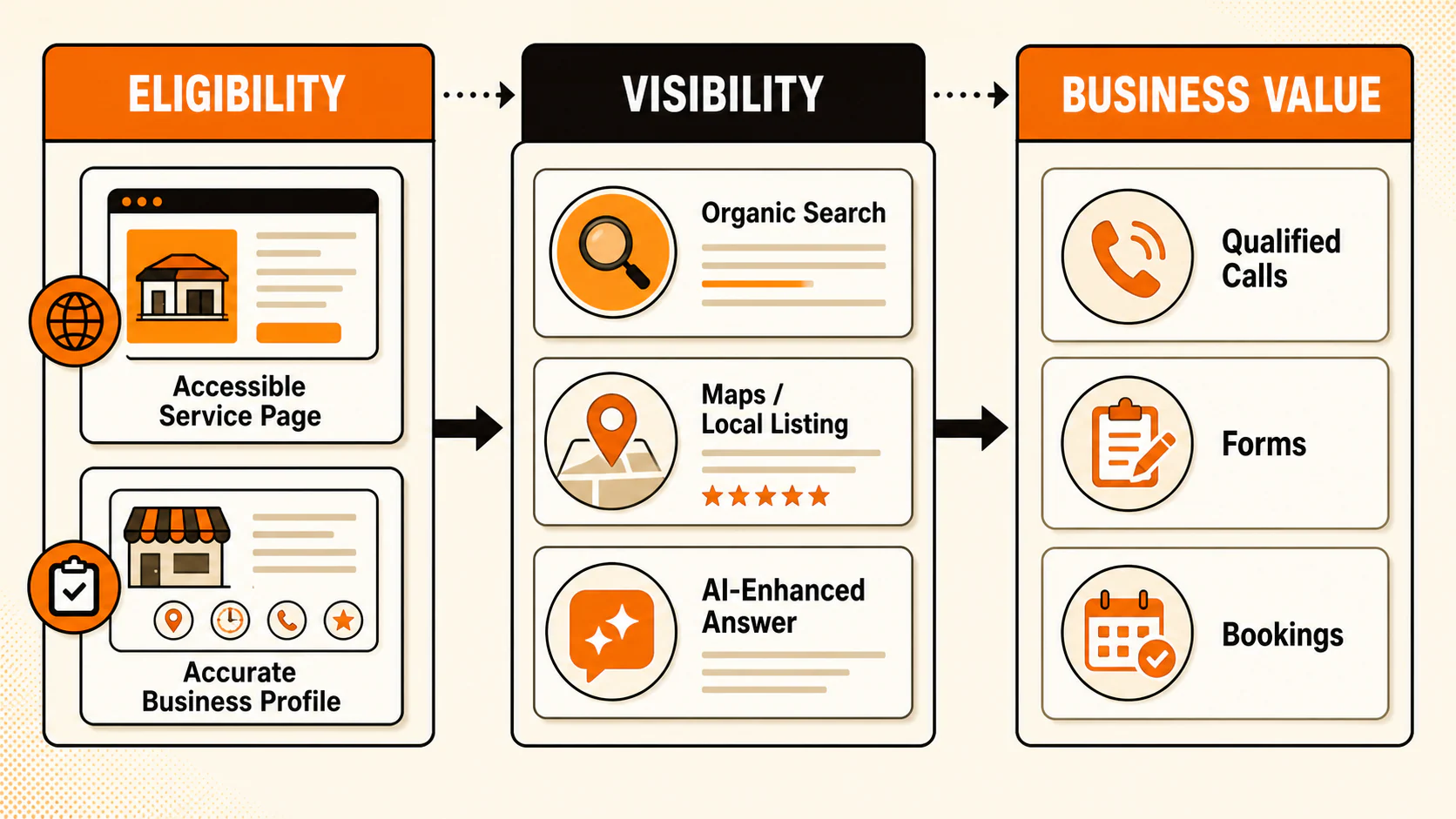
Use three separate scoreboards: eligibility, visibility, and business value
Local business owners often put every search question into one bucket called "rankings." That makes the monthly report simpler, but it makes the decisions worse.
A better operating model uses three separate scoreboards.
Eligibility
Can Google access and understand the page, and is the page eligible to appear in Search?
For supporting links in Google's AI features, Google says a page must be indexed and eligible to show a Search snippet. Its guidance also points back to familiar fundamentals such as crawlability, internal links, textual content, useful images or videos, accurate structured data, and current Business Profile information.
Eligibility is the admission ticket. It is not a reserved seat. A technically accessible page can still go unseen, and following Google's guidance does not guarantee indexing, ranking, or inclusion in an AI response.
Visibility
Where and how does the business appear?
Look at ordinary organic results, Maps and local results, branded searches, and AI-enhanced surfaces separately. A business can be visible in one and absent from another. Even AI Overviews and AI Mode can show different supporting links because Google says these features may use a process called query fan-out to explore related searches.
So a number-seven ranking is one observation about one query, location, device, and moment. It is not a complete visibility report.
Business value
Did the visibility produce a qualified call, form submission, booking, visit, or sale?
This is where the original argument still matters. Traffic is useful, but traffic is not the business outcome. A page with fewer visits can still be valuable if it helps the right people understand the offer and take action. The opposite is also true: a page can collect plenty of visits without producing a useful inquiry.
Do not force these three scoreboards into a neat funnel. A person may see a business in Maps, return later through a branded search, and call from the website. Another may never visit the site at all. The point is to observe the path honestly, not pretend Google follows a predictable sequence.
The local SEO work that still deserves attention
The work that matters is maintaining the assets a customer and a search engine need to evaluate the business. Chasing whatever acronym showed up on LinkedIn this week can wait.
Keep your Google Business Profile accurate
Hours, categories, address or service area, phone number, services, and other profile details should reflect the business as it operates today. If holiday hours change, update them. If a service disappears, remove it. If a phone number changes, do not leave the old one lingering across the web.
Google says local results are mainly based on relevance, distance, and prominence. Its local ranking guidance also recommends complete and accurate Business Profile information, review responses, and photos or videos that help people understand the business. None of that buys a better ranking, and Google says you cannot pay it for one.
If this part of your local presence is messy, start with our guide to optimizing a Google Business Profile. There is no good reason to chase AI visibility while your listed hours are wrong.
Build service pages that answer buying questions
A service page should make five things clear without forcing the visitor to dig:
- what the service is;
- who it is for;
- where the business provides it;
- what the customer should know before deciding;
- how to take the next step.
That does not require stuffing a city name into every paragraph. It requires specificity. Explain the process, common constraints, service area, pricing factors when appropriate, and what happens after someone contacts you.
Publishing another generic blog post is not a substitute for fixing a weak money page. The better priority is usually to improve the service pages that help customers make a decision, then create supporting content when it answers a real question.
Make the site easy to crawl and navigate
Important pages should be reachable through normal navigation and descriptive internal links. A link labeled "plumbing repair services" tells a visitor more than "learn more." The same clarity helps Google understand how pages relate to one another.
Local relevance should be useful, not decorative. A strong location page explains what the business offers in that area and gives a local customer something concrete to evaluate. Our near me and near you SEO guide goes deeper on that distinction.
Earn legitimate reviews and respond like a person
Ask real customers for honest reviews, then respond thoughtfully. Reviews help prospective customers evaluate a business, and Google includes reviews and review responses in its published local guidance.
The goal is not to manufacture keywords in customer feedback. The goal is to make it easy for genuine customer experience to be visible.
Keep visible content and structured data consistent
Structured data can help Google understand information already present on a page. It should describe the visible content accurately. It should not add services, ratings, locations, or credentials that the visitor cannot verify on the page.
Google's AI-feature guidance says accurate structured data should match the visible text. That is a useful quality-control rule. It is not a special AI shortcut.
Use photos and visuals that help someone decide
Show the team, location, work, process, equipment, or service details when those images help a customer understand the business. Use descriptive alt text for accessibility and context. Skip the stock-photo parade if every image could belong to any competitor in town.
Track the path from visibility to a real inquiry
At minimum, know which calls and forms came in, which were qualified, and which became appointments or sales when your records support that connection. Google also advises site owners to look beyond clicks and consider the value of visits through conversions and engagement in its guidance on succeeding in AI search.
You do not need an enterprise attribution model to improve this. You do need consistent definitions. A form submission is not automatically a qualified lead, and a qualified lead is not automatically revenue. If those labels are fuzzy, this guide to measuring which marketing channels actually make money is the sensible next step.
Four AI SEO myths to stop repeating
AI created a fresh market for confident nonsense. Here are four claims local business owners can safely stop building plans around.
Myth 1: You need special AI schema or an AI text file
Google says no special schema markup or AI text file is required for AI Overviews or AI Mode. Use supported structured data when it accurately describes visible content. Keep pages crawlable. That is the job.
If somebody is selling a secret file as the missing link between your website and an AI citation, ask for the official documentation and the evidence that it caused the claimed result. A screenshot is not a mechanism.
Myth 2: A top-ten ranking guarantees an AI citation
Google does not publish a top-ten citation rule. Its documentation says AI features can use query fan-out and may display a wider, more diverse set of helpful links.
Strong organic visibility can still be valuable. It simply does not create a contractual next step where Google must cite the page. Monitor the surfaces separately and keep the uncertainty visible.
Myth 3: More AI-generated content creates more authority
Content volume is not authority. A hundred interchangeable pages do not become useful because they were produced quickly.
Google's people-first content guidance warns against publishing at scale mainly to manipulate rankings. It also explains that E-E-A-T describes concepts Google's systems seek to identify, not a single ranking factor or a score you can max out.
Use AI to help with real work if it improves the result. Just do not confuse fast production with experience, evidence, or value.
Myth 4: Fewer clicks prove local SEO stopped working
Fewer clicks can mean many things. A results feature may have answered the question. Demand may have changed. Rankings may have moved. A different page may be competing. Tracking may be broken. The offer may be weak.
A click decline alone does not explain the cause, and it does not tell you what happened to calls, forms, bookings, or sales. Compare visibility and business outcomes before declaring the channel dead. Otherwise you are diagnosing the business with one number and a dramatic headline.
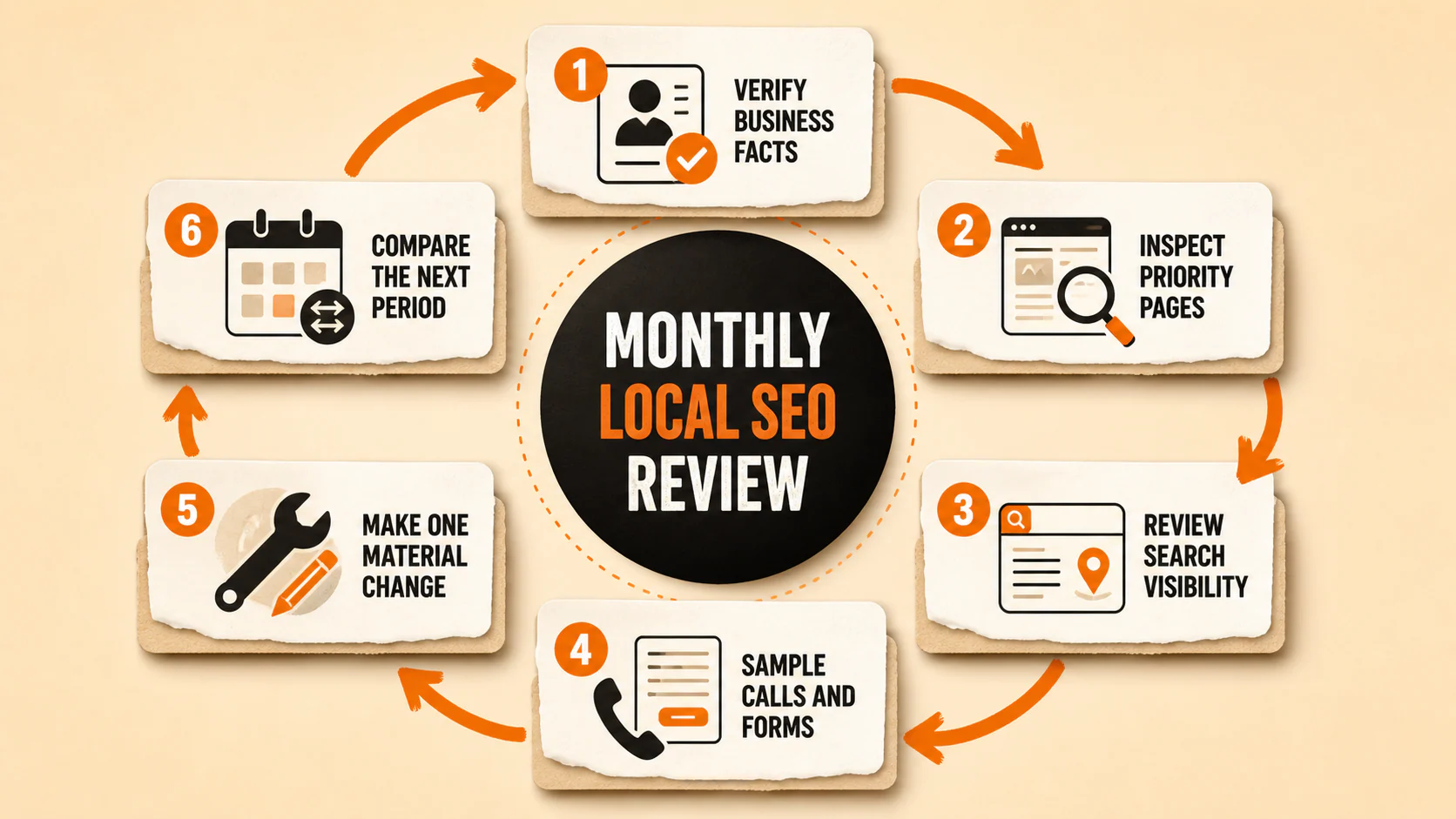
A monthly local SEO cadence you can actually maintain
A monthly review earns its keep by creating a reliable record of what changed and what happened next. More charts will not repair a missing record.
- Verify business facts. Check hours, categories, services, service areas, phone numbers, booking links, and other priority information across the Business Profile and website.
- Inspect priority pages. Open the service and location pages that matter. Confirm that they load, explain the offer, contain current information, and make contacting the business easy.
- Review search visibility. Use Search Console and consistent local observations to look for meaningful changes. Keep organic, local, branded, and AI-enhanced appearances separate when you can observe them.
- Sample calls and forms. Read actual form submissions and review call outcomes where permission and records allow. Separate spam, wrong-number contacts, unqualified inquiries, and qualified opportunities.
- Make one material change. Fix the most consequential observable problem, whether that is an inaccurate profile field, weak service section, broken conversion path, confusing internal link, or measurement gap. Do not change fifteen things and then guess which one mattered.
- Compare the next period. Record the date, the exact change, and the observations that follow. A later movement is still an observation, not automatic proof of causation.
This cadence will not forecast a ranking. It will stop your local SEO program from turning into random activity with a monthly screenshot attached.
When local SEO is the wrong first priority
Local SEO cannot rescue an offer customers do not understand. It cannot answer a phone your team ignores. It cannot create a viable service area, fix a broken booking process, or turn unqualified inquiries into sales by itself.
If the business cannot explain what it sells, start there. If calls go unanswered, fix intake. If the service area is unrealistic, correct it. If every form submission is reported as a win, repair the measurement. More content poured onto those problems just gives you a larger website with the same bottleneck.
Sometimes the right move is to fix operations first. Often, local visibility and operational fixes should happen together. The honest answer depends on the constraint, not on an SEO package.
AI raised the cost of being vague
AI did not make local discoverability irrelevant. It increased the number of places where unclear facts, thin pages, weak differentiation, and broken tracking can leave a business out of the conversation.
The response is not to publish faster or buy a new acronym. Keep your business facts accurate. Build useful service pages. Maintain the local presence customers use to evaluate you. Make the next step obvious. Measure the inquiries that follow.
That is local SEO in the age of AI: less superstition, more maintenance, and a much firmer grip on what the business actually gets from search.
If those fundamentals are not being managed consistently, see how our local SEO services approach the work, or contact YEAH! Local to talk through the bottleneck.
Last updated