

Key Takeaways
- AI changed search behavior, but it did not replace Google as the main place buyers go when they are ready to evaluate options. Google still processes far more search demand than ChatGPT, and search still owns the highest concentration of measurable high intent.
- Organic search still drives a huge share of traffic and often converts better than paid and social, especially on high-intent pages. Flatter top-of-funnel clicks do not automatically mean weaker revenue.
- Zero-click search is real, but it does not mean SEO stopped influencing buying decisions. Visibility in AI Overviews, local packs, featured snippets, and knowledge panels still shapes recall, shortlist inclusion, and later branded searches.
- AI visibility depends on existing SEO authority. AI Overviews tend to cite pages that already rank, which means you do not “pivot away” from SEO to win in AI. You build stronger SEO so AI has a reason to surface you.
- Cutting SEO often makes customer acquisition more expensive by forcing more dependence on paid search, right as paid media costs continue rising.
- For local businesses, the implication is bigger than traffic. SEO now influences discovery, trust, branded search, AI visibility, and cost control at the same time. That makes Local SEO more important, not less.
A lot of local businesses are hearing the same bad advice right now:
“AI killed SEO.”
It sounds smart. It sounds current. It sounds like the kind of thing people say when they want to seem ahead of the curve.
It's also wrong.
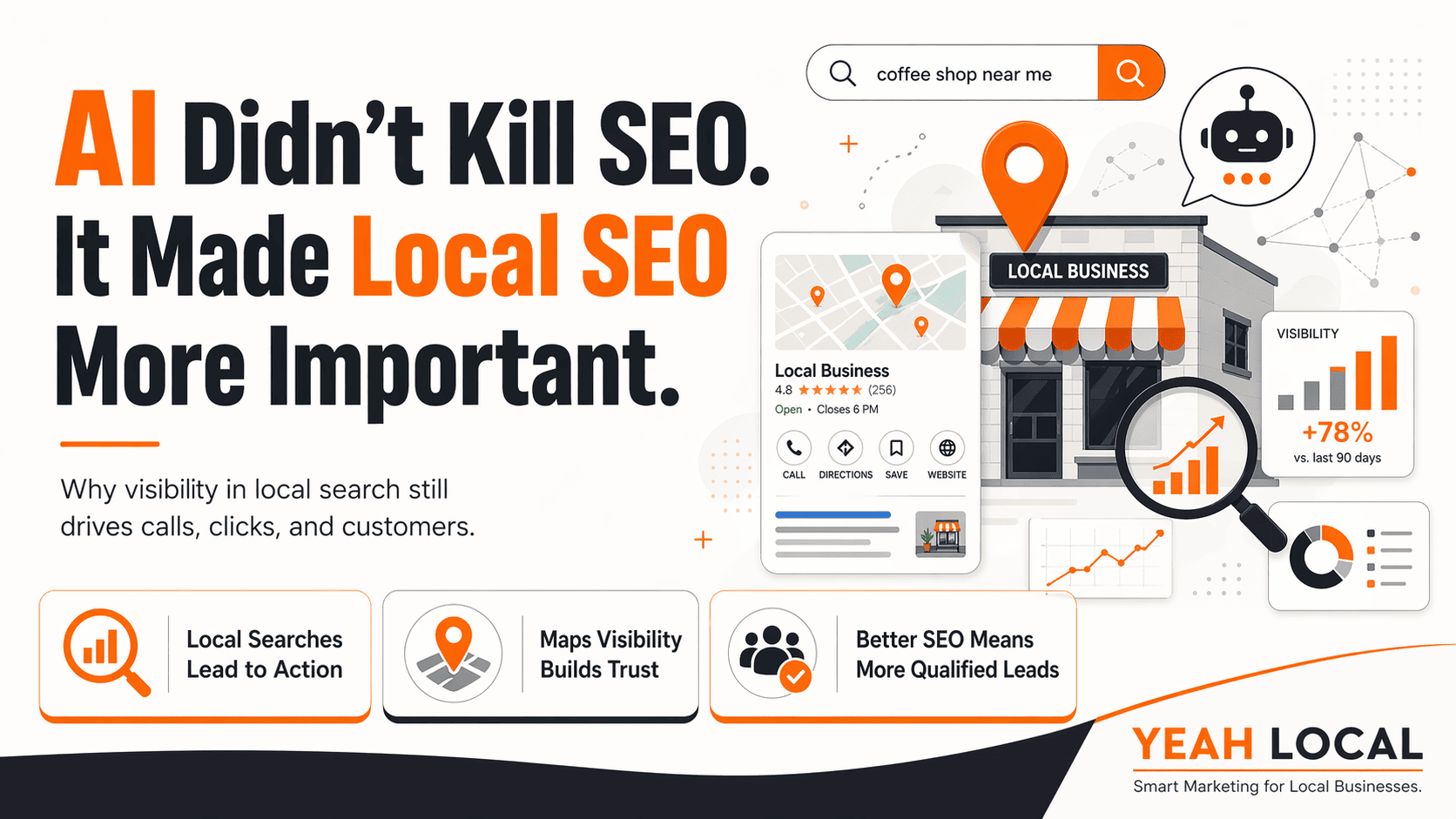
AI did not kill SEO. It changed how search works, how users interact with results, and how brands earn visibility.
But the underlying mechanics still point in the same direction: buyers search, Google still dominates intent, and authority still determines who gets surfaced.
What actually changed is this:
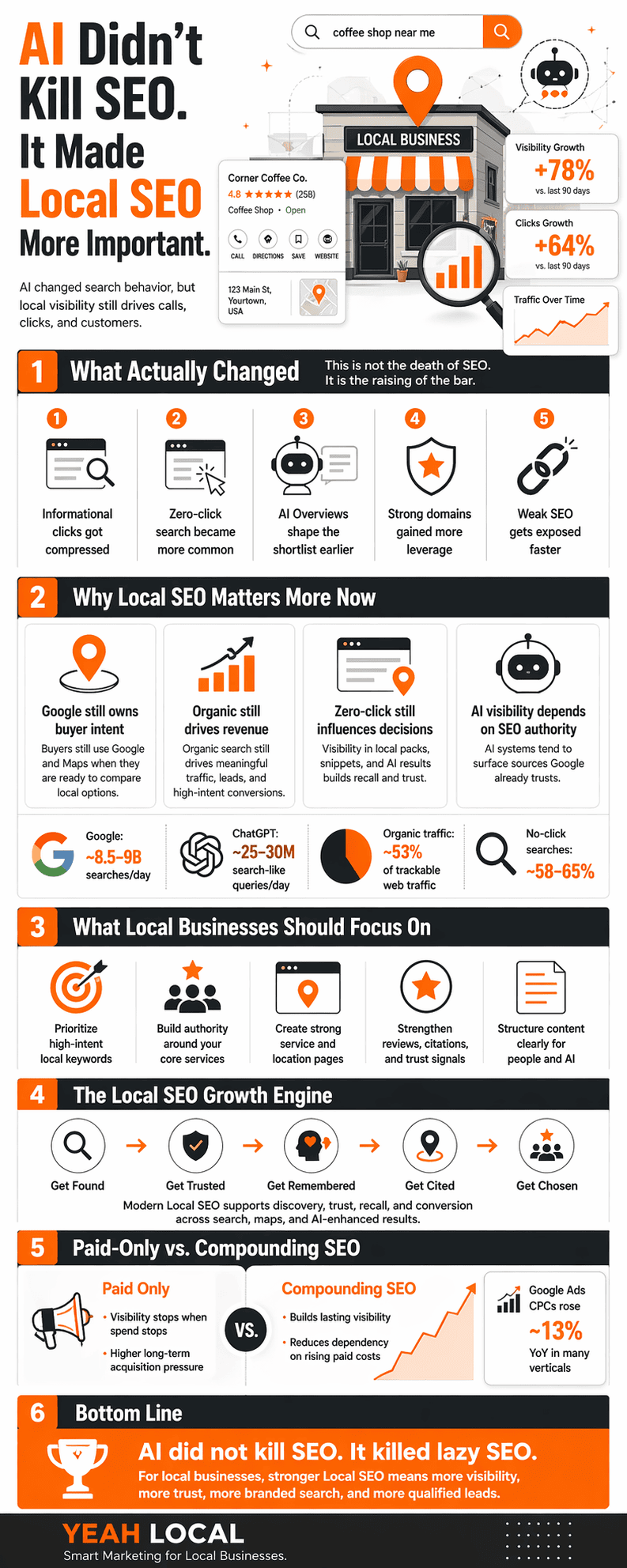
- some informational clicks got compressed
- zero-click behavior became more common
- AI Overviews started shaping the shortlist earlier
- stronger domains got even more leverage
- weaker websites got exposed faster
That is not the death of SEO.
That is the raising of the bar.
And for local businesses, that makes Local SEO even more important than it was before.
Google Still Owns Buyer Intent
If you strip away the noise, the first question is simple:
Have buyers actually left search?
The answer is no. Google still processes roughly 8.5 to 9 billion searches per day, while ChatGPT handles about 25 to 30 million search-like queries per day.
68% to 93% of online experiences still begin with a search engine. Its core argument is that AI helps people think, but search is still where people decide.
That distinction matters a lot for local businesses.
When someone is ready to compare:
- dentists
- med spas
- plumbers
- chiropractors
- weight loss clinics
- painters
- urgent care clinics
- home services
They are still overwhelmingly using Google, Maps, and local search behavior to narrow the field.
AI can compress some early research. It can help summarize categories, compare options, and speed up education. But when the buyer is ready to decide, search still carries the high intent.
That means the local business that reduces SEO because “AI is taking over” is not stepping away from a dying channel. It is stepping away from the biggest demand layer still available.
SEO Still Drives Revenue, Not Just Traffic
One of the most dangerous mistakes in marketing is assuming flatter traffic means weaker SEO ROI.
Organic search still drives about 53% of trackable website traffic and conversion-rate ranges showing organic at roughly 14% to 16%, paid search around 9% to 10%, and social under 3%. While informational CTR may soften, commercial pages often stay resilient because the remaining visitors are more qualified.
That is exactly why so many local businesses misread their SEO performance.
They look at:
- sessions
- impressions
- CTR
- top-of-funnel blog traffic
and conclude that SEO is weakening.
But what really matters is:
- qualified calls
- booked appointments
- new patient inquiries
- high-intent form submissions
- branded searches after initial exposure
- revenue from service pages
AI Overviews can absolutely reduce some low-intent clicks. But if the traffic that remains is closer to decision-making, then the business value of SEO can stay strong or even improve. That is the nuance most surface-level reporting misses.
For local businesses, this is even more important because so much buying intent happens late and locally. The person searching “best med spa near me” or “dentist in Alpharetta” is not browsing casually. They are narrowing options and preparing to act.
Zero-Click Search Did Not Kill Visibility
A lot of business owners hear “zero-click search” and assume SEO has become less valuable.
That is too simplistic.
SparkToro data states 58% to 65% of Google searches now end without a click. But it also makes the more important point: most of those no-click outcomes still involve visible search features such as featured snippets, knowledge panels, local packs, and AI Overviews. In other words, a user may not click, but they still see a brand.
That visibility shapes recall and later branded search behavior.
That is a huge shift in how Local SEO should be understood.
The old model was:
search → click → website → conversion
The new model is often:
search → see your brand in the result environment → remember you → search you later → convert through branded search, direct visit, or another touchpoint
That means Local SEO is no longer just about winning the click.
It is about winning:
- visibility
- familiarity
- shortlist inclusion
- trust before the visit
- brand recall when the buyer is ready
If your local competitors show up inside AI Overviews, local packs, and other Google result features while you do not, they get to shape the buyer’s mental shortlist before the click ever happens.
That is not a smaller role for SEO.
It is a broader one.
AI Visibility Depends on SEO Authority
This is the part most businesses still misunderstand.
You do not get to skip SEO and somehow “optimize for AI instead.”
AI Overviews do not operate in a vacuum, and Semrush and Moz found that most AI Overview citations come from pages already ranking in the top 10. It explicitly argues that AI does not invent authority. It pulls from it.
That means AI SEO is not a separate substitute for SEO.
It is layered on top of SEO.
If your local business wants to show up in:
- AI Overviews
- map-influenced searches
- high-intent local SERPs
- comparison-style searches
- branded follow-up searches
then you need the underlying authority signals that Google already trusts.
For a local business, that means:
- strong service pages
- strong location relevance
- clear entity signals
- high-intent keyword coverage
- real trust signals
- content that deserves to rank
- structured clarity that Google can understand
The AI layer is not replacing the foundation. It is exposing whether the foundation exists.
That is why AI did not kill SEO.
It made weak SEO much easier to punish.
Why This Matters More for Local Businesses
Here is the what matters:
If search still owns intent, if AI visibility depends on ranking authority, and if zero-click visibility still shapes recall, then local businesses need stronger local search signals than ever before.
Why?
Because local buying decisions are compressed and trust-heavy.
A local buyer often wants an answer to a short list of questions:
- Do you offer the exact service?
- Are you near me?
- Do you look credible?
- Are your reviews strong?
- Do you seem like the best fit?
- Can I contact you now?
That means Local SEO now has to do more than rank.
It has to help a business become:
- discoverable
- memorable
- credible
- easy to validate
- easy to choose
In practical terms, that pushes Local SEO beyond old-school tactics.
It is no longer enough to:
- stuff city names
- publish random blog posts
- chase low-intent traffic
- rely only on map presence
Modern Local SEO has to support:
- intent discovery
- authority for AI inclusion
- local trust
- brand recall inside Google’s result features
- layering of paid traffic over time
Cutting SEO Usually Makes Paid More Expensive
Google Ads CPCs rose roughly 13% year over year across many verticals and argues that when SEO weakens, paid has to fill the gap. Instead of earning visibility, the business has to buy more traffic, enter more auctions, and accept higher acquisition costs. Strong organic visibility acts like insulation against rising paid costs.
That is exactly why SEO and paid should not be treated like separate silos.
For a local business:
- strong Local SEO lowers dependency on Google Ads
- strong local rankings make LSAs and paid search more efficient
- strong branded search reduces acquisition friction
- strong organic visibility gives you more than one path into the buyer journey
Without SEO, you rent attention.
With SEO, you build an asset.
Here's a simple comparison between a paid-only strategy and a compounding SEO strategy: same total spend, very different long-term position. One business rents visibility. The other starts to own it.
That is the real financial argument for Local SEO in the AI era.
AI did not make organic less valuable.
It made owning visibility even more strategic.
The Local SEO Growth Engine That Fits the AI Era
My recommendations are:
- prioritize high-intent keywords
- build topical authority around revenue-driving categories
- publish proprietary insights where possible
- structure content clearly for both users and AI systems
- treat SEO as infrastructure, not promotion
For a local business, that translates into a sharper operating model:
1. Prioritize high-intent local searches
Focus harder on the terms tied to revenue:
- service + city
- service + near me
- cost / pricing / compare intent
- problem-aware searches
- treatment or service evaluation searches
2. Build topical authority around the services that matter most
Do not scatter your effort across weak blog topics.
Own the categories that actually drive calls, form submissions, appointments, and revenue.
3. Structure pages for both humans and machines
Make it easy for buyers and Google to understand:
- what you do
- where you do it
- who it is for
- why you are credible
- what to do next
4. Treat Local SEO like infrastructure
This is the most important mindset shift.
Local SEO is not just content production.
It is not just rankings.
It is not just Maps.
It is the underlying system that helps your business get discovered, trusted, remembered, and surfaced by both traditional search and AI-enhanced results.
| Section | Core Idea | What the LocaliQ Article Shows | What Local Businesses Should Do |
|---|---|---|---|
| Search demand | AI did not replace search | Google still processes far more daily search demand, and search still starts most online journeys | Stay invested in Local SEO and high-intent search visibility |
| Organic traffic and revenue | SEO still drives business value | Organic drives about 53% of trackable traffic and converts better than paid and social in cited benchmarks | Judge SEO by qualified leads and revenue, not just flat traffic charts |
| Zero-click search | No click does not mean no influence | 58% to 65% of searches may end without a click, but brands still gain visibility in AI Overviews, local packs, and snippets | Optimize for visibility, recall, and shortlist inclusion, not only clicks |
| AI visibility | AI rides on existing authority | AI Overviews tend to cite pages that already rank | Strengthen core service pages, authority signals, and ranking ability |
| Paid search costs | Cutting SEO raises dependency on paid | Google Ads CPCs are rising, and weak organic performance increases paid reliance | Use Local SEO to reduce acquisition-cost pressure over time |
| Strategy | More content is not the answer | The article recommends high-intent keywords, topical authority, proprietary insight, and structured clarity | Build Local SEO around revenue-driving categories and buyer intent |
| Long-term ROI | SEO compounds | Paid stops when spend stops; SEO builds lasting visibility and authority | Treat SEO as a long-term growth engine, not a short-term campaign |
| Local adaptation | Local SEO matters more now | Inference from the article’s logic: search still owns intent, AI cites authority, and visibility shapes decisions early | Make Local SEO part of a broader local growth system with GBP, reviews, service pages, and conversion tracking |
The Real Contrarian Take
The lazy take is:
“AI killed SEO.”
The smarter take is:
“AI killed lazy SEO.”
SEO is not dying. Search still owns intent, organic still drives meaningful traffic and conversions, AI inherits SEO authority, and cutting SEO now weakens one of the most important demand channels a business has.
That means the businesses most at risk are not the ones doing strong SEO.
They are the ones doing weak, shallow, undifferentiated SEO and hoping AI will somehow bail them out.
It will not.
AI systems are not here to make low-authority businesses more visible for free.
They are here to compress attention around sources that already look worthy of trust.
For local businesses, that makes Local SEO even more valuable because the buyer journey is shorter, trust matters more, and the shortlist is smaller.
Final Thought
AI did not kill SEO.
It made the old, shallow version of SEO less effective and the modern, strategic version more valuable.
That is an important difference.
If Google still owns intent, if organic still converts, if AI Overviews depend on ranking authority, and if paid costs keep rising, then the right move for local businesses is not to pull back on SEO.
It is to get better at it.
And for local businesses, “better at it” means more than just writing content.
It means building a Local SEO Growth Engine that helps you:
- get found
- get trusted
- get remembered
- get cited
- get chosen
That is why AI did not kill SEO.
It made Local SEO more important.
FAQ's
Did AI make SEO less important for local businesses?
No. AI changed how search results are presented, but it did not replace search demand or the importance of authority. For local businesses, that means SEO is still essential for discovery, trust, and AI visibility.
If zero-click searches are rising, why still invest in SEO?
Because visibility still influences buying decisions even without a click. AI Overviews, local packs, and other search features can increase recall and later branded searches, even when the first interaction is clickless.
Can a business optimize for AI without investing in SEO?
Not really. AI Overviews tend to cite pages that already rank and that AI depends on existing authority signals. SEO is the foundation AI builds on.
Why does Local SEO matter more than broad SEO for many SMBs?
Because local buyers often make compressed decisions with strong high intent. They need a nearby, credible provider fast. Local SEO helps businesses win those decision moments in Maps, local packs, branded search, and service-based local queries. This is a local-business inference built from the article’s broader search and authority argument.
What metrics should local businesses care about instead of just traffic?
Qualified calls, booked appointments, commercial-page performance, branded search lift, and cost per qualified lead are more useful than traffic alone. The broader point is that revenue and intent matter more than raw session counts.
Does cutting SEO help save money if AI is taking more clicks?
Usually not. Cutting SEO often pushes businesses into greater dependence on paid channels, where costs are rising and visibility disappears when spend stops.
What should a local business actually do next?
Focus on high-intent keywords, build topical authority around your highest-value services, structure pages clearly, and treat SEO like infrastructure instead of content promotion.