

Key Takeaway
Use real campaign evidence to decide whether to continue SEO, change the plan or provider, narrow the work, pause, or stop cleanly.
Another month closes. The SEO report is full of rankings, charts, completed tasks, and cheerful arrows. Yet you still cannot answer a basic question: Is this campaign building anything useful for the business?
That is a fair reason to get nervous. It is not proof that SEO has failed, but an agency does not get to wave it away with "be patient" either.
"Keep paying" is not a strategy. "Stop everything" is not a diagnosis. Before you do either, separate the decision into four possible moves: continue, change, pause or narrow, or stop. Then make the provider show you the evidence for the right branch.
The four decisions you can make
Use the same standard for every option. Look at the original goal, the work that is actually live, visibility for the services and locations you want, qualified business outcomes, blocked dependencies, and ownership of the next test.
| Decision | Evidence that supports it | First action | Do not assume |
|---|---|---|---|
| Continue | The agreed work is live, relevant visibility is moving in the intended services and locations, dependencies have owners, and the next decision is clear | Keep the current plan through the next defined review point | More activity automatically means more customers |
| Change the plan or provider | Work is happening, but it targets the wrong market or outcome, or the provider cannot document implementation, access, reasoning, and next steps | Correct the target or assign the work to someone who can explain and execute it | The channel failed because the current plan or provider did |
| Pause or narrow | The business has a temporary budget, capacity, offer, tracking, approval, or website problem that makes the current scope wasteful | Protect access and measurement, maintain customer-facing facts, and fund only the work that still has a purpose | A pause must mean abandoning the site |
| Stop | The business is closing or changing direction, viable search demand is absent for the offer, the economics fail under your own numbers, or repeated evidence-led changes leave no useful path | End the work cleanly, export the records, and document what happens to the site and accounts | Rankings disappear on a fixed countdown |
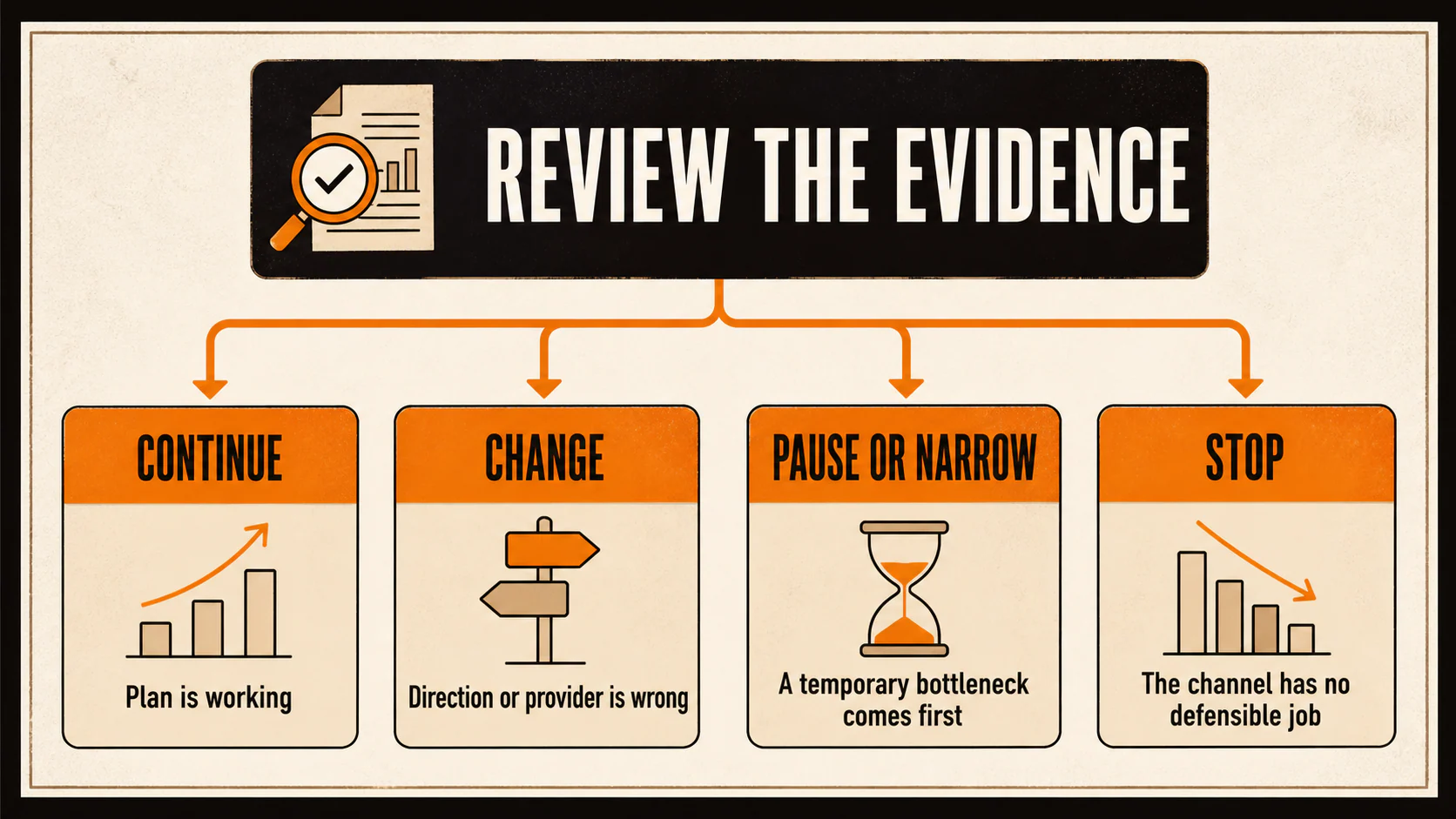
You are deciding which work still deserves money, what needs to change, and what the business must preserve if spending changes.
First, define what you mean by stopping SEO
SEO is not a single switch. A monthly engagement may include strategy, page work, technical fixes, local business information, reporting, conversion tracking, and coordination with whoever edits the website. You can stop one part without abandoning all of it.
For example, a business might stop publishing new pages while keeping its website software maintained, its hours and services accurate, and its lead tracking in place. It might end an agency relationship but retain ownership of the website, Google Business Profile, analytics, Search Console, call-tracking account, content, and reports. Or it might narrow a broad campaign to the locations and services that still make business sense.
Those are different decisions. If a provider calls all of them "quitting SEO," the conversation is already too vague.
Build a small evidence packet before the meeting
Do not hold a campaign review with only the latest monthly report open. Gather enough information to connect the work to the business.
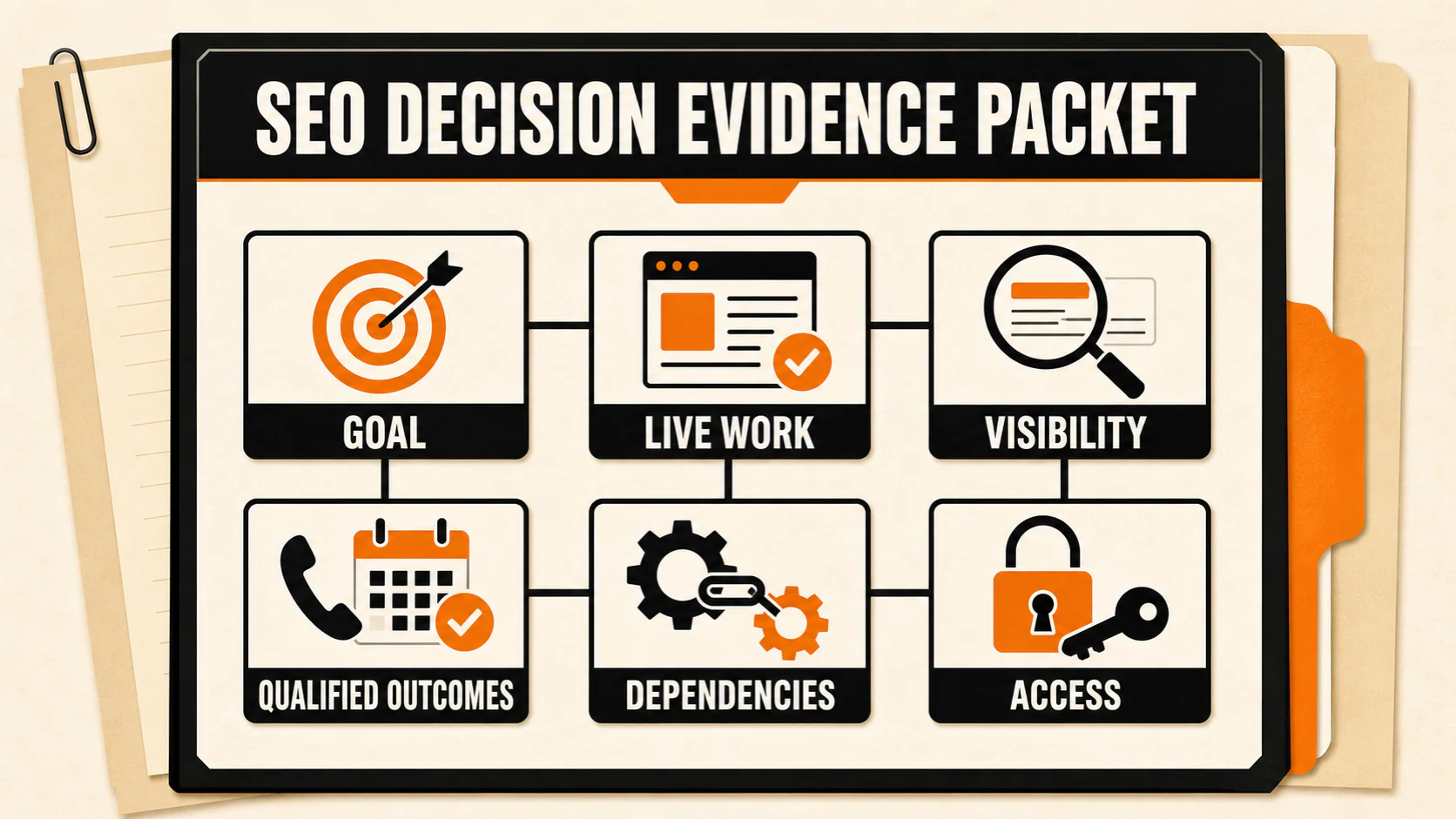
1. The baseline and the goal
Write down what the campaign was meant to improve. Name the services, locations, audiences, pages, and business outcomes in scope. Also record the starting condition that justified the work.
"Grow traffic" is too loose. Traffic from people outside your service area or searching for something you do not sell can make a chart rise without helping the business.
2. Work that is complete and live
Ask for the pages changed, technical fixes implemented, profiles updated, content published, and recommendations still waiting on someone. A task listed in a report is not the same as a change on the site.
This distinction catches a common failure: the strategist recommended the right fix, but nobody had access, approval, or responsibility to implement it. That is an ownership problem. It may require a new plan, not a verdict against SEO.
3. Relevant search visibility
Separate broad impressions and rankings from visibility tied to the services and locations you can actually serve. For a local business, also separate website results from local results such as the map pack. They are related, but they are not interchangeable.
Do not let one exciting ranking carry the whole review. Ask whether the campaign is becoming more visible for the intended market and whether the landing pages match what those searchers need.
4. Qualified business outcomes
Traffic, calls, forms, qualified inquiries, appointments, and revenue are different measures. Keep them separate.
A report can show more calls while the recordings reveal wrong numbers, job seekers, or people asking for services you do not offer. It can show more traffic while the sales team sees no change in viable opportunities. Lead quality stays unknown until someone reviews it.
5. Dependencies and the next test
List what is holding the plan back: development, approvals, missing service information, weak landing pages, bad tracking, slow follow-up, limited capacity, or an offer that does not convert. Give each dependency an owner and date.
Then ask what evidence would change the next decision. A provider should be able to explain what it will test or change and how the team will judge it. If the answer is only "more time," you have not been given a decision rule.
6. Ownership and access
Confirm who owns every important account and asset. That includes the domain, hosting, website, Google Business Profile, analytics, Search Console, tag manager, call tracking, content, reports, and any other system needed to understand or operate the campaign.
Do this before the relationship is tense. Access is boring right up until it is the only thing anyone can talk about.
Continue when patience is being earned
Continuing makes sense when the plan is specific, the work is visible, and the available evidence fits the intended direction. Instant leads are not the standard. You still need documentation, ownership, and a reasoned next step.
A reasonable case for continuing should answer these questions:
- What problem are we solving now?
- What changed on the site or local presence?
- Which relevant services and locations are showing early movement?
- What has not moved, and what is the working explanation?
- Which tasks depend on the business, developer, writer, or provider?
- What is the next decision, and what evidence will trigger it?
Some search changes are not processed instantly. Google says recrawling can take days to weeks, and requesting a crawl does not guarantee immediate inclusion. That narrow processing fact can justify waiting for a specific change to be discovered. It cannot justify an open-ended campaign timeline or guarantee a ranking. See Google's recrawling guidance for the boundary.
If timing is the main source of confusion, read how long SEO can take. Use timing as background for interpreting evidence, not as a substitute for it.
Change the plan when the work is aimed at the wrong thing
A campaign can be busy and still be wrong.
Maybe the content targets broad questions while the business needs visibility for a profitable local service. Maybe rankings are improving in cities the company does not serve. Maybe the provider reports all organic traffic together, hiding whether the right landing pages are gaining useful visits. Maybe sound technical recommendations are stuck in a queue with no implementation owner.
These problems call for a change in target, scope, sequence, measurement, or ownership. They do not automatically prove that organic search is a bad channel.
Ask the team to state the correction in one sentence: "We began with X. The evidence now shows Y. We will change Z." If nobody can complete that thought, the plan has become a recurring task list instead of an adaptive strategy.
Change the provider when accountability is missing
An SEO company should not ask for blind trust because SEO is complicated. Complicated work needs better explanation, not less.
Google's own guidance for hiring an SEO recommends asking about expected results and timeframes, measurement, communication, and whether the provider will explain its changes. Google also warns against guaranteed number-one rankings.
Consider a provider change when you repeatedly see problems such as:
- Completed work cannot be shown on the live site or in the relevant account.
- Reports emphasize activity while avoiding qualified outcomes and business goals.
- The provider cannot explain why the current priorities fit your services and locations.
- Important recommendations sit unimplemented, but nobody names the blocker or owner.
- Account access, content, data, or work products remain under the provider's control.
- Questions about uncertainty get answered with guarantees, secrecy, or another vague request for patience.
One imperfect report or missed deadline does not settle the case. A repeated inability to show the work, explain the reasoning, and define the next decision is more serious.
If you need to replace the provider, use these questions to ask before hiring an SEO agency before signing the next agreement. Otherwise, it is easy to change logos and keep the same problem.
Pause or narrow when the business has a bigger bottleneck
Sometimes SEO is not the most urgent problem in the room.
If the business cannot answer calls, has no capacity for additional work, is changing its core offer, has a broken sales process, or cannot implement website changes, increasing production may waste money. A temporary budget constraint can also force a real tradeoff. Pretending otherwise does not make the invoice easier to pay.
A pause can be intelligent if it is explicit. Decide what stops, what continues, who owns it, and when you will reconsider the choice.
At minimum, assign responsibility for:
- keeping the website secure and functional;
- updating hours, services, locations, and other customer-facing facts;
- preserving analytics and lead-tracking data;
- monitoring forms, phone routing, and critical pages;
- retaining account access, content, reports, and implementation records.
You may also narrow the work to a defined problem instead of funding a broad monthly program. For example, keep technical maintenance and measurement while pausing new content, or focus on one viable service and location while the business repairs its offer elsewhere.
The right scope depends on the actual constraint. That is why "never pause SEO" is sales copy rather than business advice.
Stop when the channel no longer has a defensible job
It can make sense when the business is closing, leaving a market, or replacing an offer. It can also make sense when careful research finds no meaningful search demand for a viable offer, when the economics fail under the business's own numbers, or when repeated documented changes produce no useful path forward.
Be strict about those conclusions. "We did not get enough leads" does not tell you whether the problem was demand, visibility, the page, tracking, follow-up, lead quality, pricing, capacity, or execution. A stop decision should name what was tested, what changed, what remained unknown, and why another adjustment is not worth the expected cost.
Run the economics with gross profit and capacity, not optimism. The SEO pricing guide shows how to compare monthly cost with the additional customers needed to cover it. That calculation is a screening tool, not a forecast, but it brings the conversation back to the business.
If search still matters but the current scope does not, narrow or change before you abandon the channel. If the channel has no defensible job, stop cleanly. Sunk cost is not a reason to keep paying.
What may happen after you stop SEO
There is no universal countdown where rankings switch off.
Your existing pages and listings do not disappear because a contract ended. At the same time, the environment does not freeze. Competitors can change their sites. Your own services, hours, staff, software, links, and pages can change. Search systems and result layouts can change too. If nobody is watching, stale information or technical problems may go unnoticed.
The speed and consequence depend on the site, market, competition, work stopped, and maintenance retained. Anyone giving you an inevitable decline date without examining those conditions is guessing.
Restarting later may require diagnosis and repair before growth work resumes. Preserve the evidence and access now so the next person does not have to reconstruct the campaign from screenshots and old email threads.
Hold a 30-minute decision meeting
Bring the evidence packet and leave the meeting with one written decision. Do not spend the whole half hour touring a dashboard.
Use this agenda:
- Restate the business goal and the services and locations in scope.
- Review what is live, what is pending, and who owns each dependency.
- Separate relevant visibility from qualified outcomes and unknowns.
- Choose continue, change, pause or narrow, or stop.
- Name the next action, owner, due date, and evidence for the next review.
- Confirm access and exports if the scope or provider is changing.
If you exit, collect the contract and notice terms, account ownership, administrator access, analytics and Search Console exports, call-tracking records, work logs, content files, technical recommendations, reporting history, and a list of changes that were proposed but never implemented. Document what will keep the site functioning and customer information accurate.
Then write the decision plainly. "Continue for now" is not enough. "Continue the current service-page and local work until the next review because implementation is live, the intended market is showing early visibility, and call quality will be reviewed weekly" is a decision someone can manage.
SEO does take patience. Your provider still has to earn it.
Last updated