

Key Takeaway
Copy seven natural review request email templates for completed jobs, recurring services, support follow-ups, consultations, and more, with Google-friendly guardrails.
Asking for a review should not feel like groveling.
You did real work for a real customer. Now you are inviting that person to describe the experience honestly. That is a normal business request, not a plea for validation and definitely not a reason to write three paragraphs about how much a five-star rating would mean to you.
Pick the template that matches what actually happened, replace the bracketed details, and send one clear review link. Keep the ask neutral. If the customer had a genuine experience, their honest opinion is the point.
Before you copy one, get the guardrails straight.
Before you send a Google review request
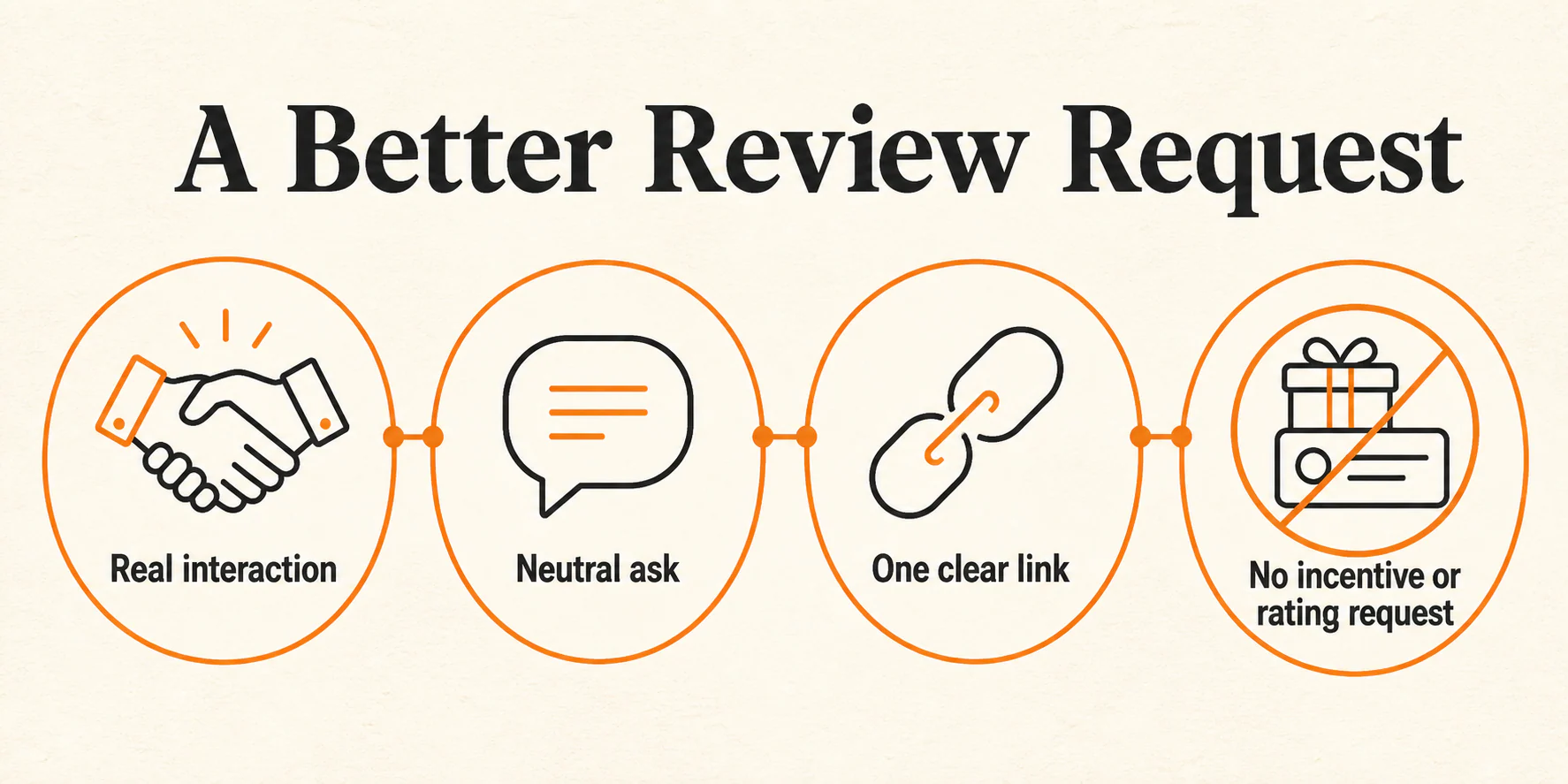
A Google review request should have four parts:
- A real interaction. The recipient actually used your service, completed a project, attended an appointment, or had another genuine experience with the business.
- A neutral ask. Invite an honest review. Do not ask for a positive review, five stars, a staff member's name, certain keywords, or a particular story.
- One clear review link. Send the customer to the correct review page without burying the link among several other requests.
- No incentive or pressure. Do not trade a discount, gift, entry, or other benefit for a Google review. Do not put a customer on the spot at your counter and wait while they write it.
Google's current prohibited and restricted content policy bars incentives, selective requests for positive reviews, attempts to influence a rating or review content, and pressure to leave a review on the premises. The FTC also says an incentive conditioned on positive or negative sentiment violates its consumer review rule. For Google reviews, the practical rule is simpler: skip the review incentive entirely.
Those Google rules apply to Google reviews. The FTC note is US federal guidance. If you are requesting a review on another platform, check that platform's current rules too.
If you need the larger process around these emails, start with a repeatable system for getting online reviews. The templates below handle the email itself.
1. Completed project or service
Use this after a customer has had enough time to experience the completed work. That might be the day after a cleaning visit, or later for a project whose result takes time to judge. There is no universal magic hour.
Subject: How did the [service/job] go?
Hi [First name],
Thanks for choosing us for your [service/job]. Now that the work is complete, would you be willing to leave an honest review about your experience?
You can share it here: [review link]
Thanks for your time,
[Your name]
Use the actual job name. "Your recent service" sounds like a mail merge because it is one.
2. Recurring service
A recurring customer does not have a neat project-complete moment. Use a natural milestone instead, such as a completed month, quarterly check-in, or a defined number of visits. Apply the same milestone consistently rather than waiting for someone to compliment you.
Subject: A quick question about your service
Hi [First name],
You have now been using our [service] for [time period]. Would you be willing to leave an honest review of your experience?
You can share it here: [review link]
Thank you for your time,
[Your name]
The milestone is context, not flattery. Keep it factual.
3. Resolved support issue
A support problem is part of the customer experience, too. Once the issue is actually resolved, you can invite an honest review of the experience. Do not send this only to customers who praised the resolution. That turns a useful trigger into satisfaction screening.
Subject: Following up on your support request
Hi [First name],
Now that we have resolved your support request about [specific detail], thank you for giving us the chance to work through it with you.
If you would like to share an honest review of your experience, here is the link: [review link]
Thanks,
[Your name]
If the problem is not resolved, do not rush to this template. Use the private service-recovery message in template seven instead.
4. Consultation or appointment
This version fits a consultation, estimate, office visit, or other appointment where the person had a genuine interaction but may not have purchased a larger service. Ask about the experience they actually had. Do not imply they should review an outcome that has not happened.
Subject: Thank you for meeting with us
Hi [First name],
Thank you for meeting with us about [service/topic]. If you have a moment, you are welcome to leave an honest review of your appointment.
Here is the direct link: [review link]
Take care,
[Your name]
Short is useful here. The appointment already supplies the context, so the email does not need to retell it.
5. Long-term customer
Long relationships deserve a better message than "valued customer." That phrase manages to sound formal and vague at the same time. Name the relationship instead.
Subject: Would you share your experience with us?
Hi [First name],
We have worked together on [service/job] for [time period], and I appreciate the trust you have placed in our team.
Would you be willing to leave an honest review of your experience? You can do that here: [review link]
Thank you,
[Your name]
Use a consistent customer milestone for this email. "People we have served for one year" is a neutral group. "People who told us they love us" is review gating wearing a nicer shirt.
6. The very short version
Some customers know exactly why you are writing. Let them get to the point.
Subject: Quick review request
Hi [First name],
Thanks for choosing us for [service/job]. Would you leave an honest review of your experience?
[review link]
Thank you,
[Your name]
That is enough. No dramatic monologue. No tiny essay about the importance of local businesses. Just a recognizable sender, a real interaction, and one clear action.
7. Service-recovery feedback
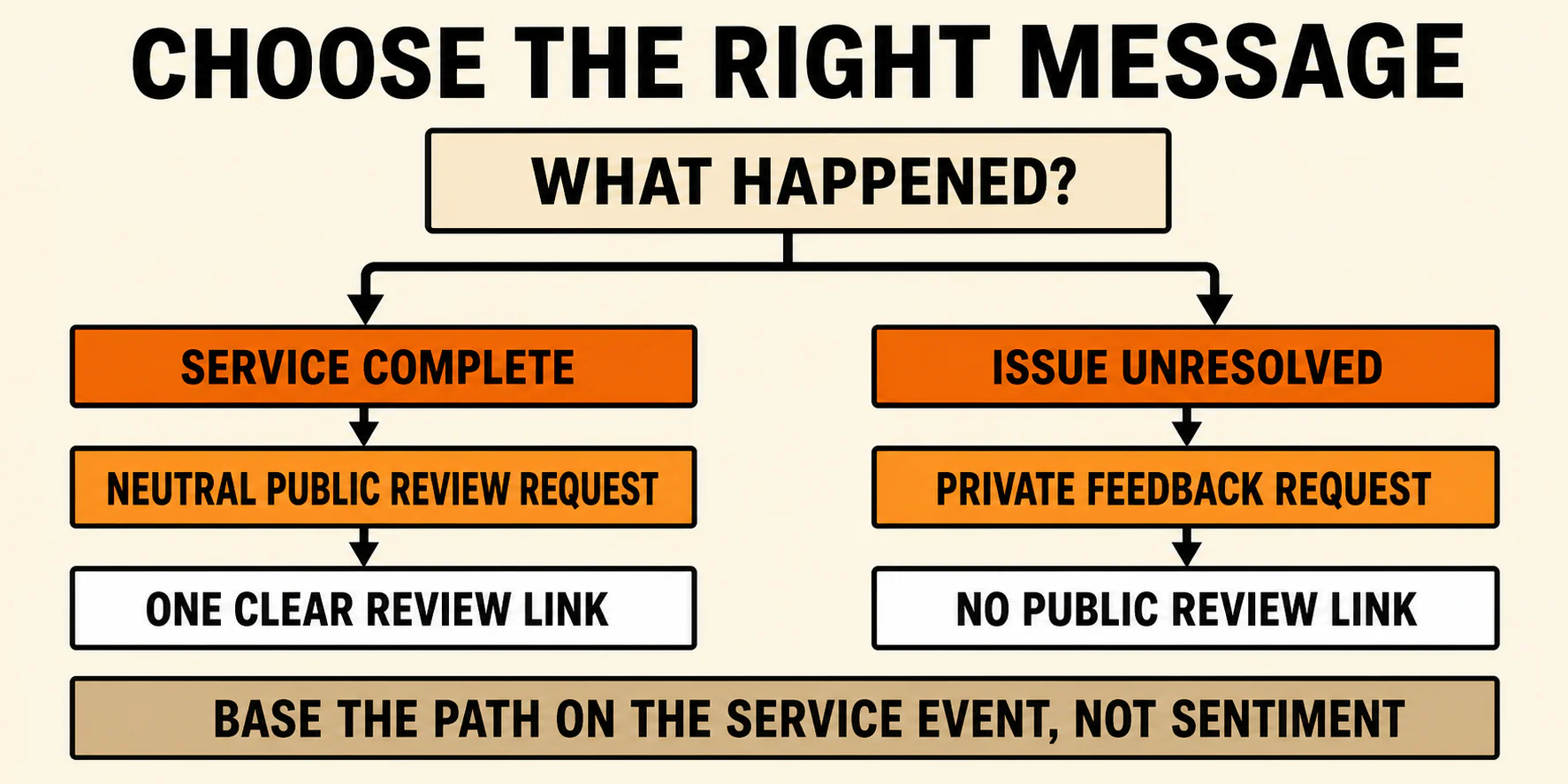
This is a private feedback email. It is not a public-review request. Do not add a Google review link.
Use it when something went wrong, the issue is unresolved, or you do not yet understand the customer's concern. The job here is to listen and fix what you can, not to steer the customer away from a negative review.
Subject: I want to understand what happened
Hi [First name],
I am sorry that [specific issue] did not go as expected. I want to understand where we fell short and what would be helpful now.
Would you reply to this email with anything you think we should know? If a call is easier, reply with a good time and we will arrange one.
This is a request for private feedback, not a request to post a public review.
[Your name]
Do not offer a fix in exchange for removing, changing, or withholding a review. Resolve the service problem because it is the right business action. Our customer service examples for earning authentic reviews go deeper on the behavior that comes before the review request.
Private feedback and public reviews are not the same thing
Private feedback comes back to your business. It helps you understand a problem, ask follow-up questions, or improve the service. A public review is written for other people on a platform such as Google.
Both paths should welcome an honest response. The problem starts when a business asks everyone a satisfaction question, sends happy customers to Google, and routes unhappy customers into a private form. That is review gating.
You can collect private feedback. You can also invite genuine customers to leave public reviews. Just do not use the private answer as a test that decides who receives the public invitation. Base eligibility on a real experience and a neutral operational rule, such as a completed job or a defined service milestone, not on whether the customer sounded pleased.
If a customer sends criticism privately, respond to the concern. Do not discourage that person from posting a review. And if they leave one, do not make assistance conditional on changing it.
Personalize the email without turning it into a project
A template is a shortcut, not a personality transplant. Four details are usually enough:
- Use the customer's first name.
- Name the service, project, appointment, or support interaction.
- Mention one specific detail you already know, if it helps the recipient recognize the interaction.
- Use the direct review link for the correct business location.
The specific detail belongs in your message, not in a list of instructions for the reviewer. "Thanks for having us complete the kitchen repair on Tuesday" gives context. "Please mention the kitchen repair, our technician, and how quickly we arrived" tells the customer what to write. Leave the content to them.
Also, write like your business. A neighborhood electrician and a medical practice may not use the same sign-off, and they should not have to. Keep the neutral ask intact, but replace any phrase that sounds wrong coming from your team.
For other channels and situations, see these broader ways to ask customers for reviews.
Review request email checklist
Before you send or automate the email, check the complete path:
- Confirm a genuine experience. The customer has enough firsthand experience to comment honestly on the service you are asking about.
- Use a neutral eligibility rule. A completed job, attended appointment, or recurring-service milestone works. A positive survey answer does not.
- Read the wording once for pressure. Remove incentives, requested ratings, suggested talking points, and language that assumes the customer was happy.
- Test the review link. Make sure it opens the correct business or location. If the profile itself needs work, fix the Google Business Profile setup and information before sending customers there.
- Check the email on a phone. The sender, reason for the message, and review link should be obvious without hunting.
- Use your normal email-compliance process. A customer relationship does not automatically make every review request a transactional message. The FTC says an email's primary purpose controls its CAN-SPAM treatment. If the email's primary purpose is commercial, including a mixed message treated as commercial, follow your normal process for accurate sender and subject information, a physical postal address, and a working opt-out. Review the FTC's CAN-SPAM compliance guide with the people responsible for your email program.
- Send one optional reminder, then stop. If your process includes a reminder, send one brief follow-up. After that, retire the sequence with dignity.
Templates make the task repeatable, but they cannot decide whether a customer has enough experience or whether your workflow filters people by sentiment. That judgment belongs in the process around the email.
Choose the closest template. Replace the bracketed fields. Read it once out loud, because corporate fog is easier to hear than to see. Then send a respectful, neutral request and let the customer decide what to say.
Last updated