
Google Ads Location Targeting for Local Businesses: Presence vs. Interest

Key Takeaway
Learn when local Google Ads campaigns should use Presence vs. Interest, then audit networks, goals, bidding, budgets, schedules, devices, audiences, and tracking.
You can target the right city in Google Ads and still pay for inquiries from people your business can't serve. The city, ZIP code, or radius is only the first geographic choice. The included-location option underneath it also affects who may be eligible to see your ad.
If you run a local service business and the customer needs to be inside your service area, Presence (people in or regularly in your included locations) is usually the safer starting point. Google describes this option as a way to minimize clicks from outside your targeted locations. It isn't a hard geofence, though, and it can't eliminate every outside-area click.
Presence or Interest may make more sense when demand starts before someone arrives. A hotel, destination wedding venue, relocation service, college, event operator, or another business that serves advance planners may need to reach people who are interested in a location but aren't there yet.
That choice matters, but it isn't the only one affecting delivery. Your networks, conversion goals, bidding, audiences, schedule, devices, and tracking can all change who sees the campaign or what Google optimizes toward. Work through them in the order below so you don't try to fix a tracking problem with a location setting.
Before you start, make sure you can view the campaign settings and conversion goals. Open a blank document or spreadsheet, then pull together your real service boundaries, response hours, and definition of a qualified lead. This guide covers Search campaigns. It isn't a full setup guide for Performance Max, Local Services Ads, Shopping, Display, or video campaigns.
1. Choose Presence or Interest based on where the buyer must be
Google Ads gives you two included-location options:
- Presence considers people in or regularly in the locations you include.
- Presence or Interest can also consider people who have shown interest in those locations.
Google uses several signals to infer location, and Google doesn't guarantee complete accuracy. Think of location targeting as a filter you have to monitor, not proof of someone's exact location when they search.
Use your buying situation to make the first call:
| Buying situation | Sensible starting point | Reason to reconsider |
|---|---|---|
| The customer must be inside a defined service area | Presence | Test broader reach only if out-of-area searchers can become serviceable customers |
| The customer visits a physical location nearby | Presence | Broader interest may matter if people routinely plan the visit before arriving |
| The purchase is tied to future travel, relocation, education, or an event | Presence or Interest may deserve a test | Separate results from local-presence traffic so poor-fit geography stays visible |
| The campaign serves both local and pre-arrival demand | Separate campaigns or another clean test may be easier to evaluate | A blended campaign can hide which location behavior produced the inquiry |
Presence or Interest isn't inherently wasteful. It serves a different demand pattern. Presence isn't exact GPS enforcement, either. Google says advertisers who are concerned about outside-area clicks can switch to Presence to minimize them, not eliminate them.
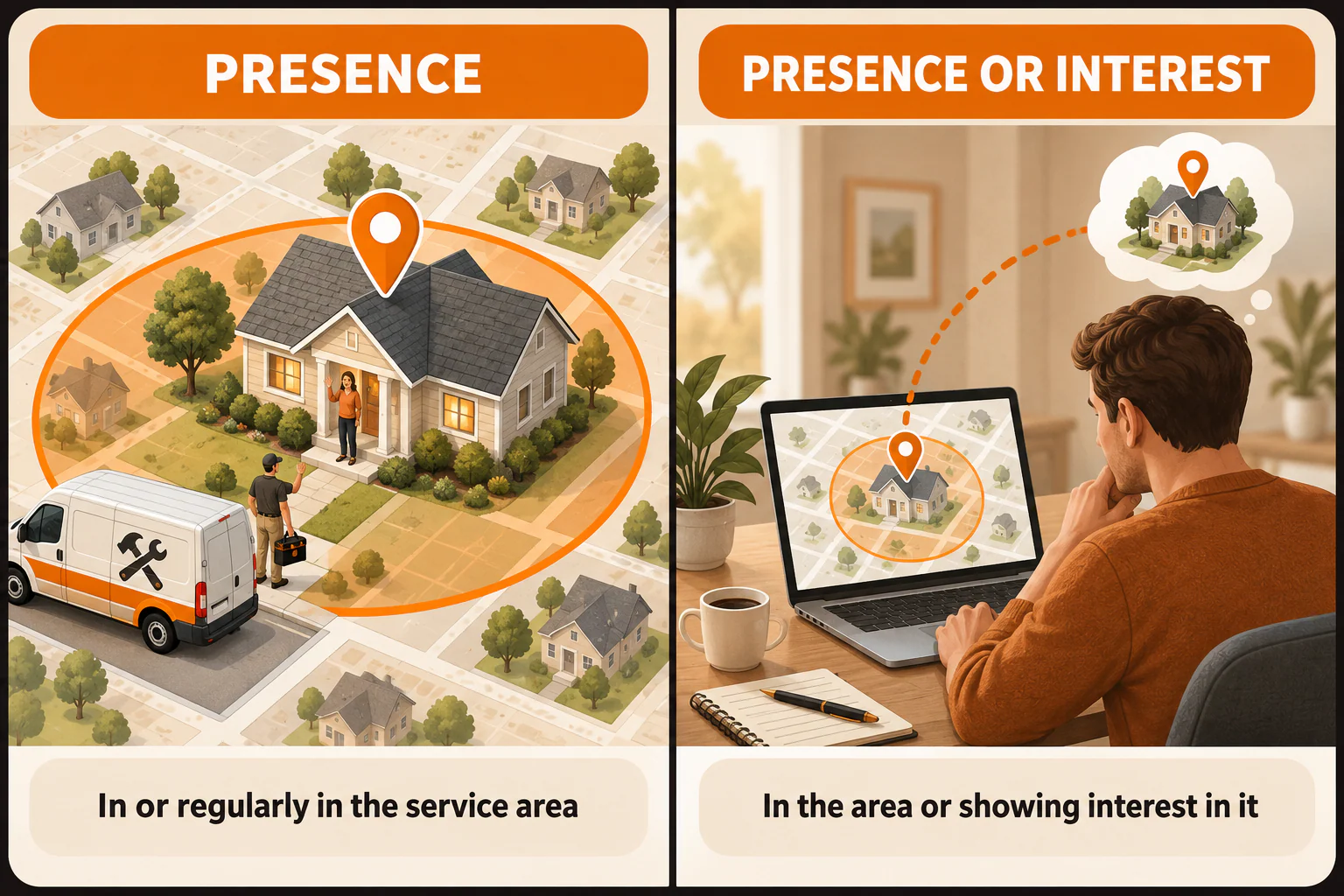
Exclusions still matter with either option. If you can't serve a neighboring county, state, or part of a metro, write down that boundary and add an exclusion where the campaign supports it. Google Ads supports geographic inclusions and exclusions, but the location types available can vary by campaign and market. Use Google's location-targeting instructions to confirm the current controls instead of trusting an old screenshot.
Completion check: Write one sentence explaining why this campaign needs physical presence, pre-arrival interest, or a separate test for both. Keep working until that sentence is specific enough to guide the setting.
2. Map the market you can actually serve
Your location targets should reflect where you can fulfill the work, not where you'd like to collect leads. Before you touch bids, list the places where your business can reliably accept and complete a job.
Look at the cities, ZIP or postal areas, regions, and radiuses that match your real service footprint. Not every target type is available in every campaign or country, so work with the choices shown in your account. Then identify nearby places that aren't workable because of travel time, licensing, staffing, delivery limits, or another concrete constraint.
A hypothetical home-services example
Imagine a home-services company that covers one metro area. Its technicians regularly work on the north and east sides, but the company doesn't cross the state line on the western edge of the metro. The business could provide plumbing, roofing, electrical, HVAC, or another in-person service. The service itself doesn't change the geographic logic.
Its campaign record might say:
- Included locations: the cities and ZIP codes inside the documented service footprint
- Excluded locations: the neighboring out-of-state county and any distant ZIP codes the team won't serve
- Included-location option: Presence
- Reason: the company can fulfill a request only when the property is inside its service area
- Next check: review user-location data and lead dispositions for service-area mismatches
Don't copy that map. Connect every inclusion and exclusion to an operational fact about your business. A broad radius may contain territory you can't serve. A city boundary may leave out nearby ZIP codes your team visits all the time. The right shape is the one you can explain and fulfill.
Once you've saved the map, compare the included locations, exclusions, and advanced location option with your written record. Then check what actually happens after the campaign runs. Presence narrows the logic, but Google's location signals are still imperfect.
3. Audit conversion goals before choosing automation
This is where many local campaigns get the order backward. A bid strategy can't tell a useful lead from a poor one unless the campaign receives signals that represent the business outcome you care about.
In Google Ads, primary conversion actions are used for bidding and appear in the Conversions column. Secondary conversion actions are generally observational, although custom goals can change how an action is used. Google's primary and secondary conversion documentation explains the distinction. A page view, button click, raw form submission, qualified phone call, booked appointment, and accepted job aren't interchangeable events.
For the hypothetical home-services company, a call that reached the office and concerned a property inside the service area may be a more useful business signal than a visit to the contact page. The exact setup depends on the account, call-tracking method, consent requirements, and sales process. Your immediate question is simpler: Does each primary conversion have a clear business reason and a tested tracking path?
Test each important action from the ad click through the landing page and handoff. Confirm that it records once, appears in the expected reporting column, and can be reconciled with call recordings, appointment records, or lead dispositions where appropriate. This Google Ads and local SEO feedback-loop guide goes deeper on using lead-quality evidence across paid and organic marketing.
Don't expand aggressively just because the account reports a large conversion count. First find out what those conversions represent.
4. Confirm the campaign type and network reach
This guide focuses on Search campaigns, where the main job is to reach people searching for relevant terms. A Search campaign can still include extra reach settings.
Search Partners extend eligible reach beyond Google Search to search-related partner inventory. Display Expansion, when available, can extend an eligible Search campaign onto Display inventory. Those are different environments, so don't lump them together as "more traffic."
Neither option is automatically a mistake. Each one changes reach and deserves its own reporting and lead-quality check. Record whether it's enabled, what inventory it adds, and whether you can evaluate those results separately. If the campaign type itself isn't clear, compare Search and Performance Max for local lead generation before changing your location settings.
The home-services business might keep the first pass focused on Search intent, then evaluate partner or Display reach as a separate decision. An increase in traffic isn't the test. You need to know whether the added reach produced calls or inquiries the company could serve.
5. Match bidding and budget to data you trust
Google advises choosing a bid strategy that matches your campaign goal. Smart Bidding uses Google's automation to optimize auction-time bids for conversions or conversion value. That's how the mechanism works, but it doesn't tell you whether a particular account is ready for it.
Before you recommend a bid strategy, document:
- What the primary conversions mean
- Whether you've tested the tracking
- Whether you can distinguish qualified leads from poor-fit leads
- The economics of an accepted lead or booked job
- The amount and consistency of useful conversion data available
- Any constraints the business needs the campaign to respect
Without that context, a bid strategy recommendation is guesswork. The home-services campaign shouldn't optimize confidently toward raw form fills if many of those forms come from outside the service area or ask for work the company doesn't provide. This local-business guide to automated bidding explains the tradeoffs in more detail.
You also need to understand how the budget behaves. In many campaigns, the number you enter is an average daily budget, not a fixed daily ceiling. Google says an individual day may spend up to twice that average, while the monthly charging limit generally uses 30.4 times the average daily budget. Google's budget documentation covers that pacing behavior and its exceptions.
Write down the average daily budget, the monthly amount the business is prepared to fund, and who will review pacing. Precise location settings won't prevent a budget surprise if someone reads the average as a guaranteed daily cap.
6. Check schedule, devices, and response capacity
Ads are generally eligible throughout the day unless an ad schedule restricts delivery. That doesn't mean every local business should limit ads to business hours.
If your team answers calls after hours, broader availability may make sense. If every evening caller reaches an unmonitored voicemail, you may need a different plan. Set the schedule based on staffing, response speed, booking behavior, and lead-quality evidence. Then make sure the campaign reflects your actual response coverage, including its time zone and holiday changes.
Treat device decisions with the same care. Google Ads can support device bid adjustments, but compatibility depends on the bidding strategy. Google documents that a supported device adjustment can be as low as minus 100 percent, which effectively removes that device from eligibility. That setting makes a consequential reach change, so review the evidence before using it.
Don't exclude mobile because its clicks look expensive or desktop because it produces fewer leads. Compare qualified outcomes. A mobile call about an urgent home repair may be highly valuable, while a desktop form can still matter for a planned project. Let the account data decide instead of relying on a generic preference.
Completion check: Your record should show the active schedule, the business's response coverage, the current device treatment, and the evidence you'll require before changing either one.
7. Keep audience controls separate from location controls
Google Ads uses similar words for controls that do very different jobs.
Geographic Presence and Presence or Interest describe how a person's relationship to the included location affects eligibility. Audience Observation and Targeting describe how an audience segment affects eligibility.
For Search campaigns, Observation can add audience reporting without narrowing who may see your ads. Targeting restricts eligibility to the audience segments you selected. Google's Targeting and Observation guidance recommends Observation for Search, but that recommendation isn't proof of performance for your account.
Record the mode applied to each audience. If Targeting is active, write down why the campaign should exclude searchers who match the keywords and geography but don't belong to the chosen audience. If you only want to compare audience performance, Observation preserves reach while adding reporting.
For the home-services example, switching the location option to Presence wouldn't repair an audience that was accidentally set to Targeting. They're separate filters, so give each one its own line in your record.
8. Review language, brand controls, and URL tracking
These settings come later in the review, but each one can still affect delivery or measurement.
Language status
Google announced that beginning in September 2026, Search campaign language settings are being removed and matching will rely on the language of the ad. This is a current rollout, not proof that every account has already changed. Check what your campaign shows today. Don't build an ongoing process around a toggle that may be disappearing from the interface.
Brand controls
Eligible Search campaigns can use brand inclusions or exclusions. These controls may help separate branded and nonbranded demand or limit eligible brands in a campaign, but there isn't one structure that fits every account. Record whether brand settings are present, what they're meant to control, and how that choice supports the campaign's job.
URL tracking
A final URL suffix can append tracking parameters to landing-page URLs. A tracking template can define click-tracking information at supported levels of the Google Ads hierarchy. Both can help carry campaign information through to the site.
Neither one proves your attribution is accurate. The landing page, redirects, consent setup, analytics, call tracking, and downstream lead system still need to preserve and interpret the data correctly. Record the active parameters, where they're set, and one click path you've tested. Google's documentation on tracking templates and their hierarchy can help when account, campaign, or entity-level settings might conflict.
9. Verify delivery with a feedback loop
Saved settings tell you how the campaign is configured. To see whether they're working as intended, compare actual delivery with serviceability and lead quality.
For a new campaign or after a major change, a practical weekly review can cover:
- Search terms that triggered ads
- User locations and obvious geographic mismatches
- Conversion actions recorded
- Call recordings or lead dispositions, where appropriate and permitted
- Inquiries the business couldn't serve
- Network, device, or time patterns that deserve a closer look
Once delivery settles down, a monthly review can compare network, device, time, geography, conversion-goal mix, cost per qualified opportunity, and accepted, booked, or sold outcomes. These are practical operating cadences, not Google mandates. If spend moves quickly or tracking breaks, check sooner.
Suppose the home-services campaign gets calls from inside the metro, but several callers need work in the out-of-state county the team doesn't enter. Don't jump straight to "location targeting is broken." Check the user's reported or matched location, the search term, the included locations, the exclusions, the location option, and the caller's actual service address. That sequence helps you separate a settings problem from an imperfect location signal or a query that simply mentions the target area.
Success here means you've verified the campaign record and scheduled the next review. It doesn't promise more leads, lower costs, or better revenue.
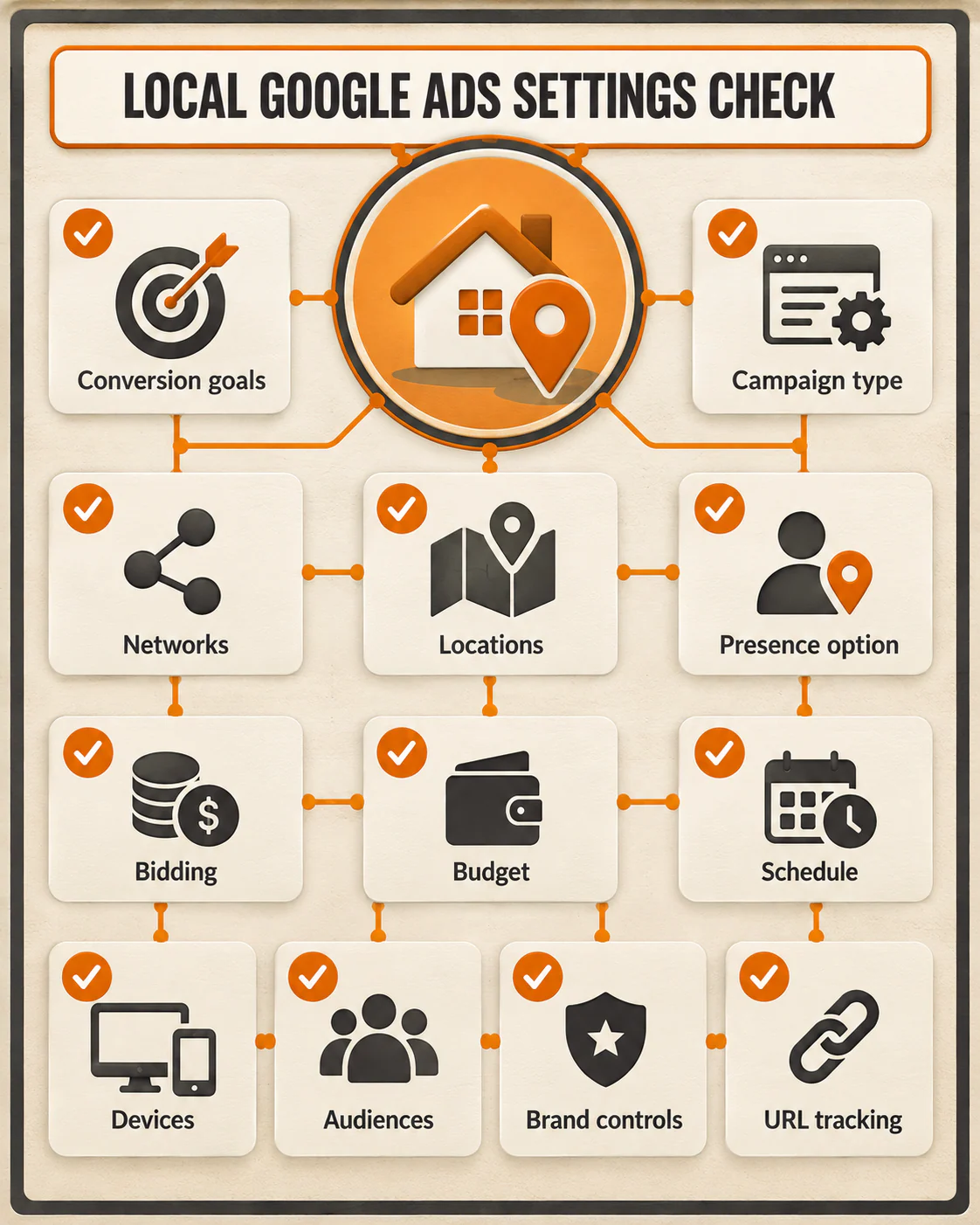
A 15-minute campaign settings checklist
Use one page or one spreadsheet row for each campaign. Record the setting, why it exists, who's responsible for it, and when you'll review it again.
- Primary conversion goals: Which actions guide bidding, and have you tested each tracking path?
- Campaign type and networks: Is this Search, and are Search Partners or Display Expansion enabled?
- Included and excluded locations: Do they match the market you can actually serve?
- Presence versus Presence or Interest: Must the buyer be in the area, or can useful demand begin before arrival?
- Bid strategy and budget: Does the strategy use data you trust, and do you understand average-daily pacing?
- Schedule and response coverage: Can your business handle leads whenever the ads are eligible?
- Devices: Does the strategy support the adjustments, and does qualified-lead evidence justify them?
- Audience mode: Is each audience in Observation or Targeting, and is any restriction intentional?
- Language status: What does the account show during Google's September 2026 Search transition?
- Brand controls: Are inclusions or exclusions active, eligible, and consistent with the campaign's job?
- URL tracking: Have you documented suffixes or templates and tested a click path?
- Next review: When will someone check search terms, user locations, and qualified-lead outcomes?
The most useful line connects a setting to a real business constraint. "Presence because we serve this metro" gives you something to verify. "Presence because someone online said it's best" doesn't.
If your settings look right but the campaign still produces poor-fit inquiries, YEAH! Local can audit the Google Ads campaign and the lead path. Bring the completed checklist, your conversion definitions, and recent lead dispositions. Those records make the next review much more concrete.