

Key Takeaway
Choose a Google Ads automated bidding strategy based on traffic, leads, or conversion value, then check tracking, targets, budgets, and lead quality.
Automated bidding can follow a bad instruction very efficiently.
If your Google Ads account counts every form submission, accidental call, and low-value inquiry as an equally important conversion, Google does not secretly know which leads your business wants. It sees the signals you give it. Then it sets bids around the outcome you selected.
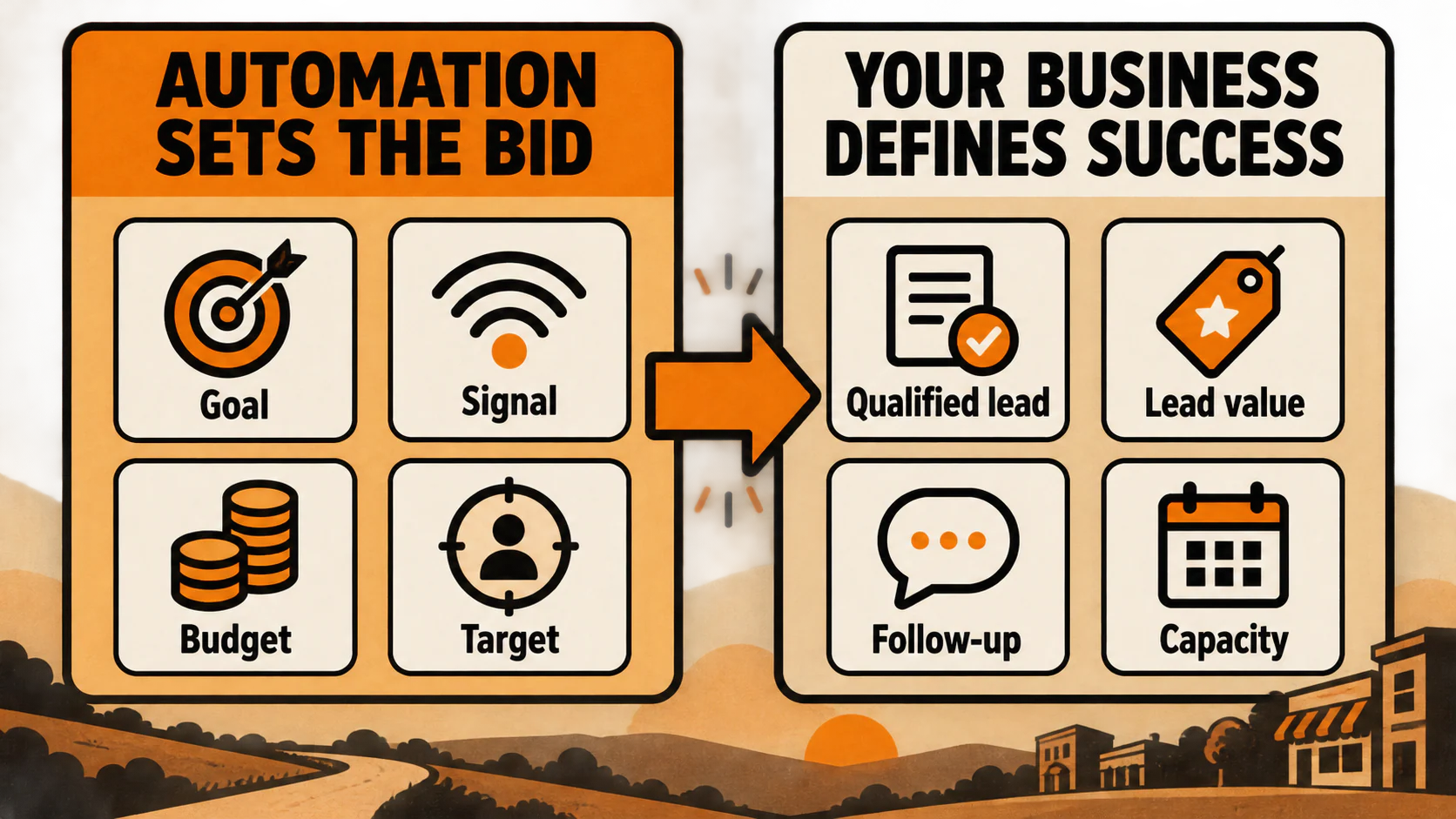
That is why the bid strategy is not the strategy. First choose the business outcome. Then verify the signal Google receives. Only then should you choose a bidding family.
The short answer: match bidding to the outcome
Use this table to narrow the choice. It is a starting point, not proof that the account is ready for automation. Exact options can vary by campaign type.
| Business objective | Closest bidding family | What Google is being asked to pursue | Main risk to check |
|---|---|---|---|
| Visits within budget | Maximize clicks | Click volume | Paying for visits that do not become qualified inquiries |
| Visibility in a chosen area of the results | Target impression share | An impression placement or share goal | Buying visibility without proving lead value |
| More tracked leads or actions | Maximize conversions, optionally with target CPA | Conversion count within budget or around a target | Optimizing toward weak or incorrectly counted conversions |
| More total tracked value | Maximize conversion value, optionally with target ROAS | Conversion value within budget or around a return target | Feeding guessed or misleading values into the system |
Match the objective to the thing you actually want. Use a click objective for clicks, a visibility objective for visibility, a conversion objective for tracked actions, and a value objective when the values themselves are credible.
Keep the labels honest. A click is not a lead, and a form submission is not a qualified opportunity until somebody checks it. Values chosen because they looked tidy in a spreadsheet are not ready for Google to maximize.
What automated bidding actually does
Automated bidding lets Google Ads set bids according to the objective and constraints in the campaign. Smart Bidding is the narrower group of automated strategies focused on conversions or conversion value.
For those conversion and value strategies, Google says Smart Bidding uses auction-time bidding. It can consider contextual signals such as device, location, time, language, operating system, and remarketing list when setting a bid. Google also describes query-level learning and location context that can reach the city level.
Google may set different bids even when two searches look similar to us, because the auction context differs.
That mechanism does not prove a result for your account. Google documents what the system is designed to pursue. It does not promise lower costs, better leads, more booked work, or a particular return for a local business.
The system works from campaign goals, recorded conversions, assigned values, budgets, targets, and auction context. It does not have access to the unrecorded details in your call notes, sales conversations, scheduling software, or profit and loss statement. If those details change what a lead is worth, the account needs an honest way to represent that difference.
Pass the measurement gate before choosing a strategy
The most important bidding work often happens before anyone touches the bidding setting.
- Name the primary business outcome. Decide whether the campaign is supposed to create visits, calls, forms, booked appointments, completed jobs, sales, or tracked value. "More activity" is not specific enough.
- Check what the account counts as a conversion. List the actions marked as primary. Look for duplicate tags, accidental calls, short calls, thank-you-page reloads, job applications, existing-customer requests, and other actions that may not belong in the main optimization goal.
- Separate lead volume from lead quality and value. A campaign can record more conversions while the business receives worse inquiries. For call-heavy businesses, listening to and classifying calls can expose the gap between reported leads and useful leads.
- Check budget, fulfillment capacity, and sales follow-up. A bidding system cannot fix missed calls, slow follow-up, a broken form, or a schedule with no room for new work. Those are business constraints, not bid adjustments.
- Choose between count and value honestly. If one completed action is close enough in business importance to another, a count-based objective may fit. If outcomes differ materially, a value-based objective can express that difference, but only when the assigned values have a defensible basis. Start with the economics, including what a customer is worth over time, rather than inventing values for the ad platform.
Google cannot optimize for a qualified lead if your account never tells it what qualified means. That is the measurement gate. If the gate fails, changing bid strategies only changes how the account pursues a blurry goal.
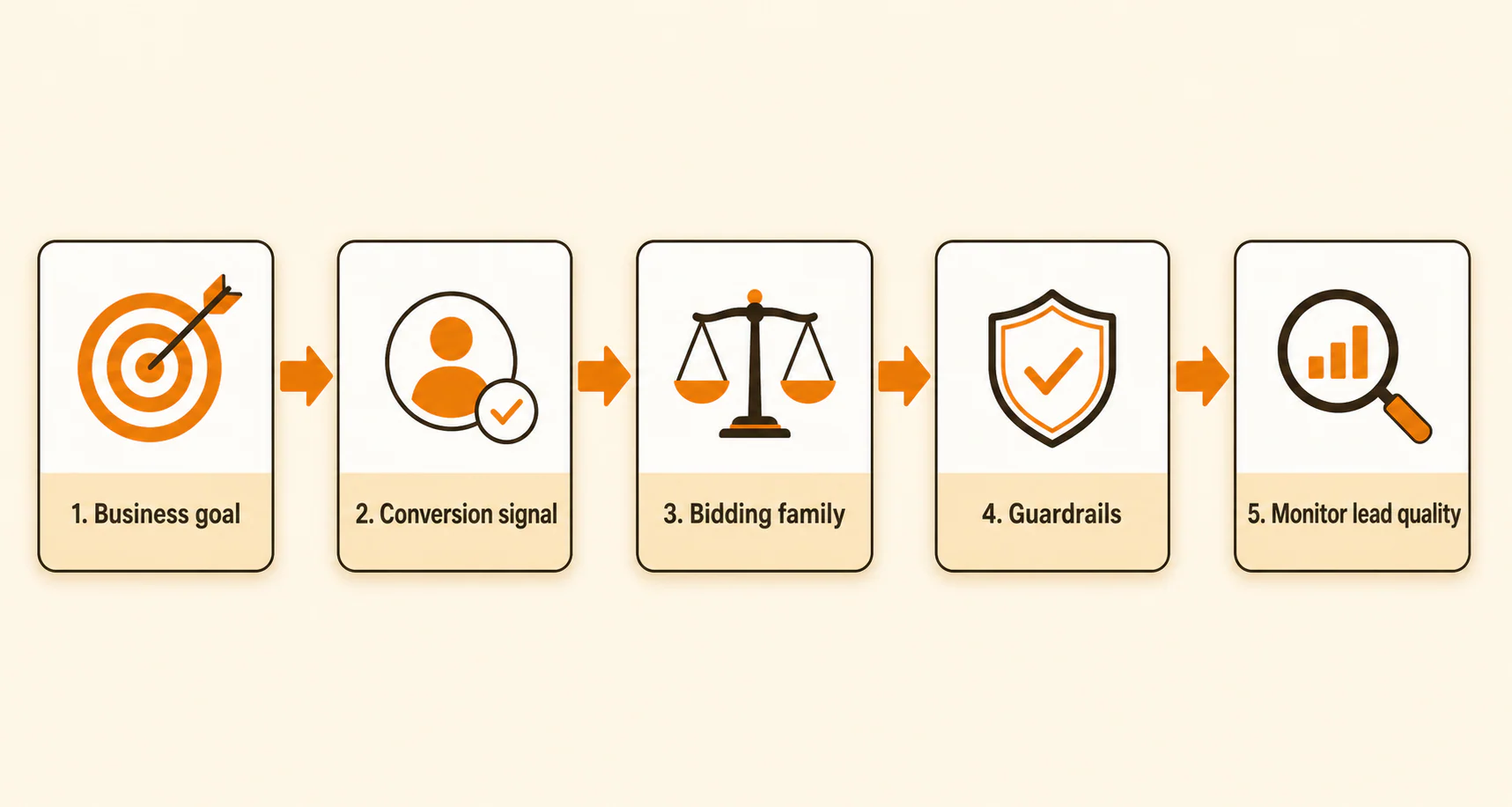
How the current bidding choices differ
Maximize clicks
Maximize clicks asks Google Ads to pursue click volume within the campaign budget. It can make sense when visits are genuinely the objective, such as when a business is deliberately evaluating whether a focused audience will engage with a page.
The limitation is right in the name. The strategy maximizes clicks, not qualified calls, booked work, or revenue. A click can be useful, irrelevant, accidental, or impossible to judge because the landing page failed. If the business really wants leads, using clicks as a stand-in can reward the wrong behavior.
Target impression share
Target impression share is a visibility strategy. It asks Google to pursue an impression-share or placement goal in search results, subject to the settings and limits available for the campaign.
That can fit a deliberate visibility objective. It is not a conversion strategy, and prominent placement does not establish that the traffic has business value. Measure it as a visibility choice rather than quietly changing the definition of success later.
Maximize conversions and optional target CPA
Google currently groups Maximize conversions with an optional target cost per action, or target CPA. Without the target, the strategy pursues conversion count within the budget. With a target CPA, the advertiser supplies a cost goal for the strategy to work around.
Target CPA is not a hard maximum cost for every conversion. Individual conversions can land above or below the target, and the target does not guarantee an average result for a particular account. It is also not a substitute for checking what the account calls a conversion.
This family is a reasonable match only when conversion count represents something worth pursuing. If a spam form and a qualified estimate request both count as one primary conversion, the arithmetic may look clean while the business outcome gets worse.
Maximize conversion value and optional target ROAS
Google pairs Maximize conversion value with an optional target return on ad spend, or target ROAS. Without a target, the strategy pursues total tracked conversion value within the budget. With target ROAS, the advertiser supplies a return goal for the system to work around.
Value-based bidding is useful when different outcomes really do carry different values and the account communicates those differences credibly. It is a poor fit for guessed values that merely make one lead type look more important than another.
For a local service business, the hard part is rarely typing a value into Google Ads. The hard part is deciding what that value represents. Is it a raw inquiry, a qualified lead, a booked appointment, collected revenue, or expected customer value? Mixing those definitions produces a precise-looking number with a shaky meaning.
Manual CPC
Manual CPC is a separate control choice that may remain available depending on campaign type. It lets the advertiser set cost-per-click bids rather than asking Google to set every bid around an automated objective.
Manual CPC is not the universal beginner strategy, and automation is not automatically the mature choice. The useful question is whether the available strategy matches the objective, measurement quality, campaign type, and level of control the advertiser can govern.
What happened to eCPC?
Enhanced CPC used to be described as a bridge between manual and automated bidding. That advice is stale for Search and Display. According to Google's current automated bidding documentation, eCPC stopped being available for those campaign types during the week of March 31, 2025.
That statement is deliberately scoped to Search and Display. It is not a claim about every campaign type or every bidding surface in Google Ads.
Targets are steering inputs, not promises
A target tells the bidding system what the advertiser wants it to pursue. It does not reserve that result in advance.
That distinction is easy to lose with target CPA. A business may decide what it wishes a lead cost and type that number into the account. Wishful thinking is not observed economics. If the target is disconnected from the campaign's actual conditions, its performance needs to be inspected. You cannot assume the number will hold because it appears in a settings field.
The same problem appears with target ROAS. A return target built on incomplete revenue tracking, inflated lead values, or missing offline outcomes gives the system a distorted map. The percentage looks rigorous. The input is not.
Before adding or tightening a target, compare it with what the account has recorded and what the business can verify. Ask:
- Are the conversion definitions still correct?
- Are values based on a consistent business rule?
- Does the target reflect observed economics, or only the result somebody wants?
- Can the business handle the type and volume of demand being pursued?
- Will qualified-lead or revenue data make it back into the measurement process?
There is no universal target, minimum budget, or starting sequence in the evidence for this guide. Account conditions decide whether a target is useful. A generic number would be comforting and irresponsible.
What to monitor after a bidding change
Do not judge a bidding change from one dashboard number. Watch the platform inputs and the business outcomes together.
- Spend pacing: Is the campaign spending in a way the business can sustain?
- Conversion recording: Are the intended primary actions firing once and only once?
- Search terms and locations: Where those reports are available, do they show demand the business can actually serve?
- Qualified-lead mix: Are calls and forms turning into the kinds of conversations the business wants?
- Conversion values: Are values complete, current, and applied consistently?
- Campaign status and diagnostics: Is Google Ads flagging a limitation, learning state, policy issue, or measurement problem?
- Landing-page function: Do forms submit, phone links work, pages load, and confirmation steps record correctly?
- Sales follow-up: Are calls answered and inquiries handled fast enough for the business to learn what happened?
Avoid changing the goal, tracking, ads, budget, landing page, and bid strategy at the same time. If the result moves, you will not know which change mattered.
No universal waiting period applies either. Use the campaign's status, data volume, conversion delay, spend, and business feedback to decide whether the evidence is mature enough. A fixed calendar rule ignores too much.
Common ways local businesses waste money with automation
Counting weak actions as primary conversions
A page view, short call, duplicate form, and qualified estimate request do not become equally useful because they appear in the same conversion column. If weak actions are primary goals, the bidding system has permission to pursue them.
Treating every lead as equal
Count-based bidding assumes each counted action deserves the same unit of attention. That can be reasonable when outcomes are genuinely similar. It becomes misleading when one lead type is routinely more valuable, more qualified, or more serviceable than another.
Setting targets from aspiration
A target should express a business constraint grounded in observed economics. Setting an aggressive target because it is the number the owner wants does not make that number available in the auction.
Changing everything at once
When multiple campaign and website inputs change together, diagnosis gets muddy. Even a favorable result cannot be assigned confidently to the bid strategy.
Celebrating platform conversions while lead quality declines
Google Ads can report the action it was configured to count. The business still needs to inspect whether those actions became qualified conversations, appointments, sales, or another real outcome.
Leaving an automated campaign unattended
Automated bidding automates bid setting. It does not own conversion definitions, search-term judgment, location coverage, landing-page maintenance, call handling, capacity planning, or profit analysis. Set-and-forget is not a management strategy.
Frequently asked questions
Does automated bidding take away all control?
No. Advertisers still set important inputs such as budgets, goals, targets, conversion actions, values, campaign settings, ads, and landing pages. Automated bidding changes who sets the auction bid. It does not remove the advertiser's responsibility for the system around it.
Is Smart Bidding the same as automated bidding?
No. Automated bidding is the broader category. Smart Bidding refers to the conversion and conversion-value strategies that use auction-time bidding.
How much conversion data do I need?
There is no universal conversion-count threshold in the evidence for this guide. Inspect whether the account has enough relevant, correctly recorded outcomes to evaluate the objective, and pay attention to campaign diagnostics and strategy eligibility. A raw count is not useful if the conversions are mislabeled or materially different.
How long should I wait before judging a change?
There is no single evaluation period that fits every account. Consider the campaign's status, conversion delay, spend, traffic, data volume, and qualified-lead feedback. Judge the change when the evidence is meaningful enough to separate a pattern from ordinary variation, not when a generic number of days has passed.
Is target CPA a maximum cost per lead?
No. Target CPA is a steering target, not a hard cap on each conversion. Some recorded conversions can cost more and others less. It also applies to the conversions the account records, which may not equal qualified leads.
Should a local business use conversion value?
Use it when different outcomes have meaningfully different values and the business can assign or import those values consistently. If the values are guesses or the underlying conversions are unreliable, fix the measurement first.
Give Google a goal worth optimizing
The best bidding choice is the one that matches a clearly defined outcome and an honest signal. Clicks, visibility, conversion count, and conversion value are different jobs. Qualified leads and profitable work sit one level deeper, inside the business data and follow-up process.
Before delegating bids to Google, write down four things: the outcome you want, the action the account records, the bidding family that matches it, and the checks that reveal whether the business is getting what it actually needs.
If those basics are not settled, start with the Google Ads campaign setup and tracking prerequisites before changing the bid strategy. If you want help connecting bidding decisions to lead quality and business economics, review YEAH! Local's pay-per-click advertising service.
Last updated