

Key Takeaway
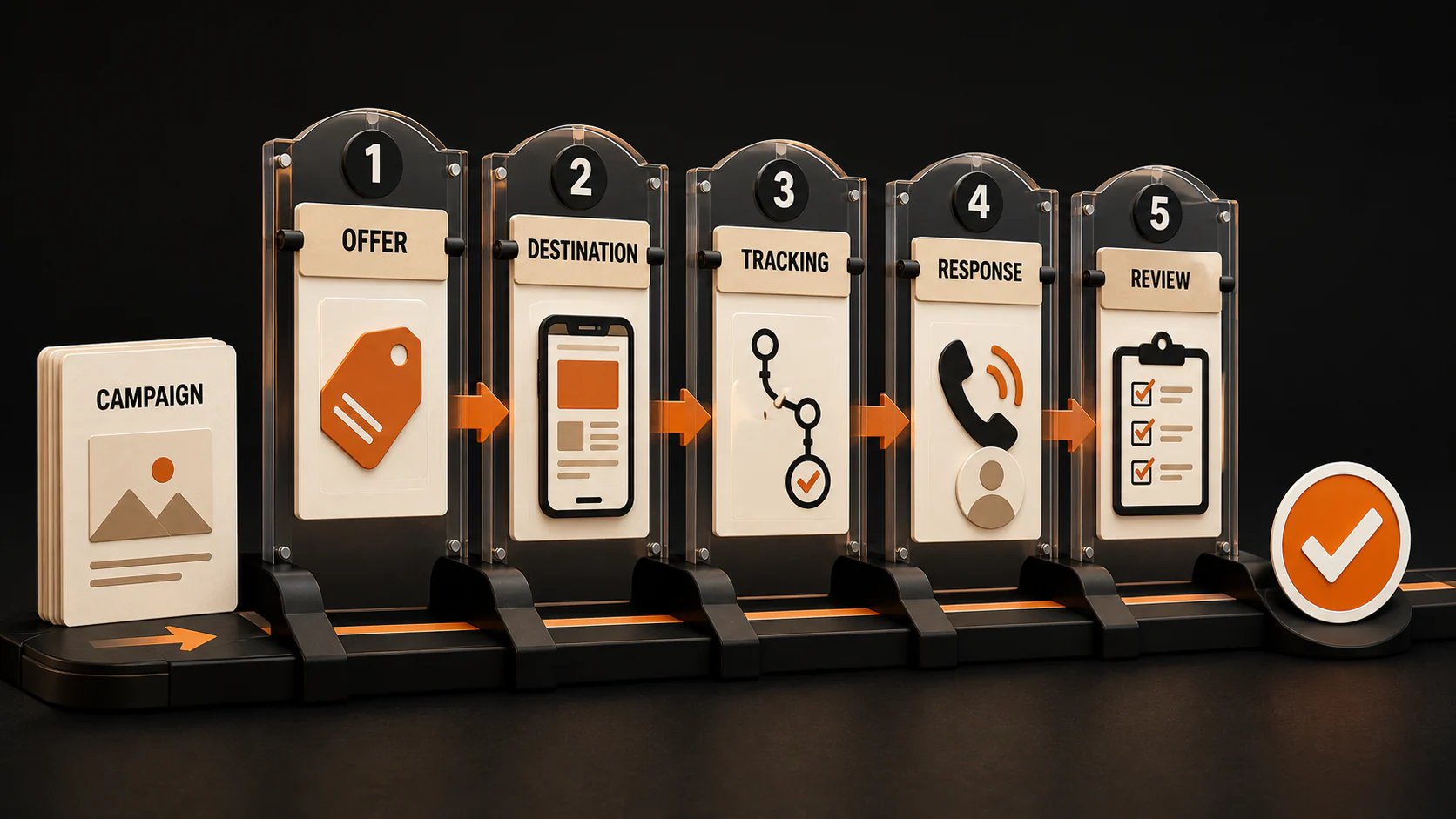
Use this Instagram ads checklist to plan the offer, tracking, creative, follow-up, and review process before your local business spends more.
A cheap Instagram lead can still be expensive. If that inquiry comes from outside your service area, asks for work you do not offer, or sits unanswered, the low number in the ad report is not much of a win.
That is why this checklist starts with the business result, not the buttons inside an advertising account. Keep the rule simple: one campaign, one qualified action, one tested path, one next test.
Before spending, you should be able to answer five questions:
- What service and offer are we advertising?
- What action do we want a potential customer to take?
- What makes that action qualified for this business?
- Who will respond, classify the inquiry, and review the campaign?
- Can we test the entire path without guessing whether it worked?
If any answer is fuzzy, keep the campaign paused. Better targeting and prettier creative will not repair a broken lead path.
1. Define the qualified action and give it an owner
Pick one service and one meaningful next action. That might be a phone call, form submission, booking request, or another event your team can verify. Do not make one campaign responsible for every service, every location, and every possible customer action. That creates a reporting problem before the first ad appears.
Next, define what "qualified" means for this campaign. For a local service business, useful criteria may include:
- The person needs the service named in the ad.
- The property or customer is inside the area the business serves.
- The inquiry shows genuine intent to discuss the work.
- The contact information is usable.
Those are examples, not universal rules. Write the definition that fits your service, capacity, and approval requirements.
Assign an owner for response and an owner for classification and review. On a small team, that may be the same person. Record each inquiry using a short set of agreed categories, such as qualified, unqualified, duplicate, spam, or unreachable.
Before moving on, give a labeled test inquiry to another team member. If that person cannot classify it consistently or does not know who should respond, the campaign is not ready.
2. Choose a destination that keeps the ad's promise
An Instagram ad can send someone to a native form, landing page, phone call, booking path, or another destination available in the account. The right choice depends on what the customer needs to understand and what the business can reliably handle.
A shorter path removes steps but may collect less context. A landing page can explain a complicated service, but it adds another place where the experience can break. A call works only when someone can answer or return it. A booking path helps only when the appointment matches the offer.
The destination should continue the ad's promise. An emergency plumbing ad for one county should not open on a generic homepage covering unrelated services. Make offer rules, dates, exclusions, and service-area limits visible before submission.
Inspect the path on a phone. Check that the page loads, the text is readable, the primary action works, and the next step is clear. Review the privacy notice and requested information. Get appropriate professional guidance for legal or privacy questions.
For a deeper look at the handoff after the click, use our guide to building a local lead funnel. If the website itself is the weak link, start with turning the site into a lead-generating system.
Then complete the intended action with labeled test information. Confirm that the person responsible for follow-up receives it. A destination is not ready just because the page opens.
3. Make the measurement chain testable
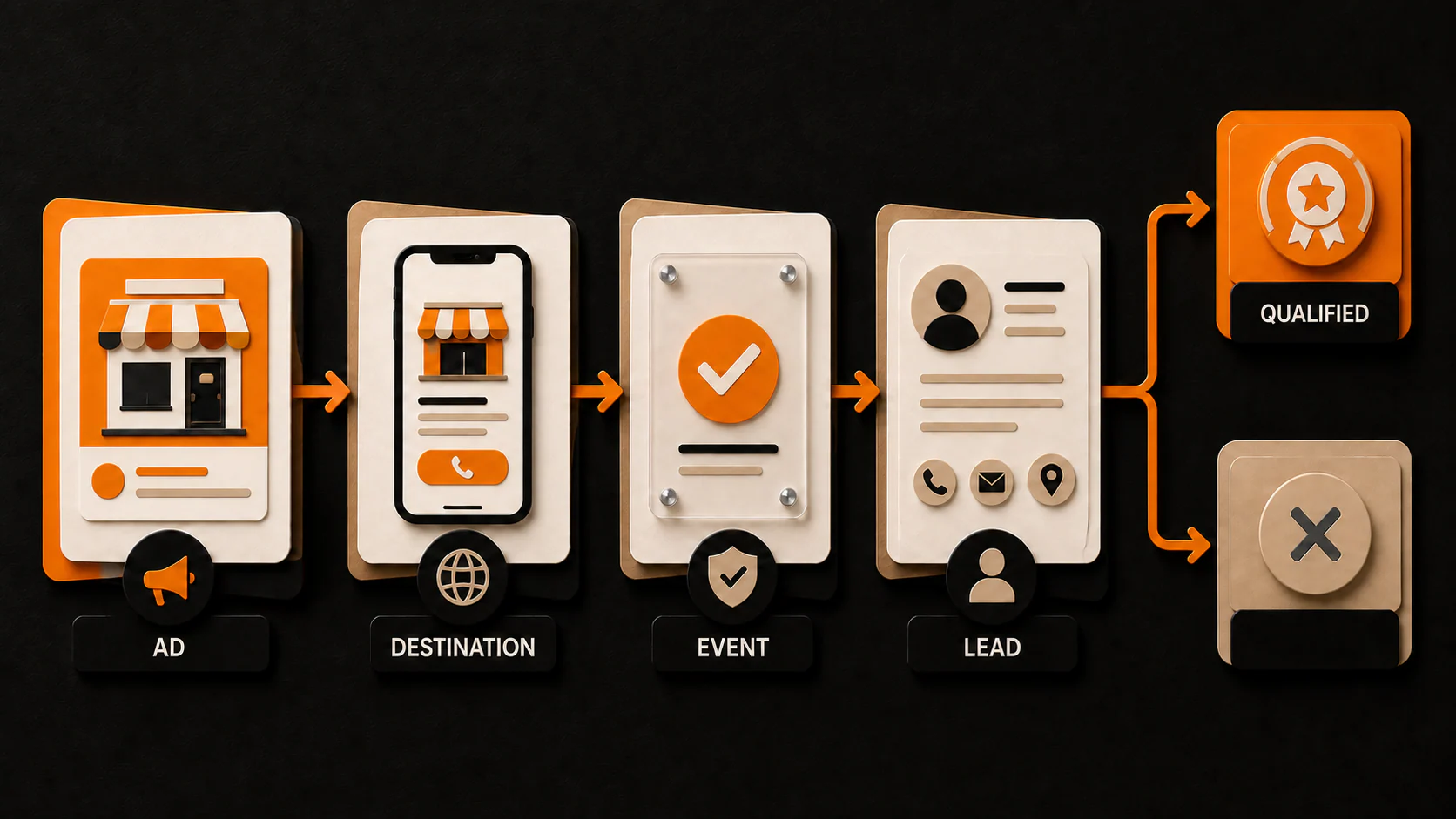
The useful measurement chain is not simply "ad to click." It is:
Ad to destination to verified event to lead record to qualified or unqualified outcome.
Each handoff answers a different question. Did the destination record the action? Did the inquiry reach the business? Was it qualified? What happened after the response?
Your account or website may use Meta Pixel, Conversions API, or another supported measurement route. Installing a tool does not make the chain accurate by itself. Consult current official Meta documentation and verify the event path in the advertiser's own account before launch. Product controls, access, and labels can change.
Two basic failures deserve attention. A missing event can hide an action. A duplicate can make one action look like more than one. Compare a labeled test with both the event record and the business's lead record.
Test the complete path
- Use clearly labeled, non-sensitive test information.
- Open the intended destination from the same type of device a customer would use.
- Complete the call, form, or booking request.
- Confirm that the expected event appears once in the relevant measurement system.
- Confirm that the inquiry reaches the lead record and assigned responder.
- Classify the test using the campaign's written qualification rule.
- Remove or clearly exclude the test from business reporting where appropriate.
Do not paste customer details, private lists, account exports, or sensitive data into a general AI tool to troubleshoot this chain.
4. Build one campaign your team can explain
Meta's interface and controls can change, but the decisions underneath them are durable. Keep three layers legible:
- Campaign: What business action is this effort meant to support?
- Audience and placement: Who might be eligible, where can the ad appear, and what hypothesis are you testing?
- Ad: What promise, proof, visual, copy, and next step will the person see?
Verify the current controls in your account instead of following an old screenshot. Meta's official page for Instagram Reels ads is a product pointer, but the live account remains the place to confirm placements and setup choices.
Keep the campaign narrow enough to audit: one service, one offer, one service area, one destination, and one qualified action. Narrow does not mean tiny. It means a team member can explain what the campaign is trying to do without opening six tabs and reconstructing the strategy.
Our guide to local Facebook ad targeting and AI prompts covers the broader Meta advertising context without replacing the checks on this page.
Ask a reviewer to state the service, offer, geography, destination, action, and owner from the campaign record. Any gap in that explanation points to a decision that needs to be recorded.
5. Treat audiences and placements as hypotheses
Start with operational reality. Where can the business actually deliver the service? Do travel limits, licensing constraints, office locations, scheduling limits, or service exclusions affect who can become a customer?
Only then consider audience controls. Interests, demographics, custom audiences, automated options, and placements are hypotheses to test when available and appropriate. They are not proof that an inquiry will be qualified.
Write the hypothesis in plain English. For example: "People in this service area who respond to this specific home-maintenance problem may be a reasonable audience for this offer." That is more honest and more useful than declaring a targeting formula "best."
Be especially careful with customer lists and sensitive categories. Use customer data only when the business has the appropriate rights, permissions, notices, and platform eligibility. Do not ask an AI model to review a raw customer list. This checklist is practical marketing guidance, not legal advice, and it cannot certify that an audience or campaign complies with current rules.
Preview the ad wherever the account may deliver it. A visual and headline that look clean in one format can crop, wrap, or lose context in another. Verify what is currently available before choosing or excluding a placement.
The audience note should explain the service geography, exclusions, hypothesis, data source, and any permission check required. If it cannot, the audience is still an idea rather than a documented test.
6. Create ads that survive the scroll and the follow-up
Strong local-service creative does not need to look like a national brand campaign. It needs to make the right person recognize the problem, understand the offer, trust the claim, and know what to do next.
Build each ad around four elements:
- A recognizable problem or result. Use language a potential customer can understand without exaggeration.
- An accurate offer. Name the service and relevant conditions. Do not hide exclusions that will surprise the person later.
- Substantiated proof. Use real credentials, reviews, project details, guarantees, or other proof only when the business can support and use them appropriately.
- A clear next step. The call to action should match the destination and the team's response process.
Use realistic photos or video without staging a false claim. Review text, captions, cropping, sound dependence, and the call to action in available previews.
Skip fake testimonials, unsupported superlatives, bait, and urgency that is not real. "Best in town" is not a strategy. Neither is a countdown that resets tomorrow.
AI can help organize supplied facts and generate variations. It cannot decide whether a claim is true. The copy-ready prompts appear in the safety box below.
Before approving the ad, map every factual statement to approved business information or evidence. Then make sure the next step matches the destination.
7. Set a bounded budget and a review rule
There is no responsible universal starting budget for a local Instagram campaign. The useful amount depends on the business's approved risk, local market, service economics, measurement quality, available creative, and capacity to answer leads.
Before launch, write down:
- The maximum approved test spend
- Start and end dates, or another defined review boundary
- Who can approve spending changes
- How many inquiries the team can handle
- Stop conditions, such as a broken destination, bad tracking, policy issue, or response failure
- Which single campaign element may change next
An AI model may organize numbers you supply. A human with business authority must approve the amount and any change.
Do not react to every small dashboard movement. Do not let a broken path keep spending until a scheduled review, either. Mechanical failure is a reason to stop and repair. Performance judgment needs campaign context and an agreed rule.
The campaign record should name the spend boundary, dates, owner, operational capacity, stop conditions, and next review point. Without that record, the budget is merely a number in an account.
8. Run the pre-launch QA pass
This is the last gate. Have someone other than the builder review the campaign when your team allows it.
- Confirm the service, offer, conditions, and service area.
- Open the exact destination URL on a phone.
- Check the call, form, or booking path.
- Preview every available format you intend to use.
- Review spelling, cropping, captions, proof, and the call to action.
- Submit one labeled test action from start to finish.
- Confirm the event record and lead record without duplication.
- Confirm the assigned responder receives the inquiry.
- Review current Meta advertising policies and any business-specific requirements. Do not treat this checklist or an AI review as approval.
- Save a record of the initial campaign decisions and settings so later changes are understandable.
If the test action fails anywhere, stop. Fix the first broken handoff and repeat the complete test. Testing only the final form after changing the destination is not enough.
AI prompt safety box
Use AI to transform facts you have already approved, not to supply missing truth. Remove personal information, customer records, private account data, and confidential business material before using any prompt.
Offer clarity prompt
Act as a copy editor. My local business offers [service] in [service area]. The intended action is [call, form, or booking request]. The approved offer facts and conditions are: [facts]. Identify unclear wording, missing conditions, and possible customer questions. Do not add claims, prices, urgency, guarantees, locations, or qualifications. Return questions where facts are missing. I will verify every statement before use.
Creative variation prompt
Create three concise Instagram ad-copy variations using only these approved facts: [facts]. Each version should include the customer problem, accurate offer, substantiated proof, and next step. Do not invent testimonials, results, credentials, scarcity, policy claims, or account settings. Label any sentence that needs human verification.
Pre-launch QA prompt
Compare the supplied ad copy and destination summary against this checklist: offer match, service area, conditions, proof, call to action, response owner, tracking test, and review date. Report inconsistencies and unanswered questions. Do not certify Meta policy compliance, legal compliance, live account settings, tracking accuracy, or performance. Do not infer missing information.
A model may organize facts, propose wording, surface questions, and check consistency. A human remains responsible for claims, live settings, policy review, spend, privacy, and final approval.
9. Review the first campaign without fooling yourself
Do not collapse every signal into "the ads worked" or "the ads failed." Review four separate layers:
| Layer | Question to answer |
|---|---|
| Delivery | Did the campaign spend and deliver as recorded? |
| Contact | Did people complete the intended call, form, or booking action? |
| Lead quality | Were those inquiries qualified under the written rule? |
| Business outcome | What happened after follow-up, within the limits of the records available? |
Clicks and engagement can help diagnose delivery or creative response. A platform conversion can help diagnose the event path. None of those proves qualified demand or a completed sale by itself.
Compare the campaign record with the lead record. Look for out-of-area inquiries, wrong-service requests, duplicates, spam, missed calls, delayed responses, and tracking mismatches.
Then choose one next test. Change the offer, creative, audience hypothesis, placement choice, destination, or response process only when the evidence gives you a reason. Changing several at once makes the next result harder to interpret.
Keep a short decision log with:
- Date
- Change
- Reason
- Spending or operational guardrail
- Owner
- Next review point
The review should separate delivery, contact, qualification, and business outcome. It should also produce one next test, not a pile of simultaneous edits.
Instagram ads checklist FAQ
Should a local business advertise on Instagram?
It may be worth testing when the business can define an audience hypothesis, present the service honestly, handle responses, and measure lead quality. It is a poor fit when the team cannot support the destination, follow-up, or measurement path.
Can I run Instagram ads without a website?
If the account offers a native destination, such as a form, a website may not be necessary for that campaign. Verify what is currently available and appropriate in your account. A shorter path does not remove the need for clear offer conditions, privacy review, response ownership, qualification, and record keeping.
How much should a local business spend on Instagram ads?
There is no universal number. Set a maximum test amount that an authorized owner approves, based on the business's economics, capacity, and tolerance for uncertainty. Define stop conditions and a review point before launch.
What should I track beyond clicks?
Track the intended contact action, whether the inquiry reached the team, whether it was qualified, how it was handled, and what business outcome the available records can support. Keep platform activity separate from lead quality and completed business.
Can ChatGPT build or optimize the campaign for me?
It can help organize supplied facts, create draft variations, and check a checklist for inconsistencies. It should not receive private customer data, certify policy or legal compliance, choose live account settings, approve spend, invent performance, or replace the human responsible for the campaign.
Make the campaign accountable before making it clever
The checklist comes back to one rule: one campaign, one qualified action, one tested path, one next test.
That discipline will not guarantee results. It will give your team a campaign it can inspect, answer, and learn from without pretending clicks are customers.
If you need help connecting the offer, campaign, measurement, and follow-up path, explore YEAH! Local's Facebook and Instagram advertising service or talk with our team. We can help you build a managed system around qualified local demand without a ranking or results promise.
Last updated