How to Create a High-Converting Funnel for a Local Service Business
Key Takeaway
Build a simple local-service funnel around one qualified action, clear handoffs, useful tracking, and one test at a time.
The one funnel template guaranteed to quadruple your sales by tomorrow is right here:
Yep, nothing is loading. That template does not exist.
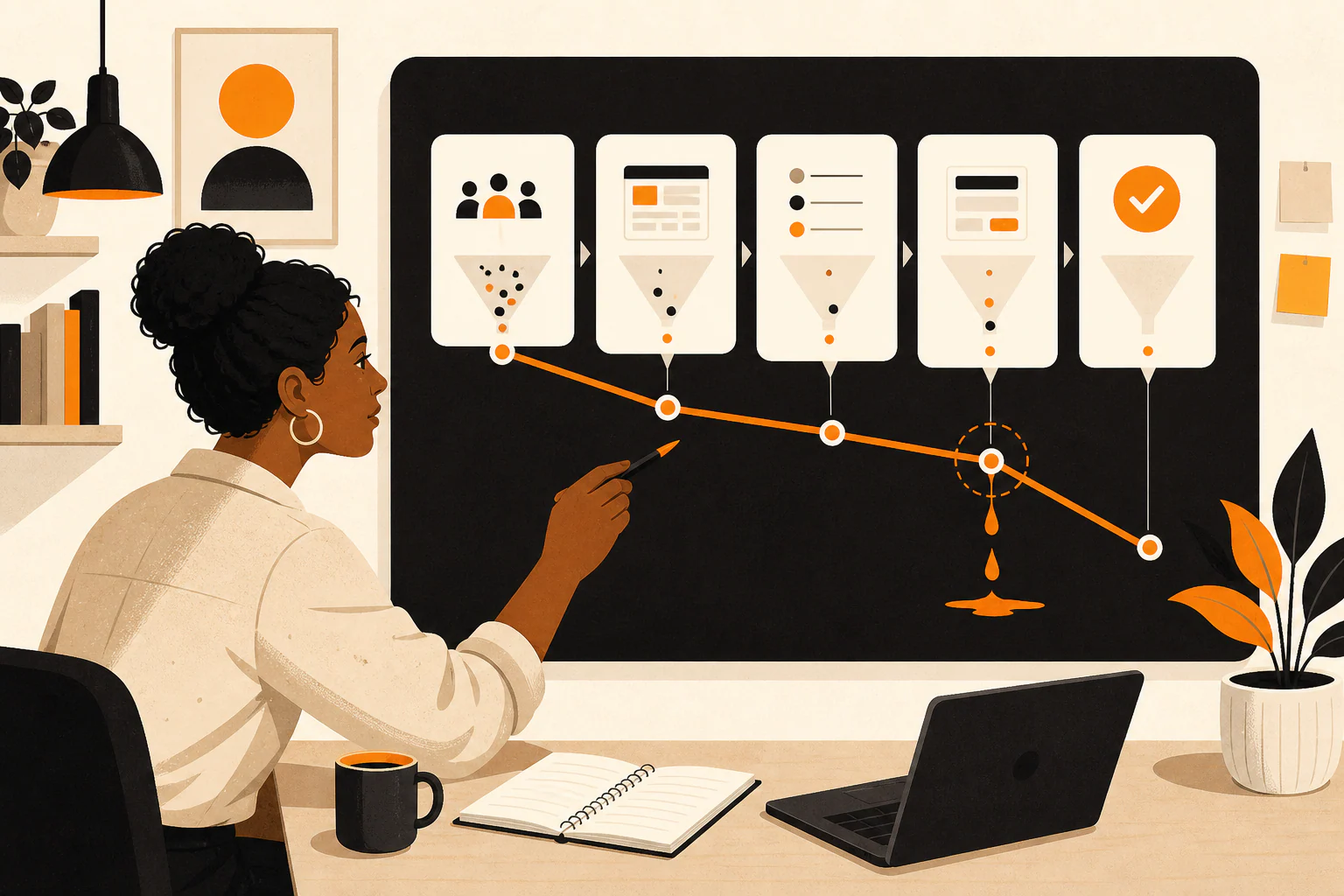
A funnel is simply a buying process. It is the path a prospect follows from having a problem to taking the next sensible step with your business.
For a local service company, "high-converting" means removing avoidable friction and measuring where qualified prospects stop moving. It does not mean chasing a universal conversion-rate benchmark. One number cannot honestly describe an emergency plumber, a cosmetic dentist, an attorney, and a lawn care company.
Choose the one qualified action you want the right prospect to take next. Get that clear, then build the shortest useful path to it. Software comes later.
Before you map the funnel
You need three things:
- A specific service or offer to build the path around.
- A working definition of a qualified prospect for that offer.
- Access to the pages, phone system, form, booking tool, and analytics involved, or help from the person who manages them.
Also write down what happens after someone calls, submits a form, or books. If that part is fuzzy, the website cannot compensate for it. A polished page followed by a neglected inbox is just expensive marketing furniture.
This exercise gives you a five-part map you can inspect, measure, and improve without guessing. It cannot guarantee a sales lift.
What a local-service funnel actually looks like
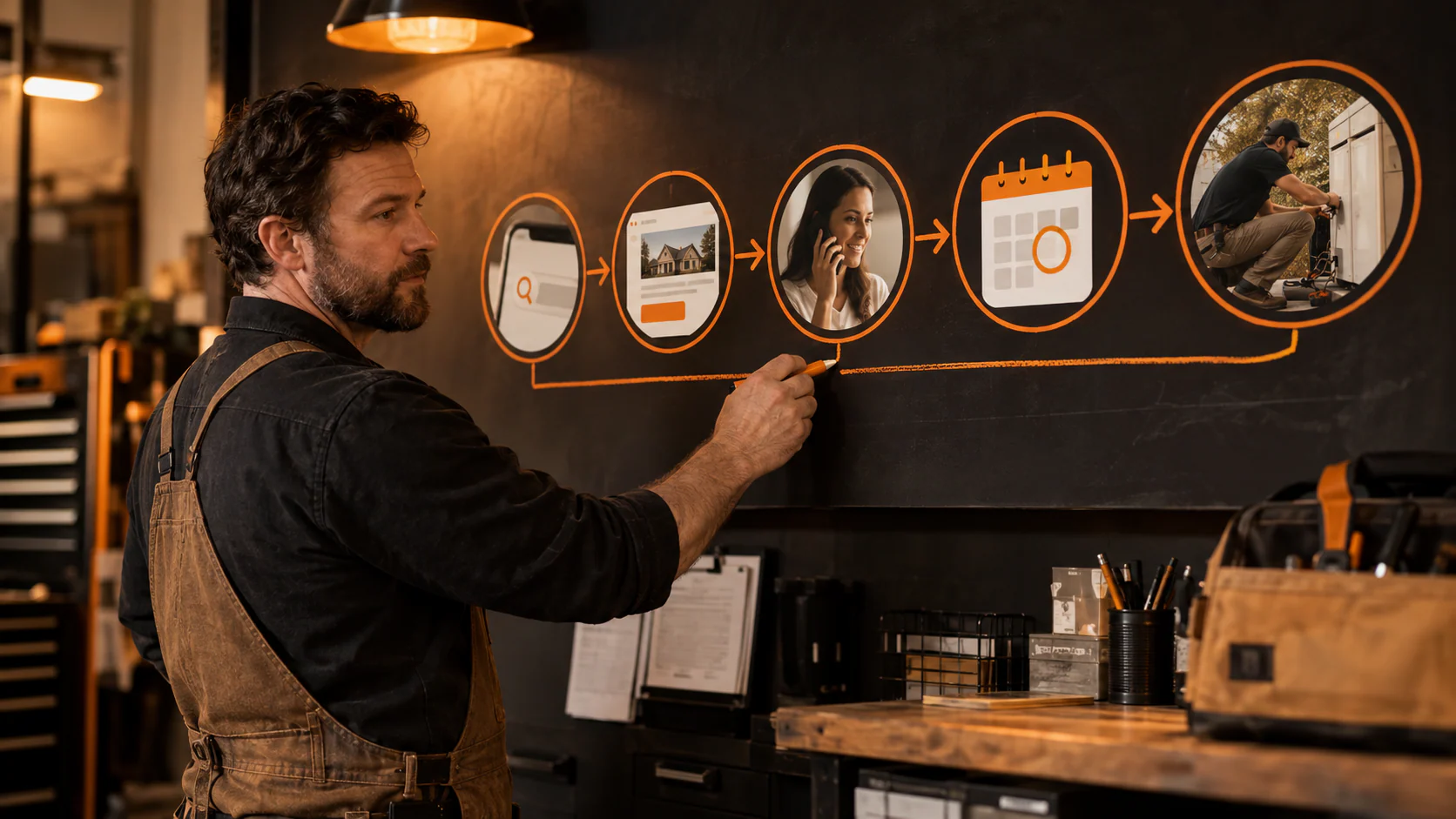
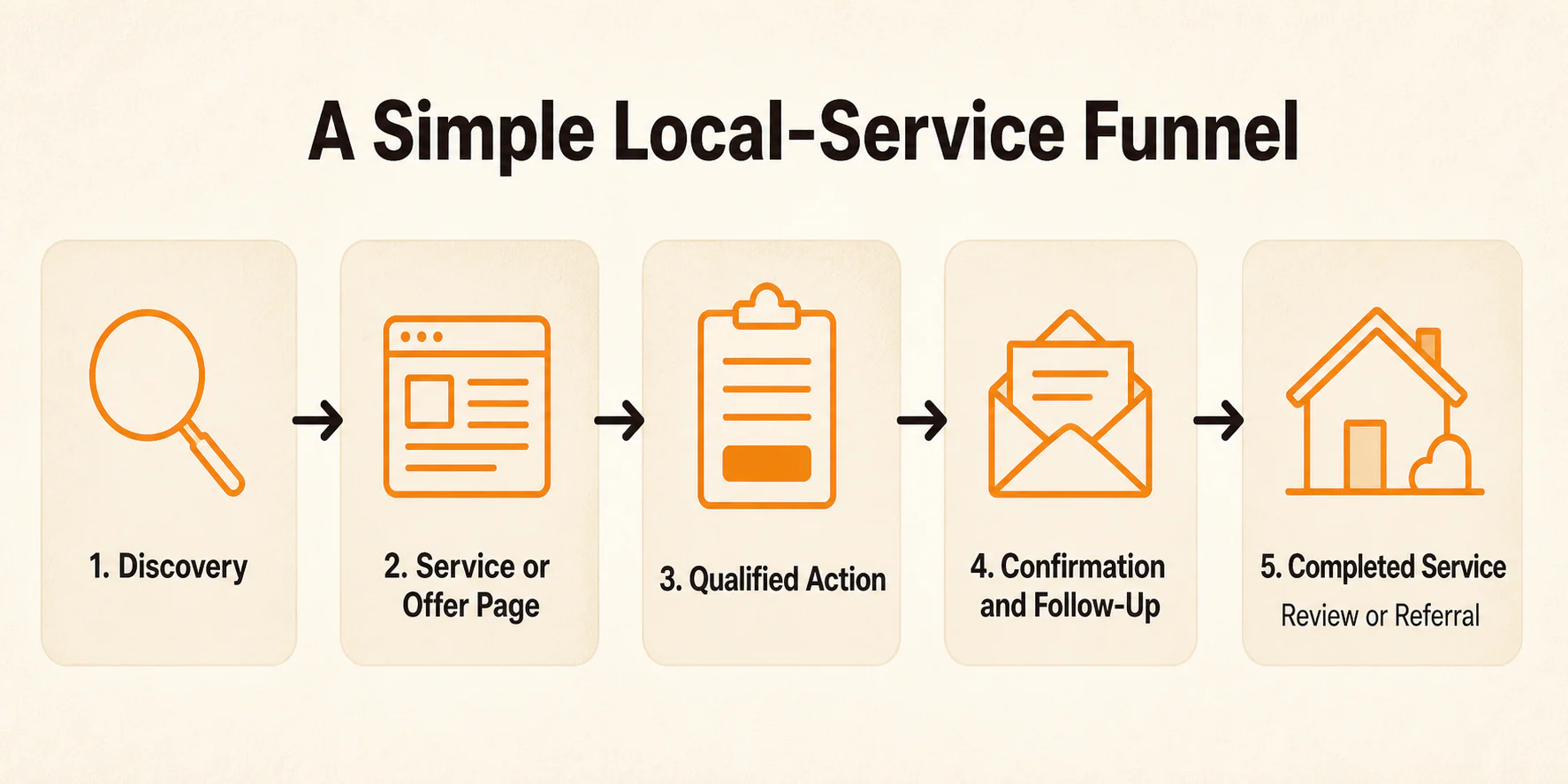
A practical local-service funnel can be this simple:
- A prospect discovers the business through search, an ad, a referral, a directory, or another channel.
- They visit a service or offer page and decide whether the service fits their problem, location, timing, and expectations.
- They take a qualified action by calling, requesting an estimate, scheduling a consultation, booking an appointment, or buying.
- A person or system confirms the request, sets expectations, and moves the prospect toward the appointment or sale.
- The business completes the service. The customer may then be invited to leave a review, refer someone, or use another relevant service.
Not every business needs every channel, page, automation, or follow-up sequence. The goal is to make the real path visible. Adding steps because a template includes them creates more places for things to break.
Step 1: Choose the qualified action before the software
A form submission is an action. It is not automatically a qualified lead.
Start by naming the business action that matters. Depending on the service, that might be:
- A call from someone in your service area who needs a service you provide.
- An estimate request with enough detail to price or schedule the next step.
- A consultation request from someone who meets your basic fit requirements.
- A booked appointment for the correct service.
- A completed purchase when the service can be bought directly.
Then define "qualified" in plain language. Geography, service need, urgency, budget range, property type, insurance status, or another fit factor may matter. Use only the factors that genuinely affect whether your business can help.
Finish this sentence:
We want [type of person] with [specific need and relevant fit] to [take one next action].
If you cannot finish that sentence, do not choose a template yet. You would be automating an unclear decision.
Step 2: Map the question at each handoff
Imagine a homeowner searching for an urgent repair. This is a hypothetical example, not a claim about how every service journey works.
At discovery, the homeowner may ask, "Do you handle this problem in my area?" On the service page, the question becomes, "Can I trust you, and what happens if I contact you?" After submitting a request, it becomes, "Did this go through, and when will someone respond?"
Your funnel should answer each question where it appears. Do not make the prospect hunt for an answer that determines whether they can move forward.
The difference between a feature and a benefit matters here. "Same-day appointment slots" is a feature. "Know today whether your issue can be handled before it gets worse" explains why the feature matters. The wording still needs to be true for the service you provide.
If the offer, proof, or next action is muddy, use these three website changes for clearer local-business conversions as a focused follow-up instead of adding more funnel pieces.
This diagnostic map gives each stage a job:
| Funnel stage | Prospect's question | Business action | Signal to track | Common failure to inspect |
|---|---|---|---|---|
| Discovery | "Is this relevant to my problem and location?" | Send the right visitor to the right page | Visit by channel and landing page | Message or location mismatch |
| Service or offer page | "Can you help, and why should I trust this next step?" | Explain fit, proof, and expectations | Meaningful page interaction and CTA click | Vague offer, buried proof, competing actions |
| Call, form, or booking | "What information do you need from me?" | Capture enough information to route the inquiry | Call, form submission, or booking event | Broken form, confusing fields, unclear scheduling |
| Confirmation and follow-up | "Did it work, and what happens now?" | Confirm receipt, owner, timing, and next step | Confirmation delivered and inquiry assigned | No owner, no expectation, slow or inconsistent handling |
| Appointment or sale | "Am I ready to proceed?" | Qualify and complete the next business step | Qualified lead, booked appointment, completed sale | Inquiry quality or operational handoff failure |
The "signal to track" column does not make all signals equal. A button click, a submitted form, a qualified lead, a booked appointment, a completed job, and revenue are different facts. Treating them as interchangeable can make the funnel look healthier than the business result.
Step 3: Build the shortest page path that answers those questions
Now decide which pages the prospect actually needs.
For many local service journeys, one focused service or offer page can do the heavy lifting. The visitor should be able to find the offer, who it fits, accurate proof, and the next action without digging.
More pages are not inherently better. More calls to action are not inherently better either. If the page asks the visitor to call, download, subscribe, watch, compare, chat, and request an estimate, the business has avoided making a decision and handed the mess to the visitor.
Use one primary action. Supporting links can answer necessary questions, but they should not compete with the next step.
If the primary action is a consultation, qualify the reader and set expectations. A vague "free consultation" can attract the wrong inquiry as easily as the right one. This guide to fixing a weak free-consultation offer covers that branch in more depth.
Someone who fits the offer should be able to identify the service, decide whether it is relevant, find credible proof, and understand the next step without opening a second page. If they cannot, the page path is not finished.
Step 4: Design the handoff after the call, form, or booking
The funnel keeps going after somebody presses "Submit." This is where the least glamorous and most operational work begins.
For each inquiry route, name:
- The confirmation the prospect receives.
- The person or system that owns the inquiry.
- The response expectation you can honestly set.
- The next step toward qualification, scheduling, or purchase.
- The place where the outcome is recorded.
Then test the handoff itself. Submit the form, use the booking path, and call the published number. Confirm that the request reaches the correct destination and that the promised next step is possible. This verifies the workflow. It does not prove prospects will convert.
Poor lead quality calls for another look at the offer, service-area language, qualification questions, and source. More traffic will only feed the same mismatch.
Qualified inquiries that fail to become appointments point somewhere else. Inspect ownership, response timing, scheduling friction, and follow-up before rewriting the ad or headline. The page may have done its job. The handoff may be where momentum disappears.
Step 5: Track the handoffs, not just the form submission
Google Analytics 4 uses event-based data. An event records an interaction or occurrence, and an event important to the business can be marked as a key event. Google's current guidance on events and key events also notes that recommended and custom events require implementation. Custom events may need custom reporting or explorations before they become useful for analysis.
So, "we installed analytics" is not a measurement plan.
Choose a signal for each handoff, then connect website activity to what happened downstream. That means tracking website actions such as phone-link clicks, form submissions, and completed bookings while separately recording lead quality, sales milestones, completed work, and revenue when your systems can connect those records accurately.
Do not claim the later outcome based on the earlier action. A phone-link click is not a connected call. A call may not be a qualified lead. A qualified lead is not a booked appointment, and a booked appointment is not completed revenue.
If channel reporting stops at clicks or raw form totals, this guide to measuring which marketing channels produce qualified business outcomes is the logical next step.
Pick one inquiry from a tracked website action and see whether your records can follow it through qualification and the next business milestone. Where the trail disappears, you have found a measurement gap.
Step 6: Run one test with a reason
Once the funnel is mapped and tracked, resist the urge to "optimize everything." That produces activity, not learning.
Write one hypothesis:
If we change [one element] for [a defined audience or page], then [a predetermined metric] may change because [a specific source of confusion or friction] is reduced.
For example, a business might hypothesize that replacing a vague "Learn More" button with an accurate "Request a Repair Appointment" label will change completed appointment requests because the next step becomes more explicit. That is a hypothesis, not a promised result.
An A/B test compares variations with a live audience against metrics chosen in advance. The Nielsen Norman Group's A/B testing guidance recommends beginning with a defined goal and hypothesis, then comparing the variations instead of declaring a preference based on taste.
Change one meaningful variable, choose the metric before reviewing the result, and use an observation period that fits the traffic available. This research does not support a universal duration or sample size.
If the page lacks enough relevant activity for a confident comparison, do not crown a winner early. Keep collecting observations, inspect the questions and failure points available to the business, or choose a busier part of the path. "Not enough evidence yet" is still a result. Not an exciting one, admittedly, but an honest one.
For a deeper way to prioritize the first change, use this conversion-rate optimization checklist. Keep the test tied to the qualified action and downstream outcome you already defined.
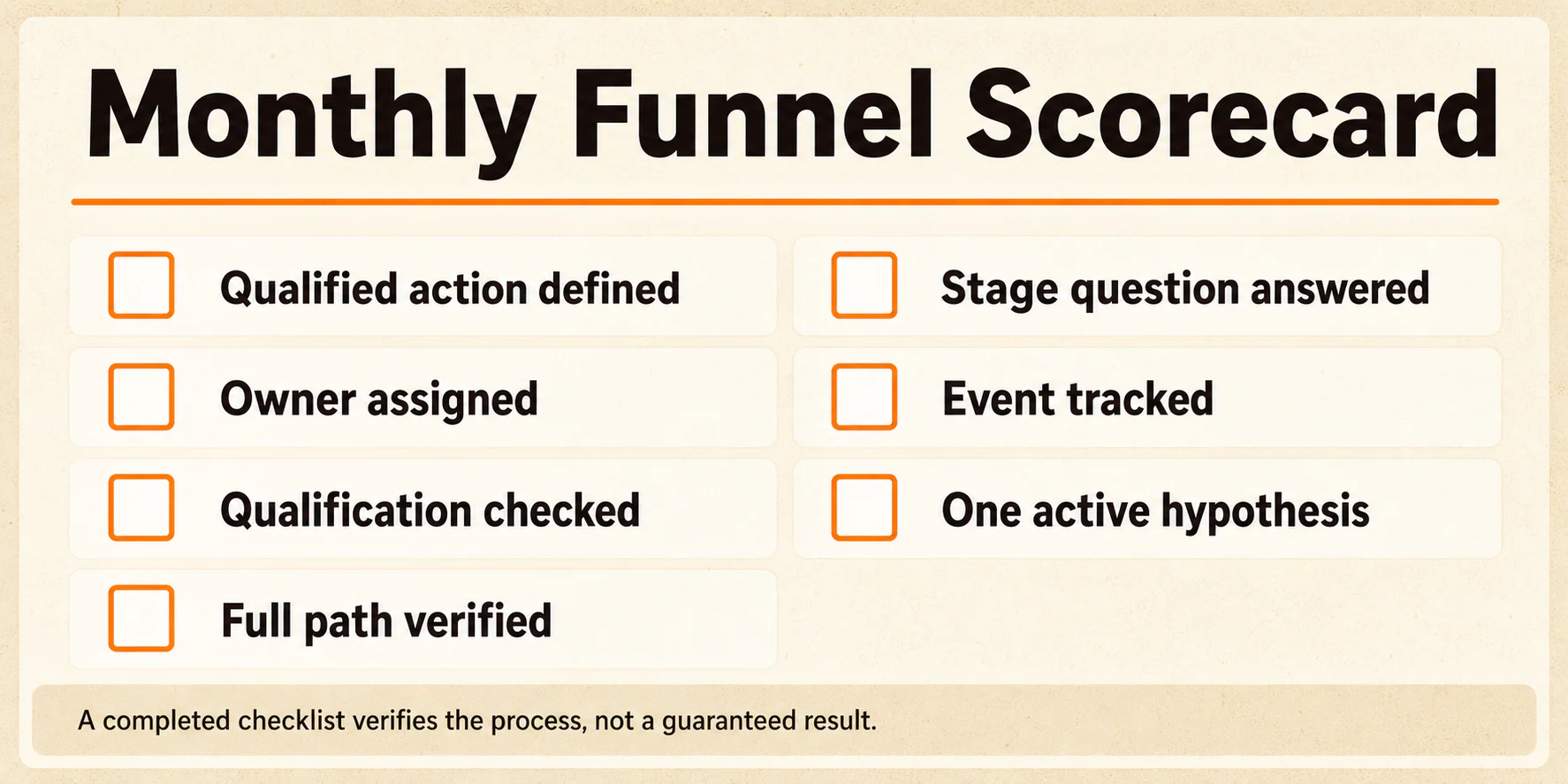
A simple monthly funnel scorecard
Review the path often enough to catch broken handoffs and challenge old assumptions. Monthly is a practical rhythm for this scorecard, not a universal testing schedule.
| Check | What "done" looks like |
|---|---|
| Qualified action defined | One sentence names the person, need, fit, and next action. |
| Stage question answered | Each handoff answers the question that could block the next step. |
| Owner assigned | Every inquiry route has a person or system responsible for the next action. |
| Event tracked | The important website handoffs have implemented, verified events. |
| Qualification checked | Raw actions are separated from qualified leads and later business outcomes. |
| One active hypothesis | One meaningful variable and predetermined metric are documented. |
| Full path verified | A test call, form, or booking reaches the correct destination and receives the promised next step. |
Find the first handoff you cannot explain
Draw your current path on one page. Start with discovery and end with the completed service. Write the owner and tracked signal under every handoff.
Now circle the first point where you cannot answer one of these questions:
- What does the prospect need to know here?
- What does the business need to do next?
- Who owns that next step?
- What signal confirms it happened?
- Can we distinguish the action from a qualified business outcome?
That circle is your first repair. Skip the new template and six new automations. Fix one unexplained or unmeasured handoff.
As you learn, the funnel should evolve. Keep the qualified action steady long enough to understand the path, repair one meaningful break at a time, and change the map when the business or offer genuinely changes.
If the gaps run across the offer, website, lead handling, and measurement, the Local Growth Engine addresses that connected problem. Either way, begin with the map. It will tell you whether you need a campaign, an operational fix, or simply a clearer next step.
Last updated