

Key Takeaway
Use this local business call-audit scorecard to find booking blockers, separate qualified calls from noise, improve follow-up, and measure better outcomes.
Your phone rang. Marketing did its part. Then the caller left without booking.
The tempting response is to buy more traffic. Before you do that, look at what happened on the calls you already have permission to review. The caller may have been outside your service area, looking for a different service, confused about logistics, or unable to get a clear next step. Maybe the ad promised one thing and the call delivered another. Those are different problems. Throwing more leads at all of them is an expensive way to stay confused.
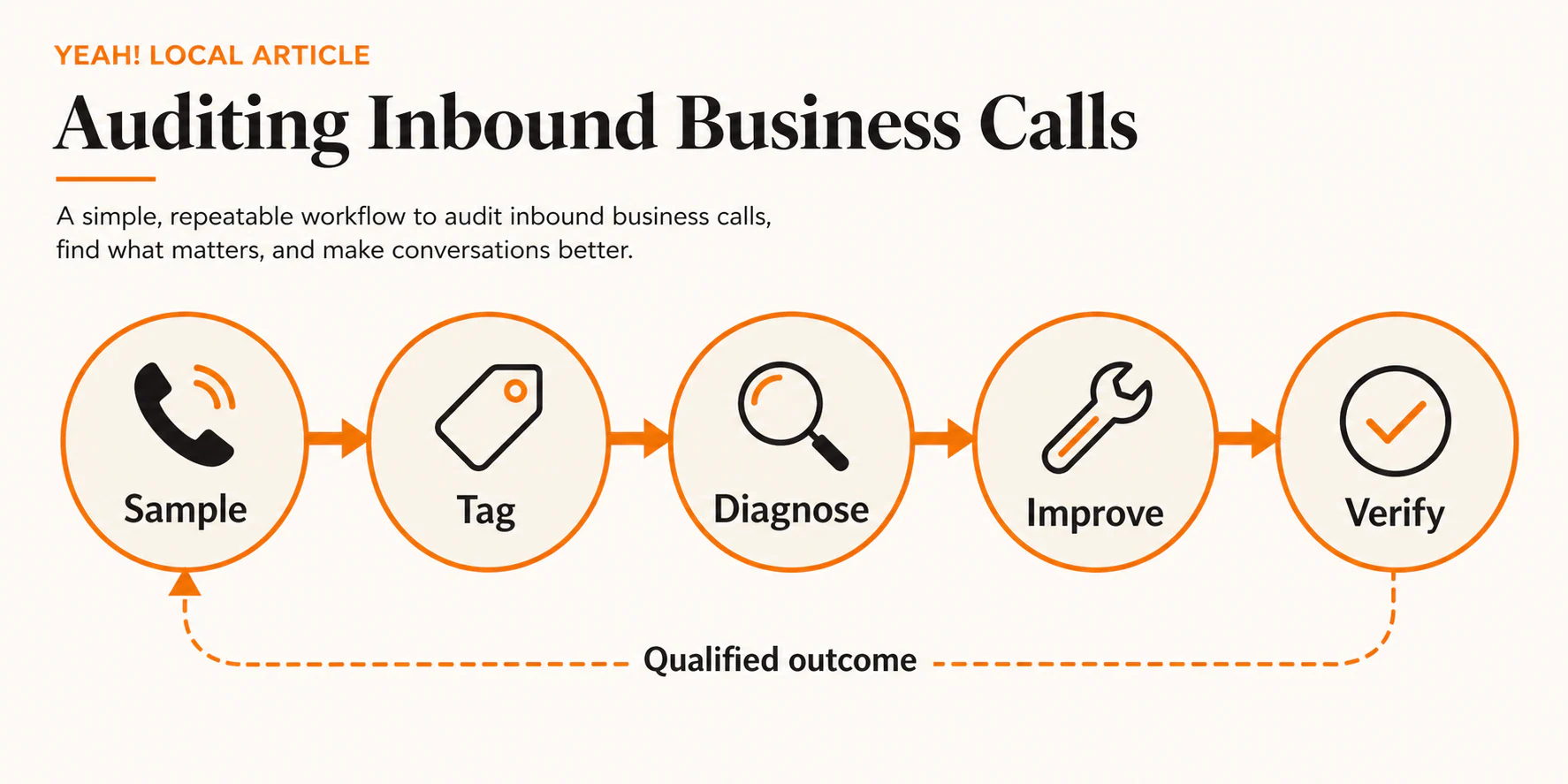
This article gives you a practical audit framework, not the results of a completed call study. It does not claim that YEAH! Local reviewed a set of calls or found these blockers at any particular frequency. The goal is to help you run your own defensible review: define the outcome, tag what happened, choose one controllable blocker, and check a later comparable sample.
Start with one question: "How many reviewed calls were a real fit, what happened next, and where did the process become unclear or incomplete?" That tells you far more than call volume alone.
1. Define the outcomes before reviewing calls
Call reporting gets slippery when one label tries to do six jobs. A platform may count a phone call as a conversion. You still need to know whether someone answered it, whether the caller was qualified, whether an appointment was booked, whether the person showed up, and whether the call eventually became a customer or job.
Those events are connected. They are not interchangeable.
Set the definitions before anyone starts tagging:
- Reviewed call: A call included in the defined sample and examined using the same scorecard.
- Connected call: A call that reached a person or approved call-handling process. Define how voicemail, abandoned calls, and transfers are handled before counting.
- Qualified call: A call that meets your documented criteria for service, location, timing, and any other legitimate business requirement. Qualification is not the same as a caller sounding eager.
- Booked appointment: A specific appointment, consultation, estimate, or service visit was scheduled according to your business rules.
- Attended appointment: The person appeared for, completed, or received the booked next step, using the definition that fits your operation.
- Closed customer or job: A downstream sale, customer relationship, or completed job recorded in the business system.
Use a denominator every time you report a rate. Otherwise, the same numerator can tell two very different stories.
| Metric | Formula | What it answers |
|---|---|---|
| Qualified-call rate | Qualified calls / reviewed calls | How much of the reviewed sample met the stated fit criteria? |
| Booked rate among qualified calls | Booked calls / qualified calls | Of calls that were a fit, how many reached a booking? |
| Booked rate among reviewed calls | Booked calls / reviewed calls | What share of the complete reviewed sample booked? |
| Show rate | Attended appointments / booked appointments | Of booked appointments, how many reached the attendance definition? |
| Close rate | Closed customers or jobs / attended calls, or / qualified calls | What downstream result occurred, with the chosen denominator named? |
Do not call every inquiry a lead, every lead a patient or customer, or every booked appointment revenue. That shortcut makes the report look cleaner than the business actually is. If you want cost per qualified lead or cost per booked appointment, you also need complete source-cost and outcome-attribution data. Without it, the honest answer is that the cost is unknown.
2. Build a privacy-safe call sample
There is no universal number of calls every local business must review. Choose a recent, manageable sample that covers the sources, services, days or times, and intake staff relevant to the decision you need to make. If you need a separate answer for one campaign, service line, or staffing pattern, expand the sample or split it into segments. Blending unlike calls may be convenient, but it makes the result harder to use.
Write down the sample rule. It might read: "All inbound calls connected to the scheduling line during a defined recent period, grouped by source where known." A boring rule written in advance beats a memorable collection of handpicked calls every time.
Before recording, transcribing, storing, sharing, or summarizing calls, check the obligations that apply to your business, contracts, locations, and tools. In healthcare, a covered entity or business associate should have an appropriate HIPAA and privacy review for the data flow and vendors involved. HHS explains that the HIPAA Privacy, Security, and Breach Notification Rules apply to covered entities and business associates, including in technology-assisted communications and tracking contexts. See HHS HIPAA guidance for the current official material. This is not legal advice.
Automated call summaries deserve the same care. A tool can save time without being an approved place for protected or sensitive information. Use approved systems, limit access, and remove or avoid unnecessary personal detail in the working review where appropriate.
Follow-up has its own boundary. A call that did not book is not blanket permission for a fixed outreach sequence. Consent, do-not-call requests, the purpose and channel of the message, federal and state requirements, and the circumstances of the call all matter. The FTC's Telemarketing Sales Rule guidance is a useful official starting point for outbound activity within its scope. It is not a complete compliance plan for every business or communication.
3. Use one scorecard row per inbound call
Give every sampled call one row. That small bit of discipline is what turns a pile of conversations into something you can compare.
Keep the tags neutral. Record what the caller stated, what the team answered, and what next step was offered. Labels such as "not serious" or "just price shopping" are mostly opinions unless the call supports a defined, observable tag.
| Field | What to capture |
|---|---|
| Source or campaign | Known source, campaign, referral, organic search, direct, or unknown |
| Date and time | Call timing and, where relevant, staffing context |
| Stated need and location | The service requested and location stated by the caller |
| Service fit | Fit, not fit, uncertain, or needs escalation, using documented criteria |
| Urgency or readiness | The timing stated by the caller, without guessing motivation |
| Question or objection | The factual question, concern, or barrier raised |
| Pricing or coverage question | What was asked and whether an approved answer was available |
| Trust or proof gap | A request for credentials, process, proof, availability, or other clarification |
| Answer or response status | Answered, missed, transferred, delayed, incomplete, or escalated |
| Next step offered | Specific action, owner, and timing, if any |
| Booking outcome | Booked, not booked, pending, or unknown |
| Follow-up status | Due, completed, not due, declined, or unknown, subject to applicable rules |
| Downstream status | Qualified, attended, closed, or unknown when lawfully available |
Protect the difference between a fact and your interpretation of it. "Asked whether the office accepts a plan" is a useful tag. So is "asked for proof of credentials." Neutral wording makes calls easier to compare and keeps the audit from turning into a personality review of either the caller or the employee.
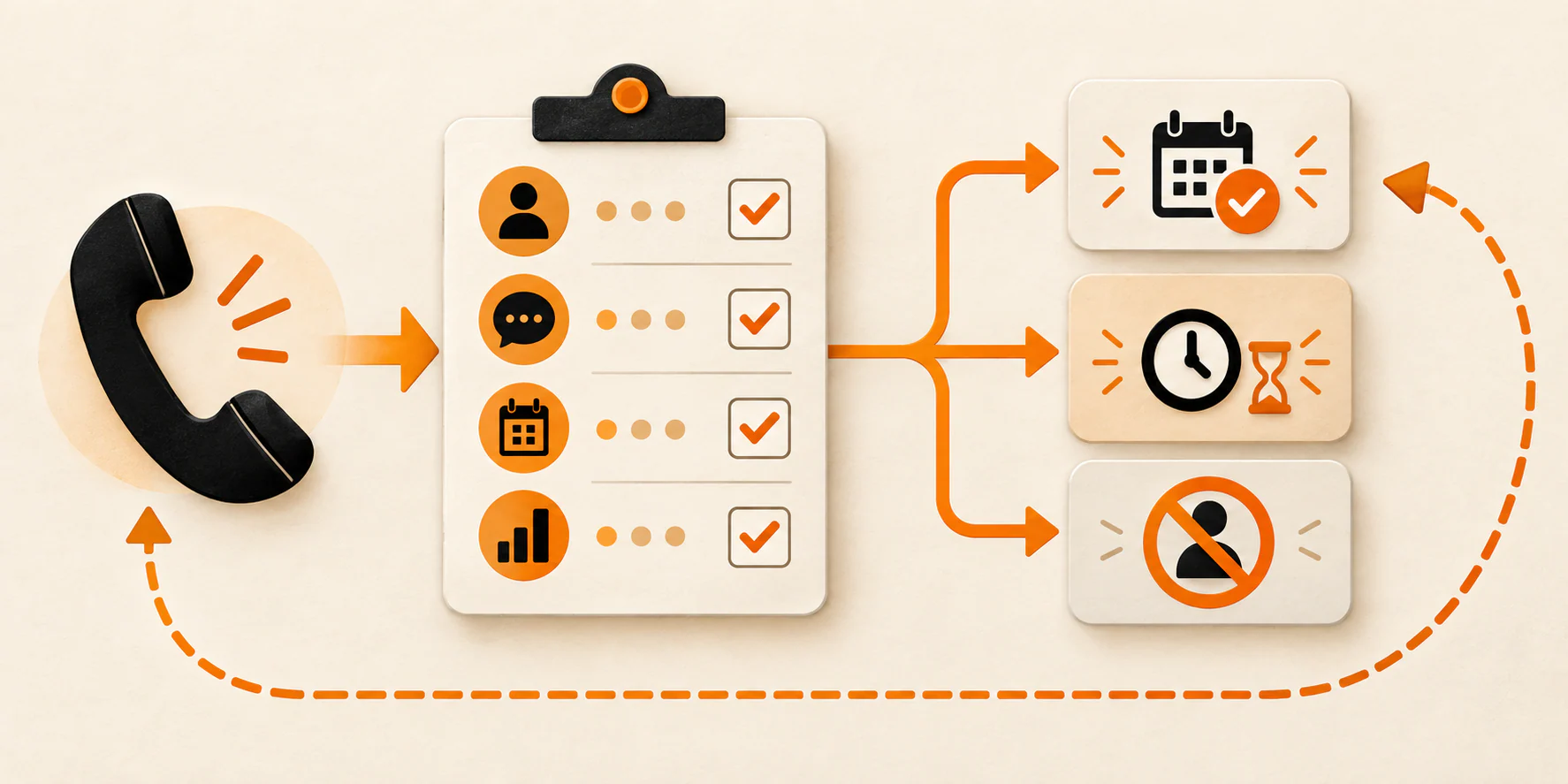
4. Eight booking blockers to test in your own calls
These are questions to test, not findings to paste into a report. Your sample may show none of them, one of them, or several at once. Follow the call evidence, then choose the smallest useful response.
1. Is the caller a service or location fit?
Tag the service, location, and any requirement that puts the request outside your scope. This is where it is easy to jump to the wrong conclusion. An out-of-area caller might point to broad targeting or unclear service-area copy. A caller who could have been routed correctly but was dismissed without checking may expose an intake problem. You need the call record and the campaign context before deciding which one it is.
If the pattern is a real mismatch, clarify service areas and boundaries in ads, pages, and call-routing guidance. When a request is genuinely out of scope, give staff an accurate way to explain the boundary and, where appropriate, offer a compliant referral option.
2. Does the caller understand which service fits?
Your caller does not carry your service menu around in their head. They may be able to describe the problem perfectly and still use the wrong service name. Listen for a team member expecting the caller to diagnose the solution, or for a call ending because nobody clarified the available path.
Use a short set of approved discovery questions and routing choices. Keep intake within its role while identifying the next appropriate operational step, so the caller does not have to solve your org chart first.
3. Are price, insurance, or coverage questions handled clearly?
Tag the exact question and the answer given. A vague "it depends" may be accurate, but by itself it is not much of an answer. Pricing, insurance, and coverage logistics can be straightforward, or they may require verification and a qualified handoff. In healthcare and similar regulated settings, keep factual logistics separate from individualized clinical, benefits, or financial advice.
Build an approved answer set for common questions. Staff should know what they can confirm, what needs verification, and when to escalate. Reassurance is nice. Accuracy is better.
4. Does the business reduce the uncertainty the caller names?
Listen for questions about credentials, the consultation, appointment availability, process, timing, or documentation. These are not abstract "trust issues." They are specific requests for information, and the scorecard should show whether the caller received an answer.
Improve the explanation of the process, the proof points the business can substantiate, and the realistic next step. The answer should reduce uncertainty without replacing it with a guarantee the business cannot make.
5. Is the next step clear and easy to complete?
Not every legitimate call should end in a booking. It should still end with clarity. Tag whether the caller received a specific action, a named owner, and a timing expectation.
"Call us back sometime" is technically a next step. It is not a useful one. Define the approved paths for common call types. If a booking cannot happen on the call, explain what happens next and who owns it.
6. Is the call missed, delayed, or handed off poorly?
A missed call looks simple on a report. The reason behind it might not be. Record missed calls, transfers, documented hold experiences, return-call attempts, and whether a promised handoff occurred.
Measure the sample before declaring a response problem or adopting a service-level target. Then fix the handoff the evidence exposes: coverage during a certain window, voicemail ownership, routing rules, or a missing escalation contact. A universal response-time promise does not fix a local process you have not identified.
7. Is follow-up ownership missing?
"Follow up later" is not an owner, a due date, or an outcome. For calls where lawful and appropriate follow-up is due, tag the owner, due status, completion status, and result.
Create a consent-aware workflow with clear ownership and a documented outcome. Do not prescribe a fixed number or cadence of outreach attempts without compliance review and local evidence.
8. Did the ad, page, or offer create the wrong expectation?
This blocker belongs on marketing's desk, too. Where the source is known, compare the caller's stated need with the promise that brought them in. A recurring question may point to unclear copy, a missing FAQ, an overly broad keyword, or an offer whose limits were hard to find.
Feed the pattern back into targeting, ad copy, service pages, and FAQs. The call is a clue worth testing. It is not proof that one channel caused the mismatch.
5. Turn tags into one operational fix at a time
Finding six issues does not mean you should change all six at once. Start with a short summary of the sample: outcomes, reason codes, represented sources or services, and the limits of the review. Then choose one blocker you can control.
Suppose a practice finds several reviewed calls where a scheduling question was tagged "needs verification" and no owner was named. The first move is not a grand intake overhaul. Add an approved escalation path and a simple way to record whether the caller received the promised answer. Review a comparable later sample before calling the change successful.
Keep a change log beside the scorecard. Record the date, owner, change made, calls affected, and what you will check next. You might improve the experience by changing ads, pages, intake language, scheduling, and follow-up at the same time. You will also make it much harder to explain what helped. Small samples require the same restraint: a directional change can deserve more investigation without proving causation.
6. Use call insight across marketing and intake
The scorecard should improve the route from discovery to a useful next step. If it becomes another report nobody uses, you have built a nicer filing cabinet.
Service pages and FAQs: Use recurring factual questions to clarify service fit, process, locations, and logistics. Do not publish private caller details. A well-structured FAQ can answer a common question before the phone rings while leaving room for case-specific answers.
Google Ads and paid search: Wrong-service or wrong-location tags can justify a review of search terms, negative-keyword candidates, targeting, ad copy, and landing-page alignment. If the implementation supports it, Google Ads documents how advertisers can store a click identifier with prospect data and import later offline conversion events. That is a measurement mechanism, not proof that every account is ready for it or that a conversion action should be changed casually. See Google's offline conversion import guidance. For help connecting paid-search decisions to qualified outcomes, see our PPC services.
SEO and content: Caller language can expose a page that is unclear. Use that language to improve the explanation, not to copy private conversations into public content. Our guide to AI call summaries and local lead quality covers a related way to turn approved call information into useful marketing feedback.
Intake training: Build compliant decision paths, approved answers, and escalation rules. A pressure script is a poor substitute for a staff member who knows what they can answer, what they must not answer, and who owns the next step.
Follow-up and attribution: Track ownership and outcome within the applicable consent and compliance boundaries. When source data and downstream records are complete enough to join, call quality can improve the attribution discussion. It cannot repair missing data after the fact.
7. Adapt the scorecard by industry
The core fields can work across appointment-driven businesses. The questions need to fit the service and its limits.
Healthcare
Include service availability, location, scheduling, accepted payment or coverage logistics, and non-clinical next steps. Intake staff should not diagnose, give individualized medical advice, or promise outcomes. If a caller needs a clinical decision, tag the right escalation. Do not turn an unanswered clinical question into a sales failure.
Aesthetics and wellness
Review how the team handles consultation logistics, credential questions, timing, and requests that may need a practitioner review. Candidacy and expected results are not casual talking points. The useful question is whether the caller received a clear, realistic next step without an outcome guarantee.
Home services
Add property or service fit, service area, urgency, availability window, estimate or diagnostic-process expectations, and decision-maker access where relevant. A homeowner may need to know what the first visit is for before scheduling it. That is a clarity problem to test, not permission to promise a price, timeline, or repair outcome you cannot confirm.
8. Measure the next sample
Compare like with like where you can. Keep the source, service, location, time period, and staffing context visible. Report the count with the rate. "8 booked calls out of 20 qualified calls" tells the reader more than a percentage floating by itself, and the denominator is impossible to miss.
Look at lead quality, booking, attendance, downstream outcome, and reason codes together. Call volume alone cannot tell you whether the business attracted the right people, offered an appropriate next step, or completed the work. When the next sample is small, treat a directional difference as a reason to keep reviewing, not as a victory lap.
9. A practical call-audit checklist
- Confirm that recording, transcription, storage, access, and follow-up practices have the required approvals.
- Define the recent sample and document what is included or excluded.
- Define reviewed, connected, qualified, booked, attended, and closed before coding.
- Use one neutral scorecard row for each call.
- Separate stated facts from assumptions about motivation or intent.
- Report counts and name the denominator for every rate.
- Identify one controllable blocker supported by the reviewed calls.
- Assign one owner and one bounded process, page, ad, or training change.
- Keep a change log and review a comparable later sample.
- Share only the minimum information necessary and preserve the applicable privacy and compliance boundaries.
Conclusion
A phone call can look like a conversion in a marketing report and still go nowhere. The useful work starts when you define what happened after the ring.
Review a fair sample. Separate qualified calls from booked appointments and downstream outcomes. Then choose one controllable blocker and test a bounded fix. That gives your team a better basis for improving intake, pages, ads, and follow-through without pretending every non-booked call has the same cause.
For a broader system that connects local marketing activity to the quality of the inquiries it produces, explore the Local Growth Engine. Keep the first review simple enough to act on and honest enough to teach you something. Fancy dashboards can wait.
FAQs
Why do qualified prospects call but not book?
You have to establish the reason from the call and the business context. A qualified caller may still need a clearer answer about process, availability, pricing logistics, trust, timing, or the next step. Tag the observable question and response instead of assigning a universal motive.
How many calls should a local business review?
Choose a manageable recent sample that represents the sources, services, times, and staff relevant to your decision. Expand it when you need more confidence or want to compare meaningful segments. The right size depends on what you are trying to learn. There is no universal target.
What should a call-audit scorecard track?
Track source, date and time, stated need and location, service fit, urgency or readiness, questions raised, pricing or coverage logistics, response status, next step, booking outcome, follow-up status, and lawful downstream outcomes. Use neutral tags and define each outcome before coding.
How do call reviews improve Google Ads and SEO?
They can show which questions, mismatches, and service-fit issues deserve a closer look in search targeting, ad copy, landing pages, service pages, and FAQs. Use the review to support a bounded change, then compare a later sample. The review by itself does not prove that the change caused an improvement.
Can AI summarize customer calls?
AI can assist with structured summaries when the tool, data flow, permissions, and review process are appropriate. Do not assume a tool is approved for sensitive information. A person still needs to verify tags and handle escalations correctly.
What privacy issues matter when recording or transcribing calls?
Applicable recording-consent laws, contracts, access controls, storage, vendor practices, data minimization, and industry obligations can all matter. Healthcare organizations should assess HIPAA and related privacy obligations for their own workflow and vendors. Seek qualified legal or privacy guidance for your specific situation.
Is a missed call always a lost lead?
No. Examine the record: whether a return call occurred, whether the caller was a fit, and what happened afterward. Do not count a missed call as a lost qualified opportunity without a documented definition and outcome.
How should booking rate be calculated?
State the numerator and denominator. Two useful measures are booked calls divided by qualified calls and booked calls divided by reviewed calls. They answer different questions, so label both clearly and report the underlying counts.
Last updated