

Key Takeaway
New-patient calls are down. Diagnose demand, search visibility, website conversion, call handling, and booking before blaming Google AI.
The unnerving part is that your practice may still look visible. You search the obvious phrases, see the website or Google Business Profile, and wonder why the phone is quieter.
AI-assisted search could be part of the environment. Google may summarize information in an AI Overview before someone visits a website. ChatGPT and Perplexity create different discovery paths of their own. But jumping from "calls are down" to "AI did it" skips the diagnosis.
Blaming AI before checking the funnel is not a strategy.
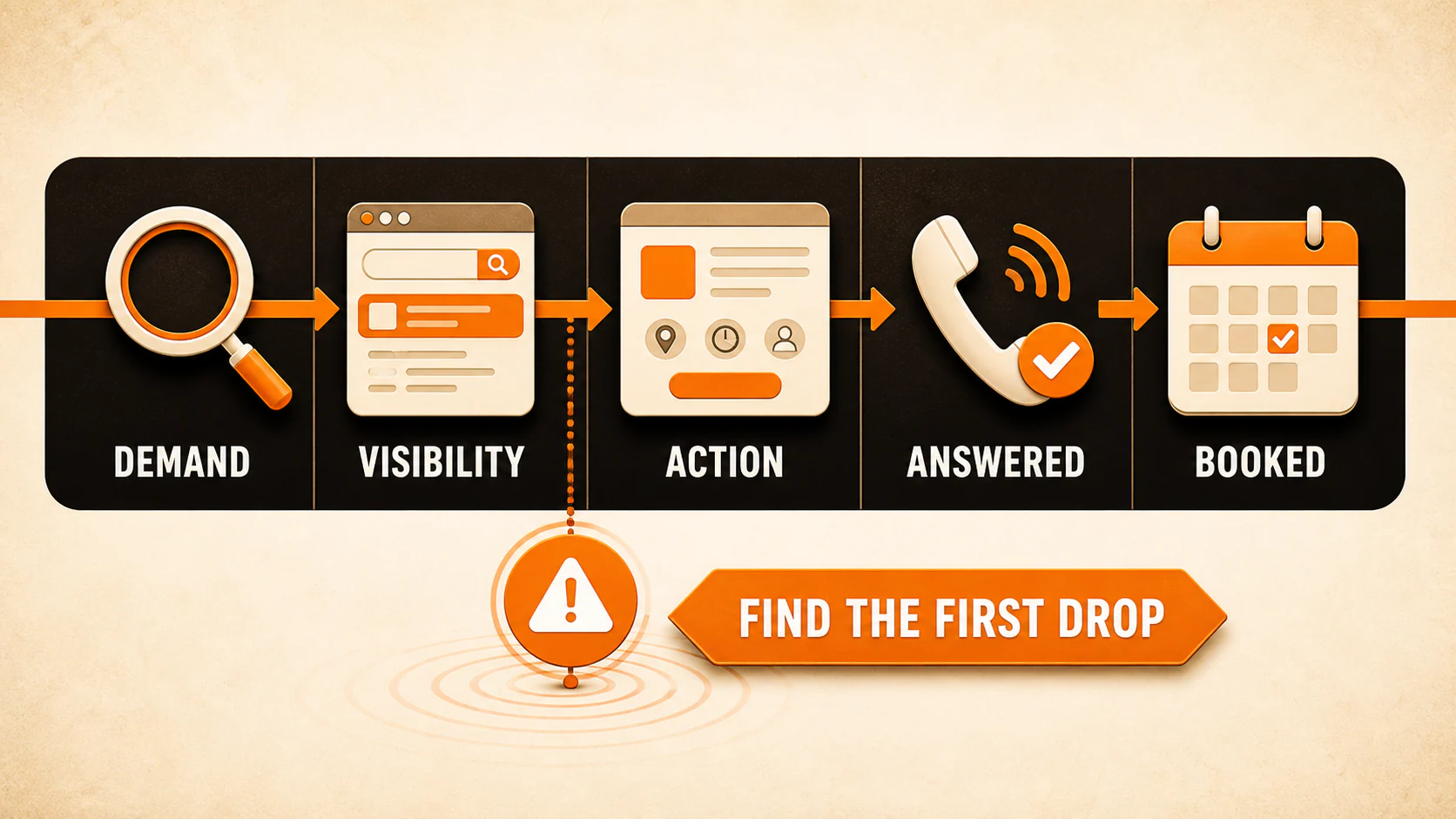
The patient path is straightforward on paper:
Demand → search visibility → website or profile action → answered inquiry → booked appointment
Find the first meaningful drop in that path and fix that stage first. Otherwise, you can spend a month rewriting content while the actual problem is a missed-call issue, a broken form, reduced search demand, weaker local visibility, or a scheduling bottleneck.
This guide is for U.S. private medical, dental, therapy, wellness, and aesthetic practices. It covers marketing and measurement, not medical, legal, or privacy advice. Before you begin, gather access to Google Search Console, website analytics, Google Business Profile performance data, call or phone logs, form submissions, and the system that records booked appointments.
1. Build the patient-discovery scoreboard before changing anything
No single dashboard tells the whole story.
Google Search Console shows how your site performs in Google Search. An impression means one of your pages appeared in a search result; a click means someone selected it. Website analytics shows what people do after they arrive. Your Business Profile records available local actions. Phone and form systems show whether inquiries reached you. Your scheduling system tells you whether those inquiries became appointments.
Those numbers will not match perfectly. That alone does not mean something is broken. Google describes Search Console and Google Analytics as tools that answer different questions. Treat each system as evidence for one stage, not as a universal source of truth.
Start with comparable periods. If the phone became quiet in the last 28 days, compare that window with the previous 28 days and, when seasonality matters, the same period last year. Then record this scoreboard:
| Signal | What a drop may mean | Where to look | First verification |
|---|---|---|---|
| Search impressions | Demand changed, rankings slipped, pages disappeared, or query mix shifted | Search Console | Compare queries, pages, devices, locations, and search appearances across matching periods |
| Website clicks or profile actions | Your result became less compelling or relevant, competitors changed, local visibility shifted, or summarized answers altered the path | Search Console and Business Profile performance | Check whether impressions held steady while clicks, calls, directions, or website actions fell |
| Calls and forms | The website or profile path is failing, tracking is wrong, or the offer is unclear | Analytics, call tracking, forms, and manual tests | Submit every form and tap every phone number from a mobile device |
| Answered inquiries | Calls are being missed, routed poorly, abandoned, or recorded incorrectly | Phone logs and call reports | Match incoming calls with answered, missed, abandoned, and voicemail records |
| Booked appointments | Availability, response time, fit, insurance, intake, or scheduling is creating friction | Scheduling and intake systems | Trace a sample of inquiries from first contact to final disposition |
Look past the tiny daily wobble. You need a change large and consistent enough to alter the decision you would make. The useful answer is the first stage where the path changed.
2. Follow the branch that matches the first drop
Once you find the first weak stage, stay in that branch. A traffic problem and a phone-answering problem do not need the same repair.
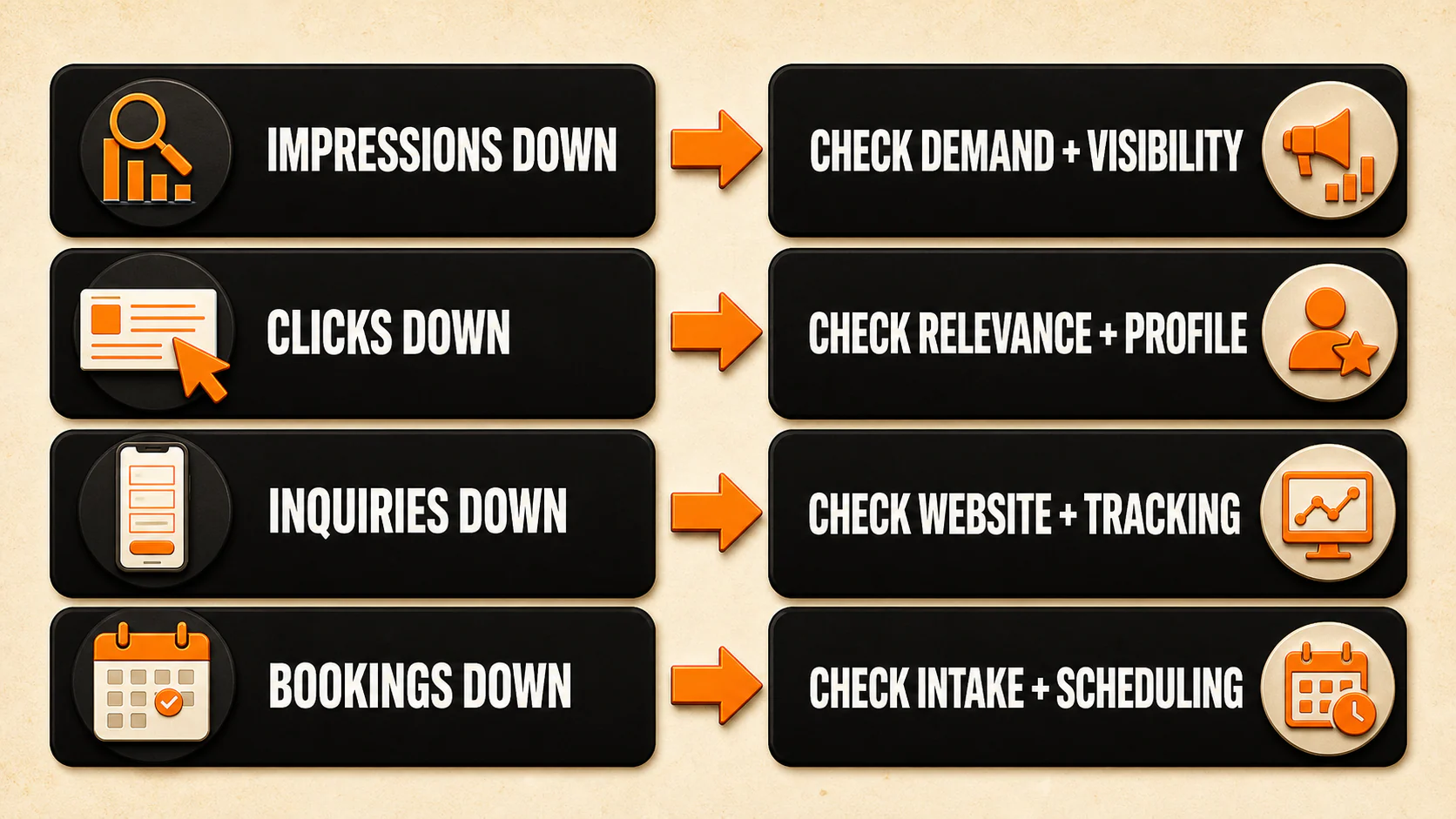
If search impressions are down
First, separate a visibility loss from a demand change. Compare branded searches, high-intent service searches, informational questions, locations, pages, and devices. A broad decline across the market points you in a different direction than one service page quietly disappearing.
Then check the unglamorous stuff:
- Can Google access and index the important pages?
- Did a redesign, migration, redirect, canonical tag, or robots setting change?
- Did rankings fall for one service or location?
- Did search demand or seasonality change?
- Did a competitor, map result, or search feature alter what appears above you?
Google's traffic-drop debugging guide recommends comparing periods and segmenting by queries, pages, countries, devices, and search appearances. Follow that discipline before reaching for an AI explanation.
If the loss is local, check visibility for the areas and services that matter. Proximity cannot be fixed with clever copy. Complete service and location information, however, is something you can fix when Google cannot clearly match the practice to the search. Our advanced "near me" local SEO guide explains that distinction in more detail.
Verification: name the affected query, page, device, location, or search type, or confirm that demand itself changed. "Organic is down" is not specific enough to prescribe a repair.
If impressions are steady but clicks or local actions are down
The problem is now more likely between being seen and being chosen.
Review the pages and queries that lost clicks. Does the title still match what the searcher wants? Is the description accurate? Did competitors present a more useful result? Does the Business Profile show the right category, hours, services, phone number, website, location, and appointment path?
Google says local results are mainly shaped by relevance, distance, and prominence, and it recommends keeping Business Profile information complete and accurate. That does not make your profile an "AI fact sheet," and it does not guarantee visibility. It makes a thorough Business Profile cleanup a sensible repair when the information is incomplete or inconsistent.
This is also where AI-assisted search belongs as a hypothesis. An AI Overview may answer part of an informational query before a click. A standalone assistant may introduce a practice through another route. But Google currently combines traffic from its AI features with the regular Web search type in Search Console. It does not give you a neat filter that proves "AI took these calls."
Verification: confirm that visibility held relatively steady while the next action fell. Then compare result presentation, local information, competitor changes, and search features for the affected queries. Correlation is not a diagnosis.
If visits or profile actions are steady but calls and forms are down
Stop thinking about rankings for a moment. The leak is closer to the practice.
Test the path like a potential patient would:
- Open the top landing pages on a phone.
- Tap every phone number and appointment button.
- Submit every form with a clearly labeled test entry.
- Confirm that the submission reaches the correct person or system.
- Check whether service, provider, location, insurance, hours, and next-step information is easy to find.
A page can attract the right visitor and still make the next step feel risky or confusing. Tiny contact information, a generic "learn more" button, unclear insurance details, an intimidating form, or a disconnected phone number can erase the value of the visibility you already earned.
Verification: complete the path at more than one common mobile screen size when possible. Confirm that each test appears in the destination system with the correct source and timestamp.
If inquiries are steady but answered calls or bookings are down
This is an operational problem, not an SEO problem. Calling it SEO only delays the fix.
Compare incoming calls with answered calls, missed calls, abandoned calls, voicemails, callbacks, form-response times, and appointment outcomes. Check routing during lunch, after hours, busy periods, and staff handoffs. Review whether callers reach the correct location or service line and whether scheduling availability changed.
Keep the analysis non-medical. You are tracing response and intake, not judging treatment decisions. Use neutral disposition categories such as booked, not a fit, insurance mismatch, no availability, no response, duplicate, and unknown. If too many records land in "unknown," fix that before drawing conclusions.
Verification: trace an inquiry from source to answer status to booking disposition without guessing what happened between systems.
3. Adapt for AI-assisted discovery without chasing myths
Once the basic path works, strengthen how clearly the practice can be understood across search experiences.
The good news is wonderfully boring: Google says its established SEO practices still apply to AI Overviews and AI Mode. Its current guidance says there is no special AI schema, AI text file, or separate technical shortcut required for those Google features.
Skip the magic-file sales pitch. Focus on work that helps people and ordinary search systems:
- Keep provider names, credentials, services, locations, contact details, hours, and insurance information accurate and consistent.
- Give each important service and location enough clear, crawlable information to stand on its own.
- Answer real patient questions in plain language, with appropriate clinical review for medical information.
- Put important information in visible page text instead of hiding it in images, scripts, or inaccessible widgets.
- Maintain accurate profiles and reputable third-party listings so conflicting details do not create confusion.
- Make the appointment path obvious after someone lands on the page.
Google AI features, ChatGPT, Perplexity, and other assistants are not one system with one checklist. For the deeper implementation work, use our clinic AI-visibility guide. This article has a narrower job: prove where the patient path broke before expanding the strategy.
For monitoring, save a small fixed set of important searches and prompts. Record the date, location or context, whether the practice appears, any linked source, the landing page, and the downstream action. This is a directional observation log, not a universal "AI ranking." It also cannot prove that a mention produced a patient.
4. Handle reviews like a healthcare practice, not a keyword farm
The old advice to coach patients into mentioning diagnoses, treatments, or outcomes is a bad fit for healthcare.
Ask for an honest review. Keep the request neutral. Do not offer an incentive for positive sentiment, feed patients phrases to repeat, or pressure someone to remove criticism. Google says reviews should reflect genuine experiences and prohibits incentives tied to posting, changing, or removing a review. The FTC's Consumer Reviews and Testimonials Rule guidance also addresses fake reviews, sentiment-conditioned incentives, suppression, and other deceptive practices.
Public replies need even more restraint. Do not confirm that someone is or was a patient. Do not discuss an appointment, diagnosis, procedure, treatment, payment, or other protected detail. Google tells businesses not to share a reviewer's private information and recommends moving complex situations to phone or email. HHS has also publicized an enforcement settlement involving patient information disclosed in responses to negative online reviews.
That example does not turn every clumsy response into a legal violation, and this article is not legal advice. It does show why a conservative response policy matters. Follow your privacy counsel, compliance requirements, and internal procedures.
For the mechanics of making a neutral request part of your process, see our guide to getting online reviews without sounding pushy.
5. Use a seven-day triage and 30-day repair plan
You do not need a six-month transformation plan to begin. You need one clean week of diagnosis, followed by enough time to implement and observe the right repair.
The first seven days
- Day 1, verify the measurement. Test phone numbers, forms, call tracking, analytics events, and scheduling records. Save the baseline.
- Day 2, segment Google visibility. Compare Search Console periods by query, page, device, location, and search appearance. Note where the first meaningful decline appears.
- Day 3, review local actions. Check available Business Profile calls, website visits, directions, and other actions. Confirm that the live profile information is accurate.
- Day 4, test the top landing pages on a phone. Check speed, clarity, service and insurance information, contact actions, form delivery, and confirmation messages.
- Day 5, audit practice facts. Compare provider, service, location, hours, insurance, and contact details across the website, Business Profile, major directories, and insurer listings where applicable.
- Day 6, trace inquiry handling. Match calls and forms with answered status, response time, outcome, and appointment disposition. Look for routing and ownership gaps.
- Day 7, choose one repair branch. Write down the evidence, the owner, the change, the metric you expect to move first, and the review date. Do not launch five unrelated fixes and then pretend you know which one mattered.
The next 30 days
Implement the repair that matches the first broken stage. Keep the other variables as stable as practical. Review the leading indicator after seven days, but do not force a conclusion from a tiny sample. At 30 days, compare the same funnel stages and matching periods again.
Use the same observation set:
- Search impressions and clicks for the affected queries and pages
- Relevant Business Profile actions
- Website calls, forms, and appointment actions
- Answered and missed inquiries
- Booked appointments and clear non-booking dispositions
- Saved search and assistant observations, kept separate by product and context
The completion check is simple. You can identify the first stage that changed, document the repair, verify that the repair is live, and compare the same downstream measures after a defined window. That verifies the work. It does not promise a ranking, AI mention, call, or booked appointment.
Fix the first broken stage, then measure the whole path
AI-assisted search is changing how people gather information. It deserves attention. It does not deserve automatic blame every time the phone gets quiet.
The smarter move is less dramatic. Map demand, visibility, action, response, and booking. Find the first drop. Repair that stage. Then watch the whole path long enough to see whether the change holds.
If the diagnosis points to local visibility, YEAH! Local's local SEO services can help strengthen the search-to-inquiry path. If you need help tracing the problem before choosing the fix, contact YEAH! Local. We will start with the evidence, not a trendy explanation.
Last updated