

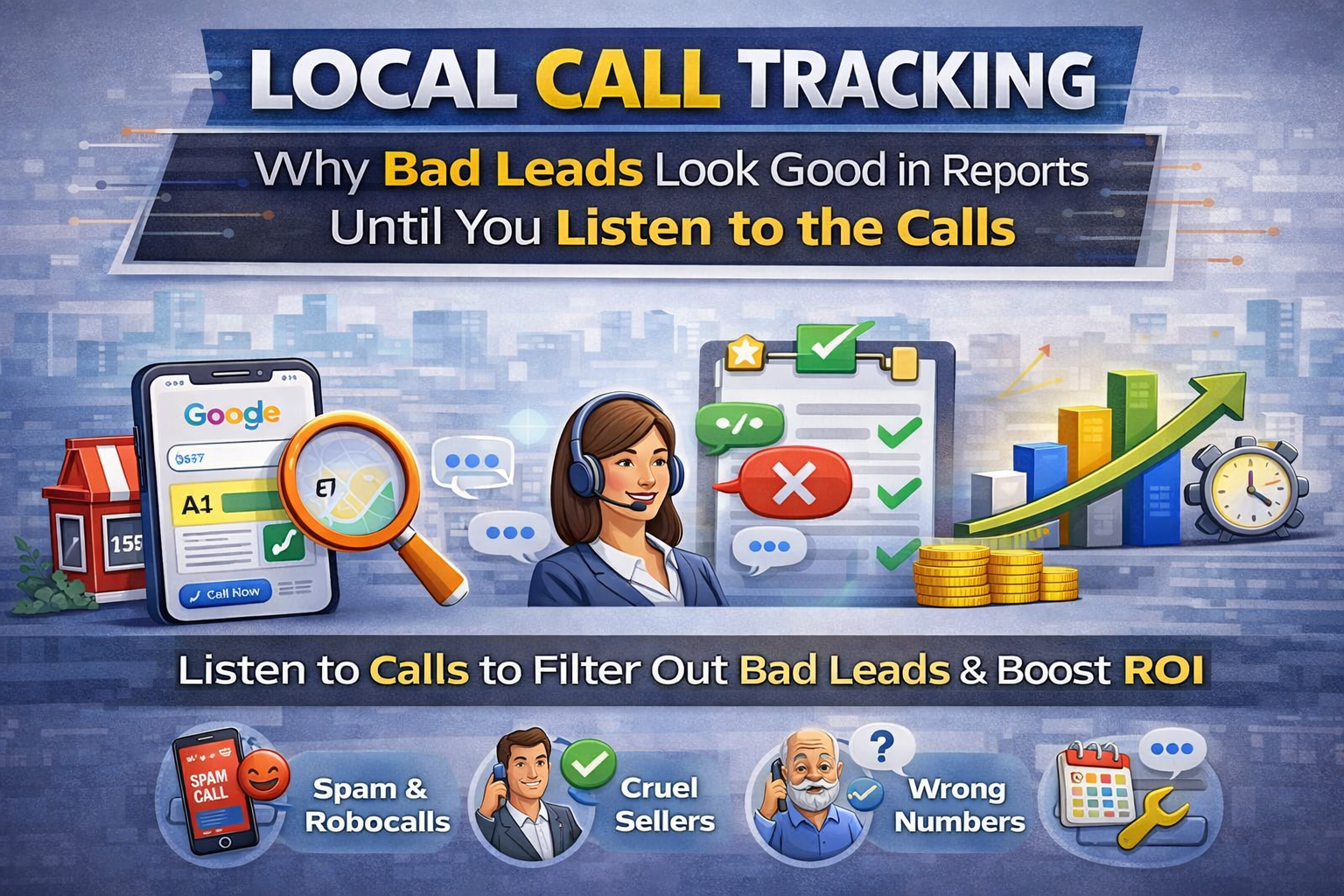
Key Takeaways
- Most local marketing reporting makes bad leads look better than they really are.
- Clicks, conversions, and cost per lead can all look strong while lead quality quietly declines.
- Call tracking exposes which leads are actually qualified, bookable, local, and worth paying for.
- The real power of call tracking is not just attribution. It is truth.
- When you listen to calls, you uncover what reporting misses: wrong-service leads, out-of-area calls, price shoppers, intake breakdowns, and missed revenue opportunities.
- Businesses that improve fastest are the ones that use call tracking to optimize for lead quality, not just lead volume.
Why This Happens So Often in Local Marketing
A lot of local businesses think they understand their marketing because the reporting looks good.
They see:
- leads up
- conversions up
- cost per lead down
- campaign performance improving
- month-over-month growth
On paper, everything looks healthy.
But then the real-world signals start saying something else.
The front desk says the calls are weak.
The owner says the leads are not converting.
The sales team says too many callers are a bad fit.
Revenue does not move the way the reporting suggests it should.
That disconnect is not unusual. It is one of the most common problems in local marketing.
Because reporting often measures activity, not actual opportunity.
And that is exactly why bad leads can look good until you listen to the calls.
The Core Problem: Reporting Treats Too Many Leads Like They’re Equal
This is the lie at the center of a lot of local marketing reporting:
A lead is a lead.
It is not.
A spam call is not a lead.
A wrong-number call is not a lead.
A call from someone outside your service area is not a lead.
A call for a service you do not offer is not a lead.
A bargain hunter who was never going to book is not the same as a qualified buyer ready to move forward.
But in reporting, those often get counted the same way.
That is how businesses end up with reports that say:
- 63 leads
- $42 cost per lead
- strong campaign efficiency
While the reality looks more like:
- 12 wrong-service calls
- 10 out-of-area calls
- 8 spam or junk calls
- 14 price shoppers
- 7 missed calls
- 12 actual opportunities
That is not 63 leads.
That is reporting making noise look like growth.
Why Bad Leads Look Good in Reporting
There are a few reasons this happens over and over.
1. Reporting counts conversions, not quality
Most platforms are built to count actions:
- phone calls
- form fills
- clicks on call buttons
- booked events
- tracked conversions
What they usually do not tell you is whether the lead was actually worth having.
2. Low cost per lead creates false confidence
A cheap lead sounds efficient.
But cheap bad leads are still expensive if:
- they waste staff time
- they clog the phone line
- they lower close rates
- they distort campaign optimization
- they make the business think the campaign is working when it is not
3. Volume hides friction
High lead counts can make a campaign look successful even when:
- callers are confused
- service expectations are mismatched
- location targeting is sloppy
- intake is weak
- landing pages are qualifying poorly
4. Platforms do not hear the conversation
This is the biggest limitation.
The ad platform knows a call happened.
It does not know:
- what the person wanted
- whether they were serious
- whether they were in your market
- whether they booked
- whether they were ever a fit
That truth only shows up when you listen to the calls.
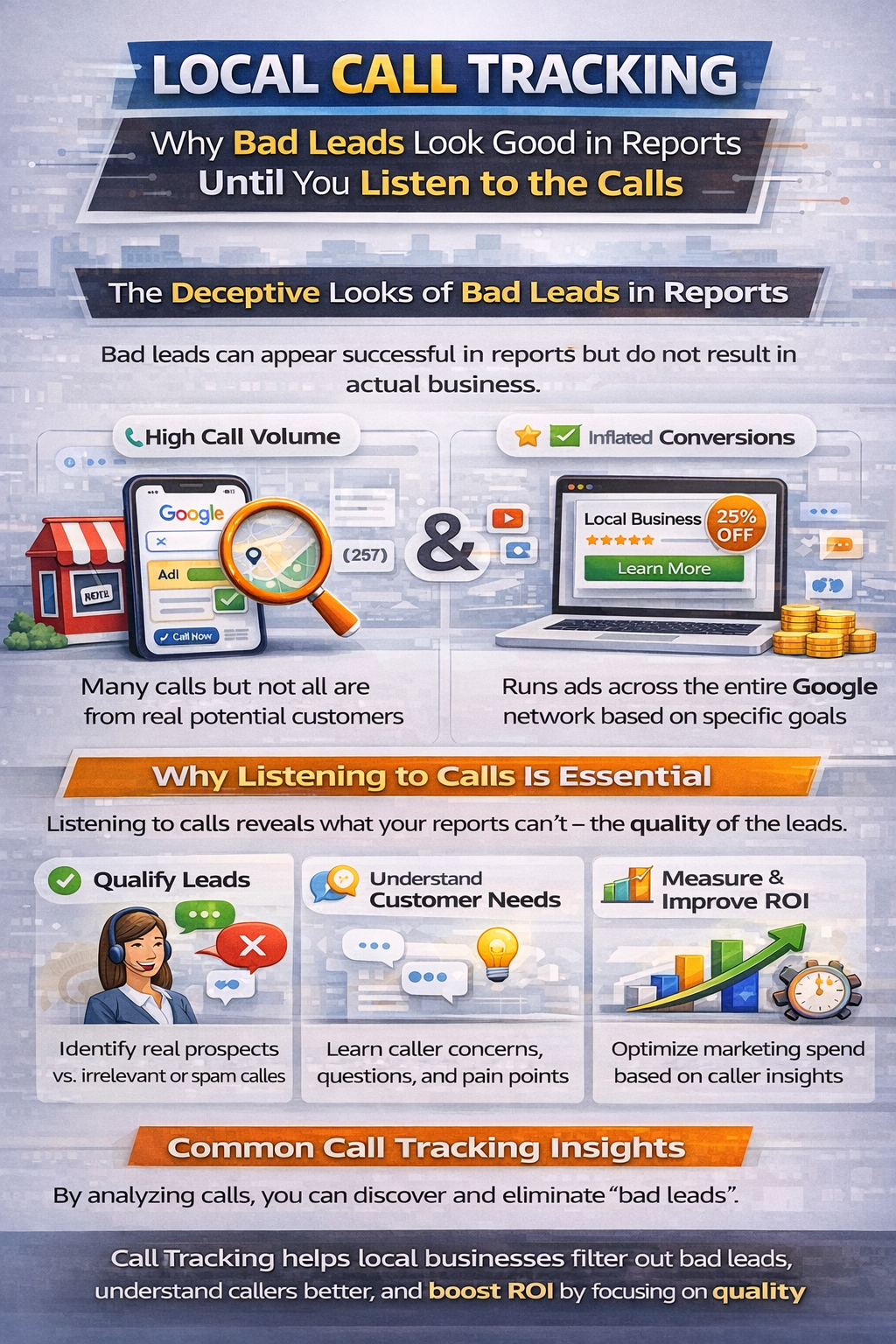
What Call Tracking Reveals That Reporting Can’t
Call tracking closes the gap between what the report says and what the business is actually experiencing.
Done well, it reveals:
- where the call came from
- what service the caller wanted
- whether the caller was qualified
- whether they were in your service area
- what objections they raised
- whether they booked
- whether your team handled the call well
- where the lead was lost
This matters because local marketing is not won at the click.
It is won in the conversation.
The Real Value of Call Tracking Is Not Attribution. It’s Truth.
A lot of businesses think call tracking is mainly about source attribution.
That matters, but it is only the beginning.
Basic call tracking tells you:
- this call came from Google Ads
- this call came from organic search
- this call came from your Google Business Profile
Useful, yes.
But real call tracking intelligence tells you:
- this Google Ads campaign is producing too many wrong-service calls
- this AI SEO page is driving calls from people outside your ideal geography
- this GBP listing gets good lead volume but a weak booked rate
- this landing page creates confusion about pricing
- this staff member handles high-intent calls better than others
- this campaign looks good in reporting but performs poorly in real conversations
That is what changes strategy.
The Marketing Lies Call Tracking Exposes
“Our Google Ads are working because lead volume is up.”
Maybe. Or maybe the campaign is attracting:
- poor-fit leads
- price-first callers
- irrelevant service requests
- people outside your market
Reporting may celebrate that growth.
Call tracking shows whether it is actually valuable.
“SEO is performing because conversions increased.”
Possibly. But if calls are coming from:
- the wrong audience
- low-intent searchers
- confused visitors
- non-buyers
Then the increase is not as impressive as it looks.
“Our landing page is doing its job.”
Not if the calls keep sounding like this:
- “Do you even offer that?”
- “What area do you service?”
- “Do you take my insurance?”
- “How much does this usually cost?”
- “What exactly happens next?”
If every caller has to clarify basic information, the page is not really converting. It is offloading its job onto your phone team.
“We just need more leads.”
Sometimes the issue is not more leads.
Sometimes the issue is:
- the wrong leads
- poor qualification
- weak intake
- missed calls
- inconsistent call handling
- unclear messaging
Call tracking helps you fix the actual bottleneck instead of guessing.
What You Learn When You Actually Listen to Calls
The moment you start listening, patterns show up fast.
You hear what buyers really care about
Not what marketers assume. Not what the website says. What real people care about.
That usually includes:
- price
- urgency
- availability
- trust
- insurance
- provider experience
- natural results
- recovery time
- financing
- location convenience
You hear the language they actually use
Customers rarely describe their problems the way businesses do.
That matters for:
- AI SEO
- ad copy
- FAQs
- landing pages
- GBP content
- review prompts
If your marketing language does not sound like your buyers, conversion friction goes up.
You hear where your team loses good opportunities
This is one of the hardest truths and one of the most valuable.
Sometimes the traffic is fine.
Sometimes the campaign is fine.
Sometimes the leads are fine.
The issue is what happens after the phone rings.
Call tracking reveals:
- weak call handling
- unclear next steps
- poor follow-up
- missed booking opportunities
- inconsistent confidence from staff
That is operational gold.
Why AI Call Summaries Make This Even More Powerful
Listening manually is useful, but AI makes the system much more scalable.
With AI call summaries, you can categorize calls by:
- service requested
- lead quality
- booking status
- urgency
- objections
- location fit
- sentiment
- outcome
Now instead of relying on vague impressions, you can see patterns like:
- 22% of paid-search calls were outside the service area
- 18% of organic calls were for the wrong service
- 31% of non-booked calls asked about financing
- 27% of missed opportunities happened after hours
- 40% of qualified callers asked a question your landing page should have answered
That is the kind of insight reporting alone cannot give you.
How Call Tracking Improves Local Marketing
Once you know what is really happening, you can optimize the right things.
Google Ads
Use call tracking to:
- remove bad keywords
- tighten match types
- improve negative keyword lists
- narrow location targeting
- refine ad messaging
- identify which campaigns produce qualified calls
SEO & AI SEO
Use call tracking to:
- build content around real buyer questions
- improve service pages
- tighten local intent
- reduce confusion
- match search language more closely
Google Business Profile
Use call data to improve:
- service descriptions
- categories
- Q&A content
- messaging
- review prompts
Intake and sales process
Use call insights to:
- train staff
- improve scripts
- reduce missed calls
- speed up follow-up
- increase booking rates
This is where call tracking stops being a reporting tool and becomes a growth tool.
| What Reporting Shows | Why It Looks Good | What Call Tracking Reveals | What You Should Measure Instead |
|---|---|---|---|
| High lead volume | More calls and forms coming in | Many leads are wrong-service, out-of-area, or low-intent | Qualified lead volume |
| Low cost per lead | Campaign looks efficient | Cheap leads may be junk or non-booking calls | Cost per qualified lead |
| Rising conversion count | More tracked actions month over month | Conversions may not turn into real opportunities | Booked call rate |
| Strong Google Ads performance | More calls from paid campaigns | Paid traffic may be attracting poor-fit callers | Qualified calls by campaign |
| Good SEO conversion numbers | Organic traffic appears to be working | Callers may be informational, not commercial | Commercial-intent call rate |
| Landing page success | Calls are being generated | Page may be causing confusion and poor-fit calls | Conversion quality |
| Front desk “doing fine” | No obvious issue in reporting | Staff may be mishandling qualified calls | Booking rate by call source |
| Positive month-over-month trend | Reporting shows growth | Lead quality may actually be getting worse | Revenue per qualified lead |
The Local Growth Lesson Most Businesses Miss
The businesses that grow fastest are not the ones with the best-looking reporting.
They are the ones closest to reality.
That means they know:
- which leads are worth paying for
- which campaigns attract junk
- which pages create confusion
- which objections are blocking conversions
- which staff behaviors improve bookings
- which questions buyers ask over and over
That is what call tracking reveals.
And once you see that clearly, your marketing gets a lot smarter.
Final Thought
Reporting is useful.
But reporting alone can make bad leads look a lot better than they are.
That is the danger.
It creates false confidence.
It hides waste.
It celebrates volume when the real issue is quality.
Call tracking changes that.
Because the moment you listen to the calls, you stop optimizing for what looks good in a report and start optimizing for what actually grows the business.
That is where better lead quality starts.
FAQ's
What is call tracking?
Call tracking is a system that helps you see where calls came from and evaluate which marketing sources are generating real opportunities, not just call volume.
Why do bad leads look good in reporting?
Because most reporting counts actions like calls and form fills without showing whether those leads were qualified, local, relevant, or likely to book.
How does call tracking improve lead quality?
It reveals patterns in caller intent, service fit, objections, booking behavior, and staff performance so you can improve targeting, messaging, and follow-up.
Is call tracking only useful for Google Ads?
No. It is valuable for SEO, Google Business Profile, landing pages, intake performance, and any channel where phone calls matter.
What should local businesses measure instead of just cost per lead?
Cost per qualified lead, booked call rate, qualified call volume, and revenue per lead source are all better indicators than raw CPL.
Can call tracking help improve SEO?
Yes. It gives you the real language customers use, the questions they ask, and the gaps in your content, which can improve service pages, FAQs, and blog topics.
What role do AI call summaries play?
AI call summaries make call tracking more scalable by automatically tagging call outcomes, lead quality, objections, and service requests so you can find patterns faster.