

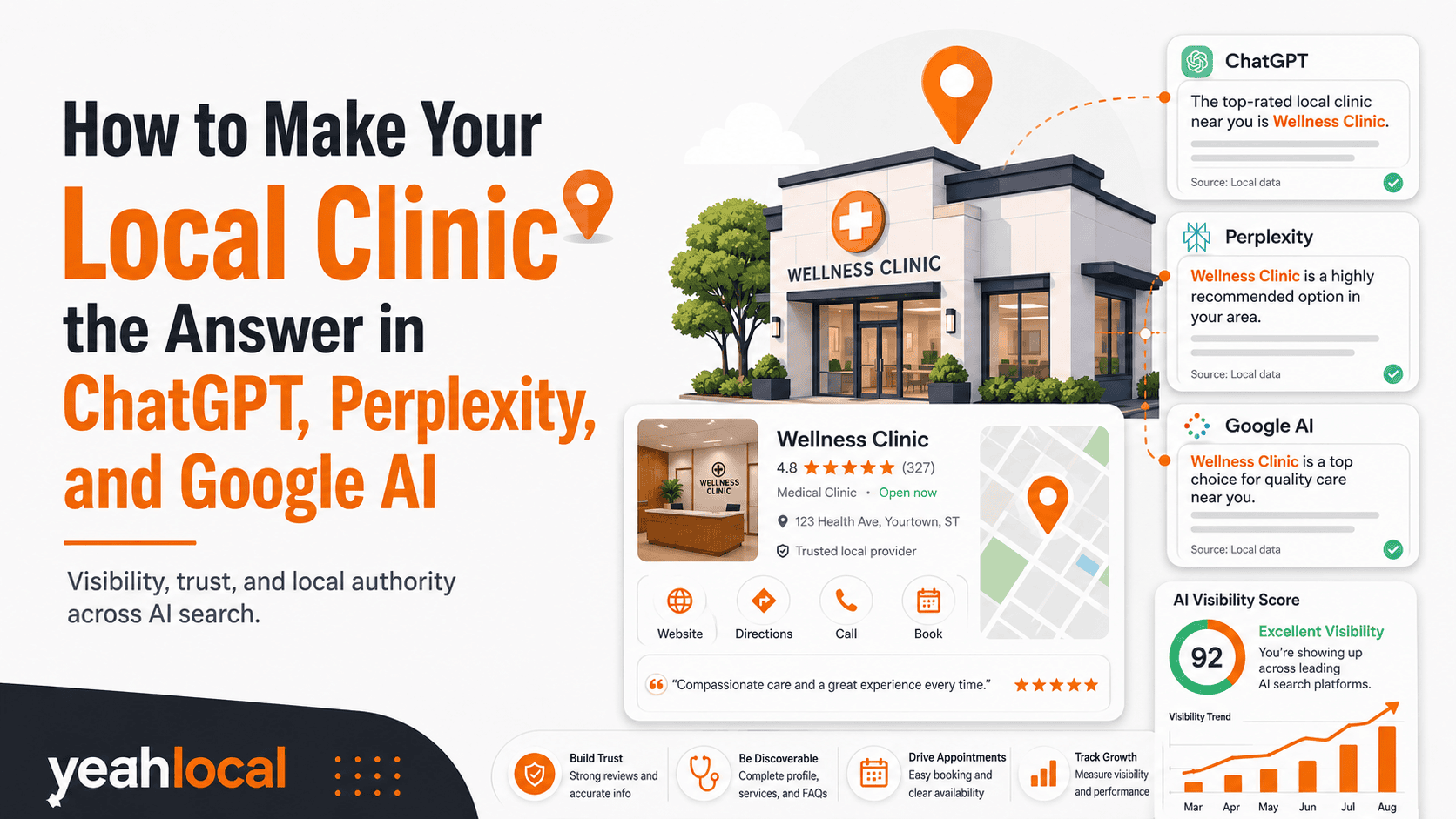
Key Takeaways
- AI search does not replace local SEO. It rewards the local clinics that are already clear, trusted, well-structured, and well-referenced online.
- Healthcare, aesthetics, and wellness businesses need stronger trust signals than most industries because patients are making decisions about their health, appearance, safety, and money.
- ChatGPT, Perplexity, and Google AI results do not all work exactly the same way, but they all need reliable, crawlable, clearly structured information to reference.
- Your website, Google Business Profile, reviews, provider bios, service pages, local mentions, and press coverage all help AI systems understand whether your business deserves to be recommended.
- The goal is not just to “rank.” The goal is to become the obvious, trusted answer when someone asks an AI tool who they should call, book, or compare.
- The fastest path is to build a clear local entity, answer real patient questions, show proof, earn third-party authority, and track which AI-influenced searches turn into calls and appointments.
The New Local Search Question
For years, local businesses asked:
“How do I rank higher on Google?”
That question still matters.
But now there is a second question:
“How do I get recommended when someone asks ChatGPT, Perplexity, or Google AI who to trust?”
That shift matters a lot for healthcare, wellness, and aesthetic businesses.
A prospective patient might ask:
- “Who is the best med spa near me for natural-looking Botox?”
- “What’s the best clinic in Atlanta for medical weight loss?”
- “Which wellness clinic near me offers hormone therapy?”
- “Who has the best reviews for primary care in my area?”
- “What should I know before choosing a therapist?”
- “Which provider near me offers GLP-1 weight loss with medical supervision?”
Those searches are not just informational.
They are decision-making searches.
The person is not just browsing. They are forming a shortlist.
And if your business is not visible in that AI-generated shortlist, you may never get the phone call.
First, Understand How AI Search Actually Finds Businesses
There is no single “AI search algorithm.”
ChatGPT, Perplexity, and Google AI results each work differently.
But they share one big principle:
They need sources.
ChatGPT search can search the web, produce timely answers, and include links to relevant web sources. OpenAI also notes that ChatGPT may rewrite a user’s prompt into one or more targeted search queries, and it may use general or precise location signals when location is relevant.
Perplexity describes itself as an AI-powered search engine that searches the web and provides conversational answers backed by citations and links to original sources.
Google says AI Overviews and AI Mode surface relevant links to help people find information, and its AI features may use a “query fan-out” technique, issuing multiple related searches across subtopics and sources to develop a response.
That means AI discovery is not magic.
It is built on a source layer.
If your business does not have strong, crawlable, trustworthy source material across the web, AI systems have less reason to include you.
What “Getting Found in AI Results” Actually Means
For a local clinic, “getting found” in AI does not always mean the same thing.
You might appear as:
- a cited source
- a recommended provider
- a business mentioned in a comparison answer
- a Google AI Overview supporting link
- a Perplexity citation
- a ChatGPT search result source
- a business pulled from Maps-style local information
- a brand patients search for after seeing you mentioned elsewhere
That last one is important.
AI visibility is not always a direct click.
Sometimes it is the moment your business gets introduced into the patient’s mind.
A user may ask an AI tool for options, see your clinic mentioned, then search your brand on Google, check reviews, visit your website, and call later.
Your analytics may credit that as branded search, direct traffic, or Google Business Profile.
But AI influenced the decision upstream.
That is why healthcare, wellness, and aesthetic businesses should not think of AI SEO as a replacement for local SEO. It is an added layer on top of local search, reputation, authority, and conversion.
Why Healthcare, Wellness, and Aesthetic Businesses Have a Higher Bar
A med spa, medical weight loss clinic, mental health practice, hormone clinic, chiropractic office, or wellness center is not the same as a coffee shop.
Patients are asking trust-heavy questions.
They want to know:
- Is this safe?
- Is this provider qualified?
- Are the results realistic?
- Will I be pressured?
- Do they understand my specific concern?
- Are they reputable?
- Do real patients say good things?
- Is this medical, cosmetic, holistic, or something in between?
Google’s guidance on helpful content says its systems aim to prioritize helpful, reliable, people-first content, and it specifically says trust is the most important part of E-E-A-T. Google also notes that topics affecting health, financial stability, safety, or well-being fall under “Your Money or Your Life” topics, where strong E-E-A-T becomes even more important.
That is why generic clinic content performs poorly in AI search.
AI systems do not need another page that says:
“We offer personalized care in a relaxing environment.”
They need clear, specific, verifiable information.
The Big Idea: AI Recommends Businesses It Can Understand and Trust
If you remember one thing, make it this:
AI search rewards clarity plus credibility.
For a healthcare, wellness, or aesthetic business, that means AI needs to understand:
- Who are you?
- Where are you located?
- What services do you provide?
- Who provides those services?
- What credentials support those services?
- What do patients say about you?
- What are you known for?
- What makes you different?
- Are your claims supported by your website, reviews, business profile, and third-party mentions?
If those signals are weak, scattered, inconsistent, or generic, AI has no strong reason to recommend you.
If those signals are clear and reinforced across multiple sources, your chances improve.
There is no guaranteed “submit your clinic to ChatGPT” button.
Google states there are no special requirements or special optimization needed to appear in AI Overviews or AI Mode beyond core SEO best practices, and OpenAI says there is no way to guarantee top placement in ChatGPT search.
So the play is not to chase gimmicks.
The play is to become the best, clearest, most trustworthy source in your local category.
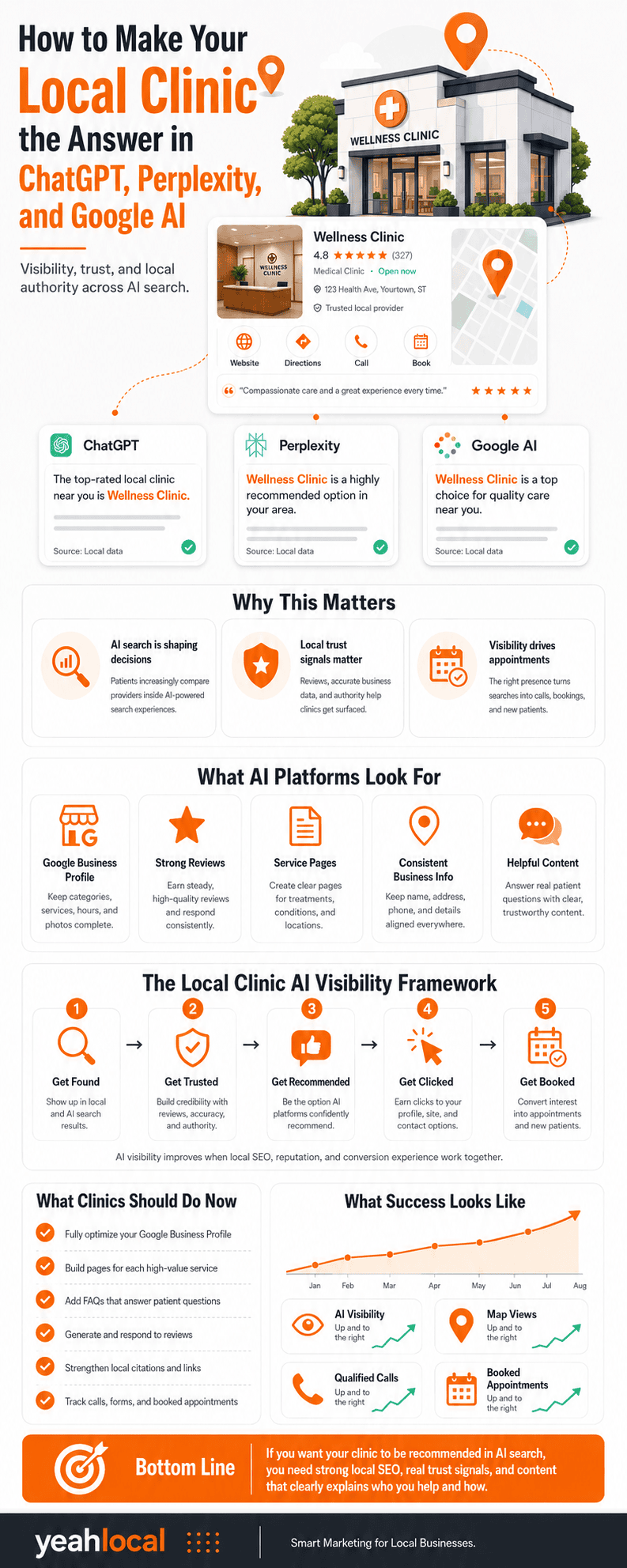
The AI Visibility Stack for Local Clinics
Think of AI visibility as a stack.
Each layer supports the next.
Layer 1: Technical Accessibility
Before AI systems can cite, summarize, or reference you, your information needs to be accessible.
At minimum:
- your site must be crawlable
- important content must be in text, not trapped in images
- your service pages must be indexable
- your site should load properly on mobile
- your structured data should match visible page content
- your hosting or CDN should not block relevant crawlers
Google says pages must be indexed and eligible to appear in Google Search with a snippet to be eligible as supporting links in AI Overviews or AI Mode. Google also recommends making important content available in text, making content findable through internal links, and keeping Business Profile information up to date.
OpenAI says that to be included in ChatGPT search, site owners should allow OAI-Searchbot to crawl their site and ensure their host or CDN allows traffic from OpenAI’s published IP addresses.
This is basic, but it matters.
A beautiful site that AI systems cannot crawl is invisible.
Layer 2: Local Entity Clarity
AI systems need to understand your business as a real-world entity.
That means your information should be consistent across:
- website
- Google Business Profile
- Apple Maps
- Bing Places
- top healthcare directories
- top aesthetic directories
- top wellness directories
- review platforms
- local chamber pages
- press mentions
- social profiles
For Google local rankings, Google says local results are mainly based on relevance, distance, and prominence. Google also says complete and accurate Business Profile information helps customers know what you do, where you are, and when they can visit, and that reviews, positive ratings, and links can influence prominence.
For healthcare, aesthetics, and wellness businesses, entity clarity should include:
- legal business name
- DBA or public-facing brand name
- address or service area
- phone number
- website
- primary category
- secondary categories
- services
- providers
- credentials
- hours
- appointment options
- photos
- reviews
- service descriptions
A vague entity is hard to recommend.
A clear entity becomes easier to classify, match, and surface.
Layer 3: Service Pages That Answer Decision-Making Questions
Most clinic websites have service pages.
Few have service pages good enough for AI search.
A weak service page says:
“We offer Botox to help reduce fine lines and wrinkles. Contact us today.”
A strong AI-ready service page answers:
- What is Botox?
- Who is it for?
- Who is it not for?
- What areas can be treated?
- What does the appointment involve?
- Who performs the treatment?
- How long does it take?
- When do results appear?
- How long do results last?
- What does it cost or what affects cost?
- What are the risks or limitations?
- Why choose this clinic?
- What should someone do next?
AI search tools tend to answer nuanced questions. If your page does not answer nuanced questions, you are giving AI systems very little to work with.
For healthcare, aesthetics, and wellness, your best content should be specific enough to help someone feel informed, but responsible enough not to overpromise.
The goal is not hype.
The goal is confidence.
Layer 4: Provider and Expertise Signals
This is where many clinics lose.
They have treatment pages, but no clear human expertise.
For AI visibility, your provider pages should not be thin biographies.
They should explain:
- who the provider is
- credentials and licenses
- areas of focus
- years of experience
- treatment philosophy
- conditions or services they commonly support
- associations or training
- media mentions or publications, if applicable
- patient experience approach
- links to related services
For a med spa, that may mean injector bios with credentials, training, aesthetic philosophy, and treatment specialties.
For a wellness clinic, that may mean provider pages explaining functional medicine, hormone therapy, medical weight loss, peptide therapy, or nutrition expertise.
For a mental health or integrative practice, that may mean detailed pages explaining specialties, modalities, populations served, and clinical approach.
Google’s helpful content guidance explicitly asks whether content makes users want to trust it through clear sourcing, evidence of expertise, and background about the author or site.
Patients want to know who is behind the care.
AI systems need the same clarity.
Layer 5: Review Language That Teaches AI What You’re Known For
Reviews are not just social proof anymore.
They are local language data.
A generic review says:
“Great staff. Highly recommend.”
That is nice, but it does not teach AI much.
A useful review says:
“I came here for natural-looking lip filler before my wedding. The injector explained the process, listened to what I wanted, and made sure I didn’t look overdone.”
That teaches:
- service: lip filler
- outcome: natural-looking result
- patient concern: not overdone
- experience: consultative and careful
- audience: event / wedding prep
A wellness review might say:
“I started medical weight loss here after struggling with cravings and low energy. The provider reviewed my labs, explained my options, and helped me understand whether GLP-1 treatment made sense.”
That teaches:
- service: medical weight loss
- concern: cravings and low energy
- process: labs and explanation
- trust: provider guidance
- treatment category: GLP-1
You cannot script reviews, and you should not pressure patients.
But you can guide the review request.
Instead of asking:
“Can you leave us a review?”
Ask:
“Would you be willing to share what service you came in for, what concern brought you to us, and what your experience was like?”
That one change can dramatically improve the usefulness of review content.
Layer 6: Third-Party Authority and Digital PR
If your website says you are great, that is marketing.
If other reputable sources mention you, link to you, quote you, or include you in local coverage, that becomes external validation.
For AI search, third-party signals can include:
- local news features
- medical or wellness directory listings
- local business awards
- podcast interviews
- expert commentary
- niche publication features
- community sponsorship pages
- chamber of commerce listings
- high-quality backlinks
- press releases that get indexed and syndicated
- citations from trusted sites
This matters because AI systems often synthesize answers from multiple sources.
If your business is only described on your own website, your footprint is thin.
If your business is consistently described across your website, GBP, reviews, and media mentions, your entity becomes easier to trust.
This is especially powerful for clinics trying to own terms like:
- “top-rated med spa in [city]”
- “best medical weight loss clinic near [city]”
- “functional medicine doctor in [city]”
- “best Botox provider in [city]”
- “holistic wellness clinic in [city]”
AI systems are not just looking for pages.
They are looking for corroboration.
Layer 7: Content Built Around Real Patient Questions
Most clinic content is written around services.
AI search is often triggered by questions.
That means your content strategy should include both:
Service-intent content
- Botox in [City]
- Medical Weight Loss in [City]
- Hormone Therapy in [City]
- Primary Care in [City]
- Functional Medicine in [City]
Question-intent content
- How much does Botox cost in [City]?
- How do I choose a med spa?
- Is medical weight loss right for me?
- What is the difference between hormone therapy and functional medicine?
- What should I ask before getting filler?
- How do I know if a wellness clinic is legitimate?
- What are the risks of GLP-1 weight loss treatment?
Comparison-intent content
- Med spa vs dermatologist for Botox
- Semaglutide vs tirzepatide for weight loss
- Functional medicine vs traditional primary care
- Chemical peel vs microneedling
- IV therapy vs oral supplements
Trust-intent content
- What credentials should an injector have?
- What makes a weight loss clinic safe?
- How should a clinic monitor hormone therapy?
- What should happen during a first wellness consultation?
That is the content AI tools can summarize, cite, and recommend.
Case Study 1: The Med Spa That Looked Popular but Not Specific
This is a composite example based on a pattern we see often.
A med spa had a strong Instagram presence, decent reviews, and a modern website.
But when someone asked AI tools questions like:
“Who is the best med spa near me for natural-looking Botox?”
the clinic rarely appeared.
Why?
Because the web did not clearly connect the clinic to that specific expertise.
Their website had one broad injectables page. Provider bios were short. Reviews were positive but generic. The Google Business Profile listed basic services but did not explain the difference between Botox, Dysport, filler, lip filler, facial balancing, or natural-looking results.
The business was visible to humans who already knew it.
But it was not clear enough for AI systems to confidently describe what it was known for.
What changed
The clinic rebuilt its AI visibility stack:
- separate Botox, Dysport, dermal filler, and lip filler pages
- injector bios with credentials and treatment philosophy
- before-and-after galleries with context
- FAQs around cost, results, maintenance, and safety
- review requests that encouraged patients to mention the service and experience
- Google Business Profile services updated with detailed descriptions
- a local press feature about aesthetic trends and natural-looking results
- internal links between service pages, provider pages, and related blog content
The lesson
The problem was not that AI “ignored” the med spa.
The problem was that the med spa’s strongest differentiator was not clearly documented online.
AI cannot recommend what it cannot understand.
Case Study 2: The Wellness Clinic That Had Authority Offline but Not Online
A wellness clinic had strong patient relationships and a good reputation locally.
But online, it looked vague.
The homepage said:
“Whole-person care for better health and vitality.”
That sounds nice.
But it did not tell AI systems or prospective patients enough.
The clinic offered:
- hormone therapy
- thyroid support
- medical weight loss
- gut health programs
- peptide therapy
- nutrition coaching
The problem was that all of those services were blended together.
When people searched or asked AI tools about “hormone therapy clinic near me” or “medical weight loss with lab testing,” the clinic did not have strong enough pages to support those answers.
What changed
The clinic built service clusters:
- Hormone Therapy in [City]
- Thyroid Support in [City]
- Medical Weight Loss in [City]
- GLP-1 Weight Loss Program in [City]
- Functional Medicine Consultation in [City]
Each page explained:
- who the service is for
- who it may not be for
- what the first visit includes
- what labs or evaluation may involve
- what outcomes are realistic
- how medical oversight works
- what questions patients commonly ask
- how to book
They also added provider review language, educational articles, and a clearer About page explaining the clinic’s philosophy.
The lesson
Offline trust does not automatically become AI visibility.
You have to translate real-world expertise into structured, findable, trustworthy content.
Case Study 3: The Aesthetic Clinic That Was Losing AI Mentions to Weaker Competitors
A small aesthetic clinic had excellent providers but kept losing visibility to bigger competitors.
The owner assumed the problem was budget.
It was not.
Competitors had stronger external signals.
They appeared in:
- local “best of” lists
- local news mentions
- beauty and wellness directories
- interviews
- review platforms
- local event sponsorship pages
The smaller clinic had happy patients, but almost no third-party footprint.
What changed
The clinic focused on authority-building:
- local digital PR around safe injectable trends
- expert commentary from the provider
- partnerships with local wellness events
- backlinks from high authority websites
- new service pages tied to high-intent aesthetic queries
- detailed reviews mentioning treatment type and outcomes
Over time, the clinic’s online footprint started to match its real-world credibility.
The lesson
In AI search, being good is not enough.
Being documented as good across the web matters.
The 9-Step AI Visibility Playbook for Local Clinics
Here is the practical playbook.
1. Audit What AI Tools Already Say About You
Search prompts like:
- “Best med spa in [city] for Botox”
- “Top wellness clinic in [city]”
- “Where can I get medical weight loss near [city]?”
- “Best clinic for hormone therapy near me”
- “Who offers natural-looking filler in [city]?”
- “Best functional medicine clinic in [city]”
Check:
- Does your business appear?
- Which competitors appear?
- What sources are cited?
- What language is used?
- Are the recommendations accurate?
- Are outdated or weak competitors being mentioned?
This is not perfect measurement, but it gives you directional insight.
Run the same prompts in ChatGPT, Perplexity, and Google.
Do not assume they will behave the same.
2. Fix the Crawlability Layer
Make sure:
- your website is indexable
- important service content is visible in HTML text
- robots.txt does not block key crawlers
- your sitemap is current
- pages have clear titles and meta descriptions
- internal links connect related services
- your website works well on mobile
- your Google Business Profile is accurate
This is the foundation.
AI visibility cannot compensate for a technically weak site.
3. Build Dedicated Pages for Your Highest-Value Services
Do not bury revenue-driving services on one generic page.
For aesthetics:
- Botox
- Dysport
- Lip Filler
- Dermal Filler
- Microneedling
- Chemical Peels
- Laser Treatments
- Body Contouring
For wellness:
- Medical Weight Loss
- GLP-1 Treatment
- Hormone Therapy
- Peptide Therapy
- Functional Medicine
- IV Therapy
- Nutrition Counseling
For healthcare-adjacent clinics:
- Chiropractic Care
- Physical Therapy
- Mental Health Counseling
- Psychiatry
- Integrative Medicine
- Primary Care
- Urgent Care
Each service deserves a page if it drives meaningful revenue and search demand.
4. Add “Should I Choose This?” Content
AI tools are often used for decision support.
So your content should answer decision-support questions.
For example:
- “Is Botox right for me?”
- “How do I know if I’m a good candidate for medical weight loss?”
- “What should I ask before choosing a wellness clinic?”
- “What makes a safe med spa?”
- “How do I compare GLP-1 clinics?”
- “What credentials should an injector have?”
This content helps AI and patients at the same time.
It also separates serious clinics from content farms.
5. Make Provider Expertise Impossible to Miss
Every clinic should have a strong “who is behind the care?” layer.
Add:
- provider bios
- credentials
- licenses
- specialties
- treatment philosophy
- professional photos
- media mentions
- associations
- clinical review process
- author or reviewer bylines on health content
For medical or wellness content, add a “reviewed by” note when appropriate.
This is not just SEO.
It is patient trust.
6. Use Reviews Strategically
Do not just chase star count.
Improve review depth.
Ask patients to describe:
- what service they received
- why they chose you
- what concern they had
- what the experience was like
- what outcome they appreciated
- what made them comfortable
Again, do not script or pressure.
Guide reflection.
The best review strategy helps AI systems understand what real patients associate with your clinic.
7. Earn Mentions and Links
AI visibility is easier when your business has external validation.
Pursue:
- local press
- expert interviews
- community partnerships
- local awards
- niche industry features
- provider commentary
- sponsorship mentions
- podcast appearances
For healthcare, wellness, and aesthetics, the most valuable mentions are not always national.
A highly relevant local mention can reinforce both geography and expertise.
8. Keep Your Google Business Profile Tight
Your Google Business Profile is still one of the most important local entity assets.
Google says complete and accurate profile information helps local customers understand what you do, where you are, and when they can visit. Google also says local ranking is driven mainly by relevance, distance, and prominence.
For clinics, optimize:
- primary category
- secondary categories
- service list
- service descriptions
- appointment link
- business hours
- photos
- posts
- Q&A
- reviews
- review responses
Your GBP should describe your clinic as clearly as your website does.
9. Measure AI Visibility Like a Funnel, Not a Ranking Report
AI visibility is messy.
Do not rely on one metric.
Track:
- appearances in ChatGPT, Perplexity, and Google AI prompts
- cited sources
- branded search growth
- referral traffic from AI platforms
- organic commercial-page performance
- Google Business Profile calls
- calls asking about specific services
- booked appointments by source
- lead quality by channel
The goal is not to prove that one AI answer caused one appointment.
The goal is to see whether your authority footprint is expanding and whether more high-intent local buyers are finding you.
AI Visibility Checklist for Healthcare, Aesthetics, and Wellness
| AI Visibility Layer | What It Means | What to Fix | Why It Matters |
|---|---|---|---|
| Technical access | AI/search systems can crawl and understand your site | Indexability, robots.txt, sitemap, internal links, mobile performance | You cannot be surfaced if your content is inaccessible |
| Local entity clarity | AI knows who you are, where you are, and what you do | NAP consistency, GBP, directories, schema, service categories | Helps AI match your clinic to local queries |
| Service depth | Each revenue service has a clear page | Dedicated pages for Botox, GLP-1, hormone therapy, IV therapy, etc. | Gives AI specific source material to cite or summarize |
| Provider expertise | Patients and AI can verify who provides care | Bios, credentials, licenses, bylines, reviewer notes | Builds trust in high-stakes categories |
| Review specificity | Reviews describe real services and experiences | Ask for experience-based reviews, not generic praise | Helps AI understand what patients associate with your clinic |
| Third-party authority | Other sites validate your business | Local PR, directories, links, interviews, awards | Strengthens credibility beyond your own website |
| Decision content | Your site answers comparison and suitability questions | FAQs, cost pages, “is it right for me?” content | Matches how people use AI tools to evaluate options |
| GBP strength | Google understands your local relevance and prominence | Categories, services, photos, reviews, Q&A, posts | Supports Maps, local pack, and AI-enhanced local results |
| Measurement | You know whether AI visibility is improving | Prompt tracking, branded search, call tracking, referral data | Turns AI SEO from guesswork into a growth system |
The Story Patients Need to See Before They Book
Here is the real reason this matters.
A patient does not wake up and think:
“I need a provider with excellent entity clarity and strong AI discoverability.”
They think:
“I don’t want to make the wrong choice.”
That is the emotional driver.
They may be nervous about their appearance.
They may be embarrassed about their weight.
They may be exhausted from symptoms no one has explained.
They may be worried about cost.
They may be afraid of looking unnatural.
They may be skeptical because they have been burned before.
AI tools are becoming part of how they reduce uncertainty.
They ask questions before they call.
They compare before they book.
They validate before they trust.
Your digital footprint needs to answer those doubts before your front desk ever picks up the phone.
What Most Clinics Get Wrong
Most clinics approach AI visibility like a trick.
They ask:
- How do we rank in ChatGPT?
- What schema gets us into AI Overviews?
- How many blogs do we need?
- Can we use AI to write more pages?
Those are the wrong starting questions.
Better questions:
- Are we clearly known for the services we want AI to recommend?
- Do our reviews reinforce our positioning?
- Do our provider bios prove expertise?
- Do our service pages answer real patient concerns?
- Do other websites validate our authority?
- Does our Google Business Profile match our website?
- Do we have content worth citing?
- Can a nervous patient trust us before they call?
AI visibility is a byproduct of becoming easier to understand and trust.
The Local Growth Engine View
For healthcare, wellness, and aesthetic businesses, AI search should not be a separate tactic.
It should be part of the Local Growth Engine.
Here is the loop:
- SEO and GBP make you discoverable
- Service content and provider expertise make you understandable
- Reviews and PR make you trustworthy
- AI tools surface or cite the clearest sources
- Patients search your brand, visit your site, or call
- Call tracking and booking data reveal what patients actually ask
- Those insights improve your pages, reviews, FAQs, ads, and follow-up
That is how AI visibility compounds.
Not through hacks.
Through better market clarity.
Final Thought
Getting found in ChatGPT, Perplexity, and Google AI results is not about chasing a new gimmick.
It is about becoming the provider AI systems can confidently understand, verify, and recommend.
For healthcare, wellness, and aesthetic businesses, that means:
- clearer services
- stronger provider expertise
- better reviews
- stronger local authority
- more useful content
- tighter Google Business Profile information
- better measurement
- fewer vague claims
- more proof
The clinics that win will not be the ones publishing the most generic AI content.
They will be the ones with the clearest digital footprint.
Because AI does not make trust less important.
It makes trust easier to compare.
FAQ's
Can local healthcare, wellness, and aesthetic businesses really show up in ChatGPT?
Yes, but there is no guaranteed placement. ChatGPT search can use web sources and links, and OpenAI says rankings depend on several factors designed to help users find reliable, relevant information. OpenAI also says allowing OAI-Searchbot to crawl your site is important for discoverability.
How do I get my clinic found in Perplexity?
Perplexity searches the web and provides answers with citations and links to original sources. To improve your chances, create clear, crawlable, citation-worthy content and build third-party authority around your services, providers, and location.
Is Google AI visibility different from normal SEO?
Google says SEO best practices remain relevant for AI Overviews and AI Mode, and there are no special technical requirements beyond being eligible for Google Search with a snippet. That means strong SEO remains the foundation.
Do I need special schema to appear in Google AI Overviews?
No special schema is required for Google AI Overviews or AI Mode. Google says structured data should match visible page content, but there is no special AI schema you need to add.
What matters most for healthcare and wellness AI visibility?
Trust. Google’s helpful content guidance emphasizes E-E-A-T, and it says trust is the most important part. It also notes that health, safety, financial stability, and well-being topics fall under YMYL, where strong E-E-A-T matters more.
Should med spas and wellness clinics use AI to write content?
AI can help with structure and research, but generic AI content is not enough. Google warns that using AI or automation to generate many pages without adding value may violate scaled content abuse policies. Healthcare, aesthetics, and wellness content should be specific, accurate, helpful, and reviewed by qualified people when appropriate.
Do reviews help businesses show up in AI results?
Reviews help clarify what patients associate with your business. Google also says reviews, positive ratings, and links can help with local prominence. For AI search, detailed reviews can reinforce your services, outcomes, location, and trust signals.
What should a med spa prioritize first?
Start with high-value service pages, injector/provider bios, detailed reviews, Google Business Profile optimization, and local authority mentions. For most med spas, the fastest wins come from clarifying specific services like Botox, filler, microneedling, laser treatments, and body contouring.
What should a wellness clinic prioritize first?
Start by separating broad services into clear pages, such as medical weight loss, hormone therapy, functional medicine, IV therapy, and nutrition. Then add provider expertise, FAQs, safety/process explanations, reviews, and local trust signals.
How do I measure AI visibility?
Track recurring AI prompt results, cited sources, branded search growth, referral traffic from AI platforms, Google Business Profile calls, organic service-page performance, and booked appointments. AI visibility is best measured as a pattern, not a single ranking.