
A Practical Lead Follow-Up System for Local Businesses

Key Takeaway
Build a practical lead follow-up process for calls and forms, with clear ownership, useful templates, stop rules, and metrics that expose gaps.
A call comes in while everyone is busy. The caller leaves a voicemail. A form submission lands in a shared inbox. Someone writes a name on a sticky note. By the end of the day, three people assume somebody else handled it.
Nobody did.
That is the ownerless inquiry problem. It is not solved by sending more reminders or buying a CRM with enough buttons to qualify as aircraft equipment. Automation can move information around, but it cannot rescue a process that nobody has defined.
A useful lead follow-up system must answer five questions for every legitimate inquiry:
- Who owns it?
- What is its current status?
- What happens next, and when?
- Which channel can and should the business use?
- What will end the follow-up?
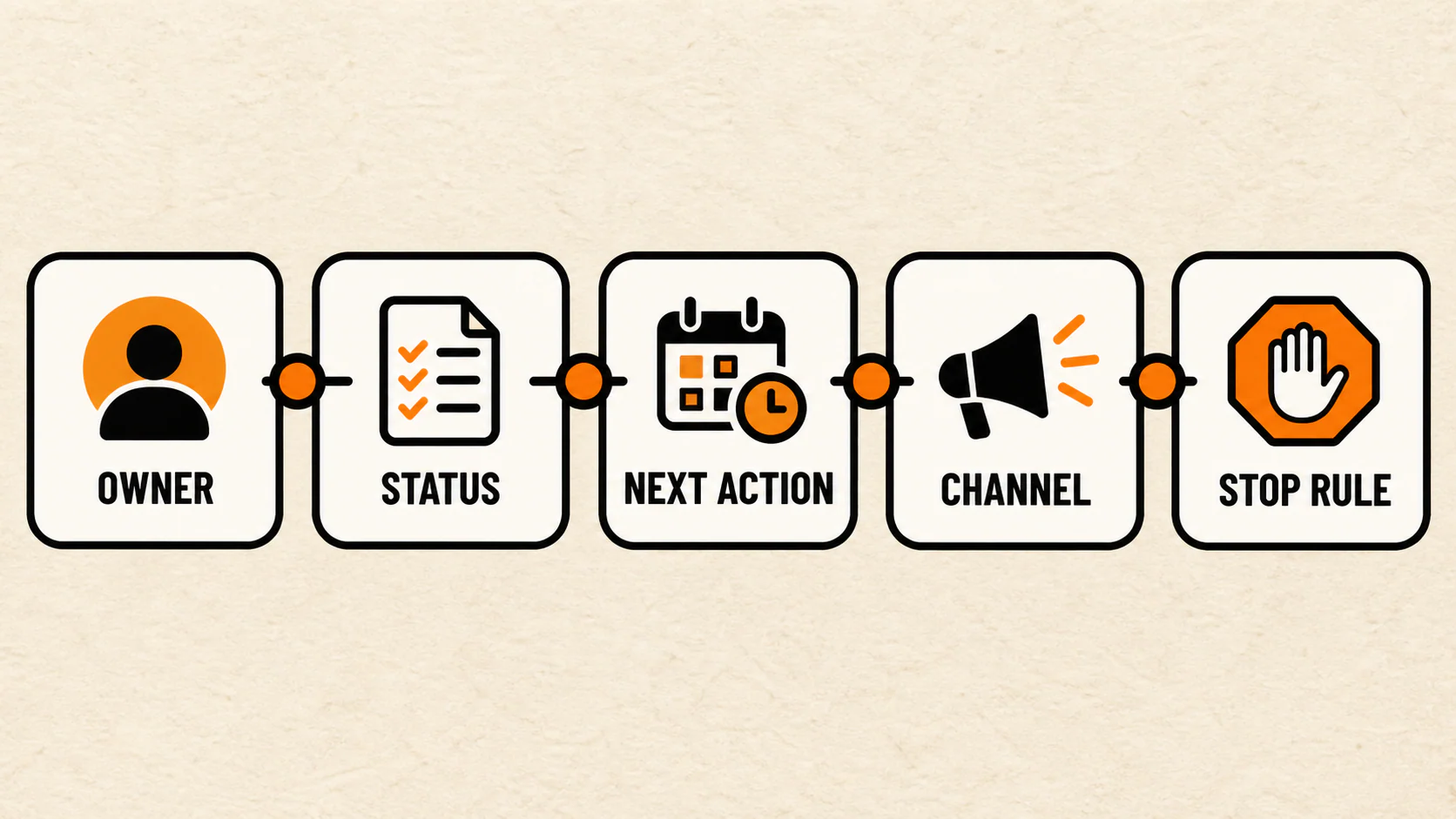
Get those five answers into one shared system, even if that system is a carefully managed spreadsheet, and follow-up becomes much easier to run and inspect. The goal is not to chase people forever. It is to give each inquiry a clear, respectful path from arrival to resolution.
1. Acknowledge the inquiry without pretending you answered it
An acknowledgment tells the person, "We received your message." A response begins to address what the person needs. Those are not the same thing.
This distinction matters because a cheerful automated text can create the impression that someone is already helping when nobody has even read the request. That is a small operational lie, and it gets more annoying the longer the person waits.
Use the acknowledgment to confirm receipt and set an expectation your team can actually meet. If the office is open, say when a person is likely to respond. If the inquiry arrived after hours, say when the office reopens. Do not promise an exact callback time unless your team can reliably keep it.
Before turning that message on, submit the form yourself. Call the tracked number. Confirm the acknowledgment arrives, the inquiry creates a record, and a real person receives a task. "The software says it is active" is not a test. It is optimism wearing a name badge.
2. Give every inquiry one owner and one due action
"The team" is not an owner. It is a group of people who can all reasonably assume someone else has it.
Assign each inquiry to one named person or one clearly defined role at a time. Then give that owner a specific next action with a due time. "Follow up" is too vague. "Call to confirm the requested service area by 10:30 a.m." is usable.
The assignment rule should also cover the moments when tidy process diagrams tend to fall apart:
- After hours: Who receives new inquiries when the office opens?
- Overflow: What happens when the primary owner already has more work than they can handle?
- Absence: Who covers lunch, vacation, illness, and an unexpectedly long appointment?
- Reassignment: Who can transfer ownership, and how does the new owner know the history?
- Overdue work: When does an untouched inquiry alert a manager or backup owner?
One record should have one current owner and one current next action. It can have a full history, but it should not have three people making separate calls because nobody checked the notes first. That does not feel attentive. It feels like the business met the prospect five minutes ago and immediately forgot.
3. Use lead statuses that describe what actually happened
A pile of leads labeled "open" tells you very little. So does a second pile labeled "closed." You need statuses that reveal both progress and failure.
A practical set for a local service business might look like this:
- New: The inquiry arrived, but no acknowledgment or human action is recorded.
- Acknowledged: The business confirmed receipt, usually through an automated message.
- Attempted: A person tried to make contact and recorded the channel and time.
- Connected: The business and prospect communicated, but no next step has been completed.
- Next step scheduled: A specific action, such as an estimate, consultation, or callback, has a date and owner.
- Booked: The agreed appointment or service is on the calendar.
- Not a fit: The request falls outside the service, location, budget, or another defined qualification.
- Declined / do not contact: The person declined, opted out, or otherwise asked the business to stop.
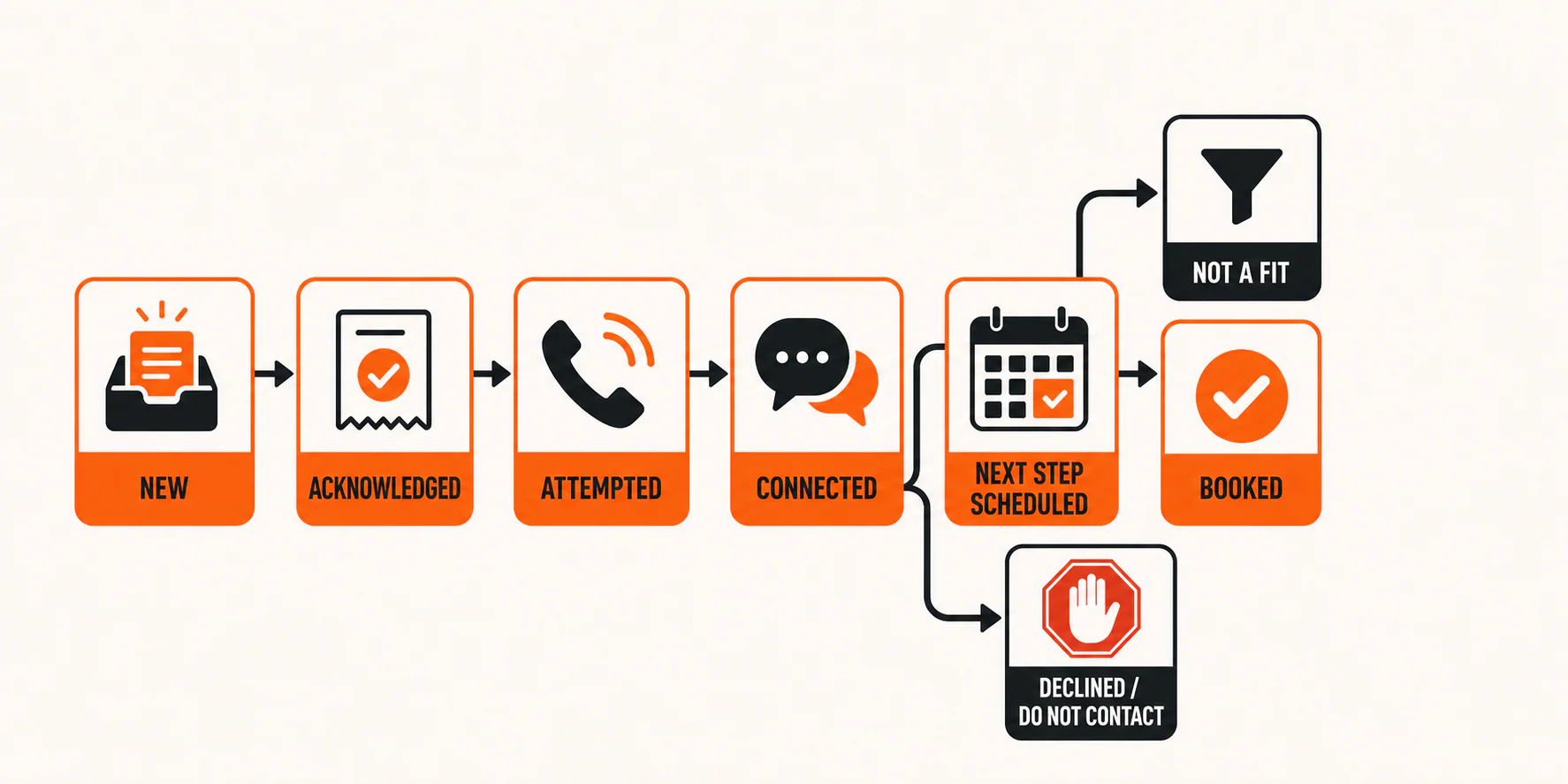
These statuses are useful because each one answers, "What is true right now?" They also make the next action easier to define. A new inquiry needs an owner. An attempted inquiry needs a recorded follow-up decision. A scheduled next step needs a date. A do-not-contact record needs the sequence stopped.
Keep "not a fit" separate from "declined." The first says something about qualification. The second says something about the person's decision or contact preference. Mixing them together makes later reporting muddy and can cause someone to contact a person who already said no.
4. Match the follow-up channel to the context and permission
When practical, begin with the channel the person used. A form inquiry may make email the least surprising first response. A return call makes sense after a voicemail. If the person states a preference, record it where the next owner can see it.
Preference is only part of the decision. Permission and applicable rules matter too, especially when software will automate calls, texts, or email.
The FCC's rules for certain automated calls and texts make consent and revocation important operational requirements. Before automating SMS or calls, confirm that your process captures the permission your use requires, keeps a record of it, recognizes reasonable revocation requests, and stops covered outreach promptly when someone opts out.
Commercial email has its own requirements. The FTC's CAN-SPAM compliance guide covers commercial email, including business-to-business messages, and explains requirements for accurate sender information, honest subject lines, required business details, opt-out methods, and timely opt-out handling.
This is operational guidance, not legal advice. Federal rules are not the only consideration. State laws, carrier requirements, and platform policies can also affect what your business may send and how. Have your normal legal or compliance resource review the setup that applies to your business.
The practical rule is simple: do not treat one inquiry as permission for endless marketing. Keep an acknowledgment factual. Use approved channels. Record preferences and permission. When someone says stop, stop.
5. Build an adaptable follow-up cadence, not a magic number
There is no responsible universal schedule for every plumber, attorney, dentist, dog trainer, and home remodeler. The urgency of the request, the service, the business's hours, and what the person asked for all change the right next step.
Start with a few decision rules:
- Send a prompt acknowledgment when the channel and permission make it appropriate.
- Assign a human attempt within a service window the business can consistently meet.
- Make each later contact useful. Answer the question, request one missing detail, share the promised estimate, or offer a clear scheduling option.
- Adjust the channel and timing when the prospect expresses a preference.
- Stop when the person responds, books, declines, opts out, supplies an invalid contact, or is disqualified.
Do not add another message just because the automation has an empty slot on Thursday. Every contact should have a reason.
Five low-pressure follow-up templates
Templates should remove blank-page hesitation, not remove judgment. Edit these to match the inquiry, your business hours, and the channel you are allowed to use.
1. Receipt acknowledgment
Hi [Name], thanks for contacting [Business Name] about [service]. We received your request. [Owner or team role] will respond [honest time window].
2. Missed-call acknowledgment
Hi, this is [Name] with [Business Name]. Sorry we missed your call. We received it at [time] and will call back [honest time window]. If you prefer, reply with your name and what you need help with.
Only automate a missed-call text when your business has confirmed that its permission and messaging process support that use.
3. Second attempt with one specific question
Hi [Name], I am following up on your request for [service]. Are you looking for help at [service address or area]? That will help me confirm whether we can assist.
4. Helpful follow-up with a real next step
Hi [Name], I have the information you requested about [service]. The next step is [estimate call, site visit, consultation, or other accurate action]. I can help arrange that if you would like to continue.
5. Respectful close-the-loop message
Hi [Name], I have not heard back, so I am closing this request for now. If you still need help with [service], you can contact us again at [phone or email]. We will not continue following up on this request.
No fake held spot. No imaginary rush of appointments. No "things are filling up fast" unless things are, in fact, filling up fast. Honest follow-up may sound less dramatic, but it does not create a trust problem you then have to solve.
6. Automate the boring parts, not the judgment
Automation is good at repetition. Let it handle work such as:
- sending an approved acknowledgment;
- creating a record from a call or form;
- assigning the primary or backup owner;
- setting task reminders;
- alerting someone when a next action becomes overdue;
- updating a status after a defined event;
- stopping a sequence after a reply, booking, decline, disqualification, or opt-out.
Keep a person involved for nuanced questions, sensitive situations, pricing exceptions, complaints, and fit decisions. A system can route a difficult request to the right employee. It should not improvise a confident answer because the office is busy.
The same boundary applies if you use an automated answering system. Voice AI can help capture and route local business calls, but the handoff still needs an owner, a due action, and clear rules about what the system may say or do.
After configuring automation, test every branch. Use an internal call and form submission. Reply to a message. Trigger an opt-out. Enter an invalid number. Make sure the system creates the right status, alerts the right person, and stops when it should. The uncomfortable test is usually the useful one.
7. Measure the process, then clean it up every week
Do not begin by asking whether the follow-up system "increased conversions." First make sure the underlying records describe reality.
Track process health with measures such as:
- inquiries acknowledged;
- median human response time by channel;
- inquiries without an owner;
- overdue next actions;
- contact rate;
- booked, qualified, not-a-fit, declined, and do-not-contact outcomes;
- opt-outs;
- records with no final disposition.
Review those numbers by source and service only after the statuses are being used consistently. Otherwise, a source can look productive because it generates a lot of inquiries while nobody notices that they are unqualified, duplicated, unreachable, or simply never resolved. That is why listening to calls and checking actual outcomes matters when evaluating lead sources.
Schedule a short weekly cleanup. Find every ownerless record, overdue action, stale "connected" lead, and missing outcome. Fix the record, assign the action, or close it with an accurate reason.
This meeting should be boring. Boring is good. It means the business is discussing a few exceptions instead of conducting an archaeological dig through three inboxes and someone's desk drawer.
Use 30 minutes to map the basic system
You do not need to perfect the process before using it. Spend 30 minutes mapping a visible first version, then allow more time for configuration and testing if your tools require it.
- Choose one system of record. Use the CRM or spreadsheet the team will actually update.
- Create meaningful statuses. Start with the eight above, then remove any your team cannot define consistently.
- Name a primary and backup owner. Cover business hours, after hours, overflow, and absence.
- Write one truthful acknowledgment per channel. State what happened and what the person should expect next.
- Define due actions and escalation. Decide what creates an alert and who receives it.
- Configure stop conditions. Include replies, bookings, declines, opt-outs, invalid contacts, and disqualification.
- Schedule the weekly cleanup. Give it an owner and a recurring time.
- Test the entire route. Place a real internal call and submit a real internal form. Confirm the owner, status, next action, message, and stop logic all behave as intended.
You have a workable first version when a manager can open one place and explain what happened to every test inquiry. Not when the dashboard looks impressive. Not when the automation vendor sends a congratulatory email.
Good follow-up creates a clear ending
Lead follow-up is not a contest to send the most messages. It is the discipline of making sure a legitimate inquiry does not become an ownerless mystery.
The system can be modest. One shared record. One owner. One next action. Honest messages. Permission-aware channels. Clear stop rules. A weekly cleanup that catches what the normal workday missed.
That is less exciting than a secret conversion formula. It is also something your team can actually run.
If you want help connecting your local marketing, call handling, and follow-up process, talk with YEAH! Local. We can look at where the handoff breaks and what a practical system should do next.
Last updated