
Why Your Free Consultation Offer Is Not Working (And How to Fix It)

Key Takeaway
Diagnose why your free consultation is not producing useful bookings, then fix the promise, qualification, call structure, follow-up, and tracking.
"Book a free consultation."
That CTA tells a visitor one thing: the price. It does not tell them whether the call is for them, what will happen, what they should prepare, what they will leave with, or what comes next.
Right now, it is a calendar invitation wearing a marketing hat.
The word "free" is probably not the problem. Your consultation may be failing at one of four points: too few people book, the wrong people book, people book but do not show up, or the calls happen and go nowhere. Those problems can look similar from a distance. They need different fixes.
Start with the broken stage. Then fix the promise, booking process, call, or follow-up that belongs to it. Buying more traffic, changing button colors, or adding six required fields will not repair the wrong problem.
Diagnose the failure before you rewrite the CTA
Start with the outcome you can observe. Your own records can show where the process is breaking, even when you do not have an industry benchmark. Count what happens between the page visit and the next business step.
| What you see | Likely cause to investigate | First thing to check | First action to try |
|---|---|---|---|
| Too few bookings | The offer is vague, poorly matched to the visitor, hard to find, or difficult to book | Can a new visitor explain who the call is for and what they will get? | Rewrite the promise before adding traffic |
| Wrong-fit bookings | The page attracts broad interest but does not state fit or collect useful context | Which bookings fall outside your service, area, timing, or other actual requirements? | Add clear fit language and a few relevant intake questions |
| No-shows | The visitor booked without understanding the commitment or forgot what to expect | Does the confirmation restate the time, format, purpose, and preparation? | Improve the confirmation and pre-call reminders |
| Calls that go nowhere | The session lacks a defined outcome, next step, or follow-up owner | Does every completed call end with a recorded disposition and action? | Use a call agenda and assign the follow-up before ending |
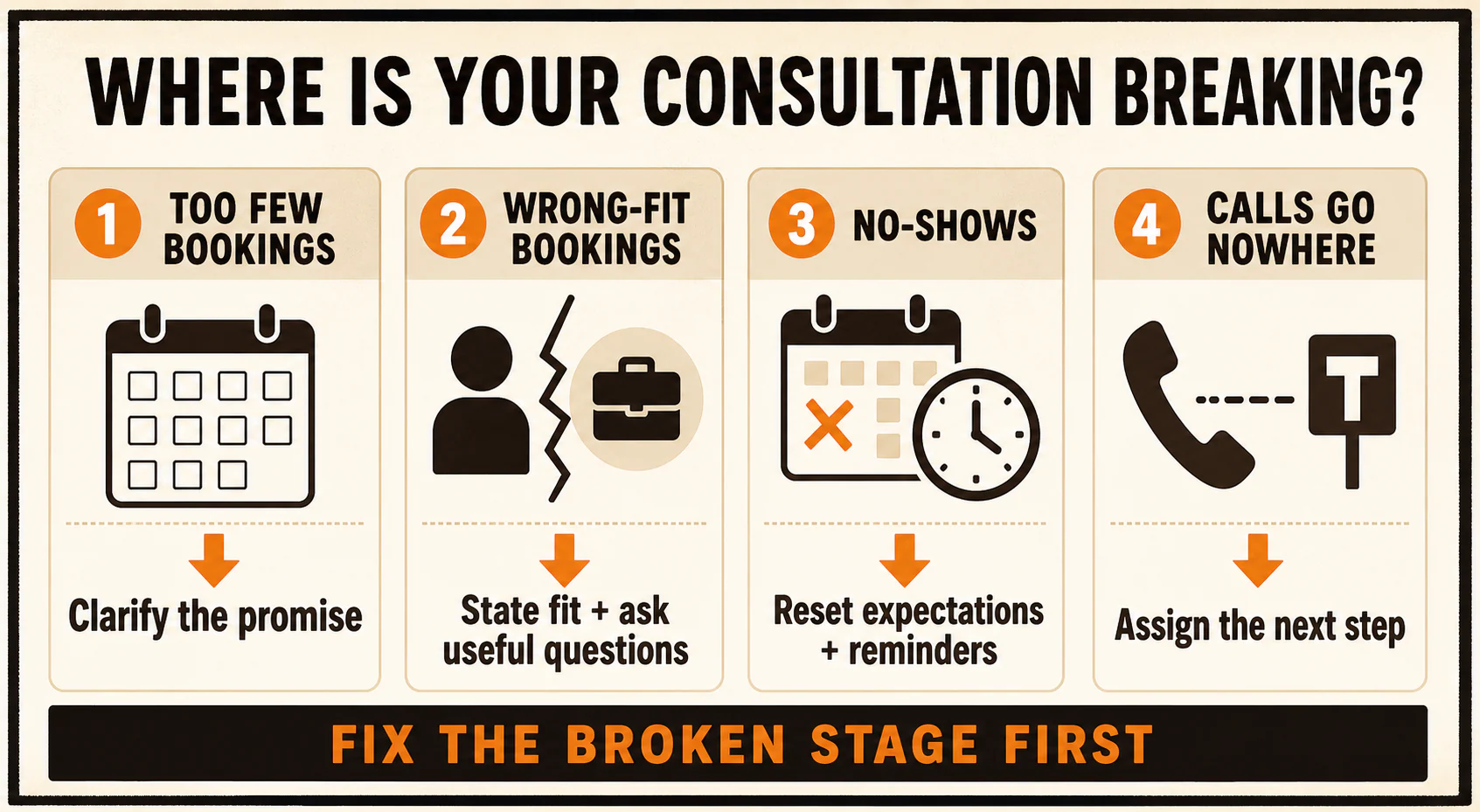
Pick one primary failure mode for the next round of changes. You may have more than one, but changing every stage at once makes it harder to learn which edit helped.
Keep other causes in view. Weak demand, mismatched ad targeting, price expectations, slow response time, staffing, and the sales process can all affect what reaches your calendar. Without analytics, form data, call records, and customer notes, nobody can diagnose your business from the CTA alone.
Rewrite the promise, not just the button
"Free consultation" names a format. It leaves the value fuzzy.
A useful consultation promise answers five questions:
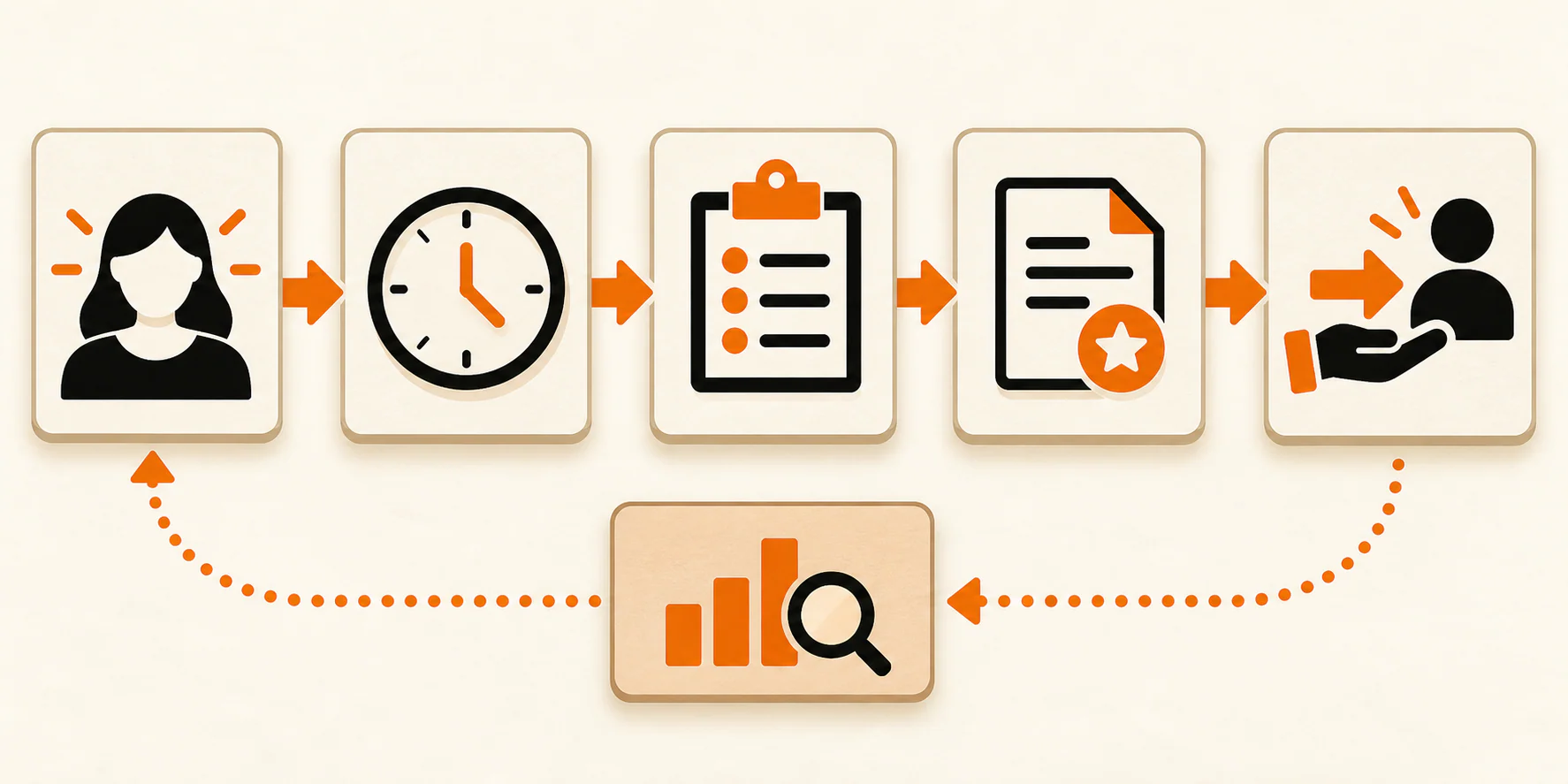
Who it is for + duration + what happens + useful outcome + next step
The button does not need to carry all of that. Let the headline and supporting copy do the heavy lifting, then give the visitor a clear action.
Before:
Book a free consultation.
After:
Own a home in our service area and unsure whether repair or replacement makes sense? Book a 20-minute call to discuss the problem, review the options we can assess remotely, and decide whether an on-site estimate is the right next step.
The second version does not promise a diagnosis, price, or result the business cannot deliver by phone. It tells the visitor who the conversation is for, what will happen, and what decision the call should support.
Your version might be a treatment consultation, project-fit call, property assessment, discovery call, or strategy session. The label matters less than the expectation. If the call cannot produce the advertised outcome, narrow the promise until it can.
If this promise is hard to write, the consultation may not be the only confusing part of the offer. This guide to clarifying your offer for more qualified leads will help you define the customer, problem, and next step before you rewrite the booking page.
Add enough qualification without turning the form into an interrogation
Qualification means deciding whether a booking fits the work your business can perform. It should not force every visitor to prove their worth before they can speak to you.
Ask for information that changes what you do next. Depending on the business, that could include:
- Service needed
- ZIP code or service area
- Property, project, or treatment type
- Desired timing
- Budget range, when price fit is necessary for routing the inquiry
- The main question the person wants answered
- Relevant photos, documents, or website links, when you can realistically review them before the call
Every question should earn its place. Keep it when the answer changes routing, preparation, eligibility, or the agenda. Remove it when nobody uses the answer.
This is where businesses often overcorrect. A calendar full of poor-fit calls is frustrating, so the booking form starts to resemble a mortgage application. If bookings drop after that change, the lower count does not prove the remaining leads are better. Add friction only when it supports a business decision.
Put disqualifying conditions before the form when you can. If you serve a limited area, say so. If the free call does not include a custom plan, diagnosis, quote, or on-site inspection, say that too. Clear boundaries keep both sides out of the wrong conversation.
Make booking easy, then set expectations
Qualification and booking friction are different. A useful question helps you prepare or route the lead. A broken calendar, unclear time zone, surprise account requirement, or form error simply gets in the way.
Walk through the process as a visitor would. Test the landing page and booking flow on a phone. Confirm that available times load, the form submits, and the confirmation arrives. If you need a broader inspection, use this conversion rate optimization checklist to review the page and form instead of guessing from the design.
Once someone books, repeat the promise while the decision is fresh. The confirmation should state:
- Date, time, time zone, and meeting format
- Who will attend from your business
- What the call will cover
- What the call will not provide
- What the prospect should bring or send
- How to reschedule or cancel
- The likely next step when there is a fit
Send reminders that help the person attend and prepare. There is no universal reminder schedule in the evidence for this article. Choose timing that fits your booking window, then watch your own attendance data.
Run the call you promised
A consultation should not depend on whoever answers the phone remembering what to do that day. Give the call a bounded agenda.
One practical structure is:
- Confirm the purpose. Restate what the person booked and check that their main question still fits the session.
- Collect the missing context. Ask only what you need to understand the situation and determine fit.
- Address the promised topic. Deliver the review, explanation, or decision support described on the page.
- Summarize what you heard. Confirm the problem, constraints, and priorities in plain language.
- Choose the next step. Explain what happens, who owns it, and when.
The agenda gives the caller a guardrail while leaving room to listen. If the caller reveals that the service is a poor fit, say so instead of stretching the conversation toward a sale. If the question requires an inspection or a licensed professional's judgment, keep that boundary clear and route the person appropriately.
Deliver what the page promised. If you advertised a review of three options, cover the options. If you promised to decide whether an estimate makes sense, reach that decision. A polished sales presentation cannot substitute for the consultation the visitor booked.
End with an owned next step
"We will be in touch" is where useful conversations go to disappear.
End each call with a specific disposition. For example:
- Schedule an on-site estimate
- Send requested information by a stated date
- Refer the caller to a better-fit provider or resource
- Mark the inquiry as not a fit and record why
- Set a future follow-up date because the timing is not right
- Close the inquiry with no further action
Then name the owner. "Our office will send the estimate link by tomorrow" is clearer than "someone will follow up." If the prospect owns the next action, confirm what they need to do and what will happen afterward.
The call is complete when that next step is recorded somewhere your team uses. A customer relationship management system can help, but a consistent shared record also works. Clear ownership matters more than fancy software. Do not leave the result in one person's memory.
For a deeper process after the first conversation, see this guide to building a lead follow-up system.
Track the stages you can control
Raw booking volume tells you little by itself. Ten bookings can be useful or useless depending on who booked, who attended, and what happened next.
Create a small record with these fields:
- Lead source
- Consultation booked: yes or no
- Consultation attended: yes or no
- Fit: yes, no, or unclear under your written definition
- Call outcome or next step
- Reason code for no-show, disqualification, or no action
- Follow-up owner and due date
Define "qualified" for your business before you score leads. It might depend on service area, job type, timing, minimum project requirements, or another legitimate operating constraint. Keep the definition stable long enough to compare periods in a useful way.
Review the records for patterns. If people from one source rarely fit, inspect the message and targeting tied to that source. If qualified people book but do not attend, inspect the confirmation and reminders. If they attend but stall, review the promise, agenda, next-step language, and follow-up record.
Call notes can expose repeated questions and objections. If manual review becomes inconsistent, this guide explains how AI call summaries can organize outcomes and recurring themes. They still need a consistent field structure and human judgment. A pile of transcripts is not a measurement system.
A consultation should not be the only option
Some visitors are interested but not ready to book time. Others already know enough to request an estimate or buy. Sending everyone through the same consultation creates friction at both ends.
Offer paths that match different levels of readiness. That might include:
- A guide or checklist for someone still defining the problem
- A case study for someone comparing approaches
- A consultation for someone who needs a conversation before deciding
- A direct estimate or service request for someone ready to act
Treat these as choices. No path guarantees a funnel. A downloaded guide does not prove that someone will book later. A direct consultation is not automatically the most valuable route. Watch what each path produces in your records.
You may also discover that "free consultation" is the wrong label. If the interaction is an estimate, assessment, eligibility check, or project-fit call, use the more accurate term. Specific beats impressive.
Check the whole consultation offer
Before sending more people to the booking page, confirm that you can answer yes to each item:
- We know whether our main problem is booking volume, lead fit, attendance, or post-call action.
- The page says who the consultation is for.
- The promise states the duration, coverage, useful outcome, and likely next step.
- The form asks only for information we use.
- Important fit boundaries appear before booking.
- The booking flow works on mobile and sends a clear confirmation.
- The caller knows what to prepare and what the session will not include.
- The team uses a bounded call agenda and delivers what the page promised.
- Every call ends with a disposition, owner, and due date.
- We track source, booking, attendance, fit, outcome, and reason codes.
- Visitors who are not ready for a consultation have another useful path.
"Free" cannot rescue a vague offer or an unowned process. Fix the stage that is failing. Make the promise specific. Collect only the context you will use. Run the call you advertised. Record the next step.
Then review your own data and decide what to change next. That is a consultation strategy. "Book a free consultation" is just a button.
Last updated