
Do Local SEO Citations Still Matter? What to Fix and What to Ignore

Key Takeaway
Learn which local SEO citations matter, what listing problems to fix, which directories to choose, and when to spend your budget elsewhere.
Citation reports can look impressively busy. Fifty listings checked. Twenty-seven profiles updated. A spreadsheet with enough colored cells to qualify as modern art.
But did the work help a customer find you? Did it correct a wrong phone number? Did it put your business on a site people in your market actually use?
Here’s the quick answer: local SEO citations still matter, but raw citation count is a lousy goal. Accurate information on important platforms helps customers and keeps the internet from sending people to the wrong version of your business. Relevant directories can also create real discovery opportunities. What usually isn’t worth the money is chasing hundreds of obscure listings or paying someone to change every “St.” to “Street.”
Accuracy and platform fit beat raw count. That’s the rule.
What Is a Local SEO Citation?
A local citation is an online mention of your business information. It usually includes some combination of your:
- Business name
- Address
- Phone number
- Website
- Hours
- Business category
- Services or other location details
Name, address, and phone number are commonly shortened to NAP.
There are two broad kinds of citations.
Structured citations appear in a standard business profile or directory format. Your Google Business Profile, a map listing, a professional directory profile, and a chamber of commerce listing are common examples. Each field has a designated place.
Unstructured citations appear naturally in editorial content. A local newspaper might mention your company in a story. An industry publication might quote you. A neighborhood organization might include your business in a resource guide. The information is still a citation even though it isn’t sitting in a neat directory template.
A citation can include a backlink to your website, but citations and backlinks are not the same thing. Some listings link to your site. Some don’t. A backlink is specifically a clickable link from one site to another. A citation is the business mention itself.
That distinction matters because a relevant editorial mention can bring an audience, authority, referral traffic, and a link. A generic directory row may do little beyond confirming your contact information. Calling both of them “one citation” hides a pretty big difference.
Do Citations Still Matter for Local SEO?
Yes, within reason.
Citations can matter in four different ways, and mixing them together is where the advice gets fuzzy.
They help customers reach the right business
If a listing shows your old address, a disconnected phone number, or hours from three years ago, that isn’t a tiny SEO detail. It’s a customer problem. Someone can drive to the wrong building or call a number that no longer works.
That isn’t advanced SEO. It’s basic customer service, whether or not a rank tracker gives you a gold star for it.
They can create discovery and referral opportunities
Directories sometimes occupy valuable space in organic search results. A BrightLocal study of 8,000 organic results found directory pages in 31% of the sampled results overall, with substantial differences among industries and query types.
That does not prove that creating a directory listing will push your Google Business Profile higher. It does show that some directories already have an audience and search visibility. If a platform repeatedly appears for searches your customers make, being represented there may help people discover or compare your business.
They help present a coherent business identity
Google’s public guidance says local results are mainly based on relevance, distance, and prominence. Google mentions links and reviews when explaining prominence, but it does not publish a magic citation count.
That silence does not mean citations have no role anywhere in local search. It means we should stop pretending Google handed us a formula that says 73 listings equals a three-position jump.
Current practitioner research still treats citation quality and consistency as useful signals. For example, the Whitespark 2026 Local Search Ranking Factors survey of 47 invited practitioners places the quality and authority of structured citations above raw citation quantity in its local-pack factor table. Whitespark also sells citation services, and this is professional opinion, not a peek inside Google’s algorithm or a controlled experiment.
They give you control over important profiles
Claiming a useful profile lets you correct information, choose appropriate categories, add hours, and keep access when something changes. That operational control is worth more than bragging about how many rows are in a citation report.
So yes, citations still matter. Endless citation production does not automatically matter more.
Use This Three-Bucket Citation Framework
You do not need to treat every listing issue as equally urgent. Put each task into one of three buckets instead.
| Priority | What belongs here | Action |
|---|---|---|
| Fix now | Wrong phone, address, or hours; an old brand name; a duplicate major profile; a missing core search or map profile; anything creating customer confusion | Correct or consolidate it promptly |
| Build selectively | Category or local platforms customers use; directories visible for your actual target searches; associations, government sources, or publications with a real audience | Add the listing or pursue the mention when relevance and discovery justify the effort |
| Ignore for now | Harmless “St.” versus “Street” differences; obscure directories with no audience or visibility; arbitrary count gaps; repeated cleanup with no material problem | Document it and move the budget to the real bottleneck |

This framework keeps a five-minute correction from getting buried beneath a five-month scavenger hunt.
Start with customer harm. Then look for genuine discovery value. Leave the cosmetic long tail alone unless you uncover a specific reason to care about it.
Which Citations Should a Local Business Have?
There is no universal list, and there is no number that every business needs.
A dentist, a roofer, a hotel, and a family law firm don’t share the same customer journey. Their important profiles won’t be identical either.
Start with the core search and map profiles that matter in your market. Your Google Business Profile is the obvious place to begin, but the broader principle is more useful than any fixed list: claim the platforms people use to find, evaluate, navigate to, or contact businesses like yours.
Then look at category-specific and local opportunities:
- Professional associations
- Industry directories with a real audience
- State or local government databases where appropriate
- Local chambers and business groups
- Trusted community resources
- Relevant news, trade, and editorial publications
Regulated and professional industries often have authoritative sources that matter more than another generic directory. A licensing board profile may help a patient or customer verify a professional. A respected trade association may send better visitors than 50 sites nobody has heard of.
Use the search results as a clue. Search the services and locations that matter to your business. If a directory repeatedly ranks, contains active profiles, and appears to influence how customers compare options, investigate it. If a directory is invisible, abandoned, and stuffed with thin listings, adding profile number 84 is not a strategy.
Also remember that unstructured mentions can be more valuable than another profile. A useful local story, industry interview, or community resource can introduce the business to real people and may also include a relevant backlink.
How Consistent Does NAP Information Need to Be?
Your material business facts should describe the same real business everywhere that matters.
That means the correct name, current location or service-area setup, working phone number, accurate hours, and right destination page. Google’s business representation guidelines emphasize representing the business as it exists in the real world and using phone and website information that connects to the actual location.
Major problems deserve attention:
- An old address after a move
- A disconnected or tracking number that routes incorrectly
- Duplicate profiles that confuse customers
- A former brand name after a rebrand
- A closed location shown as open
- Different businesses accidentally sharing or merging profile details
Harmless formatting variations are different. “Suite 200” and “Ste. 200” usually describe the same place. So do “Road” and “Rd.” Search platforms are not helpless because one site used punctuation.
This does not mean consistency is pointless. It means literal character-for-character sameness should not outrank customer-facing accuracy.
Service-area businesses and multi-location companies need a little more care. Each real location should be represented according to the platform’s rules, and location details should not be invented just to create extra profiles. When the setup is complicated, start with the real-world business structure and the customer experience, not a template copied from a generic checklist.
Citations vs. Backlinks, Reviews, Content, and Your Website
The old version of this article made a sharp distinction between citations and backlinks. That part was useful. The mistake was turning it into a cage match where only one tactic could win.
Some citations include backlinks. Some don’t. Some editorial mentions are both strong citations and useful links. Some directory links send qualified visitors. Others exist mainly because a software tool found another submission form.
Once your citation foundation is accurate, the best next investment depends on what is actually holding growth back.
Maybe your Google Business Profile needs better optimization. Maybe you need a steady, policy-safe system for earning more customer reviews. Your service pages may be thin. Your website may be slow or confusing. You may need relevant links and local mentions. Or perhaps leads are arriving and nobody is following up quickly enough.
That’s the point: citation work is one piece of local SEO, not the whole machine.
Your website should also state your business information clearly. Google’s documentation explains how LocalBusiness structured data can help communicate details such as hours, telephone information, and business properties on your site. Schema is useful context, but it is not a substitute for correct real-world information and it does not guarantee rankings.
When you compare SEO costs and priorities, ask what each activity is supposed to fix. A thick deliverables list is not a strategy. Work should connect to a real constraint, and expectations should account for how long SEO can take.
When Should You Audit or Update Citations?
Your citations don’t need a standing monthly appointment. They need attention when something real changes.
Audit important profiles when:
- The business relocates
- The name or brand changes
- A phone number or website changes
- Hours change materially
- A merger or acquisition affects the public identity
- You discover a duplicate
- A customer reports incorrect information
- You lose access to an important profile
A light periodic check of core, customer-facing profiles is sensible. I’m deliberately not giving you a universal monthly, quarterly, or annual schedule because businesses change at different speeds. A seasonal restaurant and a stable professional office do not have identical maintenance needs.
Keep one canonical business-information sheet with the approved name, address, phone, URLs, hours, categories, descriptions, and profile access details. That makes future updates faster and prevents three people from “correcting” a listing with three different answers.
Know When to Stop Citation Work
Here’s the stopping rule:
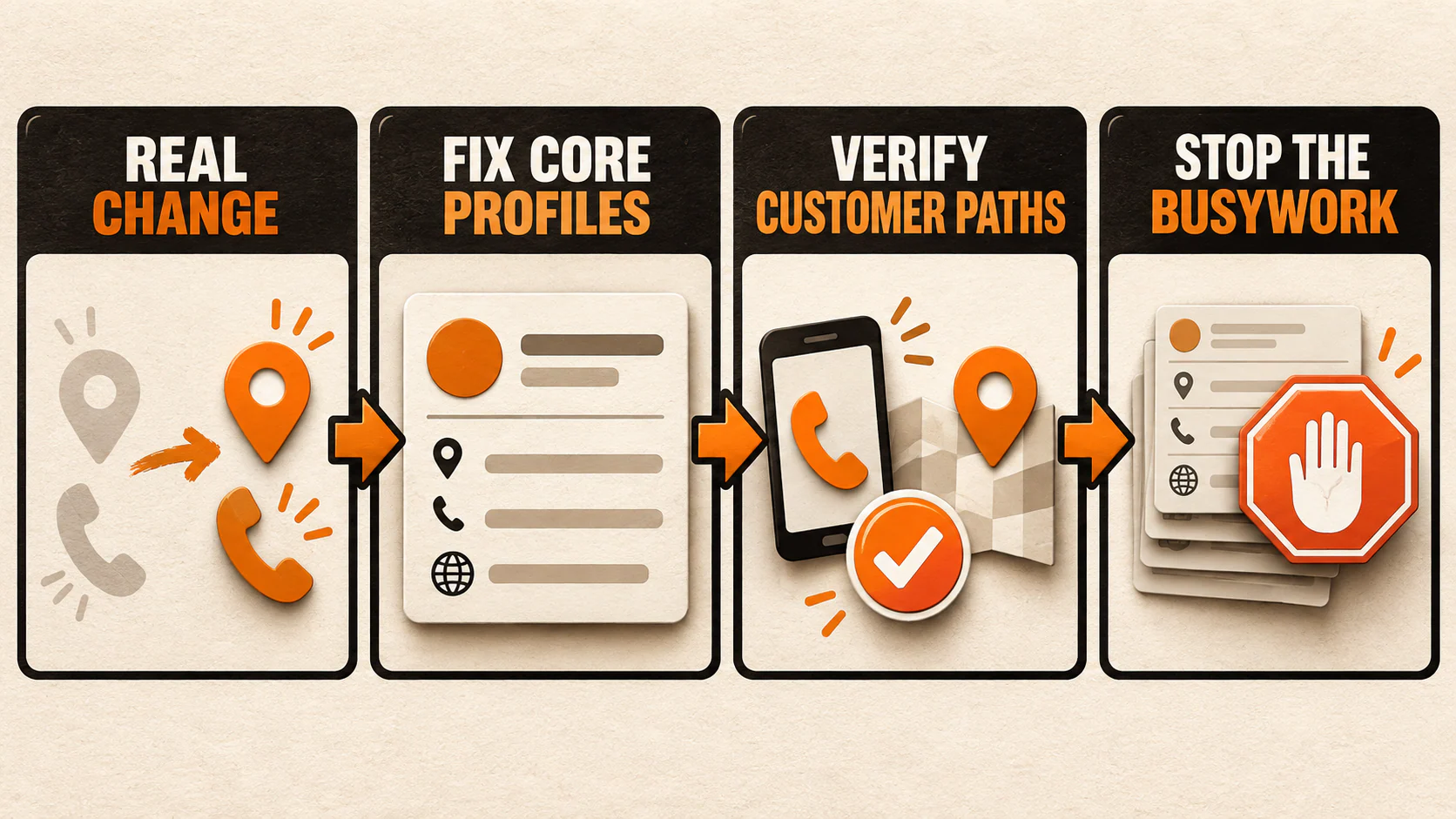
Stop broad citation work when your core and genuinely valuable profiles are claimed and materially accurate, duplicates that could confuse customers are handled, and the remaining queue is mostly obscure sites or cosmetic differences.
Reopen the work when your business information changes or when evidence points to a specific high-value opportunity. Maybe a relevant directory starts ranking for your best service queries. Maybe customers regularly use an industry platform you’ve ignored. Fine. That is a reason.
“Our tool found 83 more sites” is not, by itself, a reason.
If an agency or citation vendor recommends ongoing work, ask:
- Which platforms are being changed, and why?
- What material error or discovery opportunity does each task address?
- Is this a one-time cleanup or recurring work?
- How will we verify ownership, access, and accuracy?
- What higher-priority work is this displacing?
Those questions are not hostile. A good provider should be able to answer them without hiding behind a dashboard.
Frequently Asked Questions About Local SEO Citations
How many citations do I need for local SEO?
There is no evidence-backed universal number. Cover the core search and map platforms, then add local, industry, professional, or editorial sources when they have a relevant audience or visible discovery value. Stop when the remaining opportunities are mostly obscure or cosmetic.
Do citation inconsistencies hurt rankings?
Major inconsistencies can create customer confusion and weaken the clarity of your online business identity. Correct wrong phone numbers, addresses, hours, brands, and important duplicates. Harmless abbreviations and punctuation differences usually do not deserve the same priority. Google does not publish a formula that connects a certain number of inconsistencies to a certain ranking loss.
Are citations the same as backlinks?
No. A citation is an online mention of the business and its information. A backlink is a clickable link to your website. A citation may include a backlink, but it does not have to.
Should I pay for a citation-building service?
Possibly, if you have material errors across important platforms, a relocation or rebrand to clean up, duplicate profiles, or relevant listings that require substantial setup. Ask for a platform-level scope and the reason each task matters. Be cautious when the main promise is simply “more citations” with no connection to customers, search visibility, or accurate data.
Do citations help Google Maps rankings?
They may contribute to the broader picture of business identity and prominence, and practitioner surveys still assign some value to citation quality. But Google does not publish citation count as a direct Maps ranking formula. Relevance, distance, prominence, complete profile information, reviews, links, and many other factors can matter. No citation package can guarantee a Maps position.
What should I do after moving or changing my phone number?
Update your own website and core profiles first. Then correct high-use local and industry platforms, resolve important duplicates, and verify that calls and directions work. Keep the old information in your canonical business sheet so you can search for lingering versions later. Prioritize sites customers can actually encounter before chasing every old record on the internet.
Fix What Matters, Then Move On
Local SEO citations are not dead, and they are not a collectible card game either.
Fix one listing problem that could cost you a customer. Choose one relevant platform or mention that could create real discovery. Then stop chasing the rest unless you can explain why it deserves time or money.
If your foundation is sound and you need help deciding what should come next, our local SEO approach focuses on the actual bottleneck, not the longest possible task list.
Last updated