

Key Takeaway
Learn when a local business needs a simple website, when to build more, how it works with Google Business Profile, and what AI search actually changes.
For most local service businesses, the answer is yes. If customers need to verify what you do, where you work, and how to contact you, you should have an accurate website you control.
That does not mean every local business needs a sprawling site on day one. A newly launched or referral-heavy business may be well served by one strong page. Decide how much site your customers need to choose and contact you right now.
Calling a website an irrefutable source of truth goes too far. A website can be outdated, vague, or flat-out wrong just like any other listing. It also will not automatically earn rankings, leads, or a mention in an AI-generated result.
What it can do is give your business a place online that you control. You decide how the service is explained, which locations you actually serve, what proof you can substantiate, and what the visitor should do next. Google Business Profile, social accounts, directories, and advertising can support it. They should not be asked to do the whole job.
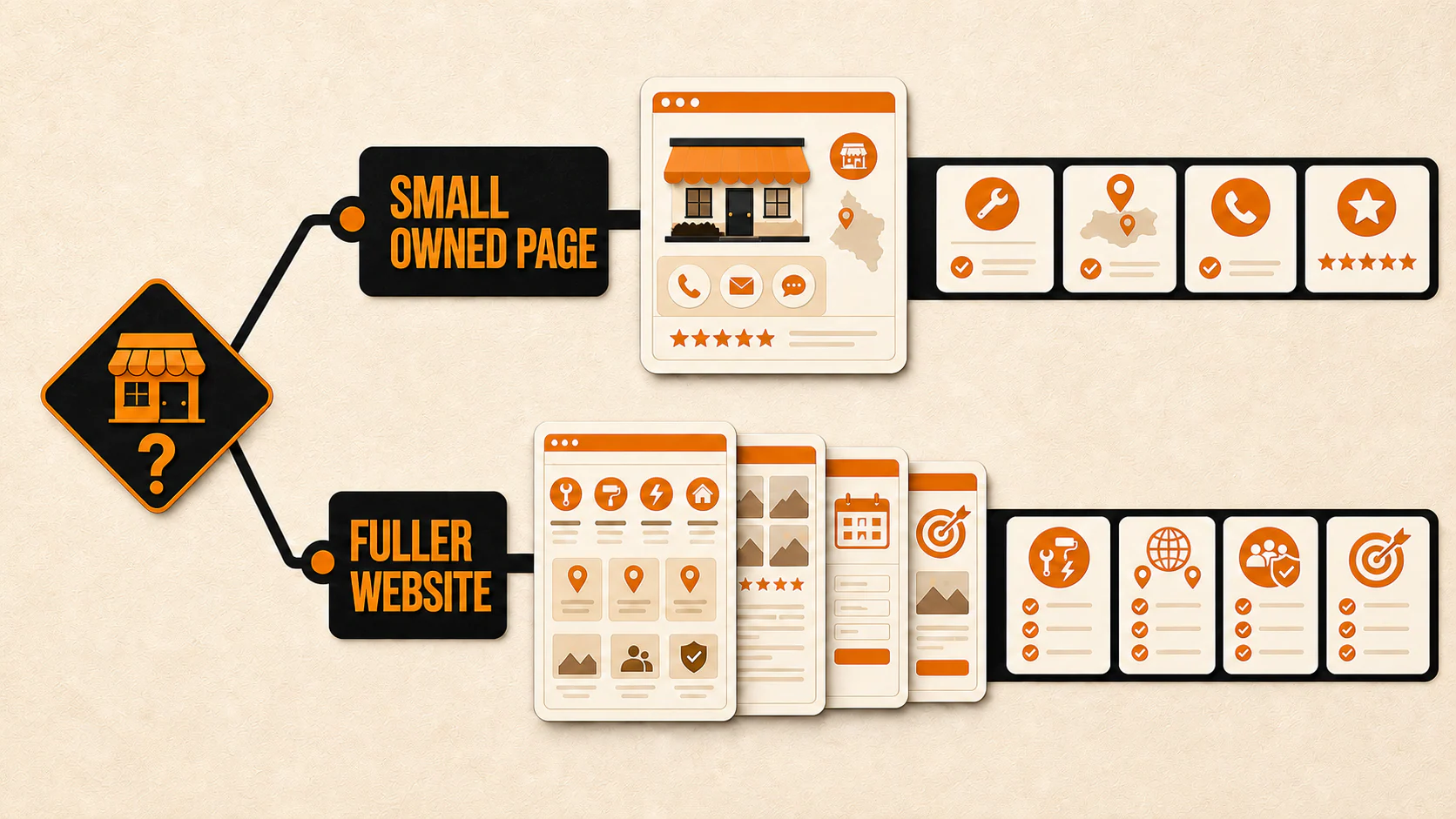
Decide how much website you need
Start with the smallest site that can answer the customer's real questions. Add pages and features when the business has a reason for them, not because somebody sold you a page-count package.
| Decision factor | Start with a small owned page now | Build or expand a fuller site now |
|---|---|---|
| Offer complexity | You provide one straightforward service or a narrow group of closely related services. | You provide several services that need different explanations, qualifications, or next steps. |
| Service areas or locations | One location or a simple, clearly defined service area covers the business. | Different locations, markets, or service areas need accurate, distinct information. |
| Proof needed | A concise set of substantiated reviews, credentials, photos, or work examples answers the main trust questions. | Prospects need detailed case studies, team information, galleries, credentials, process details, or other substantial proof before acting. |
| Contact or intake | A phone number, short form, or direct booking link gives the customer a sensible next step. | Scheduling, intake, estimates, applications, ecommerce, or qualification require a longer path. |
| Paid traffic | You are not sending paid traffic to multiple offers or audiences. | Ads need dedicated landing pages that keep the offer and next step clear. |
| Buying decision | The customer can understand the service and act after a short explanation. | The decision involves meaningful objections, comparisons, risk, or education that one page cannot handle cleanly. |
A small site can still be credible. A one-page site needs to load properly on a phone, state the facts, look trustworthy, and make contact easy. Without those basics, it is a placeholder rather than a minimum viable site.
What the minimum credible site must answer
Forget page count for a minute. A useful local-service site should let a prospective customer answer these questions without hunting:
- What do you do? Name the service in plain language. "Solutions" is not a service.
- Who is it for? Explain the customer, property, problem, or situation you are equipped to help with.
- Where do you actually work? State the real location or service area. Do not imply coverage you cannot provide.
- How can someone contact or book you? Make the next step obvious and usable on a phone.
- Are the practical details current? Keep hours, contact details, availability notes, and other decision-critical facts accurate where they apply.
- Why should the customer trust the claim? Use proof you can substantiate, such as relevant credentials, real work photos, reviews you are allowed to display, team information, or a clear process.
- What happens next? Tell the visitor whether to call, request an estimate, schedule, submit details, or take another specific step.
This is where many local-business websites get distracted. They publish another broad blog post while the core service page still does not explain the offer, local fit, proof, objections, and next step. If that sounds familiar, read the guide on why better service pages often matter more than more content.
Content should support the buying decision. It should not become a hiding place for an unclear service page.
Your website and Google Business Profile have different jobs
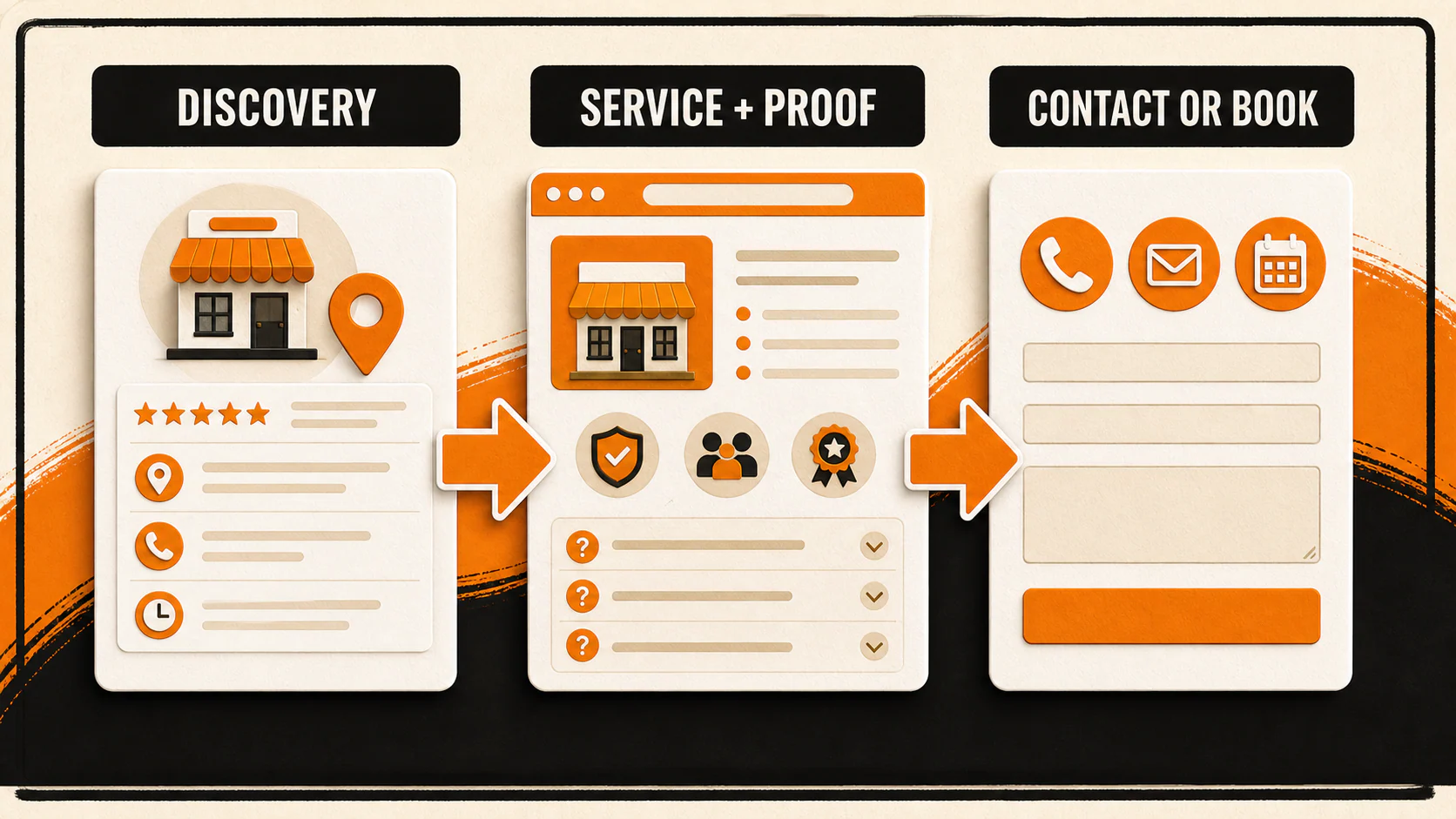
Google Business Profile can help people find and evaluate current business information in Google Search and Maps. Your website can give them the fuller explanation that does not fit neatly inside a profile: service details, process, proof, important objections, and the path to contact or book.
That division of labor is simple:
- Google Business Profile helps with discovery and quick facts in Google. Keep the business name, category, address or service area, hours, phone number, photos, and other applicable details accurate.
- Your website helps with depth and action. It should explain the offer, establish the real local fit, answer the questions that block a decision, and provide a clear next step.
Google says complete and accurate profile information can make a business more likely to appear for relevant local searches. It also says local results are based mainly on relevance, distance, and prominence. That is a useful reminder that no single profile field or website change is a guaranteed ranking lever. You can read the exact boundaries in Google's local ranking guidance.
If the profile needs work, use this Google Business Profile optimization guide to review the information customers can see. Just do not confuse a complete profile with the full path from discovery to contact. A profile can introduce the business. It cannot always carry the entire sales conversation.
The website does not replace the profile, either. A beautiful site with the wrong hours, an outdated phone number, or inconsistent location details elsewhere still creates friction. The practical goal is agreement between the two, not a contest over which one matters more.
What AI search changes, and what it does not
AI features have changed the shape of some Google results. They have not created a secret replacement for useful websites.
For Google's AI Overviews and AI Mode, Google says the same SEO fundamentals still apply. There is no special AI-only optimization required. A page must be indexed and eligible to appear with a Search snippet before it can be eligible as a supporting link in those Google AI features.
Eligible is the word that matters. It does not mean guaranteed to be crawled, indexed, served, or selected as a supporting link.
The practical work is familiar:
- allow Google to crawl the pages you want discovered;
- put important business information in useful page text;
- use internal links that help people and crawlers reach related pages;
- keep the page usable on the devices customers use;
- keep relevant Google Business Profile facts current; and
- when you use structured data, make sure it accurately matches what visitors can see on the page.
Structured data is code that labels page information in a format search systems can process. It may make a page eligible for certain Google Search features, but Google's structured-data guidelines explicitly say it does not guarantee a feature will appear. Schema is useful when it is accurate. It is not "AI candy," a citation switch, or a substitute for clear visible content.
Keep the scope straight here. This is Google's published guidance for Google AI Overviews and AI Mode. It does not prove how every other assistant or answer engine discovers, evaluates, or presents local businesses. For a deeper explanation of that specific Google surface, see what AI Overviews mean for local SEO.
If you already have a site, fix the path before rebuilding everything
An old-looking site is not automatically a failed site, and a redesign is not automatically the cure. Before you rebuild, find the actual problem.
- Verify the facts. Check core services, location or service-area language, hours, phone numbers, forms, booking links, team details, and other information a customer relies on.
- Test the important path on a phone. Open the pages a prospect is most likely to use. Tap the phone number. Submit the form. Try the booking path. Look for dead ends, unreadable text, intrusive elements, and missing confirmation messages.
- Give each core service a clear destination. If several services require different proof, qualifications, or next steps, one vague homepage probably cannot carry them all.
- Inspect the measurement you actually have. If Google Search Console, analytics, call tracking, form tracking, or lead records are configured, use them to observe where visibility or customer action breaks down. Do not invent a diagnosis from appearance alone.
- Make one evidence-led improvement at a time. Fix the clearest problem, record what changed, and check the relevant technical and business signals afterward.
The website audit checklist with AI prompts can help organize that review without turning "the site feels old" into an automatic rebuild order.
There is no magic quarterly update or three-year redesign rule. Update business facts when they change. Review a page when customers struggle, the offer changes, the company enters a new market, tracking exposes a problem, or the technology becomes a real obstacle. Maintenance should respond to evidence and business changes, not the calendar alone.
Build the smallest useful thing, then earn the right to add more
The right website answers the customer's next questions and makes the next action easy, regardless of page count.
For a simple business, that may be one clear page on a domain you control. For a company with several services, locations, intake requirements, paid campaigns, or a longer buying decision, a fuller site has real work to do. Build to that work.
Keep Google Business Profile accurate for discovery and quick facts in Google. Keep the website clear enough to explain the service, local fit, proof, and next step. Follow ordinary SEO fundamentals. Then measure what happens instead of declaring victory because a page exists.
If you want help deciding whether your current site needs a focused repair or broader local SEO work, YEAH! Local can review the path with you. The first recommendation should fit the problem, even when the answer is smaller than a rebuild.
Last updated